billsportsmaps.com

March 25, 2013

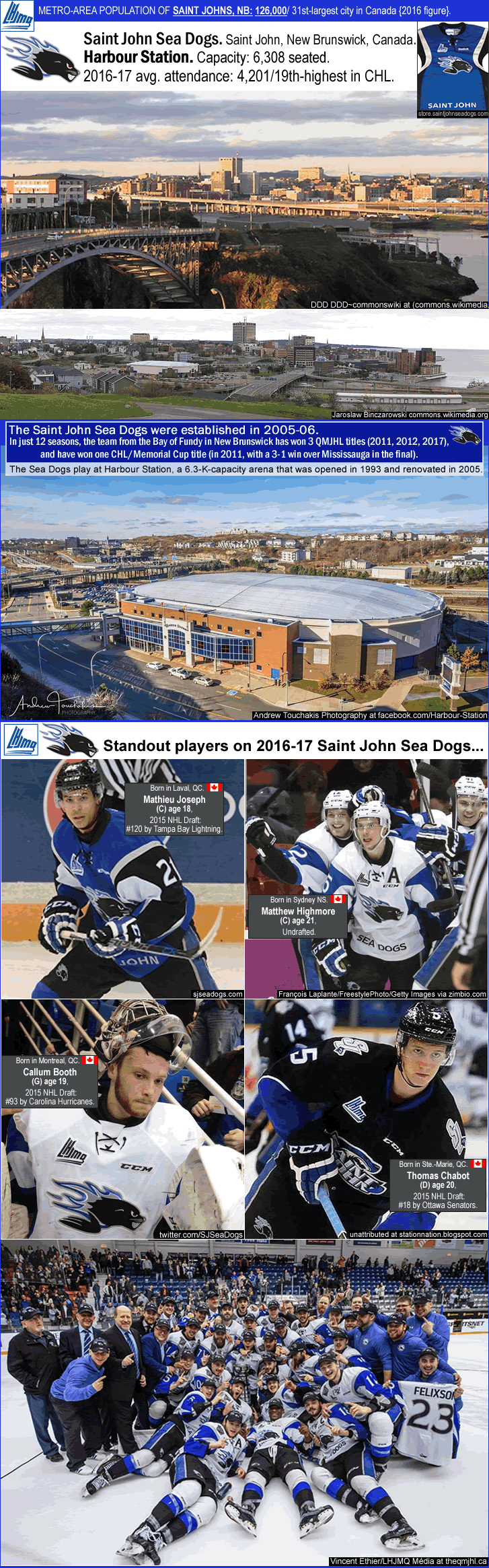
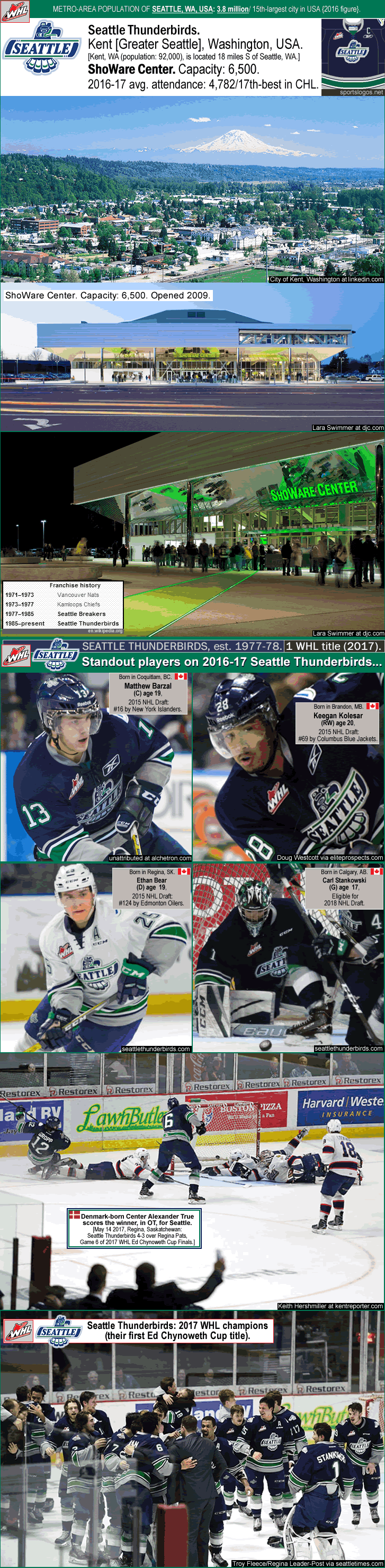
2013 NCAA Division I Men’s Ice Hockey Tournament – map of the 16 qualifying teams in the 2013 tournament, with attendance data.

Filed under: Hockey,NCAA - ice hockey — admin @ 9:39 pm

ncaa_ice-hockey_2013_division-i-tournament_post_.gif
2013 NCAA Division I Men’s Ice Hockey Tournament- map


D-I Tournament Scores (ncaa.com/scoreboards/icehockey-men).

The 2013 NCAA Division I Men’s Ice Hockey Tournament begins on March 29. The 16 qualified teams meet up in 4 regionals. Info here: ‘2013 NCAA Division I Men’s Ice Hockey Tournament‘ (en.wikipedia.org).

The Frozen Four for 2013 will be in Pittsburgh, PA on April 11th and the final is on April 13th at the Consol Energy Center (home of the Pittsburgh Penguins) on April 13th.

Defending champions are the Boston College Eagles of Chestnut Hill, Massachusetts. It was the Eagles’ 5th national championship won on the ice, and their second title in 3 years.

#1 seed overall this year is the Quinnipiac Bobcats. Quinnipiac University of Hamden, Connecticut is private/non-sectarian school about 5 miles north of another tournament qualifier, Yale (of New Haven, CT). Qunnnipiac has an undergraduate enrollment of 6,000, and is best known for something which has nothing to do with college athletics, and that is its widely-utilized polling service, the Quinnipiac University Polling Institute {see this (en.wikipedia.org)}.

The Quinnipiac Bobcats play in the TD Bank Center in Hamden, CT, which opened in 2007 and has a capacity for ice hockey of 3,386. The Quinnipiac Bobcats men’s ice hockey team drew 3,122 per game at ‘The Bank’ in 2012-13, which made for a respectable 92.2 percent-capacity, and was an increase in attendance of 598 per game from 2011-12. The Bobcats’ 3,122 per game put them at 27th out of 59 Division I teams {attendance data here, ‘Men’s Division I Hockey Attendance: 2012-2013‘ (uscho.com)}.

The Quinnipiac Bobcats (formely the Quinnipiac Braves) have only made the tournament once before, in 2002. The 2012-13 Quinnipiac Bobcats are powered by Senior Goalie Eric Hartzell, a workhorse who played in 38 games for the Bobcats in 2012-13, and ended up with a whopping 2,282.59 minutes, going 27-6-5 and with a goals-against-average of just 1.5243 per game – which was third best in D-I in this season, behind Goalie Ryan McKay of Miami (of Ohio), and Goalie Conor Hellebucyk of UMass-Lowell [note: Miami and Mass-Lowell are two other teams which have made the tournament this season]. [D-I stats, here (uscho.com).]

The three other #1 seeds in the 2013 Men’s Ice Hockey Tournament are the Minnesota Golden Gophers (#1/2 overall), the Massachusetts-Lowell RiverHawks (#1/3 overall), and the Notre Dame Fighting Irish (#1/4 overall). Notre Dame just upended the most successful D-I men’s ice hockey team, the Michigan Wolverines, on Sunday March 24 in the CCHA tournament final by a score of 3-1. This means that Michigan’s consecutive tournaments streak is over at 22 straight (from 1991 to 2012) [Note: on the map page here I don't have a list for all-time tournament appearances, but I do have one for all-time Frozen Four appearances (at the bottom right-hand corner). If you want to see a specific team's tournament appearance history, click on the following link, '2013 NCAA Division I Men's Ice Hockey Tournament', then click within the text there onto the blue-lit team's name, to get to their Wikipedia page.].

7 of the 16 teams are back from the 2012 tournament (listed from the western-most to the eastern-most team) -
The Denver Pioneers.
The University of North Dakota (note: North Dakota has no nickname anymore thanks to PC pressure to get rid of their actually rather dignified ‘Sioux’ nickname and logo).
The Minnesota Golden Gophers (who made the Frozen Four in 2012).
The Miami (of Ohio) RedHawks.
The Union College Dutchmen (who made the Frozen Four in 2012).
The UMass-Lowell River Hawks.
The Boston College Eagles (reigning champions).

__
Thanks to USCHO.com for attendance figures, ‘Men’s Division I Hockey Attendance: 2012-2013‘ (uscho.com).
Thanks to Jayson Moy at the Bracketology blog at USCHO.com site.

Thanks to the contributors to the pages at en.wikipedia.org, ‘NCAA Men’s Ice Hockey Championship‘ ; ‘List of NCAA Men’s Division I Frozen Four appearances by school‘.

Thanks to Two Hearted River at en.wikipedia.org, for 4 college hockey teams’ sweater logo illustrations used on the map (Boston College, Miami of Ohio, Minnesota, and Union College), at each team’s Wikipedia page, such as ‘Boston College Eagles’ men’s hockey‘.

Thanks to sioux-jersey.com for illustration of 2012-13 North Dakota sweater.

Thanks to buckyslockerroom.com [Wisconsin Badgers' store] for photo of 2-12-13 Wisconsin sweater.

Thanks to und.com und.com/sports/m-hockey for Notre Dame logo.

Thanks to USCHO.com, for stats and coverage.

Thanks to Luke DeVoe for Quinnipiac Bobcats info, at quhockeyblog.com (From The NIP To The Bank – Quinnipiac Bobcats Hockey Blog).

November 8, 2012

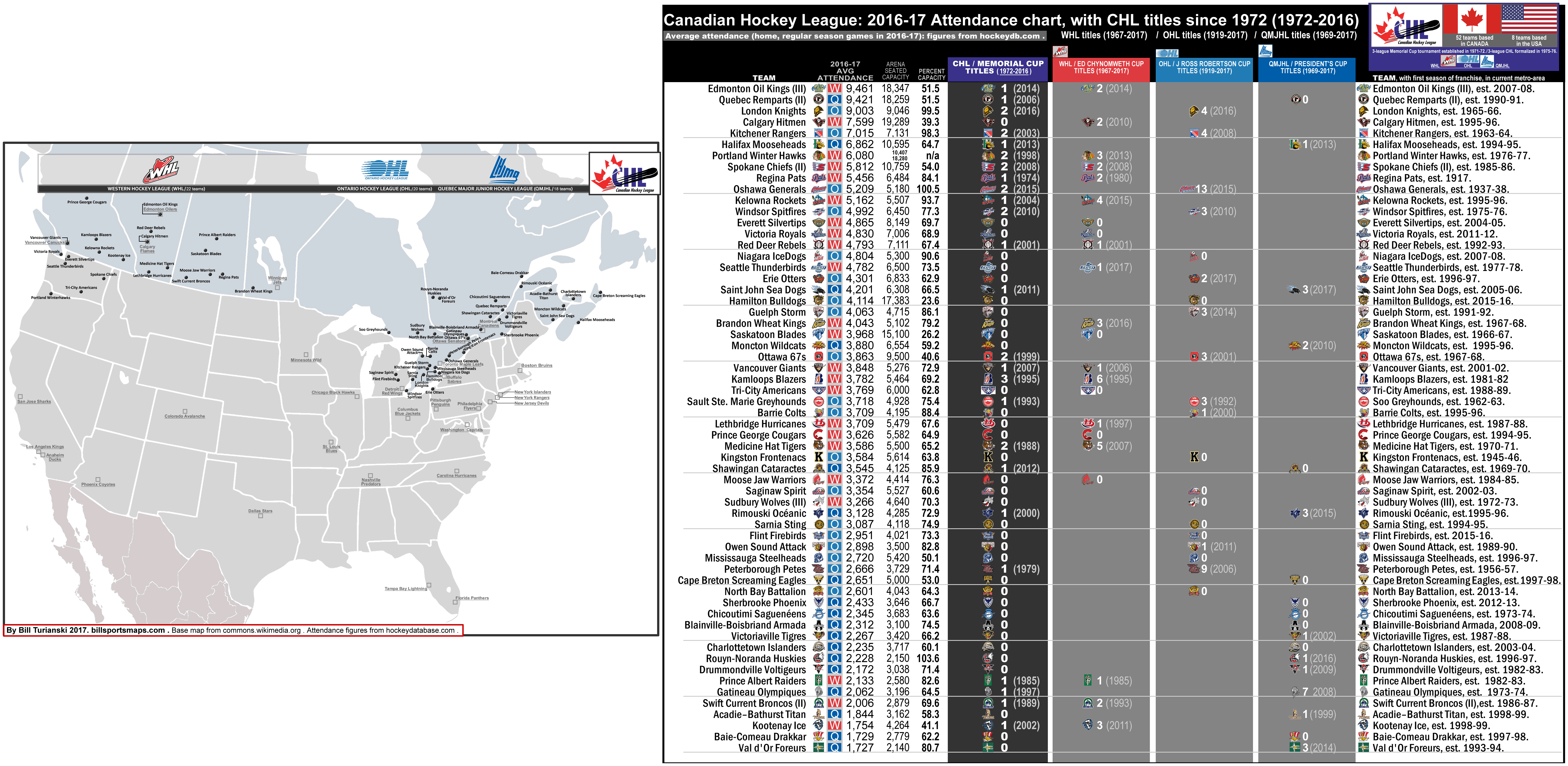
Canadian Hockey League: location maps for WHL, OHL, and QMJHL teams (60 teams) and 2011-12 attendance data. Plus the top 3 highest drawing teams, the top 10-highest percent-capacities, and the Shawingan Cataractes – the 2012 CHL Memorial Cup winners.

Filed under: Canada,Hockey — admin @ 9:14 pm

canadian-hockey-league_whl_ohl_qmjhl_2012_segment_.gif
WHL, OHL, and QMJHL teams (60 teams)


WHL standings‘ (whl.ca).
OHL standings‘ (ontariohockeyleague.com).
QMJHL standings‘ (theqmjhl.ca).

From the CHL official website, from Nov. 7 2012, ‘CHL Announces BMO CHL Mastercard Top 10 Rankings, November 7, 2012‘.

The Canadian Hockey League is an umbrella-organization for the 3 Canadian major junior hockey leagues, the Western Hockey League (WHL), the Ontario Hockey League (OHL), and the Quebec Major Junior Hockey League (QMJHL). The leagues are the top echelon of junior hockey on Canada and are for players aged 16 to 20 years old. Every June, the NHL has an entry draft where WHL, OHL, AND QMJHL players figure prominently.

There are 52 Canadian-based teams in the CHL, and 8 teams in the CHL that are based in the United States. The 5 American-based teams in the WHL are the Everett Silvertips (from Everett, Washington); the Seattle Thunderbirds (from Seattle, Washington); the Tri-City Americans (from Kennewick/Pasco/Richland, Washington); the Spokane Chiefs (from Spokane, Washington); and the Portland Winterhawks (from Portland, Oregon). The 3 American-based teams in the OHL are the Saginaw Spirit (from Saginaw, Michigan); the Plymouth Whalers (from Plymouth Township, Michigan); and the Erie Otters (from Erie, Pennsylvania). The one American-based team in the QMJHL, from Lewiston, Maine, folded after the 2010-11 season. The franchise remained dormant for the 2011-12 season, then the city of Sherbrooke in southern Quebec was awarded the franchise and the Sherbrooke Phoenix began play in 2012-13.

The Memorial Cup has been awarded to a Canadian junior hockey club since 1919. The Memorial Cup tournament dates to 1972 {see this, ‘List of Memorial Cup champions‘ en.wikipedia.org)}. The inclusion of a 4th team/host-city team began in 1982-83. This was done to boost attendance at the tournament (and recent tournaments being played to near capacity [see next paragraph] show that this decision was a good one). The winners of the WHL, OHL, and QMJHL play in a 4-team round-robin tournament along with the team from the host-city (the host city changes each year). From cbc.ca, ‘Shawinigan takes Memorial Cup in OT win over London‘.
From National Post.com, from My 28, 2012, by Bill Beacon, ‘Cataractes win Memorial Cup in overtime over Knights‘.

The Shawingan Cataractes were 2012 CHL Memorial Cup champions. The hockey club, from Shawingan, Quebec, had been the only franchise that was a founding member of the QMJHL when the league was formed in 1969-70 that had never claimed Canada’s top junior hockey prize. Shawingan is the only team in the QMJHL still operating in the same city of its founding. The Shawingan Cataractes play at Centre Bionest de Shawinigan, a 4,125-seat multi-purpose arena, which opened in 2008. Shawingan is 134 km. (83 mi.) north-east of Montreal and 116 km. (72 mi.) south-west of Quebec City. Shawinigan, QC has a metro area population of around 52,000 {2011 figure}. The most famous citizen of Shawingan is Jean Chrétien, Prime Minister of Canada from 1993 to 2003. The most notable former Shawingun Catarctes player in the NHL these days is Buffalo Sabres’ right-winger Jason Pominville, who was an NHL All-Star in 2011-12. He played for Shawingan from 1998-2002. 39 former Shawingan players have played in the NHL.
The Cataractes averaged 3,258 per game in 2011-12 (at 78.9 percent-capacity).

    2012 CHL Memorial Cup champions: Shawingan Cataractes.

shawingun-cataractes_2012-chl-memorial-cup_champions_shawingun-quebec_e.gif
Photo credits above –
Photo of 2012 Memorial Cup semifinal game by JC Pinheiro for sportsnet.ca.
Richard Wolowicz/Getty Images via sports.nationalpost.com/2012/05/27/cataractes-win-memorial-cup-in-overtime-over-knights/.
cldshawinigan.qc.ca.
Shawingan Cataractes players with Memorial Cup trophy by (Richard Wolowicz/Getty Images) at cbc.ca.

On May 27, 2012, the Shawinigan Cataractes defeated the London Knights 2-1 in overtime to win the Canadian Hockey League’s Memorial Cup, and also become the sixth team in CHL history (since 1983) to win the Canadian Junior Hockey championship as the host team without having won their league title that season. Host teams that didn’t win their league that season get a big break in being allowed to enter the tournament, but they still have to beat 3 league champions to win the Memorial Cup title. The first time a host-city won the CHL title without having won their league that season was in the first year of the 4-team format, in 1983, when the Portland Winterhawks were champions. The second time was when the Soo Greyhounds did it in 1993. The third time was when the Ottawa 67s did it in 1999. The fourth time was when the Kelowna Rockets did it in 2004. The fifth time was when the Vancouver Giants did it in 2007. That was when a record was set for highest attendance for the tournament – the 2007 tournament in Vancouver set a new Memorial Cup attendance record with 121,561 fans attending the nine games (for a 13,506 per game average). Since then, the Memorial Cup has played to 90%-to-100%+ capacity in Kitchener-Waterloo, Ontario in 2008; in Rimouski, Quebec in 2009; in Brandon, Manitoba in 2010; in Missisauga, Ontario in 2011; and in Shawingan, Quebec in 2012. This season, in May 2013, the Memorial Cup tournament will be played in Saskatoon, Saskatchewan, at the 15,195-capacity Credit Union Centre there in central Saskatchewan {see this ‘2013 Memorial Cup‘.(en.wikipedia.org)}. So there might be a new Memorial Cup attendance record set, especially if another team from Saskatchewan gets in to the tournament.

Lists of CHL titles, including WHL titles, OHL titles, and QMJHL titles…
MEMORIAL CUP CHAMPIONS‘ (tsn.ca).
List of Memorial Cup champions‘ (en.wikipedia.org).
WHL titles, ‘Ed Chynoweth Cup‘ (en.wikipedia.org).
OHL titles, ‘J. Ross Robertson Cup‘ (en.wikipedia.org).
QMJHL tirles, ‘President’s Cup (QMJHL)‘ (en.wikipedia.org).

List of CHL franchise post-season droughts‘ (en.wikipedia.org).

    The 3 highest-drawing teams in Canadian Junior Hockey – the Quebec Remparts, the London Knights, and the Calgary Hitmen.

Quebec Remparts. The original Quebec Remparts were a QMJHL team that played from 1969-70 to 1984-85, and were initially a very successful team. The Remparts were eastern Canadian champions in 1970–71. It was this team, which featured future Hockey Hall of Famer Guy Lafleur, that won a Memorial Cup title in 1971. The team also won the QMJHL title (called the President’s Cup) 5 times.

The present-day Quebec Remparts’ franchise was originally located in the Quebec City suburb of Beauport and were a QMJHL team called the Beauport Harfangs, who played in a 2,000 seat arena in Beauport. That was in the 1990-91 to 1996-97 time period. In 1995, the former-WHA-and-NHL team the Quebec Nordiques moved to Denver, Colorado, USA (becoming the Colorado Avalanche) and left the citizens of Quebec City without a pro hockey team to support. Two years later the Beauport Harfangs moved from the eastern suburbs a few kilometers west to Quebec City proper, into the Nordiques’ old arena, the Colisée de Québec, a 15,176-capacity arena built in 1949 which is now called the Colisée Pepsi. So the Quebec Remparts inherited the Nordiques’ arena. But it took a while for the Quebec Remparts to inherit the Nordiques’ fan base, because when the Beauport Harfangs first moved to downtown Quebec City and became the Quebec Remparts (II),, they were only drawing in the mid-2,000-per game range. By 2001-02 the Remparts were averaging 3,349 per game. By 2003-04 the Remparts were averaging 5,932 per game. Two seasons later, in 2005-06, the Remparts drew 8,603 per game and surpassed the Halifax Mooseheads as the highest-drawing QMJHL team. The Quebec Remparts have been drawing above 10,000 per game since 2006-07 and they reached their peak attendance in 2009-10, drawing an astounding 12,089 per game. Twelve thousand per game to watch junior hockey! Quebec City is the 7th-largest metropolitan area in Canada and has a metro population of around 765,000 {2011 figure}. Quebec City might be, from a purely mathematical viewpoint, viewed as too small a city to support a major league sports franchise. But that pure numbers viewpoint fails to factor in Canadian hockey culture, and anyway, Winnipeg is slightly smaller than Quebec City and the Winnipeg Jets (II) had no trouble at all selling out their NHL games in their first season in 2011-12. If a junior hockey team in Quebec City can draw over 10,000 per game for several years in a row now, then Quebec City can surely fill their arena for an NHL team if and hopefully when the NHL finally puts a team back where it belongs in Quebec City. The name ‘Remparts’ means curtain walls in French, and is a nod to the history of the city – the ramparts surrounding Old Quebec are the only remaining fortified city walls that still exist in Canada or in the USA. The current head coach and general manager of the Quebec Remparts is 2006 Hockey Hall of Fame inductee Patrick Roy, the great goaltender who won Stanley Cup titles with the Montreal Canadians and the Colorado Avalanche. 37 former Quebec Remparts players from the first incarnation of the team played in the NHL, including Hockey Hall of Famers Guy Lafluer and Michel Goulet. 19 former Beauport Harfangs/Quebec Remparts (II) players have played in the NHL, including LA Kings’ Cup-winner and left-winger Simon Gagné.
The Quebec Remparts averaged 10,525 per game in 2011-12.
quebec-city_quebec-remparts_colisee-pepsi_.gif
Photo credits above – gocanada.about.com
Jean Chiasson at pbase.com.

London Knights. Established in 1965. This was in the era when some junior hockey teams in Canada were affiliated with NHL teams as farm teams, and before the OHL existed [NHL-team-sponsorship of Canadian junior hockey teams ended in 1967-68; and the OHL was established in 1968-69]. The London Nationals, est. 1965 were owned by the Toronto Maple Leafs for their first 3 seasons, and sported a variation of the Leafs’ logo {see it here (en.wikipedia.org)}. In 1968 the franchise was sold and the teams’ colors became green and gold and their name was changed to the London Knights. The Knights’ name was submitted by a London, Ontario native named Brian Logie and was the winner of the team’s name-the-team contest. The London Knights played at the London Gardens (later called the Ice House), a 5,075-seat arena that was built in 1963 and was the Nationals/Knights’ home from 1965 to 2002. Then in 2002, the London Knights moved into their current home, the 9,100-seat John Labatt Centre, usually referred to as the “JLC”. The name was changed to Budweiser Gardens in 2012, but some folks and media outlets, like the site that posted the photo from the 2012 OHL finals (below) still call it the Labatt Centre (nativist impulse). The London Knights are owned by NHL veterans Dale Hunter and Mark Hunter. Dale was head coach until being hired by the Washington Capitals as head coach in Nov. 2011; while his brother Mark has been the general manager of the Knights and is now the head coach as well. An impressive 158 former London Nationals/London Knights players have played in the WHA and/or the NHL. There are 2 former London Knights players in the Hockey Hall of Fame – Leafs’ great center Daryl Sittler (on London from 1967-70) and North Stars and Capitals right-winger Dino Ciccarelli (on London from 1976-80). Another notable London Knight player in recent times was 3-time Cup winner at Detroit, the Red Wings’ right-winger Brendan Shanahan (who played for the London Knights from 1985-87). A notable present-day NHL player who played for the London Knights is Anaheim Ducks’ right-winger Corey Perry, who played for the Knights from 2001-04. Corey Perry, who won the Cup with the Ducks in 2007, is also the all-time leading scorer of the London Knights. Blackhawks’ scoring machine and 2010 Cup-winner, the American-born Patrick Kane, also played for the London Knights (in 2006-07). So did another US-born player, Islanders’ centre John Tavares (in 2008-09). Those last three players mentioned, along with Daryl Sittler, Brendan Shanahan, and Columbus Blue Jackets’ right-winger Rick Nash, are among the 21 London Knights players who were selected in the 1st round of the NHL draft.
[Note- there is another illustration and more team/city info for the London Knights further down in this post in the next section at 5th-highest percent-capacity].
The London Knights averaged 8,525 per game in 2011-12.
london-knights_2012-ohl-champions_.gif
Photo credits above -
123rf.com.
Adam Colvin at en.wikipedia.org

Calgary Hitmen. Established in 1994, the team has been owned by the NHL’s Calgary Flames since 1997. Like the Flames, the Calgary Hitmen play their home games at the Saddledome, which was opened in 1983 and which has a capacity of 19,289 seated. Bret “The Hitman” Hart, a local-born professional wrestler, was in the original ownership group of the Calgary Hitmen and was the inspiration for the team’s name. Calgary, Alberta is the fifth-largest metro area in Canada (Calgary metro population is 1.2 million {2011 figure}). Since 2005-06 the Calgary Flames have been playing to sell-out crowds of 19,289, and for the last 8 seasons the Calgary Hitmen have been averaging over 7,000 per game, with a peak of 10,061 per game in 2004-05. In other words, Calgary really supports their hockey teams. 36 Calgary Hitmen player have gone on to play in the NHL. Two Hitmen alumni have won Stanley Cup titles – Andrew Ladd has gone on to win two Stanley Cup titles since playing for the Hitmen: with the Carolina Hurricanes in 2006 and the Chicago Blackhawks in 2010. His former Hitmen teammate, Ryan Getzlaf won the Cup with the Anaheim Ducks in 2007. The Calgary Hitmen have won 1 WHL title (in 1999).

The Calgary Hitmen averaged 7,428 per game in 2011-12.
calgary-hitmen_saddledome_h.gif
Photo credits above –
Gorgo at en.wikipedia.org.
visitcalgary.com.

    The teams that fill their arenas the best – the 10 WHL, OHL, and QMJHL teams with the highest percent-capacity figures in Canadian Junior Hockey.
    The Kelowna Rockets – highest percent-capacity in Canadian Junior Hockey at 101.0%-capacity.

1. at 101.0%-capacity (and 6,072 per game), the Kelowna Rockets (WHL). Kelowna, British Columbia, Canada. Kelowna, BC metro population is around 173,000 {2011 figure}. Kelowna, BC is 273 km. (169 mi.) east of Vancouver, BC. Kelowna Rockets (WHL) est. 1991. 36 former Kelowna Rockets players have played in the NHL. Kelowna Rockets, 3 WHL titles (last in 2009). 1 CHL Memorial Cup title (in 2004).
kelowna-rockets_canadian-hockey-league_whll_best-percent-capacity_kelowna-bc_k.gif
Image and photo credits above -
kelowna.ca.
reginapatsalumni.net/2010_07_01_archive.html.
Aidan Rice at en.wikipedia.org/wiki/File:Prosperaplace.
http://www.lre.usace.army.mil/newsandevents/publications/publications/soolocks-saultste-marie/aerialpicture2/.


2. at 100.9%-capacity (and 6,236 per game) the Kitchener Rangers (OHL). Kitchener, Ontario, Canada. Kitchener-Waterloo, ON metro population is around 477,000 {2011 figure}. Kitchener, ON is 90 km. (56 mi.) north-west of Toronto, ON. Kitchener Rangers (OHL) est. 1963. The Kitchener Rangers played to standing-room-only last season [2011-12], and the city of Kitchener (the arena’s owner) expanded the arena by 973 seats during the off-season to a 7,241 seated capacity [Note: thanks to commenter Chris (see comment #3 below) for pointing this out to me]. The city of Kitchener hopes to soon build a new arena with a capacity of 10,000 or so. The Kitchener Rangers are a publicly owned hockey team, governed by a 40-person Board of Directors made up of season ticket subscribers. Former Kitchener Rangers players include Hall of Famers Scott Stevens, Bill Barber, Paul Coffey, Larry Robinson and Al MacInnis. 136 former Kitchener Rangers players have played in the National Hockey League. Kitchener Rangers, 4 OHL titles (last in 2008). 2 CHL Memorial Cup titles (in 1982 and in 2004).
kitchener-rangers_kitchener-memorial-auditorium-complex_e.gif
Photo credits above -
Jenn Wilson Photography via kitchener.cityseekr.com.
In midst of NHL absence, local talent shines‘ (theimprint.ca).


3. at 100.6%-capacity (and 2,817 per game), the Niagara Ice Dogs (OHL). St. Catherines, Ontario, Canada. St. Catherines, ON metro population is around 392,000 {2011 figure}. St. Catherines, ON is 56 km. (34 mi.) south-west of Toronto, ON. Niagara Ice Dogs (OHL) est. 1998. There are 4 formerr Ice Dogs players who have played in the NHL including 22-year-old Blues’ defenceman Alex Pietrangelo, who played full seasons for St. Louis in 2010-11 and 2011-12.
niagara-ice-dogs_st-catherines-ontario_d.gif
Photo credits above –
my.opera.com.
mrc.ca/mrc_projects.
Ryanz4 at en.wikipedia.org
stadiumjourney.com/stadiums/gatorade-garden-city-complex.
Bob Tymczyszyn/St. Catherines Standard at stcatharinesstandard.ca/2011/11/28/city-staff-recommend-new-spectator-facility-and-ice-rink-read-report.


4. at 100.0%-capacity (and 4,006 per game), the Medicine Hat Tigers (WHL). Medicine Hat, Alberta Canada. Medicine Hat, AB population is around 60,000 {2011 figure}. Medicine Hat, AB is 267 km. (166 mi.) south of Calgary, AB. Medicine Hat Tigers (WHL) est. 1970. 99 former Medicine Hat players have played in the NHL, including southern-Alberta-born right-winger Lanny MacDonald, who played for Medicine Hat from 1971-73 (see photo of his banner in the Tigers’ arena, below) and who went on to play 16 seasons in the NHL with Toronto, Colorado, and Calgary, finishing of in 1989 as captain of the Stanley Cup winning 1988-89 Calgary Flames. MacDonald was elected to the Hockey Hall of Fame in 1992. Medicine Hat Tigers, 5 WHL titles (last in 2007). 2 CHL Memorial Cup titles (in 1987 and 1988).
medicine-hat-tigers_f.gif
Photo credits above –
activerain.com/overview-of-medicine-hat-alberta.
sportsroadtrips.blogspot.com/2012/02/brandon-wheat-kings-2-at-medicine-hat.html.
ohlarenaguide.com.


5. at 97.3%-capacity (and 8,859 per game), the London Knights (OHL). London, Ontario, Canada. London, ON metro population is around 474,000 {2011 figure}. London, ON is 166 km. (103 mi.) west of Toronto, ON. London, ON is also 166 km. (103 mi.) east of Detrot, MI, USA. London Knights (OHL) est. 1965. London Knights, 2 OHL titles (last in 2012). 1 CHL Memorial Cup title (in 2005).
london-knights_budweiser-gardens_m.gif
Image and photo credits above -
penguins.nhl.com/club/news.htm?id=642843.
Go Knights Go!!‘, photo by Dude with a Canon at flickr.com.
London Knights logos, http://www.sportslogos.net/logos/list_by_team/369/London_Knights/.


6. at 96.0%-capacity (and 2,976 per game), the Blainville-Boisbriand Armada (QMJHL). Boisbriand, Quebec, Canada. Boisbriand, QC is 22 km. (13 mi.) north-west of Montreal, QC and is an off-island suburb of Montreal. Boisbriand, QC has a population of around 23,000 and is part of Greater Montreal [metro population, 3.8 million {2011 figures}]. Blainville-Boisbriand Armada (QMJHL) est. 2011 (when the Verdun, Montreall-based QMJHL franchise named Montreal Junior Hockey Club moved about 28 km. north-west to become the Blainville-Boisbriand Armada).
blainville-boisbriand-armada_centre-d-excellence-sports-rousseau_f.gif
Photo credits above -
Quevillon at .flickr.com.


7. at 88.1%-capacity (and 2,283 per game), the Prince Albert Raiders (WHL). Prince Albert, Saskatchewan, Canada. Prince Albert, SK population is around 42,000 {2011 figure}. Prince Albert, SK is 515 km. (320 mi.) east of Edmonton, AB. Prince Albert, SK is 306 km. (190 mi.) north of Regina, SK. Prince Albert Raiders (WHL) est. 1982. 56 former Prince Albert Raiders (WHL) players have played in the NHL, including future-Hall of Famer and 5-time All-Star and 1999 Stanley Cup winner (with Dallas) Mike Modano, the longtime centre for the Minnesota North Stars/Dallas Stars. Modano is from Michigan, and has the NHL record for the most goals by a player born in the United States, with 561 goals. Circa 1986-89, Modano simultaneously played for an elite midgets team in Michigan called Detroit Compuware Ambassadors, while also playing in the WHL for the Prince Albert Raiders (1986-89). That era was right after Prince Albert won their only national title in 1985. Modano was drafted #1 by the Minnesota North Stars in 1988 (one of only 5 Americans to do so). Prince Albert Raiders, 1 WHL title (in 1985). 1 CHL Memorial Cup title (in 1985).
prince-albert-raiders_northern-saskatchewan_d.gif
Photo credits above -
ca.epodunk.com.
raiderhockey.com/article/raiders-host-4th-annual-raider-day.


8. at 87.5%-capacity (and 4,375 per game), the Soo Greyhounds (OHL). Sault Ste. Marie, Ontario , Canada. Sault Ste. Marie, ON population is around 79,000 {2011 figure}. Sault Ste. Marie, ON is 498 km. (309 mi.) north-west of Toronto, ON. Sault Ste. Marie, ON is 470 km. (292 mi.) north of Detriot, MI, USA. Soo Greyhounds (OHL) est. 1962. There are 6 members of the Hockey Hall of Fame that have played for a team known as the Sault Ste. Marie Greyhounds. New York Rangers legends Bill Cook and Bun Cook played for the Greyhounds of the Northern Ontario Hockey Association (NOHA) from 1921–25, and were instrumental in helping the Rangers win their first Stanley Cup title in 1928. Canadiens’ and Black Hawks’ goaltender Tony Esposito played for the Greyhounds of the Northern Ontario Junior Hockey League (NOJHL) in 1962–63, and was inducted into the Hockey Hall of Fame in 1988. 31 Soo Greyhounds from the first era played in the NHL [1919 to 1945, 1949 to 1958 (NOHA )]. 5 Soo Greyhounds from the 1960s-early 1970s time period played in the NHL, including Jerry Korab and Ivan Boldirev [1962 to 1972 (NOJHL)]. The present-day Soo Greyhoinds’ franchise dates back to 1962 (see last sentence). That Soo Greyhounds team switched leagues after the 1971-72 season and joined the precursor-league to the present-day OHL in 1972. Since 1972, 86 former Soo Greyhounds players have played in the NHL [1972 to present (OHA / OMJHL / OHL)]. Wayne Grezsky is one of these Greyhounds alumni. The Great One played for the Soo Greyhounds in 1977-78 as a 16-year old and broke the league scoring record with 70 goals and 112 assists for 182 points in 64 games (2.84 pts. per game). Gretzky then went on to the short-lived Indianapolis Racers of the WHA (because the NHL did not allow the drafting of teen-aged players back then). After the briefest of spells at Indianapolis (8 games), Gretzky was sold to the WHA’s Edmonton Oilers in late 1978 and the rest was history, including winning 4 Stanley Cup titles with Edmonton and becoming the all-time NHL points leader (with 2,957 points in 20 NHL seasons). The Soo Greyhounds of the 1972-to-present era have three former players in the Hockey Hall of Fame – Wayne Gretzky (a 1999 Hall of Fame inductee), Paul Coffey (in 2004), and Ron Francis (in 2007). In total, spanning 87 seasons, 123 Soo Greyhounds players have made it to the NHL. Soo Greyhounds, 3 OHL titles (last in 1992). 1 CHL Memorial Cup title (in 1993).
soo-greyhounds_sault-ste-marie-ontario_m.gif
Photo credits above -
lre.usace.army.mil/newsandevents/publications/publications/soolocks-saultste-marie/aerialpicture2/.
http://www.ohlarenaguide.com/greyhounds.htm.


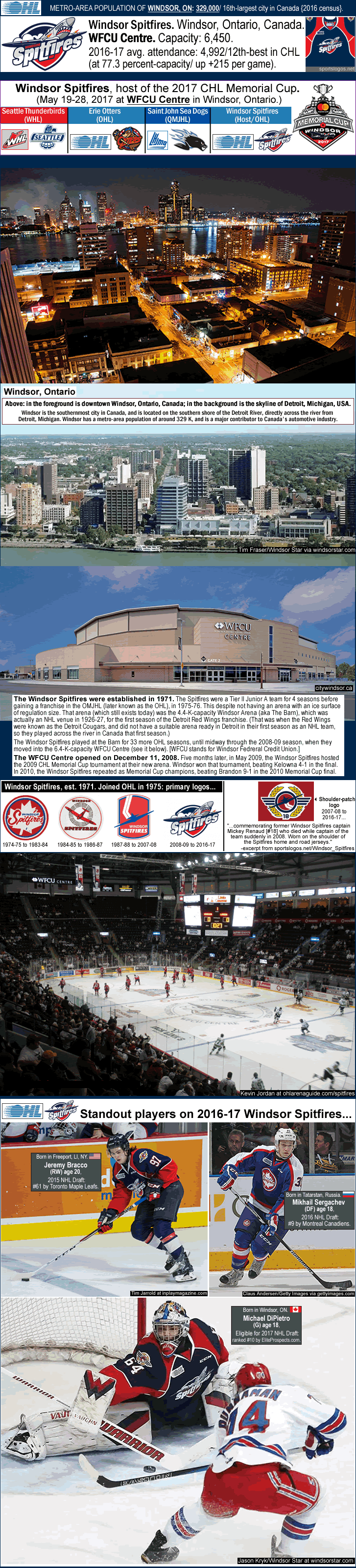
9. at 86.3%-capacity (and 5,613 per game) the Windsor Spitfires (OHL). Windsor, Ontario. Windsor, ON metro population is around 319,000 {2011 figure}. Windsor, ON is across the Detroit River from Detroit, MI, USA (6 km. east of Detroit). Windsor, ON is 329 km. (204 mi.) west of Toronto, ON. Windsor Spitfires (OHL) est. 1975. 96 former Windsor players have played in the NHL. Windsor Spitfires, 3 OHL titles (last in 2010). 2 CHL Memorial Cups (in 2009 and 2010).
windsor-spitfires_wfcu-stadium_d.gif
Photo credits above -
os2voice.org.
robsarenatour.com.


10. at 84.0%-capacity (and 3,752 per game), the Moose Jaw Warriors (WHL). Moose Jaw, Saskatchewan, Canada. Moose Jaw, SK metro population is around 35,000 {2011 figure}. Moose Jaw, SK is 605 km. (376 mi.) east of Calgary; and it is 66 km. (41 mi.) west of Regina, SK. Moose Jaw Warriors (WHL) est. 1980. 42 former Moose Jaw Warriors players have played in the NHL, including 1989 Flames’ Cup-winning pocket-dynamo right-winger and fan favorite Theo Fleury, an Oxbow, Saskatchewan native.
moose-jaw_warriors_mosaic-place_d.gif
Photo credits above –
bcrealestateconvention.com.
ibackpackcanada.com.
voicevicroyals.blogspot.com/2012/01/preview-victoria-at-moose-jaw.html.

Here is a great site – OHL Arena Guide.com, http://www.ohlarenaguide.com/.

___
Thanks very much to Hans Hornstein’s Hockey Attendance Page at www.mib.org/~lennier/hockey/leagueatt.cgi.
Thanks to the contributors to the pages at en.wikipedia.org, ‘Canadian Hockey League‘.

March 21, 2012

2012 NCAA Division I Men’s Ice Hockey Tournament – map of the 16 qualifying teams in the 2012 tournament, with 2011-12 attendance data, all-time Division I Titles list, and all-time Frozen Four Appearances list / Plus, photos and stats of top NHL Prospects in NCAA Division I Hockey – 2012 Hobey Baker Award finalists & statistical leaders for 2011-12 (17 players).

Filed under: Hockey,NCAA - ice hockey — admin @ 4:47 pm

ncaa_ice-hockey_2012-frozen-four_w-all-time-div-i-titles-list_frozen-four-appearances-list_post_.gif
2012 NCAA Division I Men’s Ice Hockey Tournament


Updateteams who qualified for 2012 Frozen FourFerris State Bulldogs, Union Dutchmen, Minnesota Golden Gophers, Boston College Eagles.

NORTHEAST – at Worcester, MA. Host, College of the Holy Cross.
#1: Boston College vs.
#4: Air Force

#3: Maine vs.
#2: Minnesota–Duluth
March 25, 2012 at Worcester, MA – Boston College 4, Minnesota-Duluth 0.
The Boston College Eagles advance to the 2012 Frozen Four
(their 23rd Frozen Four appearance, and their first since 2010, when they won their 4th NCAA Division I Men’s Ice Hockey Tournament title).
boston-college_2012-frozen-four_b.gif
Photo credit above – Melissa Wade/uscho.com.

WEST – at St. Paul, MN. Host, University of Minnesota.
#1: North Dakota vs.
#4: Western Michigan

#3: Boston University vs.
#2: Minnesota
March 25, 2012 at St. Paul, MN – Minnesota 5, North Dakota 2.
The Minnesota Golden Gophers advance to the 2012 Frozen Four
(their 20th Frozen Four appearance, and their first since 2005).
minnesota-golden-gophers_2012-frozen-four_.gif
Photo credit above – Tim Baum/photo.uscho.com/[photo gallery North Dakota vs. Minnesota 3-25-2012].

_ _

EAST- at Bridgeport, CT. Hosts, Yale University and Fairfield University.
#1: Union College vs.
#4: Michigan State

#3: Massachusetts–Lowell vs.
#2: Miami (of Ohio)
March 24, 2012 at Bridgeport, CT – Union College 4, Massachusetts-Lowell 2.
The Union Dutchmen advance to the 2012 Frozen Four
(their first-ever Frozen Four appearance).
union-dutchmen_2012-frozen-four_-.gif
Photo credit above – Union Dutchmen celebrate after clinching their first-ever trip to the Division I Frozen Four, photo by Trent Hermann/Union Athletics at unionathletics.com.

MIDWEST – at Green Bay, WI. Host, Michigan Technological University.
#1: Michigan vs.
#4: Cornell

#3: Denver vs.
#2: Ferris State
March 24, 2012 at Green Bay, WI – Ferris State 2, Cornell 1.
The Ferris State Bulldogs advance to the 2012 Frozen Four
(their first-ever Division I Frozen Four appearance).
ferris-state-bulldogs_2012-frozen-four_c-.gif
Photo credit above – ferrisstatebulldogs.com via photo.uscho.com/[photo gallery Ferris State vs. Cornell 3-24-2012].

__

FROZEN FOUR
National Semifinals & Final – at Tampa Bay Times Forum in Tampa, Florida.
Hosts, Univesity of Alabama-Huntsvile and the Tampa Bay Sports Commission.
NORTHEAST winner vs. WEST winner
EAST winner vs. MIDWEST winner.

FINAL (2012 NCAA Division I Men’s Ice Hockey National Championship Game):
APRIL 7, 2012 AT 7:00 EDT.

Division I Tournament – live blog, scores, schedule, articles (USCHO.com).

2012 NCAA Division I Men’s Ice Hockey Tournament‘ (en.wikipedia.org).

A video from espn.go.com, a three-minute ESPN Sportscenter preview of the tournament, ‘Division I men’s ice hockey tourney‘.

From ncaa.com, 2012 Bracket.

Breakdown of the 16 qualifying teams in the 2012 tournament, by the 5 Division I conferences (with links) -

Reigning champion – Minnesota-Duluth Bulldogs, of the WCHA (the Bulldogs’ first NCAA Division I hockey title was won in 2011).

CCHA, ‘Central Collegiate Hockey Association‘ (en.wikipedia.org).
http://www.ccha.com/
5 teams in the 2012 tournament from the CCHA – Ferris State Bulldogs, Miami (of Ohio) RedHawks, Michigan Wolverines, Michigan State Spartans, Western Michigan Broncos.

WCHA, ‘Western Collegiate Hockey Association‘ (en.wikipedia.org)
http://www.wcha.com/
4 teams in the 2012 tournament from the WCHA – Denver Pioneers, Minnesota Golden Gophers, Minnesota-Duluth Bulldogs, North Dakota Fighting Sioux.

Hockey East, ‘Hockey East‘ (en.wikipedia.org).
http://www.hockeyeastonline.com/
4 teams in the 2012 tournament from Hockey East – Boston College Eagles, Boston University Terriers, Maine Black Bears, UMass-Lowell Riverhawks.

ECAC Hockey, ‘ECAC Hockey’ (en.wikipedia.org).
http://www.ecachockey.com/
2 teams in the 2012 tournament from ECAC Hockey – Cornell Big Red, Union College Dutchmen.

Atlantic Hockey, ‘Atlantic Hockey‘ (en.wikipedia.org).
http://www.atlantichockeyonline.com/
1 team in the 2012 tournament from Atlantic Hockey – Air Force Academy Falcons.

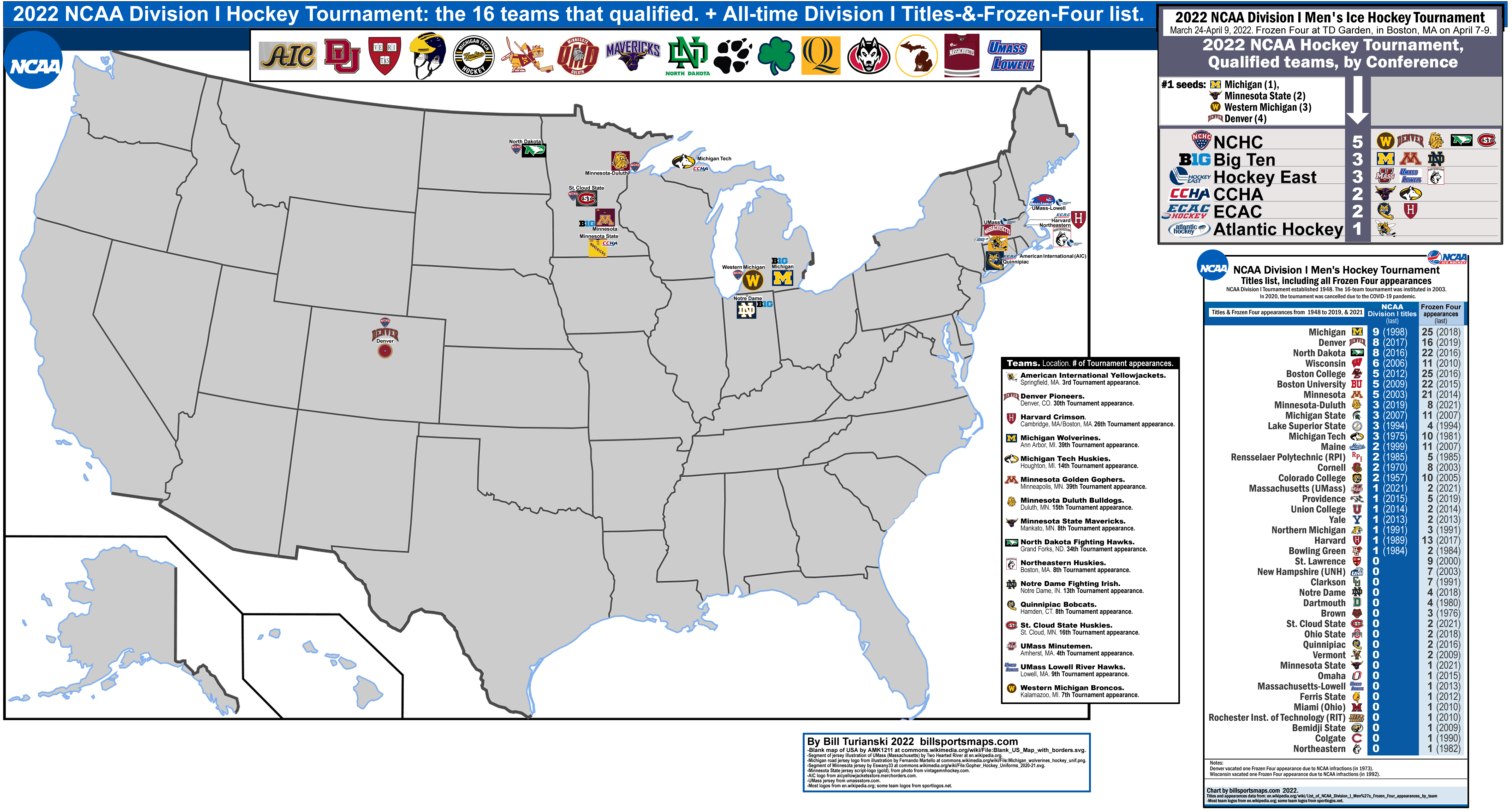
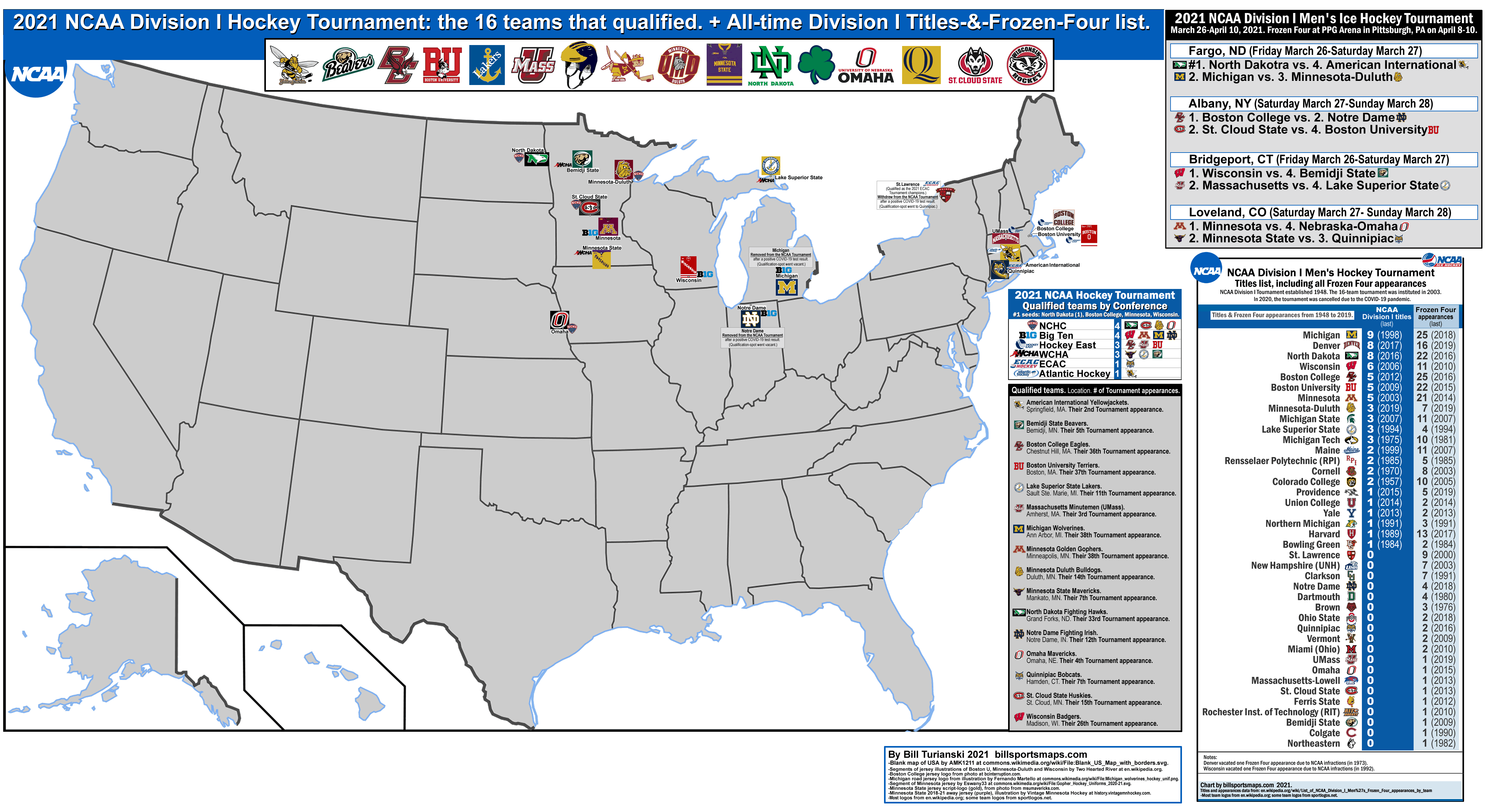
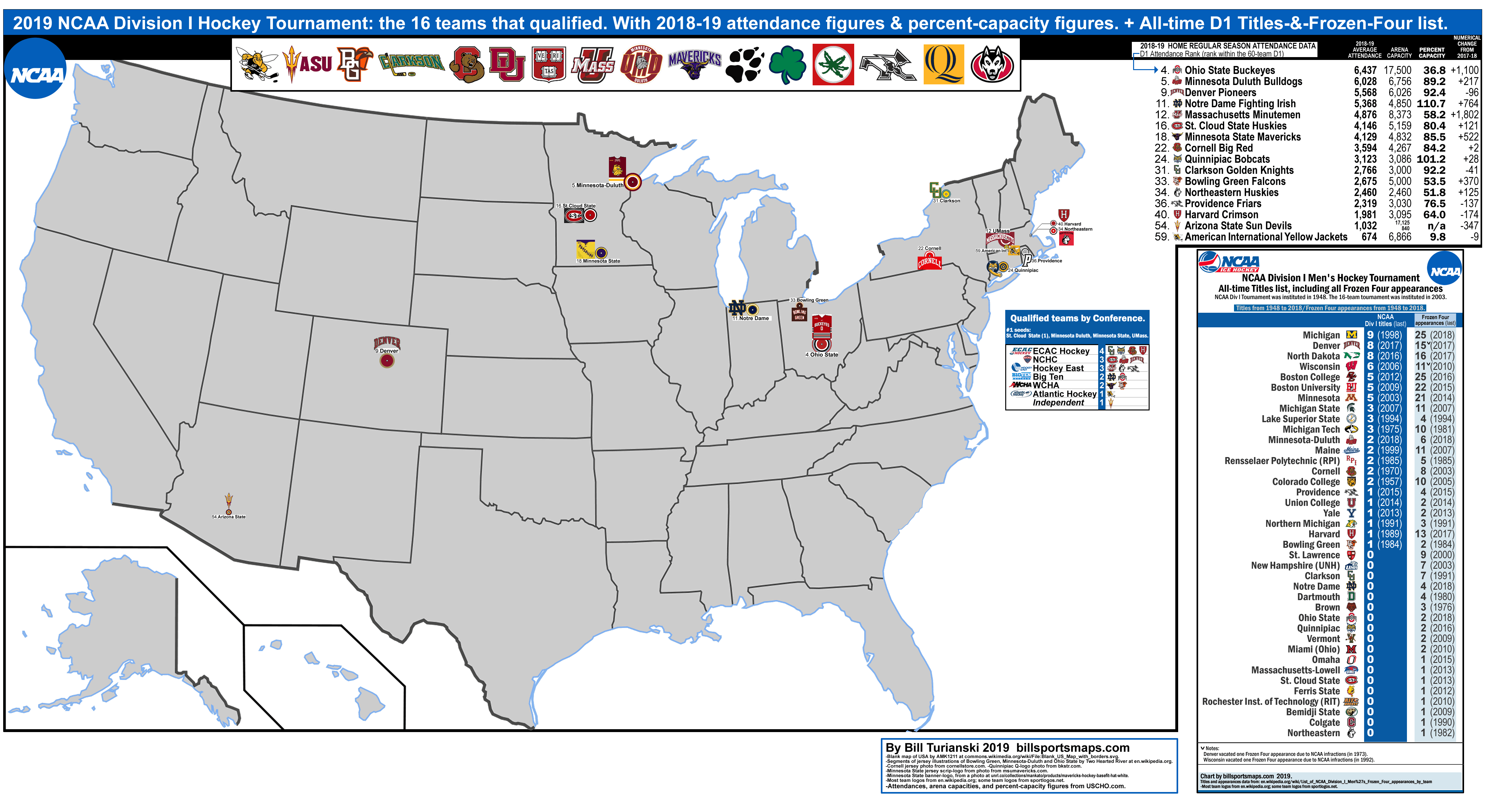
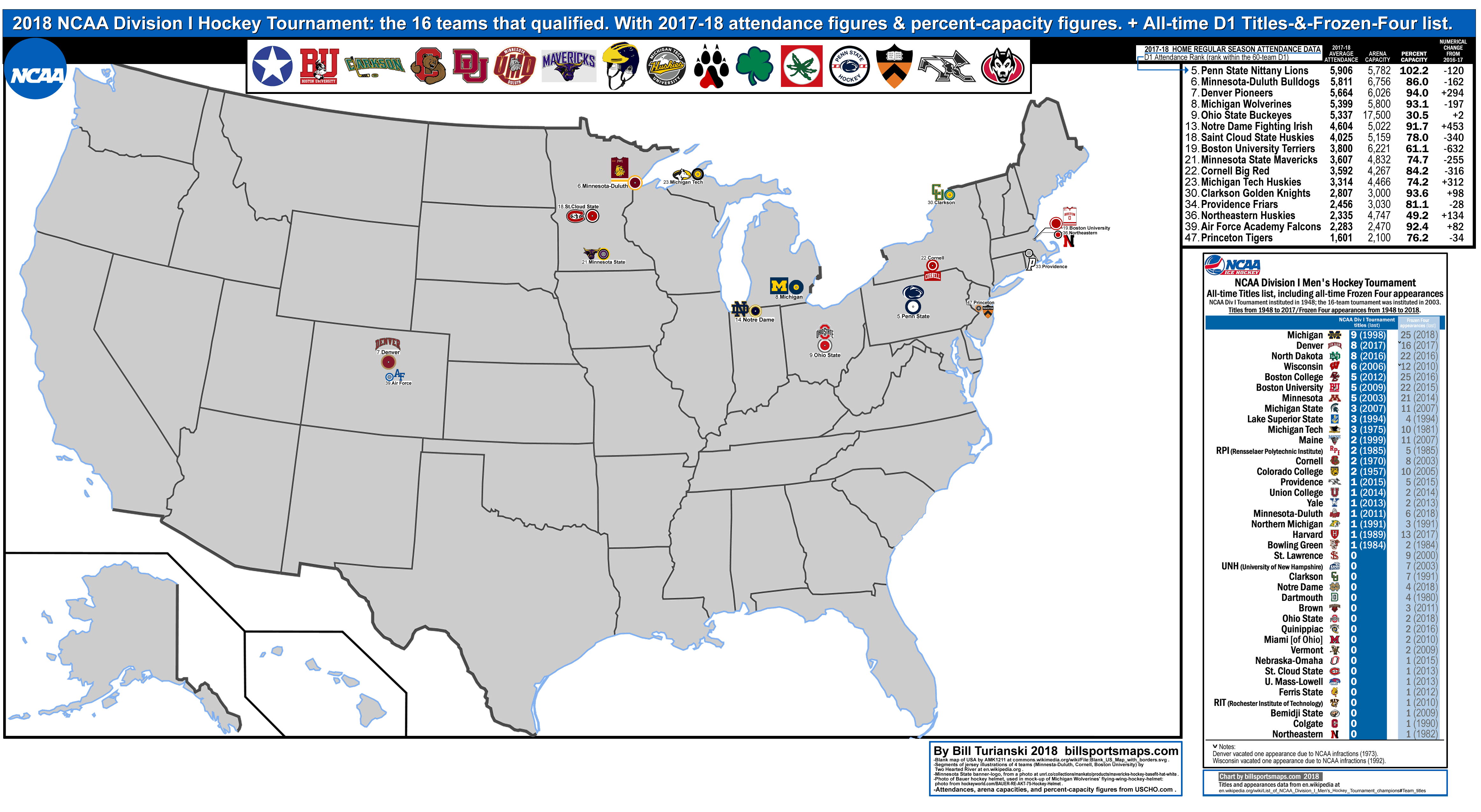
The map on the map page shows the locations of the 16 teams that have qualified for the 2012 NCAA Division I Men’s Ice Hockey Tournament. Accompanying each team’s dot on the map is either their primary logo or their script logo from one of their current sweaters. At the upper left-hand corner of the map page is a brief description of the selection process, with the four #1 seeded teams listed.

To the right of that, at the top-center of the map page, are the 16 teams in the tournament, listed by 2011-12 average home attendance.
Here is where I got the attendance data from: ‘Men’s Division I Hockey Attendance: 2011-2012‘ (USCHO.com).
Accompanying columns list the following – the schools’ locations, and the teams’ conferences; plus 4 aspects of each team’s attendance data… 2011-12 average attendance and rank (from home, regular season games), percentage-change from 2010-11, stadium capacity, and 2011-12 percent-capacity [Percent-capacity equals average attendance divided by stadium capacity].

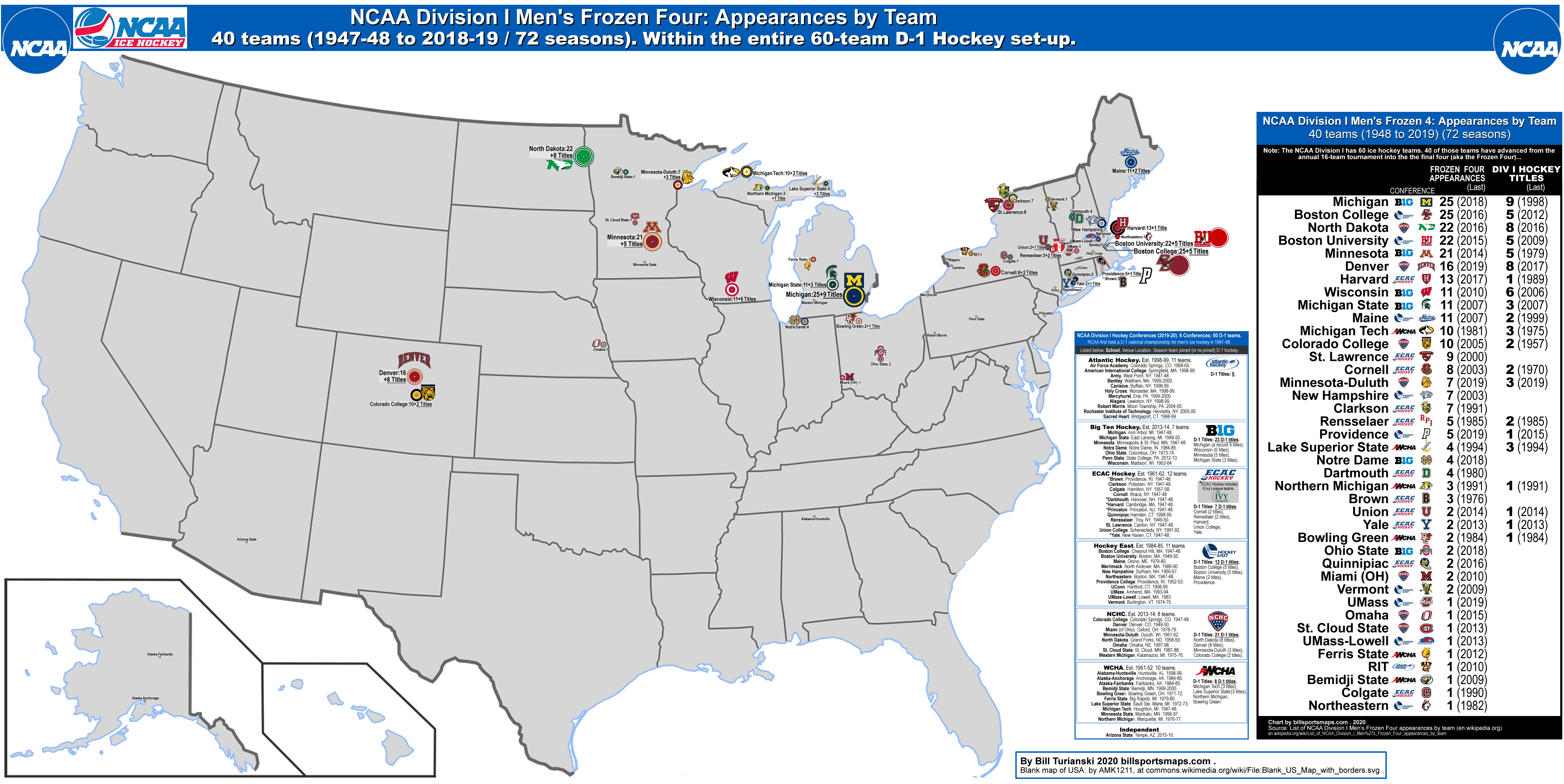
Finally, at the far right-hand side of the map page are 2 lists. The top list shows NCAA Division I Men’s Ice Hockey Tournament titles (with the year of last title). The list below that shows All-time NCAA Division I Men’s Ice Hockey Tournament Frozen Four appearances (with the year of their last Frozen Four appearance).

One thing you should be aware of is that, as opposed to the logos on the map itself, for the 3 charts I used different logos (tiny icon-sized logos) for some of the teams. I did did because of easier visibility (when the logos are shrunk so much) – not very consistent of me, I know, but I figured it wouldn’t cause confusion on a map that features only 16 teams.

One note…both these lists on the far right-hand side of the map page are for ALL teams in the 58-team Division I men’s Ice Hockey set-up, not just the 16 teams who have qualified for the tournament this season. I make this note because on some of my NCAA Basketball Tournament maps, I have listed only the participating teams’ all-time tournament appearances and touirnament titles, but here, with the ice hockey tournament, I am listing NCAA Division I Titles and Frozen Four appearances of all the teams in Division I. I did it this way for two reasons. The far smaller size of Division I men’s ice hockey made it both feasible to include a comprehensive list – there are 58 teams in NCAA Division I men’s hockey, versus 345 teams in NCAA Division I men’s basketball – and sort of pointless to list the more run-of-the-mill accomplishment of simply qualifying. 68 divided by 345 equals 19.7 %, which means that 19.7% of Division I men’s basketball teams make March Madness each year / while 16 divided by 58 equals 27.5%, which means that 27.5% of Division I men’s ice hockey teams make the NCAA Tournament each year.

The Hobey Baker Award is given each season to the top NCAA college hockey player [ Hobey Baker was a military veteran and Princeton graduate who played varsity hockey. Baker died in 1918 in France during World War I as a test pilot. ] The first Hobey Baker Award was given in 1981, and was won by Minnesota-born Minnesota Golden Gophers and 1980 US Olympic hockey team Gold Medalist Center Neal Broten. Other notable Hobey Baker Award winners are Ducks/Avalanche/Predators/Blues Canadian-born Left Winger Paul Kariya (in 1993, as a player on the Maine Black Bears), and East Lansing, Michigan-born Buffalo Sabres Goaltender Ryan Miller (in 2001, as a player on the Michigan State Spartans). ‘Hobey Baker Award‘ (en.wikipedia.org).

Below are the Hobey Baker Award finalists for 2012 (10 players), plus the top statistical leaders for 2011-12 …(photos and stats of 17 players).
Note: 4 of the Hobey Baker Award finalists are listed immediately below but shown in the stats leaders’ section further down.
From NHL.com, from March 15 2012, ‘10 finalists announced for Hobey Baker Award‘.
ncaa_ice-hockey_2012-hobey-baker-award_finalists_shaun-hunwick_tim-kirby_torey-krug_brian-dumoulin_justin-schultz_reilly-smith_d.gif
Photo credits above – Shaun Hurtwick, AP Photo/Ann Heisenfelt via espn.go.com. Tim Kirby, postbulletin.com. Torey Krug, msuspartans.com. Brian Dumoulin, Boston College via pressherald.com. Justin Schultz: collegehockeynews.com. Reilly Smith, stars.nhl.com.

Below: the 8 Points leaders (as measured by Goals + Assists), and the 3 top goaltenders (as measured by Goals Against Average), in the 2011-12 NCAA Division I Men’s Ice Hockey season (note: stats include regular season and conference playoffs) -
ncaa_ice-hockey_2011-12_top-scorers_spencer-abbott_jack-connolly_austin-smith_mark-zengerle_travis-oleksuk_chris-wagner_drew-shore_brett-gensler_b.gif

ncaa_ice-hockey_2011-12_top-goaltenders_conner-knapp_troy-grosenick_chris-noonan_g.gif

Photo credits above – Spencer Abbott, mainehockeyjournal.com/abbott-enjoying-a-memorable-season-with-black-bears. Jack Connolly, Melissa Wade/uscho.com. Ausrin Smith, alliance.pucksystems.com. Drew Shore, Melissa Wade/uscho.com. Travis Oleksuk, wcha.com. Chris Wagner, collegehockeynews.com. Brett Gensler, bentleyfalcons.com wcha.com. Mark Zengerle, Erica Treais/uscho.com. Connor Knapp, buffalonews.com. Chris Noonan, buffalonews.com. Troy Grosineck, John Carl D’Annibale/timesunion.com.

_

Thanks to Jayson Moy at the Bracketology blog at USCHO.com site.
Thanks to the contributors to the pages at en.wikipedia.org, ‘NCAA Men’s Ice Hockey Championship‘ ; ‘List of NCAA Men’s Division I Frozen Four appearances by school‘.
Thanks to blindschalet.com for the Michigan Wolverines logo.
Thanks to New Hampshire Wildcats store, for the UNH hockey sweater script logo.
Thanks to Gamewornauctions.net, for the Clarkson hockey sweater script logo.
Thanks to shop.uscho.com/College_Hockey_Jerseys for the Miami (of Ohio) hockey sweater logo, and the Vermont hockey sweater logo.
Thanks to the article from bleacherreport.com, by Nicholas Goss, from Sept. 6 2011, ‘The 50 Best Non-NHL Hockey Jerseys of All Time‘ (Minnesota hockey sweater script logo).
Thanks to sketchup.google.com, for the Providence College Friars Hockey Team Logo.
Thanks to Northeastern Univ. store, for Northeastern Huskies hockey sweater logo.

Thanks to Two Hearted River at en.wikipedia.org, for the college hockey teams’ sweater logo illustrations used on the map (at each team’s Wikipedia page, such as UMass-Lowell’s, here).
Thanks to USCHO.com, for stats and coverage.

November 21, 2011

National Hockey League, 1979-80 season, with four teams added (all from the WHA): the Edmonton Oilers, the Hartford Whalers, the Quebec Nordiques, and the Winnipeg Jets (I).

Filed under: Hockey,Hockey-NHL and expansion,Hockey-WHA — admin @ 9:03 pm

nhl1979-80map-w-jerseys_post_c.gif
1979-80 NHL


Note about the map page…teams are listed not by divisions, but alphabetically – with 1979-80 NHL teams starting with the letters A through M on the left side of the map page; and 1979-80 NHL teams starting with the letters N through W on the right side of the map page. The explanation for this is in the following paragraph.

[In all the other installments of this series (Hockey - NHL and Expansion]) I have grouped the teams on the map page by divisions and conferences. But for this map, I have listed the NHL teams by alphabetical order, going from ‘A’ at the top left, to ‘W’ at the bottom right. I did this because the league format that the NHL created in 1979-80 rendered the divisional set-up meaningless. For two seasons, 1979-80 and 1980-81, the 21-team NHL had a balanced schedule with all teams playing other teams 4 times (80-game regular season), and, crucial to my point here, all the playoff teams (16 playoff teams) were seeded. In other words, for two seasons, the NHL’s divisions were pointless, because the only way that divisional status had an impact was this: the divisional winners automatically qualified for the playoffs (as did the 12 next-best teams as wild-cards). But since over three-quarters (76%) of the teams qualified for the playoffs back then (talk about watering down your product), the divisions meant nothing. That is because the only way this “divisional” format would have come into actual relevance was if one of the divisional winners had a worse record than one of the 5 teams that didn’t qualify for the playoffs. And both seasons, of course, this did not even come close to happening.

The NH:-WHA merger, officially known as the NHL’s 4-team expansion of 1979-80
Only 4 teams survived all 7 seasons of the World Hockey Association. Those 4 WHA teams would become NHL expansion franchises in 1979-80.
[Note, if you want to know more about the WHA, you can see my post on it {here (billsportsmaps, Feb. 10, 2010)}, and/or you can read this brilliant article from SI.com/vault, from May 28, 1979, by Reyn Davis, 'A Nowhere Ride'.

The NHL had had talks with the WHA about some kind of merger almost from the start of the rebel-league's existence in 1972-73. The first talks, in 1972, had the NHL offering to buy each WHA team for $4 million, provided all lawsuits were dropped. That got nowhere. Subsequent sets of talks over the next 5 seasons had various proposals - for 6 WHA teams to join the NHL; or for 4 WHA teams to join; or for 2 WHA teams to join; or even for just one team (the Houson Aeros) to join the NHL. These all went nowhere. The one constant, from the NHL owners' bargaining position, was that there was a small and obstinate faction of NHL owners (Boston's Paul Mooney, and Toronto's Harold Ballard especially, but also initially including Chicago's Bill Wirtz), that were blocking any attempt at coming to an agreement. Those three owners wanted revenge, because the Bruins, the Maple Leafs, and the Black Hawks were the among the NHL teams that got hurt most by the WHA's existence.

Most WHA teams lived hand-to-mouth. By 1976 or so, it was obvious to WHA owners that "the game was to hang on long enough to get into the NHL," as former-Edmonton Oilers' owner, future-Calgary Flames' owner, and then-Indianapolis Racers' owner Nelson Skalbania said.

But for the first 5 years of the WHA's existence, any kind of merger with the NHL just wasn't going to happen, because NHL president Clarence Campbell was steadfastly opposed to a merger, insisting that the WHA had set out to destroy the NHL. So real merger discussions were only really possible when John Zeigler replaced Clarence Campbell as NHL president in 1977. Talks got more serious, and it looked like a 6-team/quasi-merger was set to take place after the 1977-78 WHA season ended in May, 1978. This deal would have included the 4 WHA teams that eventually joined the NHL, plus the two that were eventually paid-off to disband - the Cincinnati Stingers and the Indianapolis Racers - and would have had those 6 teams play in the NHL in a separate division, playing only versus themselves, and then to slowly begin playing a combined schedule with the NHL-proper over a 5-year-period. But the Ballard-Mooney-out-for-blood-faction got some other NHL owners to switch at the last minute, and this plan was defeated by one single vote.

The WHA owners were so incensed by this sabotage of their agreement that they decided on some hard-ball tactics, and to hit the NHL where it would hurt the most...by signing under-age juniors [at that time, the NHL did not allow players under the age of 20]. The Birmingham Bulls signed 6 teenagers, and several other WHA teams like Cincinnati and Indianapolis also signed teenagers. So that is why Wayne Gretztky and Mike Gartner and Mark Messier – all Hall of Famers – got their starts in the WHA. And that is really why the NHL finally got serious about letting WHA teams join their league – they wanted the WHA’s future stars, and were not prepared to see top-shelf talent like Gretzky play in a rival league.

Below: in honor of Mark Messier, who in 2004 was the last active WHA player playing in the NHL…
mark-messier_n.gif
Photo credits -
lowetide.blogspot.com, hhof.com/Messier, canadacardworldblog.com, Doug Pensinger/Allsports via espn.go.com/readers/beloved/newyorkers, brothersoft.com/mobile/.

The WHA’s last season (1978-79)
When the WHA’s Houston Aeros learned that the NHL did not have intentions of expanding south into the Sunbelt (not yet, anyway), the Aeros, one of the stronger WHA teams, cut their losses and folded after the 1977-78 season. That left a 7-team WHA to limp through their final season of 1978-79. Midway through that last WHA season, the Indianapolis Racers folded. The Indianapolis Racers are today best known for being the first pro team of Wayne Gretzky, who was 17 years old then. Gretzky only played 8 games for the Racers, then Racers’ owner Nelson Skalbania, who earlier that year, on the advice of Brmingham Bulls’ owner Tom Bassett, had signed Gretzky (to a 7-year personal-services contract worth $1.75 (US) million), sold Gretzky to the Edmonton Oilers. Gretzky, as a 17/18-year-old, then went on to finish third in scoring that season (behind Robbie Ftorek and Réal Cloutier), and helped lead the Oilers to the Avco Cup finals, which they lost to Winnipeg. It was the Winnipeg Jets’ 3rd Avco Cup title. [The Winnipeg Jets won the most titles in the 7-season WHA; the second-most was the 2 Avco Cup titles won by the Houston Aeros (last in 1975); and the other Avco Cup title winners were the Quebec Nordiques (in 1978) and the New England Whalers (in the first WHA season in 1973).] The $750,000 Skalbania got for Gretzky wasn’t enough to keep the Indianapolis team alive, though, and the Racers folded in December, 1978. The WHA finished their final season with just 6 teams – the Birmingham Bulls, the Cincinnati Stingers, the Edmonton Oilers, the New England Whalers, the Quebec Nordiques, and the Winnipeg Jets (I).

The NHL/WHA merger seems scuttled, until the power of the people (Canadian-style) prevails
In March, 1979, another merger proposal – the one that eventually passed – was again voted down by one vote. The 5 NHL teams that voted against the merger on March 17, 1979 were the Montreal Canadiens, the Vancouver Canucks, the Boston Bruins, the Toronto Maple Leafs, and the Los Angeles Kings.

The reasons why those 5 NHL teams initially voted against the merger with the WHA…
Boston: did not want to share New England with the Whalers, plus the owner (Paul Mooney) never forgave the Whalers for signng so many ex-Bruins players circa 1972-75.
Montreal: see above, with respect to the fact that the Habs did not want to share the Francophone hockey fan base in Canada with the Quebec Nordiques. Plus, just as when, circa 1969-70, Montreal and Toronto tried to keep Vancouver out of the league because the 2 Canadian NHL teams then didn’t want to lose their lucrative slice of the pie from Hockey Night In Canada broadcasts, now those 3 Canadian NHL teams didn’t want to share that revenue 6 ways. In other words, the Montreal (and Toronto and Vancouver) top brass turned their backs on fellow Canadians by being Canadian citizens who did everything in their power to prevent Canadian hockey fans in 3 provincial cities the chance to be able to continue having local major-league-hockey teams.
Toronto: see Montreal, above, second and third sentences. Plus factor in how angry Leafs’ owner Harold Ballard was at the WHA for raiding the Leafs’ roster in the early days of the WHA (circa 1972-75), plus factor in what an unreasonable person the felon Ballard was.
Vancouver: see Montreal above, second and third sentences. In other words, the Canucks’ top brass were hypocrites, because in 1970 they almost didn’t get into the NHL for the same reason – now they were on the other side of the fence trying to keep other Canadian teams out. Plus they were afraid gates would suffer because they would not have as many home games versus Original 6 teams.
Los Angeles: See Vancouver, above, second sentence.

So what changed it? What got some of those teams to reverse their position and let there be major-league-NHL-hockey in Alberta, in the Canadian prairies, in the frozen north of Quebec, and in the state of Connecticut? A fan boycott. Over Molson Beer products, first organized in Edmonton, Quebec City, and Winnipeg, then spreading swiftly across all of Canada. Period.

From en.wikipedia.org/NHL-WHA merger,
{excerpt} …”The Canadiens were owned by Molson Brewery, and the Canucks served Molson products at their games. Fans in Edmonton, Winnipeg, and Quebec City, believing that Molson was standing in the way of their cities remaining big-league hockey towns, organized a boycott of Molson products. The boycott quickly spread nationwide. The Canadian House of Commons weighed in as well, unanimously passing a motion urging the NHL to reconsider. A second vote was held in Chicago on March 22, 1979, which passed by a 14–3 margin as both Montreal and Vancouver reversed their positions. Both teams’ hands were forced by the boycott, and the Canucks were also won over by the promise of a balanced schedule, with each team playing the others twice at home and twice on the road…”
{end of excerpt}.

The 1979 merger between the NHL and the WHA
The NHL did not see Cincinnati or Birmingham as viable locations for franchises, and the Stingers and Bulls were paid to disband by getting $1.5 million apiece in parachute payments, then joining the Central Hockey League, the NHL-owned minor league, for one season each. The Stingers lasted just 33 games in the CHL in 1979-80; while the Birmingham Bulls played two full seasons in the CHL, folding after the 1980-81 season. Meanwhile, at the insistence of the Boston Bruins (again, one of the teams most hurt by the WHA), the New England Whalers were forced to change their name to the Hartford Whalers [the Whalers also got rid of their whale-harpoon-with-the-letter-W logo, and replaced it with a logo that had a white H and a green W under a blue whale fluke; plus the Whalers changed their colors to kelly green with blue trim (instead of dark green with yellow-orange trim) - see this, Hartford Whalers logos, from Chris Creamer's SportsLogos.net/Hartford Whalers].

So the 4 hockey franchises that moved over from the WHA to the NHL – as expansion teams – for the 1979-80 season were the Hartford Whalers, the Edmonton Oilers, the Quebec Nordiques, and the Winnipeg Jets (I).

4-wha-teams_joined-nhl-in1979-80_edmonton_hartford_quebec_winnipeg_b.gif

The NHL really got the better of the WHA teams, to the point where it was officially called an expansion, not a merger. The WHA teams were stripped of almost all their players, and were only allowed to keep 2 goaltenders and two skating players. The four ex-WHA teams had to rebuild their rosters through the re-entry draft at $125,000 per player. [Note: that makes the fact that the Edmonton Oilers won their first Stanley Cup title in just their fifth season in the NHL (in 1984) all the more impressive.]

The 1979-80 NHL season

Protective helmets were declared mandatory for all players, with players who signed contracts before June 1, 1979 having the option to not wear helmets (once they signed a waiver).

In December, 1979, the Detroit Red Wings moved over from the Detroit Olympia (capacity 15,000) to the Joe Louis Arena (capacity 19,875 [now it has a 20,066 capacity]).

The New York Islanders had a 25-point drop from the best-regular-season-points-tally of 116 in the previous season, to 86 points in 1979-90. But in the post-season, where it mattered, the Islanders 5th-seeding in the playoffs did not hold them back at all. On the other hand, the Philadelphia Flyers improved by 21 points over the previous season, and, propelled by a still-North-American-major-league-sports-record 35-game unbeaten run from mid-October to mid-January (25-0-10), the Flyers ended up with the best regular season record in 1979-80, with 116 points. The Buffalo Sabres finished as the second seed in the playoffs, with 110 points. Leading scorers were Marcel Dionne (of the Los Angeles Kings) and the 18/19 year-old Wayne Gretzky (of the Edmonton Oilers), both of whom had 137 points (with Dionne winning the Art Ross Trophy by virtue of having scored 2 more goals [53 goals] than Gretzky). Bob Edwards and Bob Suave of the Buffalo Sabres combined for the lowest goals-against-percentage and won the Vezina Trophy. None of the 4 new teams that had come over from the WHA had winning records, which came as no surprise, seeing as how the 4 “expansion teams” were stripped of all but 4 players each when they joined the NHL. Hartford and Edmonton did make the playoffs, though, as the 14th and 16th seeds, but both were swept in the 1st round of the playoffs.

1979-80 Stanley Cup Finals
The Philadelphia Flyers met the New York Islanders in the 1980 Stanley Cup Finals. It was the then-8-year-old-Islanders’ first Finals appearance. The Islanders were led by the “Trio Grande” line of C Bryan Trottier, LW Clark Gilles, and RW Mike Bossy (all Hall of Famers), and featured 2 other future Hall of Famers in D Denis Potvin and G Billy Smith. The Flyers had the second-best offense that season, with 327 goals (Montreal had 328 goals), and it was a real team effort as there were no Flyers players in the top 10 in scoring, although RW Reggie Leach had 50 goals (7th best); and Bobby Clarke and Ken Linseman both had 58 assists (tied for 8th best). Philadelphia also had the most players in the All-Star Game that season, with 7, including Leach, Rick MacLeish, and Bill Barber.

In Game 1, in Philadelphia, Denis Potvin won it for the Islanders with a power-play goal in overtime, for a 4-3 score. The Flyers answered with a flurry of goals in the second game, winning 8-3. The series resumed, at the Islanders’ home ice in Uniondale, New York, and saw the Islanders take control with a 6-2 win in Game 3; and then a 5-2 win in Game 4. Back at the Forum in Philly, the Flyers got back into it with a 6-3 win in Game 5. Back on Long Island for Game 6, Philadelphia looked poised to send the series back to Philadelphia and a seventh game, when they scored two late goals in the 3rd period – and the game went to overtime knotted at 4-4…

Via Youtube, here is the last minute of the 1980 Stanley Cup Finals (Youtube video posted by mamojica, 4:58), which shows Isles’ C Lorne Henning, near the center-circle, threading the needle [at 0:35 of the video] to fellow-third-line left-winger John Tonelli, whose goal-mouth-cross to RW Bob Nystrom is re-directed and floated over Flyers’ G Pete Peeters’ blocker pad, making the New York Islanders the champions. The Islanders would go on to establish themselves as one of the great dynasties of the NHL, winning four consecutive Stanley Cup titles…over Minnesota in 1981; over Vancouver in 1982; and over Edmonton in 1983. That 4-consecutive-Stanley-Cup-titles-run by the New York Islanders (1979-80 through to 1982-83) is surpassed only by the Montreal Canadiens, who won 5 straight Stanley Cup titles in the Original Six era, from 1955-56 through to 1959-60; and who also won 4 straight Stanley Cup titles from 1975-76 through to 1978-79.
new-york-islanders_4-stanley-cups-logo_.gif

The Islanders’ victory over the Flyers in Game 6 of the 1980 Stanley Cup Finals was the last NHL game to air on network television in the United States for 9 years.

The following season, 1980-81, ex-WHA owner Nelson Skalbania purchased the foundering Atlanta Flames’ franchise and moved the team north, to Calgary, Alberta, Canada, as the Calgary Flames (NHL, 1980-present).
atlanta-flames_move-to_calgary_flames_1980.gif

The season after that, 1981-82, the NHL went to geographically-oriented divisions and conferences.

The season after that, 1982-83, the Colorado Rockies were purchased by an East Coast-based consortium, and moved to northern New Jersey, as the New Jersey Devils (NHL, 1982-present).
kansas-city-scouts_move-to_colorado_rockies_move-to_new-jersey_devils_.gif

The season after that, 1983-84, the Edmonton Oilers, with Wayne Gretzky as team captain and league-MVP, won the first of their 5 Stanley Cup titles.
{Old content disclaimer…the image-sequence below first appeared on this site here (The World Hockey Association, 1972-73 to 1978-79: map of all 26 teams, with attendance figures and notes.)}.
Below is a tribute to the WHA-era Edmonton Oilers, and to Glen Sather and Wayne Gretzky, the two people most responsible for bringing the Stanley Cup to Edmonton

wha_alberta-oilers_edmonton-oilers_edmonton-gardens_al-hamilton_northlands-coliseum_rexall-place_glen-sather_wayne-gretzky_indianapolis-racers_si-cover1984_.gif

Photo and image credits –
Al Hamilton, HFboards.com/thread.
Old Oilers jersey illustration, http://whauniforms.com/.
Edmonton arenas: Edmonton Gardens (aka Livestock Pavillion), hockey.ballparks.com; Northlands Coliseum, http://hockey.ballparks.com/WHA/AlbertaOilers/index.htm
Gretzky on Indianapolis, 1978-79 indianapolis racers wayne gretzky jersey photos.
Wayne Gretzky on Sports illustrated cover, Wayne Gretzky Sports Illustrated covers gallery [12 SI covers between 1981 and 1999]..
_

Thanks to the JerseyDatabase.com site, for the jersey illustrations on the map page. As great as this site is, it is rather hard to navigate, so here is the page that will get you to NHL teams’ jerseys, http://www.jerseydatabase.com/browse.php?sport=nhl.

Thanks to NHL Uniforms.com, for bits of jerseys I needed to fill in (1979-80 Edmonton Oilers and 1979-80 Winnipeg Jets) because of gaps in the aforementioned database…www.nhluniforms.com/1979-80.

Thanks to Chris Creamer’s Sports Logos.net/NHL.

Thanks to WHA Hockey.com. Birmingham Bulls at WHA Hockey.com.

Thanks to WHA Hockey.tv. [Note, lots of Whalers' content here.]

Thanks to Ed Willes, for his book on the WHA…‘Rebel League, the short and unruly life of the World Hockey Association’, published by McLelland & Stewart, Toronto, 2004 {at Amazon, here}.

October 20, 2011

NCAA Division I Men’s Ice Hockey – 2010-2011 average attendance map of all 58 teams in Division I.

Filed under: Hockey,NCAA - ice hockey — admin @ 9:40 pm

ncaa_ice-hockey_2010-attendances_post_e.gif
NCAA Ice Hockey Attendance Map


[Note: Once you click onto the map page, to avoid eye-strain, I would recommend enlarging the map image by hitting the Ctrl and + keys simultaneously 2 or 3 times.]

The 2011 Frozen Four was comprised of Michigan, Minnesota-Duluth, North Dakota, and Notre Dame. And on April 9, 2011, the 2011 NCAA men’s ice hockey champions were the Minnesota-Duluth Bulldogs, who beat Michigan 3-2 in overtime. This was Minnesota-Duluth’s first ice hockey title. The team has made 4 Final Four appearances and 7 NCAA Men’s Ice Hockey Tournament appearances (16 teams currently qualify for the tournament). Minnesota-Duluth averaged 5,810 per game in 2010-11, which was 9th-best in the 58-team Division I men’s ice hockey set-up.

The highest-drawing team was once again the Wisconsin Badgers, who pulled in 13,226 per game last season. The Badgers played to a 86.8 percent-capacity at the 15,237-capacity Kohl’s Center in Madison, WI. The Badgers men’s ice hockey team have made 12 Frozen Four appearances and have won 6 NCAA titles (last in 2006).

michigan-stadium_104thousand-in-attendance_outdoor-ice-hockey-game_.gif

Helped by playing a game in the school’s football stadium, the Michigan Wolverines‘ men’s ice hockey team had the second-highest average attendance in 2010-11, at 12,291 per game. 104,173 packed in to Michigan Stadium on December 11, 2010, to see the Wolverines beat their in-state rivals the Michigan State Spartans by the score of 5-0. That game now tops this list, ‘List of ice hockey games with highest attendance‘ (en.wikipedia.org). The Wolveines have won 9 NCAA men’s ice hockey titles (but none since 1998). The Wolverines have the most titles in men’s ice hockey and have made 23 Frozen Four appearances, 21 consecutively (since 1991). That 21 straight tournament appearances is also a record. The Wolverines men’s ice hockey team plays at the 78-year-old, 6,637-capacity Yost Ice Arena.

Third highest-drawing team last season was the North Dakota Fighting Sioux. They played to 101 percent-capacity, drawing 11,756 per game at the 11,640-capacity Ralph Englestad Arena in Grand Forks, ND. Grand Forks has a metro area population of around 98,000 {2010 figure}, so that 11,700 per game is pretty darn impressive for the 7-time-champions the Fighting Sioux.

Fourth-highest-drawing last season was the Minneapolis/St. Paul-based Minnesota Golden Gophers, who played to 95.4 percent-capacity and drew 9,544 per game. The Golden Gophers have 5 men’s ice hockey titles (last in 2003), and 19 Frozen Four appearances. The state of Minnesota has 5 Divison I men’s ice hockey teams – Minnesota, St. Cloud State, the aforementioned Minnesota-Duluth, Bemidji State, and Minnesota State [Mankato, MN] – and between them they cumulatively averaged over 28,000 per game in 2010-11.

Fifth-highest-drawing team was the Nebraska-Omaha Mavericks, who averaged 7,994 per game at the 16,680-capacity CenturyLink Center in Omaha, NE. The Mavericks have never made a Frozen Four, and have just 2 NCAA Men’s Ice Hockey Tournament appearances.

Sixth-highest-drawing last season was the Colorado College Tigers, who drew 6,687 per game to the 8,000-capacity Colorado Springs World Arena and Ice Hall, for a solid 91.1 percent-capacity figure. Colorado College won their 2 NCAA men’s ice hockey titles early on in the competition’s history, in 1950 and 1958 (the tournament was first played in 1948, and initially was only a 4-team field). 7 of Colorado College’s 10 Frozen Four appearances occurred in the 1940s and the 1950s (their last Frozen Four was in 2005). There are 3 Division I men’s ice hockey teams in the state of Colorado – Colorado College, Denver University, and Air Force Academy – and the 3 teams cumulatively averaged over 13,500 per game last season.

Two seasons ago, 2010 Frozen Four winners were Boston College, who won their fourth NCAA Ice Hockey title then. In 2010-11, the Boston College Eagles drew 7th-best in Division I. The Eagles averaged 6,292 per game in 2010-11 at the 7,884-capacity Conte Forum in Chestnut Hill, MA [5 miles west of Boston]. Boston College’s 79.8 percent-capacity was among 26 Division I teams that had a percent-capacity above 75%. Boston College is one of 5 Div.I hockey teams in the Boston metro area (plus there are 3 more nearby), and between those 5 – Boston College, Boston University, Harvard, Northeastern, and Bentley College – they cumulatively averaged over 16,000 per game last season.

The map shows all 58 NCAA Division I Ice Hockey teams’ locations. Each teams’ circle is in team colors and is sized to reflect 2010-11 average attendance (from home games, with ~14-22 home games per team). Text size and team logos are also sized. Attendances are listed at the far right. Also listed are each team’s NCAA Division Men’s I Ice Hockey titles (and years the team were the champion). To see stadium capacities and percent-capacities by team, go to the US Hockey Online link 4 paragraphs down [Note: you might also be interested in checking out another link at the bottom of this post, which is the Hockey News' poll of favorite college hockey jerseys (from 2008).]

Conferences that each team are in can be seen by going to the following page at en.wikipedia.org, ‘NCAA Hockey Division I [map]‘.

This is the first time I have covered this subject, and I am just getting up-to-speed on the goings-on, of which there have been plenty, recently. That is because, just like college football, college ice hockey is in the midst of some pretty drastic re-alignments. In 2013-14, new Division I hockey programs will be born in places like Penn State and Miami, FL. Also in 2013-14, the Big Ten will be starting an ice hockey conference. Michigan, Michigan State, Minnesota, Ohio State, and Wisconsin announced in March 2011 that they will leave the CCHA (Central Collegiate Hockey Association) to join the Big Ten for 2013-14.

Excerpt from en.wikipedia.org…”In response to the creation of the Big Ten hockey conference, Miami University [Miami of Ohio] will join Denver, Colorado College, North Dakota, Nebraska-Omaha, and Minnesota-Duluth of the WCHA (Western Colege Hockey Association) to create the National Collegiate Hockey Conference. In response to the creation of the National Collegiate Hockey Conference, Northern Michigan University will join the WCHA in 2013. Invitations to join the WCHA were eventually extended to Alaska-Fairbanks, Bowling Green, Ferris State, Lake Superior State, and Western Michigan in late August of 2011. Alaska-Fairbanks, Ferris State and Lake Superior State have accepted and will join Northern Michigan into the WCHA in 2013. Western Michigan and Notre Dame have been rumored as the 7th and 8th additions to the new NCHC…”{end of excerpt}

I may not know much about NCAA hockey, but I know this: having the two Alaska teams in different conferences was always a ridiculous situation, so at the very least all this re-shuffling will have accomplished putting the Alaska-Anchorage Seawolves and the Alaska-Fairbanks Nanooks in the same conference.
National Collegiate Hockey Conference [to be instituted in 2013-14]‘.

I will be posting a map for the 2012 Frozen Four competition in March, which will include an all-time list of Frozen Four appearances by team.
_

Thanks to U.S. College Hockey Online.com for 2010-11 Division I Men’s Ice Hockey average attendance figures.
Thanks to The Hockey News.com, for this article ‘The Hockey News’ ECAC, WCHA and AHA Jersey Rankings [Aug.27 2008]‘.
Thanks to the contributors to the pages at en.wikipedia.org, ‘College Ice Hockey‘.

September 24, 2011

NHL 2011-2012 Location Map, with average attendances from 2010-2011 regular season, and Stanley Cup titles’ list (active teams) / With a short article on the arrival of European players into major-league ice hockey in North America, featuring the Hot Line of Hull/Hedberg/Nilsson (Winnipeg Jets 1974-78) / Plus Winnipeg Jets (II), logos / Plus Winnipeg Jets (I): a graphic synopsis of the franchise that is now based in Phoenix.

Filed under: Hockey,Hockey-WHA — admin @ 8:52 pm

nhl_2011-12_post_.gif
NHL, 2011-12 location map, with 2010-11 avg. attendances, and all-time titles list


NHL.com
For the fifth-straight season, the NHL will begin the season by playing a set of games in Europe…
NHL to play regular-season games in Europe again‘.
The 2011-2012 NHL regular season will begin on October 6. On October 7, 2 games will be played in Europe – one of which is the Anaheim Ducks versus the Buffalo Sabres in Helsinki, Finland. It is no coincidence that the Ducks are playing in Finland, because Helsinki is the birthplace of their 18-year veteran superstar Teemu Selänne, who plays Right Wing and is 41 years old, yet still was the 8th-highest scorer in the NHL last season (with 80 points). In fact, there are 4 Finnish players on Anaheim, the other three being the Ducks’ captain, and two-time-All-Star, the Center Saku Koivu; Defenseman Toni Lydman, and Goalie Iiro Tarkki. The Anaheim Ducks currently have 7 European players on their roster [all the roster lists linked to here were as of Sept.24,2011]. The Buffalo Sabres also currently have 7 European players on their roster, including Finnish LW Vinne Leino.

Also on October 7, the Los Angeles Kings will play the New York Rangers in Stockholm, Sweden. On the LA Kings’ current roster is 1 European playerr. The New York Rangers boast 8 European players on their current roster, including 3 Swedes, most notably their starting Goalie Henrik Lundqvist, as well as LW Carl Hagelin and RW Andreas Thuresson.

The following day (October 8) Stockholm, Sweden will host another regular-season game, with the Ducks vs. the Rangers; while the Sabres and the Kings will play in Berlin, Germany [this will the first-ever regular-season-NHL-game in Germany]. Buffalo has 2 German players on their current roster – D Christian Ehrhoff (ex-Vancouver Canuck), and assistant-captain and 8-season-Sabres’-veteran, the Left Winger Jochen Hecht.

Granted, team rosters are preseason-bloated and have not been pared down, but I think you get the idea. There are an awful lot of European players playing in the National Hockey League these days. And that brings us to my segue… the North American teams that were the trailblazers in utilizing European-born and European-raised talent. Sure, the New York Rangers had the first European-born-and-raised NHL player, Swedish 1964 Olympic Silver Medalist Ulf Sterner, who played 4 games for the New York Rangers in 1964-1965. But the first two major-league hockey teams in North America who played European players on a regular basis were the NHL’s Toronto Maple Leafs, and the Winnipeg Jets of the World Hockey Association. In 1973-1974, with the Swedes Borje Salming (D), and Inge Hammarström (LW), the Maple Leafs blazed the trail {here is the Hockey Hall of Fame site’s page on Borje Salming; here is an article on Borje Salming’s impact on the game in North America from Greatest Hockey Legends.com}. The following season, 1974-1975, the Winnipeg Jets signed three other Swedes, two of whom would go on to have a huge impact on the offensive style of ice hockey in North America. Those two players were Anders Hedberg and Ulf Nilsson, who, when teamed with legendary Hall of Famer Bobby Hull, formed the “Hot Line’” [Note: the third Swedish-born player who also played on the Jets back then was Defenseman Lars-Erik Sjöberg (1974-80 on Winnipeg), and Sjöberg usually played on the same shift with the Hull/Hedbergh/Nilsson line].

The two Swedes on Toronto, and Borje Salming in particular, showed that Europeans could hack it in major-league North American hockey. But the two Swedes who began playing for Winnipeg a year later would go on to prove that Europeans could win titles in North America. The trio of Nilsson (C), Hull (LW), and Hedberg (RW) played a swift, inter-weaving style of ice hockey that threw away the notion that wingers must stay in their channels. With their puck-handling skills and speed, they were able to control the flow of the game. On counter-attacks, when they switched positions as the need arose, they were swift and deadly.
From Rebel League - The Short and Unruly Life of the World Hockey Association, by Ed Willes (McLellan & Stewart, Toronto, 2004) -
{excerpt…”You could argue whether the Hull-Hedberg-Nilsson line – the Hot Line – was the best line in the game’s history, but they were inarguably the most influential. They played together for just four years, but when they were done practically every NHL team was trying to capture the magical combination of speed, skill, and creativity the line possessed. Glen Sather built his Edmonton Oilers dynasty on the Jets model. The modern transition game was pioneered by Hull and his colleagues, as was the practice of interchanging forward roles on the rush. The numbers they accumulated in their four seasons together are staggering, but they played in a league without a television contract, which means most of their legacy is anecdotal and almost mythic. In the end it only seems to add to their aura. And if the NHL never saw the best of Hedberg and Nilsson, in much the same way the NBA never saw the best of Julius Erving, it makes their four years in Winnipeg that much more memorable.
“They revolutionized the game,” says André Lacroix, the seven-year WHA veteran. “They said, Just because you play left wing doesn’t mean you have to go up and down your wing like a robot. You can use the whole ice. It was exciting”.
“…end of excerpt}

winnipeg-jets_1974_ulf-nilsson_bobby-hull_anders-hedberg_2d.gif

Hull, Hedberg, and Nilsson skated circles around the opposition and revolutionized the game in North America, and led Winnipeg to the first 2 of the team’s 3 WHA titles. Here’s a few numbers …in 1974-75, in their first season together, Ulf Nilsson had an astounding 94 assists (for 120 points). In 1977-78, en route to the second of Winnipeg’s 3 WHA titles, Anders Hedberg scored 76 goals in an 81-game season (and became the first-ever to score 50 goals in 50 games), and between the three of them the Hot Line amassed 365 points that season. This sort of offensive domination kick-started a scramble amongst other teams to get some European players of their own. The other WHA teams, and, more importantly, other NHL teams, soon began to dip into the vast European talent pool, to the point where, some 37 years later, roughly 25 to 30 percent of NHL players are European.
From en.wikipedia.org, ‘List of NHL statistical leaders by country‘.

Lack-of-new-content disclaimer…This map, which you can see by clicking on the image at the top of this post, and which I originally posted around 3 years ago {here} is basically an excuse to show off the new Winnipeg Jets (II), whose franchise moved from Atlanta, Georgia, USA to Winnipeg, Manitoba, Canada in June 2011, returning NHL hockey to Manitoba and the Canadian prairies after a 15-year absence. Thank you Gods of Hockey, for relocating a team, for once, in the proper direction. When a new NHL team comes to the Sunbelt, the collective response there is “Meh”. When a new NHL team comes to a Canadian city, the collective response there is to sell out the entire allotment of season tickets in a matter of minutes. From The Winnipeg Free Press, from June 4, 2011, by Ed Tait “Season ticket wait list capped at 8,000 following 17-minute sellout‘.
Thanks to the Canadians who got this team out of the Deep South and into the frozen North, where major league hockey teams belong. You’re next, Phoenix.
winnipeg-jets2011-logos_b.gif
Photo credit – shop.nhl.com

Winnipeg Jets‘ at en.wikipedia.org.
Jets.nhl.com

Winnipeg Jets (I), 1972-1973 to 1995-1996.
7 seasons in WHA, 3 Avco Cup titles. 17 seasons in NHL.
winnipeg-jets1972-1996_original-wha-team_logos_move-to-phoenix1996_c.gif

winnipeg-jets-_wha_nhl_1972-1996_phoenix-coyotes_est1996_2b.gif
_
Photo of Stanley Cup from Photobucket.com.
Photo credits (pucks) – ClassicAuctions.net (1930s) . ClassicAuctions.net (ca. late 1950s/early 1960s) . ClassicAuctions.net (“Original Six teams [on reverse of puck]). ClassicAuctions.net , here (ca. 1960s) . GasolinAlleyAntiques.com , here (ca. 1970s) . GasolineAlleyAntiques.com (1974-1983) .PittsburghHockey.net [75th] . GasolineAlley.com (ca. 1995-2008) Collectible-Supplies.com (2011 Stanley Cup Finlas puck).Amazon.com [Boston Bruins, who were 2010-11 NHL champions] .

Thanks to the contributors to the pages at en.wikipedia.org, ‘National Hockey League‘.
Thanks to ESPN for 2010-11 NHL attendances, here.
Thanks to RoadTraficSigns.com, for the arrow-sign.
Thanks to Ed Willes, for his book on the WHA…‘Rebel League, the short and unruly life of the World Hockey Association’, published by McLelland & Stewart, Toronto, 2004 {at Amazon, here}.

November 18, 2010

National Hockey League, 1974-75 season, with two more teams added: the Kansas City Scouts and the Washington Capitals.

Filed under: Hockey,Hockey-NHL and expansion — admin @ 5:51 pm

nhl1974-75-w-jerseys_post_d.gif
NHL 1974-75 season


The 1974-75 NHL season…
The league expanded the schedule slightly, from 78 games to the 80 game regular season that it still maintains to 2010-11. The two-division format was replaced by a 2-conference/4-division format that on the surface had no geographic orientation. But there actually was a couple of geographic clusters within the 4 divisions, with the teams from the Eastern seaboard cities in one division (NY Rangers, NY Islanders, Philadelphia Flyers, Atlanta Flames), and the Midwest teams (Chicago Black Hawks, St. Louis Blues, Minnesota North Stars, Kansas City Scouts), plus the Vacouver Canucks, in another division.
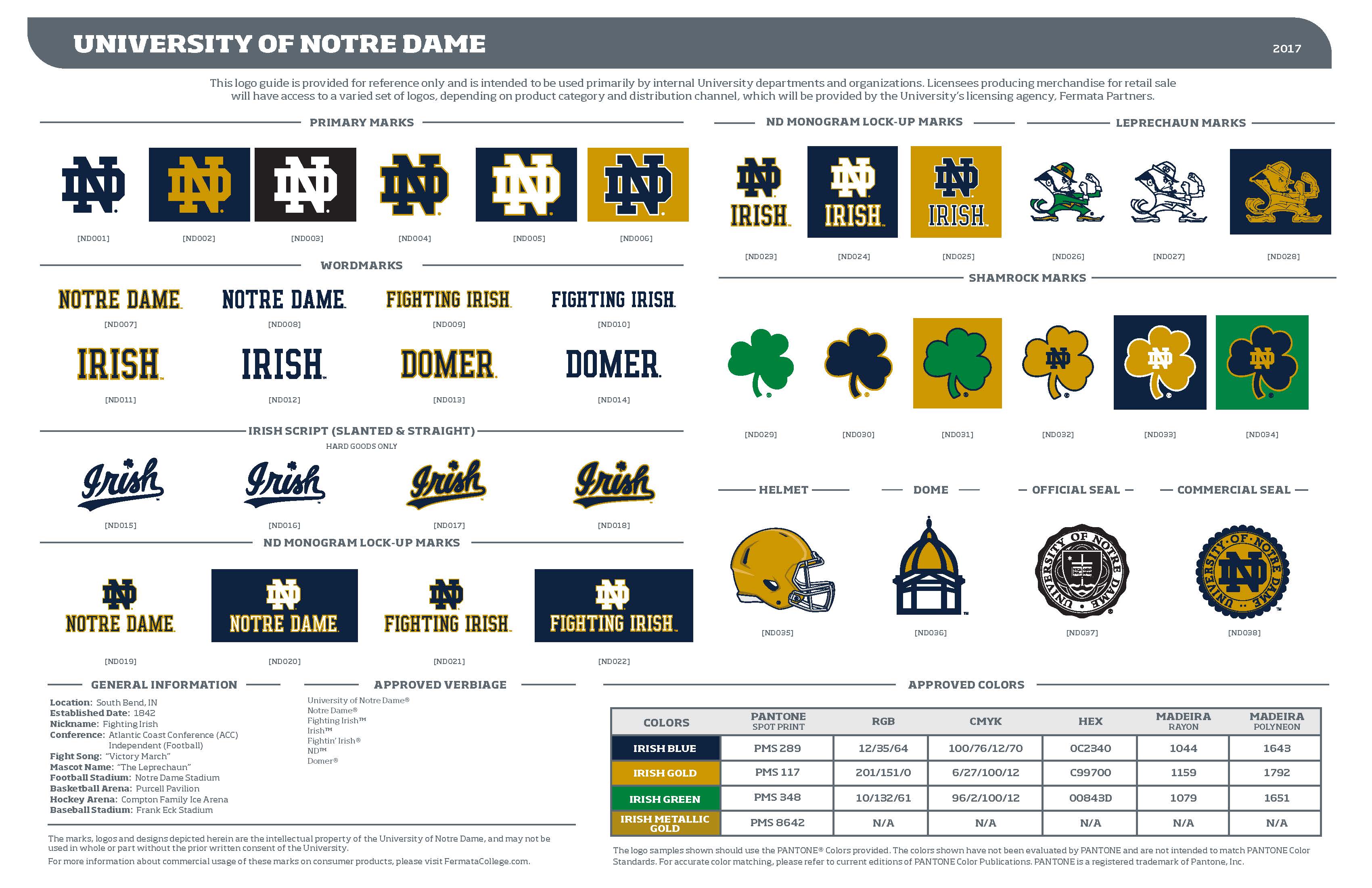
The playoffs were sort of ahead of their time in one respect, and credit must be given to the NHL front office for this innovation…In each round of the playoffs, teams were seeded according to regular-season records, so best played worst/second-best played second-worst, etc. This gave more weight to the regular season and continued to reward the teams with the better regular season records.

1974-75 playoff brackets, here.

In the Stanley Cup finals, the Philadelphia Flyers, coached by Fred Shero, led by gap-toothed scoring wizard Bobby Clarke, and muscled by a cast of goons who earned the name “The Broad Street Bullies“, beat the Buffalo Sabres, led by the “French Connection” scoring line of Rick Martin/Gil Perrault/Rene Robert, 4 games to 2. The Flyers, who would repeat as champions the following season (but have never won the Cup since) were the first modern-day expansion team to hoist Lord Stanley’s cup.

1974-75 NHL Expansion…

At this point in the history of the league, the NHL was in a war of escalation with the World Hockey Association, and that meant continued expansion in defiance of logic, and in defiance of the depleted talent pool.

So 1974-75 saw the NHL’s fourth expansion in 7 seasons, with the addition of the 11th and 12th expansion teams in that 7 year period…that made it 18 NHL teams, when there were just 6 teams 8 years previous. And because the WHA had 14 teams at this point, there were now 32 major league hockey teams in North America, where 8 years before there were just 6 teams. The quality of play obviously suffered, and this season saw the worst-ever record by a major professional hockey team, with the expansion Washington Capitals winning just 8 out of 80 games (with 5 ties), for 21 points. The other expansion team, the short-lived Kansas City Scouts, had a better showing on the ice, with 15 wins and 11 ties for 41 points, but this ill-conceived franchise had a much bigger problem. Very few people in western Missouri/eastern Kansas bothered to attend Scouts’ games. It’s pretty obvious that the NHL front office did very little in the way of, well, scouting out suitable expansion locations, because this part of the USA has never been even remotely close to being a hotbed for ice hockey. To show you how little interest there is in hockey in Kansas City, currently there is no minor league hockey team there (the last being the Kansas City Blades of the now-defunct IHL, who drew 5,235 per game in their last season in 2001-02), although there is a Central Hockey League team in Independence, Missouri, which is 18 km./11 miles south of Kansas City.

The Kansas City Scouts’ two seasons saw an average of 4,109 per game (the league average in the NHL in 1974-75 was 13,224 per game {see this, from Hockey Zone Plus.com}. The under-capitalized owners were forced to sell to a consortium in Denver, Colorado, and in 1976-77, the Scouts became the Colorado Rockies. That incarnation of the franchise would have similar problems, and the franchise only became viable when it moved east, in 1982, and became the New Jersey Devils.

The Washington Capitals had better financing, and, being situated on the southern edge of the chain of Northeast metro areas, were far better positioned to build a good fan base. The Capitals to this day have never won a Stanley Cup title (with one Stanley Cup finals appearance, in 1998), but are a strong NHL franchise that consistently sells out their arena (the Caps were one of the eleven NHL teams that played to 100% capacity last season), and have evolved into an exciting team that features one of the league’s superstars in the Russian left winger Alexander Ovechkin. Their biggest problem is that they are stuck in the NHL’s bogus Southeast Division, which, aside from the Washington Capitals (and arguably, the Carolina Hurricanes), is full of teams that never should have been created…the Florida Panthers, the Tampa Bay Lightning, and the Atlanta Thrashers. In the NHL, the Board of Governors has never learned the lessons of over-expanding.

It’s time for Canada to re-claim it’s rightful share of NHL teams

The fact is nothing has really changed in the NHL, and the top brass continues their pipe dream of establishing the NHL in places where there is no tradition of playing hockey or supporting an ice hockey team. So tens of thousands of potential season ticket holders in Canada go ignored, and the NHL is full of lame teams in the South or the Southwest that no one cares about, where attendances are even worse than the official attendance figures because the NHL pads the gate figures with thousands of free tickets per game. There are at least foure teams that should never have been created – the Phoenix Coyotes, the Florida Panthers, the Tampa Bay Lightning, and the Atlanta Thrashers. Now add the Columbus Blue Jackets to the list of failing new franchises. Columbus is a pretty small market to sustain a major league team (1.7 million, 32nd largest city in the USA), so it could be said that it was inevitable that, come an economic downturn, a team like this would suffer. Columbus, Ohio is part of a region in south-central Ohio that is pretty devoid of any ice hockey history. And, you know, it is not that uncommon to hear citizens of Columbus, Ohio that speak with a southern accent…it’s a city that is more a part of the region of the greater Ohio River Valley than the region of the Great Lakes-rim cities of the Rust Belt. Columbus only averages 29 inches of snow a year, and the average high and low temperatures in the coldest month, January, are only a high average of 36 degrees F/2.4 Celsius, and a low average of 20 degrees F/-6.5 Celsius, so you can see there could never really have been a tradition of kids playing ice hockey outdoors in Columbus…ponds and flooded park parking lots would keep melting even in the coldest part of the year, unlike in Detroit, Buffalo, southern Ontario, etc. {see this}. Also, consider that Columbus, Ohio’s most famous product is the Ohio State Buckeyes college football team, and Ohio State University boasts the largest campus in America. When you look at the the demographics and the schedules, it is college football (and to a lesser extent, college basketball) that is going to be the biggest impediment to the NHL extending their product into new markets with any success, especially since the NHL likes to choose as expansion locations mid-sized cities where no NBA team is (like San Jose, Columbus, Nashville, Tampa/St. Petersburg, Greensboro, St. Louis, Pittsburgh, and the 3 western Canadian teams). And college football is king in the South and the Southwest. College basketball is also pretty big in the Ohio Valley, and in case you’re wondering, Ohio State’s ice hockey team can also be seen to be eating into the Columbus Blue Jacket’s fan base (the Buckeyes ice hockey team averaged 3,096 per game in 2010…the 21st highest drawing program in NCAA hockey [Wisconsin was *1 again, see this pdf} . With very few exceptions, specifically the Dallas Stars, the Carolina Hurricanes, and the Nashville Predators, there will never be significant interest in major league ice hockey in the South and the Southwest.

Here's a concrete example of how little presence ice hockey has in the Southwest... from Arena Maps.com, the following link shows ice hockey arenas in the province of Manitoba, Canada, here [over 230 ice rinks in Manitoba].
This link shows ice hockey arenas in the far-more populated state of Arizona, here [20 ice rinks in Arizona}.

Where are the hard-core fans going to come from in Arizona when there is only 20 ice rinks in the whole state? Sure you are going to attract some casual fans, interested in the novelty of ice hockey in the desert, but they will by and large vanish when the economy falters and choices must be made about where someone's disposable income goes...and this is what's happening. NHL hockey games are not cheap, and good tickets are way above $100. If the team you are spending all that money on is doing bad, that 100 bucks or so you are dropping each time out gets old pretty fast. But Phoenix has a good team, so it's even worse than most examples of poor attendances in the recent past, by other NHL teams that are currently doing well. Because when teams like Pittsburgh, Buffalo, Vancouver, and Chicago were in trouble, those teams were also doing bad on the ice, and in some cases the arenas were inadequate (Vancouver especially), and in some cases the ownership was poor and alienated the fans (like in Chicago). But in those cases, bad teams precipitated poor attendances. Not so with Phoenix - the Coyotes had the 5th best record in the NHL last season, but still had the worst attendance at 11,989 {here are official 2009-10 NHL average attendance figures (as measured by tickets distributed by NHL teams), here}.

Teams like Phoenix and Atlanta and Columbus and the Islanders are getting 7,000-attendances for some games this season, and Phoenix is averaging 10,265 per game as of Nov. 18, 2010 - and remember, that's for tickets distributed, not tickets sold. Yes, the NHL's official statistics for attendances do not measure tickets sold. The figures don't even measure turnstile clicks, but rather tickets distributed. So in places like Phoenix, they are literally giving away tickets and still people won't attend. For many teams the attendance figures are hollow figures. It's the NHL's dirty little secret. And it's not like a couple hundred tickets per game, the give-away tickets very often number in the thousands per game...the poor-drawing teams are giving away, free, up to, and some times even more than 3,000 tickets per game. Often, this fact is not even brought up when poor hockey attendances are discussed, and it is all but impossible to find figures, in black and white, as to what extent free tickets are distributed in the NHL. But they were part of prospective (and continually rebuffed) would-be NHL owner Jim Balsillie's court filing in 2009... {see this post from June, 2009, from the From The Rink.com site - sorry for the tiny print in the figures, but hit the Shift and + keys a couple times to enlarge}. To save you the trouble of eye-strain, the photo of the list submitted to the court shows that the announced gates at Phoenix home games in 2008-09 averaged 3,923 higher than the turnstile count. So the low gate figures are even lower. In 2008-09, Phoenix was actually seeing 10,943 ticket holders pass through the turnstiles per game, not the "official" atendance average of 14,866. So now, 10,200 per game in Phoenix, is more like 7,000 paying customers (if that). By the way, I can't confirm this, but I have seen it posted on some hockey fan message boards that the lowest number of free tickets distributed are in Canada and specifically the western Canadian teams, especially Vancouver, and Calgary.

Go to hockey message boards {HF Boards.com/thread -Attendance Issues, part II, ~Nov. 7, 2010, here}, with discussions about falling attendances in places like Atlanta and Phoenix and you will get Atlanta Thrashers fans who insist it's because of lame ownership and "poor marketing". The fact is, hockey does not need to be "marketed" in Canada. People care about the sport and are willing to drop way more than $75 dollars a pop, several times a season, to support local NHL product. Contrast this with the South, the Southwest, and many places in the Midwest, even, where NHL hockey highlights, if shown at all, will be shown after local high school football highlights. And saying that there is great potential for major league hockey in the Greater Atlanta metro area because the nearby Gwinnett Gladiators draw over 7,000 per game in the ECHL (Gwinnett's peak crowds were actually at 5,656 per game in 2007-08,{see this}) does not prove that Atlanta can be a successful major league hockey town, because those tickets are far, far cheaper than NHL tickets. We're talking like 20 bucks for an ECHL game versus at least 50 and more like 75 bucks for an NHL game {$78 for OK seats in Atlanta, see this}. A family of four can have a night out at a minor league hockey game for around $100, versus more like $300 to $400 at an NHL game.

From NHL.FanHouse.com, November 9, 2010, by Alan Adams, 'Attendance Woes Just Won't Go Away for Sun Belt Teams'. The situation will not change until Gary Bettman is gone from the commissioner's seat. He is trying to gloss over the abject failure of NHL expansion into the Sunbelt, by propping up the Phoenix Coyotes, and preventing any talk of relocation of them, or of the other tepidly supported teams in Georgia and Florida. He thinks he is protecting his legacy, but he will only harm it more by basically betraying hockey fans. Why is it that these new teams are so crucial, but he did little if anything to save the Winnipeg Jets, the Quebec Nordiques, and the Hartford Whalers, all who moved to warm weather locales in the 1990s ? Because 2 of those 3 teams were based in mid-sized Canadian cities, and all 3 were teams in cold weather locations, and the NHL is primarily interested in expansion into warm weather areas...where very few people ever cared or ever will care about ice hockey. The NHL thinks it can create a coast to coast and north to south, continent-spanning league, that will generate vast sums in television contracts. In truth, ice hockey will always be a regional sport...but there is absolutely no shame in that. The NHL Board of Governors has been chasing this "major sport" illusion for over 40 years now, and have turned their backs on true hockey fans, and potential season ticket holders, in Canadian cities like Saskatoon, Saskatchewan; Winnipeg, Manitoba; Hamilton, Ontario; and Quebec City, Quebec.

"Can you imagine another industry which is of huge importance to Canadians, where Canadian consumers are being denied access to a product that they vigorously demand, all because of an anti-competitive agreement between 30 wealthy owners, 24 of whom are American?" -U.S. sports law professor Stephen Ross, of Penn State University, in this article by Dave Feschuk in the Star.com, from Sept. 12, 2009, here.
Canada is where ice hockey became a viable professional sport. Canada is where sizable bases of serious hockey fans are. What kind of patriots are these Canadian-born NHL owners and Canadian-born NHL Board of Governors? They have forsaken their fellow Canadians, and specifically Canadians who live in mid-sized cities who would jump at the chance to actively support new NHL teams. They have continued to reject James Balsillie's repeated attempts to relocate one of the failing US-based NHL teams to Hamilton, Ontario {see the following, 'NHL's ugly bid to beat Balsillie in Coyotes fray, more notes', by Jim Kelley at SportsIllustrated.CNN.com, August 27, 2009}. Why? The NHL can spin it any way they want, but it is because Hamilton is 57 km./35 miles away from Toronto...too close, they maintain, to the Toronto Maple Leafs and a threat to the Maple Leafs' fan base and franchise. Please. There are teams all over the world that are from cities or regions with similar or even smaller populations than Toronto (which has around 5.1 million people in the metro area, see this), who compete in the same leagues with other local rival teams, and they all are able to successfully draw fans...in association football [aka soccer]… cities from Glasgow in Scotland (approximately 1.16 million in the Greater Glasgow area), to Manchester (around 2.24 million in the Greater Manchester area) and Liverpool (around 1.37 million in the Liverpool urban area) in England, to Amsterdam/Rotterdam in the Netherlands (which are 55 km./34 miles apart and have combined metro populations of 1.5 million + 1.1 million= 2.6 million). ['List of largest United Kingdom settlements by population', from en.wikipedia.org; Netherland largest cities, from mongabay.com, here].

The football clubs in these cities…Celtic and Rangers in Glasgow; Manchester United and Manchester City in Manchester; Liverpool and Everton in Merseyside; and Ajax and Feyenoord in Holland… are all able to maintain high average attendances (all over 35,000 per game and in some cases, like Man U., of over 70,000 per game) over a slate of 20 to 30 home matches each season, even though another high drawing competitor also plays in their area. When you crunch the numbers, these football clubs are pulling in, in total accumulated attendance from home league matches, as much as or more than the highest drawing NHL teams. Example…Liverpool FC plays 19 Premier League home matches a season. They drew 42,864 per game in 2009-10. Everton FC, who play 3 miles away, drew 36,725 per game. 42,864 X 19 = 814,416 total accumulated attendance for Liverpool.; 36,725 x 19 = 697,775 total accumulated attendance for Everton.

That’s two teams in a city/metropolitan region less than half the size of Toronto, with an average total accumulated attendance in 2009-10 of 756,095. Toronto Maple Leafs played to 102.5% capacity in 2009-10, and averaged 19,260 per game, with an accumulated total attendance of 789,681 over 40 home games total {NHL 2009-10 attendances, from ESPN. here}.

So that’s almost exactly equal accumulated attendances, and remember, Liverpool is less than half the size of Toronto, and probably has even a smaller fraction of the total disposable income that Toronto citizens have. And still Liverpool is able to support 2 big teams. And I haven’t even factored in the populations of Hamilton (or Kitchener, for that matter), so there really is more like 6.1 million, not just the 5.1 million, in Toronto’s wider regional area (ie, the area which people could attend a hockey game by driving approximately one hour or less). And I haven’t even included other home matches Liverpool and Everton played in Cup competitions, so those accumulated attendance figures will surpass the Maple Leaf accumulated attendance figures…even if Toronto made the playoffs once in a while, thus adding more home dates. But that’s another problem when one team gets complacent because they play in a large sports market with no local rivals…they start to stagnate. And Toronto has not won a Stanley Cup title since the modern expansion era began in 1967-68. Coincidence ? Want another example of how a local rival breeds a more competitive atmosphere ? The New York Rangers, after winning 3 Stanley Cup titles in their first 14 seasons, did not win a Stanley Cup title during the 30 years they were the sole team in the New York/New Jersey metro area (1942 to 1972) [the Rangers, of course finally won another Stanley Cup title in 1994].

The Toronto Maple Leafs’ majority owner is the Ontario Teachers’ Pension Fund {see this}. The last thing a huge pension fund wants to do is invest with no guaranteed return, and that’s exactly what attempting to build a championship contender would entail. So the Maple Leafs are virtually institutionally guaranteed to not be successful on the ice. They play to a plus-100% capacity. They have got a sweet deal, without even having to bother to be competitive, and the Leafs suck most years. The Maple Leafs haven’t made the playoffs since 2003-04. Why would a pension fund want to invest in building a championship caliber team when there is no need (there is no relegation system like in European football), when they have basically got a license to print money – because that’s what owning the sole hockey franchise in the largest city in Canada, with no competition in the market, will get you – guaranteed sell outs, and you don’t even have to bother fielding a competitive squad.

The New York Rangers were coerced into allowing the New York Islanders into the league in 1972-73, and then a decade later those two teams were coerced into allowing a third team into the New York/New Jersey metro area, when the New Jersey Devils set up shop in 1982-83. Granted, New York City is larger than Toronto, but the Toronto-and-southern Ontario region could easily support another NHL team. After all, in 1974-75, the WHA’s Toronto Toros were drawing 10,436 per game when they rented out the Maple Leaf Gardens from the Maple Leafs, and the Toros got most of the bad nights…that is to say, very few high-attendance generating game dates like on the weekends [The NHL average in 1974-75 was 13,224 per game {1960-61 to 1998-99 NHL attendances, here}]. That Toros’ attendance avrerage of 10,436 might seem on the low side today, but it wasn’t a low figure 36 years ago for a rebel league… only one other WHA team besides the Toronto Toros ever had a higher-than-10,000 per game average attendance, and that was the Edmonton Oilers, who did it in 3 of the 7 WHA seasons. [WHA attendance figures at the left of the WHA map page, here.]
-
Thanks to Jersey Database.com site, for the 1974-75 jerseys, jerseydatabase.com/browse – hockey [click on team names, for each team's jersey fronts, which are shown on a new page, horizontally and in chronological order].
Thanks to the contributors to the pages at en.wikipedia.org, 1974-75 NHL season. 2010-11 NHL season.

November 15, 2010

National Hockey League. 1972-73 season, with the 2 expansion teams – the Atlanta Flames and the New York Islanders.

Filed under: Hockey,Hockey-NHL and expansion — admin @ 6:55 pm

NHL 1972-73 map.


1972-73 NHL season at en.wikipedia.org.
The 1972-73 National Hockey League season saw the NHL faced with rival-league competition for the first time since 1926 (when the original Western Hockey League had it’s final season). This competition came in the form of the World Hockey Association, which ended up playing 7 seasons before putting four franchises into the NHL in 1979-80. [My map and post on the World Hockey League can be seen here.] The NHL’s reaction to the upstart WHA went from indifference to mobilization pretty quickly, and a hastily-assembled expansion was put forward to block the WHA from establishing teams in Long Island, New York, and in Atlanta, Georgia. So the New York Islanders and the Atlanta Flames joined the NHL, making it a 16-team league. Then players started bolting from the NHL to the WHA, and the big losers included the NY Islanders who lost 11 players to the WHA (!), and the California Golden Seals, who lost 8 players. I find it very significant that many players back then would rather risk their careers to play in the very unstable and unproven WHA than in the long-established NHL on ersatz hockey clubs like the Golden Seals.
-
Montreal Canadians were champions in 1972-73, beating the Chicago Black Hawks 4 games to 2 in the 1973 Stanley Cup finals {playoff bracket, here}. This season and the next (1973-74) were the last seasons the NHL utilized a two-division format (a two-division format existed in the NHL from 1926-27 to 1937-38, and from 1967-68 to 1973-74). In 1974-75, yet another two teams joined the league and 4 divisions were created. That will be elaborated on in my next NHL and Expansion post, on Thursday.

Thanks to the contributors to the pages at en.wikipedia.org, 2010-11 NHL season.
Thanks to NHL.com/shop, NHL Jerseys.
Thanks to Jersey Database site, where I got the 1972-73 jerseys, Jersey Database/Hockey

September 25, 2010

Canadian Hockey League, with all WHL, OHL, and QMJHL teams (60 teams); reigning champions listed; and 2009-10 attendances.

Filed under: Canada,Hockey — admin @ 4:17 pm

canadian-hockey-league_whl_ohl_qmjhl_post_2e.gif

Canadian Hockey League


[Note: if you want to see my maps of the OHL, WHL, and QMJHL from 2008, click on the Category 'Canada'.]
I made this map because a viewer asked for a map of all 3 CHL leagues on one map, here (40th comment). At first, I didn’t think I would be able to fit in team logos, because there are so many teams in a relatively small area in southern Ontario Province. I solved that problem by including an enlarged map segment of that region at the lower left of the map page. In the OHL banner there, you will see a tiny black dot under the OHL league logo. That is a puck, and if you click-to-enlarge exactly on that little puck you will get an enlarged screen which shows all OHL team names and all OHL team logos in one screen. You can get a similar effect for the other 2 leagues by going back to the full-screen map page, then simultaneously hiiting the Ctrl key and the + key six times. That will enlarge the main map page so that you can see all WHL team names/logos in one screen (at far top left), and all QMJHL teams/logos (at far top right).

The Canadian Hockey League is an umbrella-organization for the 3 Canadian major junior hockey leagues, the Western Hockey League (WHL), the Ontario Hockey League (OHL), and the Quebec Major Junior Hockey League (QMJHL). The leagues are the top echelon of junior hockey on Canada and are for players aged 16 to 20 years old (there can exceptions made for young phenoms being allowed to play, but this has happened just once since the CHL implemented the 16 year old minimum-age rule a few years ago…that player was New York Islander and 2009 #1 draftee John Tavares, who was allowed to play when he was 15). Each team has a European player allotment of 2 players. [see this: {Junior hockey page from en.wikipedia.org}].There are 60 teams in the CHL, with 22 teams in the WHL, 20 teams in the OHL, and 18 teams in the QMJHL.

There are 51 Canadian-based teams in the CHL, and 9 teams in the CHL that are based in the United States. The 5 American-based teams in the WHL are from Everett, Washington; Seattle, Washington; Kennewick/Pasco/Richland, Washington; Spokane, Washington; and Portland, Oregon. The 3 American-based teams in the OHL are from Saginaw, Michigan; Plymouth Township, Michigan; and Erie, Pennsylvania. The one American-based team in the QMJHL is from Lewiston, Maine.

There is no inter-league play between the 3 leagues except for the Memorial Cup competition, which is played each May at a different site, and is a round robin tournament made up of the 3 league champions and a fourth team which is the team from the host city. In 2010, Brandon, Manitoba was the host city, meaning that the Brandon Wheat Kings squared off against the WHL-champion Calgary Hitmen, the OHL-champion Windsor Spitfires, and the QMJHL-champion Moncton Wildcats. In the final, Windsor demolished Brandon 9 to 1, and so the Windsor Spitfires were Memorial Cup winners for the second straight season.

One player on that twice-champion Windsor team was the #1 pick in the 2010 NHL Draft, Kingston, Ontario-born LW Taylor Hall, who was selected by the Edmonton Oilers. [2010 NHL Entry Draft, here (en.wikipedia.org).]

So I know a few of you are asking, “what do CHL players get paid?”. Well, they get paid a per deim, or basically meal money, which amounts to around $70 to $100 a week; and the families that some players are staying at [ie, being billeted at] get a little money. And, significantly, the players get full college scholarships to Canadian universities (players get a year’s tuition paid for each season they play in the CHL). The NCAA considers the CHL a “pro league”, so players have to decide at a pretty young age (14-15 years old) if they are going to play in the NCAA hockey system or the Candadian Hockey League. Because if they play in the CHL and then decide they do want to play in American college hockey, they will not be allowed to get a scholarship, because the NCAA considers that miniscule meal money to be payment as a professional. From this thread at the HF Boards, it is evident that some of the top prospects in the CHL are getting more than that meal money, though, and are being paid under the table {see entries 11 through 16, here, at ‘How much do juniors make in OHL, etc?’ thread from May, 2008 @ hfboards.com}. Entry #13 names names, and of the 5 OHL teams that the poster names, London, Kitchener, Windsor, Brampton, and Ottawa, four of those teams are in the top eight highest-drawing teams in the CHL (Brampton is the exception). So you can see how luring top-shelf players with some under the table payments has become a part of some higher-drawing teams’ business strategy. Why it isn’t being punished might be explained by the following link below.

There might be a reason all this under-the-table paying of exceptional players is being turned a blind eye by Canadian authorities…and that is the fact that the major junior leagues in Canada are competing with American universities for players. See this article from the PipelineShow.blogspot.com, from December 15, 2009, by Dean Willard, ‘[Executive Director with College Hockey, Inc.'s] Paul Kelly: CHL teams are paying players under the table‘. Kelly accuses CHL teams of targeting American players for the under the table pay arrangements.

I got the 2009-10 attendance figures from this site, http://www.mib.org/~lennier/hockey/ (Han’s Hornstein’s Hockey Attendance, Schedules, and Standings Pages).
Thanks to the contributors to the pages at en.wikipedia.org, Canadian Hockey League.
Official site, http;//www.chl.ca
Western Hockey League, http://www.whl.ca/
Ontario Hockey League, http://www.ontariohockeyleague.com/
Ligue de Hockey Junior Majeur du Québec [Quebec Major Junior Hockey League], http://www.lhjmq.qc.ca/

February 7, 2010

The World Hockey Association, 1972-73 to 1978-79: map of all 26 teams, with attendance figures and notes.

Filed under: Hockey,Hockey-NHL and expansion,Hockey-WHA — admin @ 12:31 pm

wha_1972-79map-w-jerseys_post_2b.gif


The World Hockey Association was a professional ice hockey league that operated for 7 seasons in the 1970s.  It was a rival league to the National Hockey League that was ultimately successful in that it put four of it’s teams into the NHL in 1979.  Those four franchises still operate in the NHL,  although only one,  the Edmonton Oilers,  have remained in the same city since it’s WHA days. 

The other three WHA teams that joined the NHL in 1979-80 were the New England Whalers,  the Quebec Nordiques,  and the Winnipeg Jets.  The Quebec Nordiques played 16 seasons in the NHL before moving in 1995 to Denver, Colorado, USA,  as the Colorado Avalanche.  The Winnipeg Jets played 17 seasons in the NHL before also moving across the border (in 1996),  to Phoenix, Arizona,  as the Phoenix Coyotes.  The New England Whalers changed their name to the Hartford Whalers when they entered the NHL in 1979.  The Whalers played 18 seasons in the NHL before they moved south to North Carolina,  in 1997,  as the Carolina Hurricanes.

-

The WHA was founded by sports promoters Dennis Murphy and Gary Davidson,  who had been co-founders of the American Basketball Association (1967-1976),  which challenged the National Basketball Association and eventually put 4 ABA teams in the NBA.

In 1971,  the World Hockey Association was established,  and began laying the groundwork for it’s first season,  which would be in 1972-73,  with 12 teams:  4 in Canada and 8 in the USA.  The 12 teams that began play in 1972-73 were…Eastern Division:  Cleveland CrusadersNew England Whalers New York Raiders,  Ottawa Nationals,  Philadelphia Blazers,  Quebec Nordiques.      Western Division:  Alberta Oilers, Chicago Cougars,  Houston Aeros,  Los Angeles Sharks,  Minnesota Fighting Saints,  Winnipeg Jets.  8 teams would make the playoffs and compete for the Avco Cup. 

67 NHL players jumped to the WHA in the WHA’s first season.  The move that gave the new league instant credibilty was the signing of Chicago Black Hawks’ superstar Bobby Hull by the Winnipeg Jets.  Hull was lured by the then-unheard of sum $1 million,  which he received as a signing bonus (Hull earned $250,000 per year on top of that).  Hull went on to be a two-time WHA MVP,  scoring 77 goals in one season (1974-75).  In a four-season period between 1974 and 1978,  Hull’s teaming with Swedish linemates Anders Hedberg and Ulf Nilsson led the Winnipeg Jets to the first two of the team’s three Avco Cup titles. 

wha_winnipeg-jets_bobby-hull_anders-hedberg_ulf-nilsson_b.gif

-

Before the first season began,  in 1972,  other WHA teams used a similar strategy of luring an NHL star or two to build a team around.  The Philadelphia Blazers had goalie Bernie Parent,  who they’d snatched from the Toronto Maple Leafs,  and former Boston Bruins defenseman Derek Sanderson.  The Cleveland Crusaders signed Boston Bruins goaltending star Gerry Cheevers.  The Quebec Nordiques signed defenseman  JC Tremblay,  who’d bolted from the Montreal Canadiens.  The New England Whalers stole defenseman Ted Green from the Boston Bruins.  Green would captain the Whalers to the league’s first championship in 1972-73.

The NHL responded to all the incursions by the upstart WHA teams in two ways,  by litigation (all of which failed to get their players back) and by blocking the WHA from forming teams in arenas,  such as the newly built Nassau Coliseum in Long Island, New York.  There,  the NHL hastily assembled the expansion New York Islanders to play in 1972-73.  The WHA’s New York Raiders were forced to rent Madison Square Garden on onerous terms which they could not keep up with due to lackluster attendance.  The New York Raiders changed their name to the New York Golden Blades in 1973-74,  then moved to south New Jersey halfway through the season,  becoming the New Jersey Knights.  The Knights played in a dilapidated 4,000 seat areana that had a slope in the ice that caused pucks to shoot up in the air.  The franchise moved again,  this time across the country to San Diego,  where they became the San Diego Mariners,  who lasted for three seasons as a competitive hockey club that drew around 6,000 per game. 

The Houston Aeros got off to a rocky first season,  then set about trying to find a marquee name to draw the spotlight.  They came up with a promotional coup that in the end won them two championships.  The Aeros persuaded NHL legend Gordie Howe to come out of retirement as a 45-year old and play with his two sons,  Mark and Marty.  Some felt this was just a cheap stunt to draw attention to the novelty of an ice hockey team in the Sunbelt,  but no one was criticizing the Houston Aeros after the team won the Avco Cup in the first two seasons the Howe family played for them (1973-74 and 1974-75). 

wha_gordie-howe_mark-howe_marty-howe_houston-aeros_new-england-whalers_hartford-whalers_nhl_.gif
Gordie Howe scored 100 points his first season back,  winning the 1973-74 MVP.  Mark Howe won Rookie of the Year that season.  The Aeros repeated as champions in 1974-75,  then moved into the swank new Houston Summit,  where they became one of the top 3 draws in the league,  averaging 9,180 per game in 1975-76.  But in 1976-77,  the three Howes opted to sign with the New England Whalers.  The Houston Aeros folded after the 1977-78 season,  a year before the WHA did.  Once it became known that the NHL wasn’t interested in a team in Houston,  management cut their losses and did not play in the final WHA season of 1978-79. 

-

Circa 1973-76,  in Toronto,  the Maple Leaf Gardens and Toronto Maple Leafs’ owner Howard Ballard did everything in his power to make life difficult for the WHA’s Toronto Toros,  starting with charging an exhorbitant rent and including dimming the lights during Toros games,  preventing the Toros from using the Leafs’ locker room,  and taking away club house seat cushions.  The Toros actually drew pretty well,  averaging over 10,000 per game in 1974-75.  And the Toros got back at Ballard by stealing some of his players,  like Frank Mahovlich and Paul Henderson.  But two years later the Toronto Toros gave up trying to compete with the Maple Leafs and moved to Birmingham, Alabama as the Birmingham Bulls,  where they lasted until the end of the WHA in 1979,  drawing over 8,000 in 1976-77 and 1977-78.  The 1977-78 Bulls were maybe the largest collection of bruisers and goons ever assembled on a major league hockey team, including Steve Durbano and Dave Hanson.  The Bulls management had got to understand the Birmingham fan base after 2 seasons there,  and what those fans wanted there (in the Deep South which had no hockey tradition) was fights,  and lots of them. In the book “Rebel League”, by Ed Willes, veteran sportswriter Al Strachan recalls going to a game during the 1977-78 season in Birmingham, when the Bulls hosted the New England Whalers. After the Star Spangled Banner and ‘Dixie’ were played, a priest blessed the players. About 4 minutes into the game, the fans started chanting “Bring in the goons, bring in the goons.” So Bulls coach Glen Sonmor sent in a line featuring three toughs including Gilles “Bad News” Bilodeau. Bilodeua immediately jumped the Whalers Mark Howe. The next shift, Dave Hanson started another fight. The crowd went wild. So this was essentially the routine for hockey night in Birmingham.

Another team with a pugilistic legacy was the aptly named Minnesota Fighting Saints.  The Fighting Saints had the Carlson brothers,  three big shaggy enforcers who wore dorky black plastic rimmed glasses while terrorizing opponents on the ice, and relaxed by playing slot-cars in their free time.  If this all seems familiar,  that’s because the Carlson brothers (particularly Jack Carlson) were the prototype for the characters of the Hanson brothers in one of the greatest sports movies ever made,  Slap Shot  (1977),   which starred Paul Newman (and two of the three Carlsons) {see this, ‘Slap Shot’ (film), at en.wikipedia.org}.  Right before he began his big-league career with the Fighting Saints,  Jack Carlson had played for the minor-league Johnstown (Pennsylvania) Jets in 1974-75,  and was a teammate of Ned Dowd,  whose sister Nancy Dowd wrote the screenplay for the film. 

wha_minnesota-fighting-saints_mike-walton_jack-carlson_steve-carlson_jeff-carlson_aka-hanson-brothers_.gif

The Minnesota Fighting Saints best moment was when they made it to the semi-finals of the Avco Cup playoffs for the second straight season in 1974-75,  selling out the 16,000-capacity St. Paul Civic Center for some thrilling games versus the high-flying Quebec Nordiques.  But the Fighting Saints could not compete in the crowded Minneapolis-St. Paul market with the NHL’s Minnesota North Stars,  in spite of having attendances in the top 5 of the WHA (their best was 8,410 per game in ’74-75).  The Fighting Saints could not meet payroll for much of the 1975-76 season, and did not last the season.  The following season,  1976-77,  the Cleveland Crusaders then moved to Minnesota as the reborn Minnesota Fighting Saints (with red and yellow instead of blue and yellow uniforms),  but this team also could not last the season.

That was part of another instance of the NHL making a franchise move in response to the WHA..  The weakest NHL team,  the California Golden Seals,  moved to Cleveland, Ohio as the Cleveland Barons after the 1975-76 season.  The somewhat successful WHA team the Cleveland Crusaders chose not to compete directly with an NHL team for fans in Cleveland and promptly moved to Minnesota as the second incarnation of the Minnesota Fighting Saints (where they had to compete with the Minnesota North Stars,  but go figure;  they obviously felt that Minnesota was a better market for two ice hockey teams than northeast Ohio).  The Cleveland Barons were dissolved in 1978 (as the last NHL team to fold),  while the second Fighting Saints did not last the 1976-77 season.

-

While the WHA saw relatively successful franchises being built in Edmonton,  Winnipeg,  Houston,  Quebec,  and Hartford (New England),  all of the other WHA teams were on shaky ground.  But in spite of this,  the WHA expanded to 14 teams in 1974-75.  [And insanely,  the WHA also added 2 more expansion teams the following season in 1975-76:  the Cincinnati Stingers (1975-1979),  and the short-lived Denver Spurs (who folded before the end of their first season)] .  The new teams in 1974-75 were the Indianapolis Racers and the Phoenix Roadrunners.  Indianapolis drew well,  with averages of 7,900;  8, 700;  and 9,200 in their first three seasons.  The Indianapolis Racers lasted until early in the final WHA season of 1978-79.  The hockey club is now best known as the first pro team Wayne Gretzky played on,  in 1978,  when Gretzky was a 17-year old (and ineligible to play in the NHL).  The Phoenix Roadrunners lasted three seasons in the WHA,  with their highest average gate in their first season,  when they drew 7,400 per game.  Their star was Robbie Ftorek,  whose MVP season in 1976-77 was still not enough to keep the team from folding.

-

wha_quebec-nordiques_jc-tremblay_marc-tardiff_serge-bernier_real-cloutier-_.gif

-

Of their time in the WHA,  the Edmonton Oilers only won one playoff series,  and that was in the final season of 1978-79.  In the first 4 seasons,  the team pretty much was a perpetual .500 percentage club run by tireless promoter Bill L. Hunter,  who despite his lack of hockey coaching acumen would perenially step in and replace the coach midway through the season…this happened in 1972-73,  1974-75,  and 1975-76.  The city of Edmonton had begun building a new hockey arena in 1973,  with the hopes of attracting an NHL team,  and the Oilers began playing at the Northlands Coliseum in November, 1974.  Their gates,  previously hampered by the small arena the team originally played in (see below),  shot up to the top of the league in 1974-75.  They drew 10,722 in 1974-75.  The club was still mediocre,  though,  but the arrival of two individuals would soon change that:  Glen Sather and Wayne Gretzky…

wha_alberta-oilers_edmonton-oilers_edmonton-gardens_al-hamilton_northlands-coliseum_rexall-place_glen-sather_wayne-gretzky_indianapolis-racers_si-cover1984_.gif

-

In all,  26 teams played in the World Hockey Association.  7 seasons were played,  with the Winnipeg Jets winning 3 Avco Cup titles,  the Houston Aeros winning 2 Avco Cup titles,  and the New England Whalers and the Quebec Nordiques winning 1 Avco Cup title each. 

The WHA effectively refuted the NHL’s postiion that there weren’t more than 3 cities in Canada capable of supporting a major league hockey team.  The fact that 2 of those 3 Canadian WHA teams that made it into the NHL in 1979 were eventually moved to American cities doesn’t diminish the WHA’s importance to Canadian hockey fans.  Had the WHA never existed,  it is doubtful that the NHL would have ever put a team in Calgary in 1980 (thus making road trips to Edmonton that much more economical) or put a team back in Ottawa in 1992.  And it is very doubtful the NHL woukd have ever put a team in Edmonton,  whose Oilers went on to win 4 Stanley Cup titles in 5 years from 1984 to 1990.  The WHA also is important for opening the door to European players,  which in turn had a big influence in changing the game to the swift,  skills-oriented passing game it is today. 

And finally,  the WHA is important to hockey players for challenging and legally removing the NHL’s reserve clause which (illegally) restricted hockey players’ rights and abilty to seek employment elsewhere when their contracts ended,  thus allowing pro hockey players the chance to realize previously unheard of earning potential. 

-

I recommend this site for further info on the late great WHA… http://www.whahockey.tv/ .   There is lots of old video from WHA games here.

Here is but one,  of New England Whaler Tom Webster scoring two sweet goals {click here}.

This one is not from that site,  but I decided to end with this… ‘WHA Hockey’- Fights and Fashion’ (7:13),  posted by galaxycorps,  on Youtube {click here}.

-

Thanks to the contributors to the pages at en.wikipedia.org {click here}.   Thanks to WHA Uniforms.com,  for jerseys {click here}.   Thanks to Super 70s.com,  for attendance figures {click here}.   Thanks to Chris Creamer’s Sports Logos Page {click here}.   Thanks to WHA San Diego Mariners site {click here}.   Thanks to Winnipeg Jets Online.com {click here}.   Thanks to Joe Pelletier’s Greatest Hockey Legends site {Glen Sather page, here}.

Thanks to  WHAhockey.com {click here},  for some of the photos,  and for some of the facts.

Thanks to Ed Willes,  for his book on the WHA…‘Rebel League, the short and unruly life of the World Hockey Association’,  published by McLelland & Stewart, Toronto, 2004  {at Amazon,  here}.

Older Posts »

Powered by WordPress