billsportsmaps.com

May 29, 2014

2014 FIFA World Cup teams: Spain (UEFA), prominent players in 2014 FIFA World Cup Qualifying (theoretical best XI for Spain, with 8 other player-options listed).

Filed under: Spain — admin @ 5:26 pm


Spain national team. UEFA (Europe). Nickname: La Roja (the Red [One]). Home jersey: red, with gold and dark blue trim.
2014 FIFA World Cup qualification: 14th qualification out of 19 tries (1930, did not enter). Spain has qualified for the World Cup in: 1934, 1950, 1962, 1966, 1978, 1982, 1986, 1990, 1994, 1998, 2002, 2006, 2010, 2014.
Previous WC finish:
2010, Champions (6-0-1).
Highest WC finish: 2010.

Population of Spain: 46.7 million {2013 estimate}.
Capital and largest city: Madrid, metro area pop. 6.3 million {2013 est.}.

-Spain coach, Vicente del Bosque. Vicente del Bosque.
-Spain squad captain, Iker Casillas (Real Madrid). Iker Casillas.

From The Guardian, from 31 May 2014, ‘World Cup 2014: Fernando Torres and Juan Mata in Spain’s finals squad • Diego Costa retains place despite injury worries • Álvaro Negredo and Jesús Navas among those left out‘ (theguardian.com/football).

Below: Theoretical Best XI for Spain (with 8 other player-options further below) -
spain_2014-fifa-world-cup_squad_best-xi_alternate-options_v-del-bosque_v_.gif
Photo and Image credits above -
Spain 2014 home jersey badge, photo from aliexpress.com.
Spain 2014 home jersey, photo from citysports.com/adidas-2014-Spain-Home-Jersey.
Spain/EU map, by HansenBCN Miguillen at ‘File:Spain 2 location map.svg‘ (commons.wikipedia.org).
Map of Autonomous communities of Spain, at en.wikipedia.org/wiki/Autonomous_communities_of_Spain.
Coach,
Vicente del Bosque, photo by Laurence Griffiths/Getty Images Europe via zimbio.com.
Goalkeeper,
Iker Casillas (Real Madrid), photo by Claudio Villa/Getty Images Europe via zimbio.com.
Defenders,
Sergio Ramos (Real Madrid), photo by Juan Manuel Serrano Arce/Getty Images Europe via zimbio.com.
Raúl Albiol (Napoli), photo by AP/La Presse via it.eurosport.yahoo.com.
Gerard Piqué (Barcelona), photo by Denis Doyle/Getty Images Europe via zimbio.com.
Jordi Alba (Barcelona), photo by Stanley Chou/Getty Images AsiaPac via zimbio.com.
Midfielders,
Xavi (Barcelona), photo from fcbarcelona.com/xavi-hernandez-makes-450th-league-appearance.
Sergio Busquets (Barcelona), photo from fcbarcelona.com/sergio-busquets-makes-150th-liga-appearance-with-barca.
Andrés Iniesta MF/AM (Barcelona), photo by Getty Images via bbc.com/sport/football.
Forward/Wingers,
Pedro RW/LW (Barcelona), photo by Alex Caparros/Getty Images Europe via zimbio.com.
David Villa CF (New York City FC), photo by Gonzalo Arroyo Moreno/Getty Images Europe via zimbio.com.
David Silva AM/LW/RW (Manchester City), photo by Kieran McManus/ISIPhotos.com via soccerbyives.net.
Other player-options,
Juan Mata AM/W (Manchester United), photo unattributed at independent.co.uk/sport/football.
Diego Costa CF (Atlético Madrid), photo by Carlos Delgado at ‘File:Diego Costa – 01.jpg‘ (en.wikipedia.org).
Cesc Fàbregas (Barcelona), photo by David Ramos/Getty Images Europe via zimbio.com.
Koke AM/W (Atlético Madrid), photo by Carlos Delgado at ‘File:Koke Resurrección – 01.jpg‘ (en.wikipedia.org).
Juanfran RB/RM (Atlético Madrid), photo by Carlos Delgado at ‘File:Juanfran Torres – 03.jpg‘ (en.wikipedia.org).
Javi Martínez DM/CB (Bayern Munich), photo unattributed at goal.com.
Santi Cazorla LW/AM/RW (Arsenal), photo by Richard Heathcote/Getty Images Europe via zimbio.com.
César Azpilicueta LB/RB/RM (Chelsea), photo unattributed at upload.wikimedia.org/wikipedia/commons/5/5d/C%C3%A9sar_Azpilicueta_Chelsea_vs_AS-Roma_10AUG2013.jpg.
Xabi Alonso (Real Madrid), photo by Angel Martinez via mirror.co.uk/sport/football.
Fernando Torres FW (Chelsea), photo by Py21 at ‘en.wikipedia.org/wiki/Fernando_Torres#mediaviewer/File:TorresFinale12_cropped.jpg‘.

___
Thanks to the contributors at ‘2014 FIFA World Cup qualification‘ (en.wikipedia.org).
Thanks to the contributors at ‘Spain national football team‘ (en.wikipedia.org).
Thanks to http://www.transfermarkt.com/en/, for player-position details.
Thanks to Soccerway.com, for recent squad line-ups (with positions-on-the-field graphics), at int.soccerway.com/international/europe/wc-qualifying-europe/2014-brazil/1st-round/r15653/.

October 24, 2013

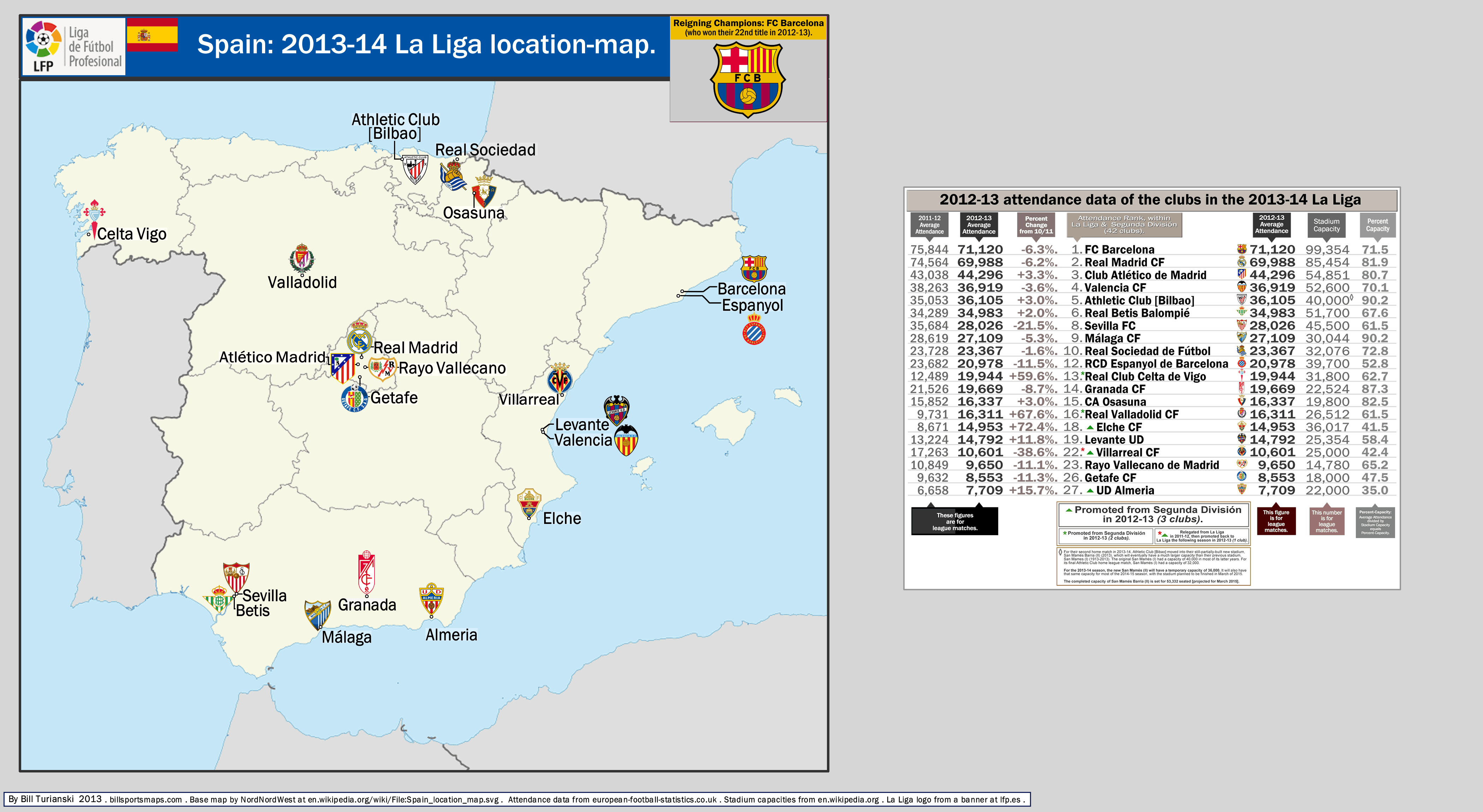
Spain: 2013-14 La Liga location-map, with 2012-13 attendance data. / Plus, the new stadium of Athletic Club [Bilbao], San Mamés Barria. / Plus, photos of top 3 scorers & the top 3 on the assists table (after 9 games).

Filed under: Spain — admin @ 4:26 pm

2013-14_spain_la-liga_map_attendances_post_b.gif
Spain: 2013-14 La Liga Location-map, with 2012-13 attendance data


Note: to see my latest map-&-post of Spanish football, click on the following, category: Spain.

The following link shows 2 pie-charts which reveal one of the primary causes of the pronounced duopoly in Spanish football. In other words, there are several reasons why Real Madrid and FC Barcelona dominate La Liga to such an extent, but uneven distribution of television revenue is at the top of the list of causes for this disparity. A disparity, which, when combined with the absolutely dreadful economy in Spain, threatens the viability of first division Spanish football. From Imgur, ‘How TV money is shared in Spain and in England [2012 figures/illustration unattributred]‘ (imgur.com/vTZ9B5f).

The record for most wins to start a Spanish first division season was set by Real Madrid, with 9 straight wins to open the 1968-69 La Liga season (Real Madrid won the title that season of 1968-69 by 19 points over second-place finishers UD las Palmas). This season [2013-14], both FC Barcelona and Atlético Madrid started the season 8 and 0. Then both teams stumbled in the 9th week, with Barcelona being held scoreless for the first time in the league in two years (64 league games), by drawing 0-0 away to Osasuna; and with Atlético Madrid falling 1-0 away to Espanyol. Meanwhile, Real Madrid were 2-0 winners at home versus Málaga. So that leaves Real Madrid within just 3 points of Barcelona in first. Now on Saturday, 26 October 2013, FC Barcelona will host Real Madrid in the 167th league meeting between the two clubs. The derby match, the Spanish derby, is of course called El Clásico. In the league games between the two biggest and most successful clubs in Spain, Real Madrid (with 32 Spanish titles) have won 70, and Barcelona (with 22 Spanish titles) have won 64, and there have been 22 draws. Last season, in October 2012, there was a 2–2 draw in the first El Clásico at Nou Camp in Barcelona; then in Madrid in March 2013 at the Bernebeau, Real beat Barça 2-1, although Barcelona was in firm control of first place by that time (and Barcelona eventually went on to win the 2012-13 La Liga title by 15 points).
El Clásico‘ (en.wikipedia.org).

From Guardian.com/football, ‘El Clásico: Sid Lowe on the Barcelona v Real Madrid rivalry – video‘ [4:57 video hosted by Amy Lawrence] (theguardian.com/football/video/).

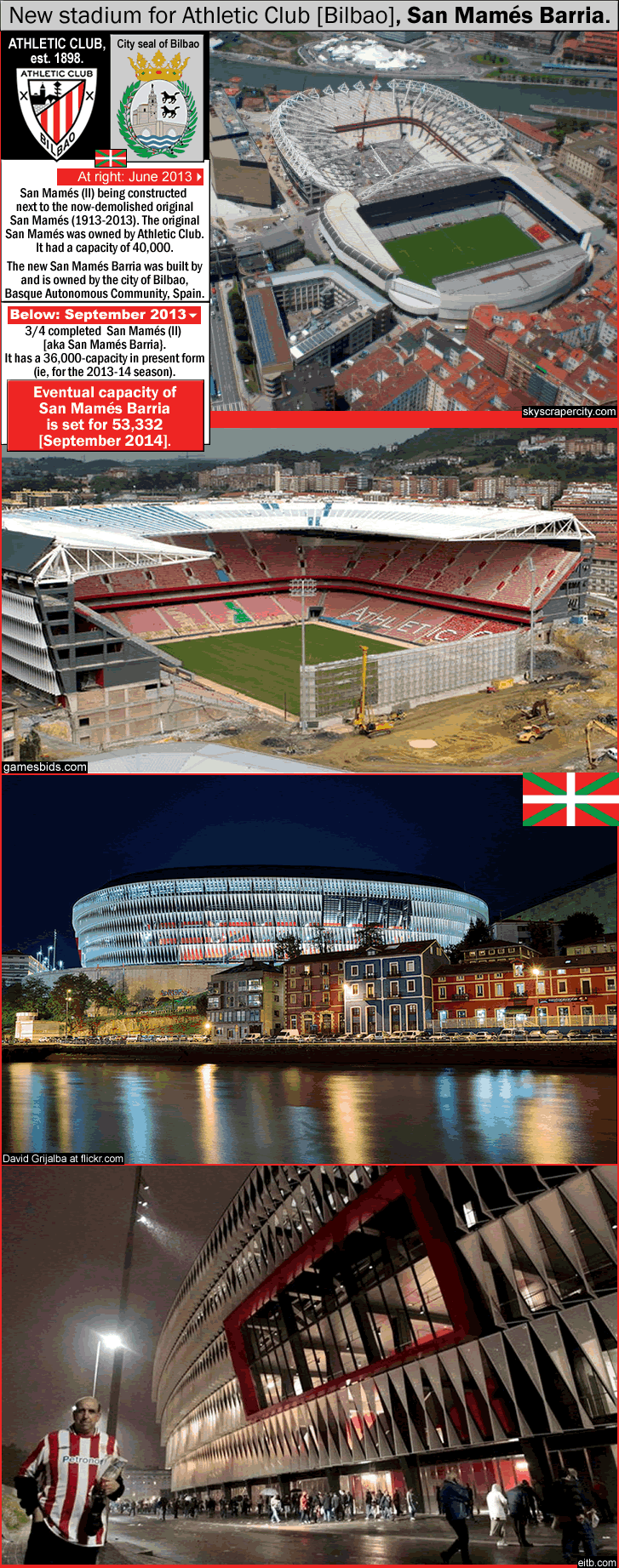
    New stadium in Bilbao, San Mamés Barria, opened September 2013 (still only partially constructed, and at 3-quarters capacity). Current capacity: 36,500. Eventual capacity [with full-stadium completion projected for September 2014]: 53,332 all-seated. Owner: city of Bilbao, Basque Country, Spain.

athletic-club-bilbao_new_estadio_san-mames-barria_opened-2013_e.gif
Photo credits above -
Photo of construction at San Mamés from June 2013 uploaded by master_klon at skyscrapercity.com/thread, BILBAO – San Mamés Barria.
Photo of stadium from Sept.2013 (showing un-constructed section and interior of the constructed sections, from gamesbids.com/forums.
Exterior photo of San Mamés Barria, at water-side by David Grijalba at flickr.com.
Exterior street-view photo of San Mamés Barria, from ‘GALERÍA DE FOTOS: EL ATHLETIC NO FALLA EN LA INAUGURACIÓN‘ (eitb.com).

From WSC.co.uk, from 5 Nov. 2013, by Antonio Mateo, ‘Diego Costa a “traitor” for choosing Spain over Brazil – Striker won’t represent hosts at World Cup‘ (wsc.co.uk).

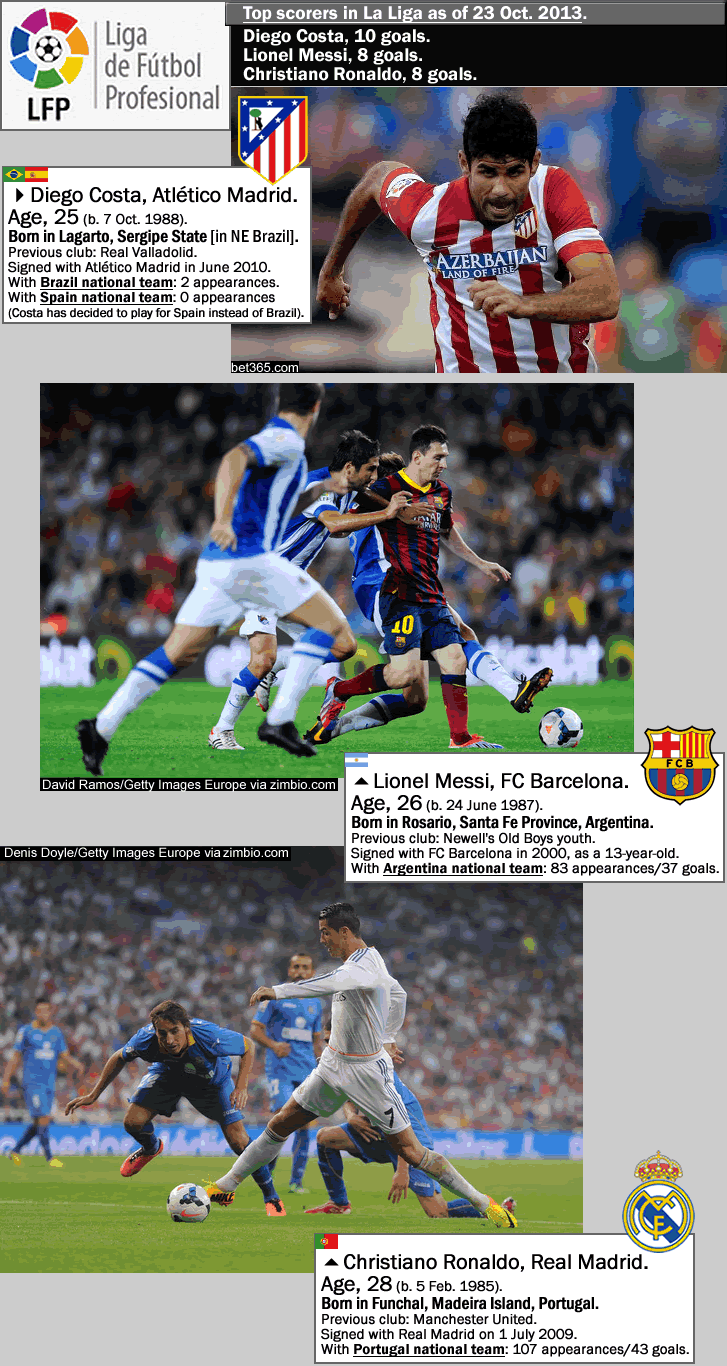
Top scorers in La Liga as of 23 Oct. 2013…
Diego Costa (Atlético Madrid), 10 goals.
Lionel Messi (Barcelona), 8 goals.
Christiano Ronaldo (Real Madrid), 8 goals.
spain_la-liga_2013-14_top-scorers_as-of-24-october-2013_d-costa_l-messi_c-ronaldo_h.gif
Photo and Image credits above –
LFP logo, from a banner at http://www.lfp.es/.
D. Costa, bet365.com.
L. Messi, David Ramos/Getty Images Europe via zimbio.com.
C. Ronaldo, Denis Doyle/Getty Images Europe via zimbio.com.
Pedro, kicksocca.com.

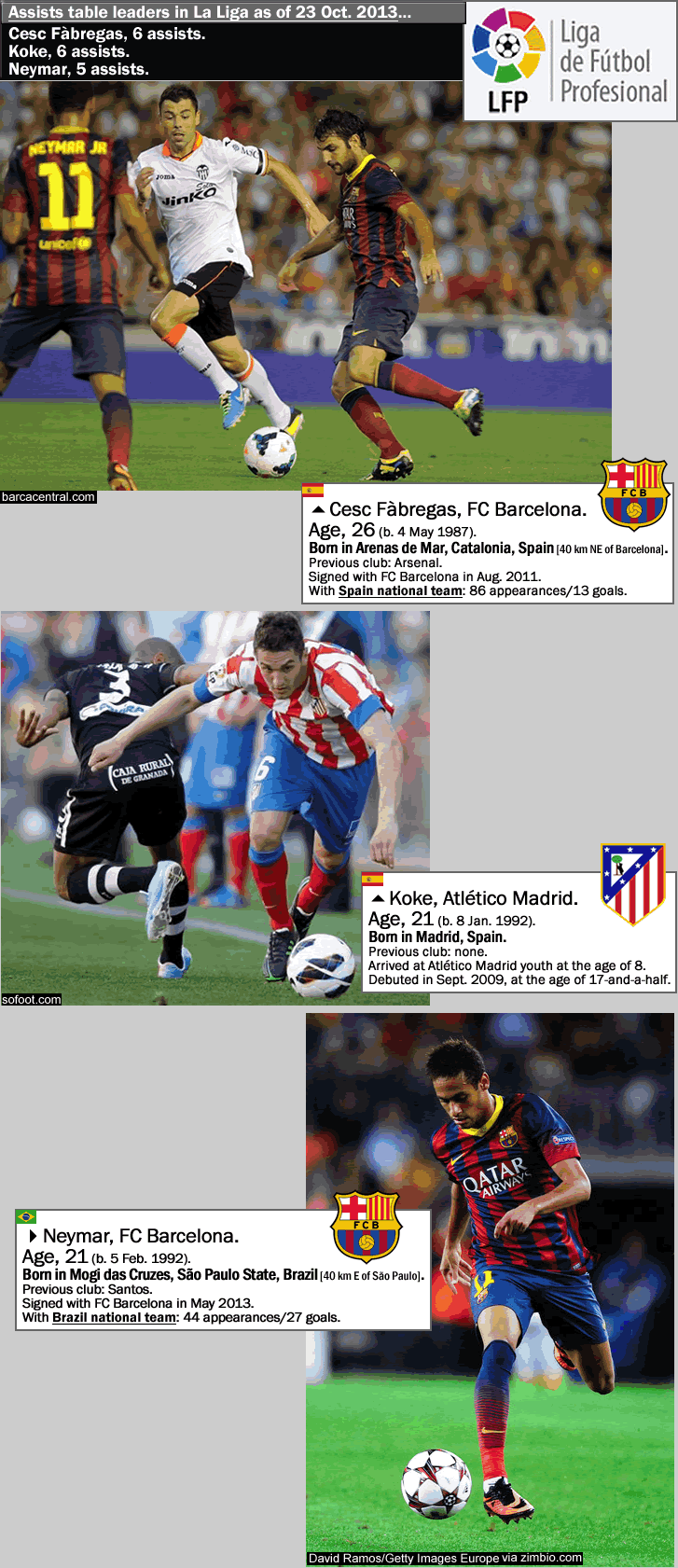
Assists table leaders in La Liga as of 23 Oct. 2013…
Cesc Fàbregas (Barcelona), 6 assists.
Koke (Atlético Madrid), 6 assists.
Neymar (Barcelona), 5 assists.
http://billsportsmaps.com/wp-content/uploads/2013/10/spain_la-liga_2013-14_assists-table-leaders_as-of-24-october-2013_c-fabregas_koke_neymar_d.gif
Photo and Image credits above –
LFP logo, from a banner at http://www.lfp.es/.
C. Fàbregas, barcacentral.com.
Koke, sofoot.com.
Neymar, David Ramos/Getty Images Europe via zimbio.com.
___

Thanks to footiemap.com/madrid.
Thanks to official La Liga site for LFP logo, from a banner at http://www.lfp.es/.
Thanks to the contributors to the pages at en.wikipedia.org, ‘2013–14 La Liga‘;
and at es.wikipedia.org, ‘Primera División de España 2013/14‘.
Thanks to NordNordWest at en.wikipedia.org, for the blank map of Spain, http://en.wikipedia.org/wiki/File:Spain_location_map.svg.

August 15, 2012

Spain: La Liga 2012-13 – Top of the Table chart, featuring 2011-12 La Liga champions Real Madrid / Plus 2012-13 La Liga Location-map, with 2011-12 attendance data.

Filed under: Football Stadia,Spain — admin @ 12:06 pm
    Real Madrid – champions of Spain for the 32nd time

real-madrid_2011-12champions_la-liga_.segment_.gif
Segment of photo of Real Madrid 2011-12 home jersey (above) from beautifulgear.com/2011/06/adidas-201112-adidas-home-kit.


Note: to see my latest post on Spanish football, click on the following, category: Spain.

From guardian.co.uk/Football, from 25 May 2012, by Sid Lowe. ‘It’s the Sids 2012! The complete review of the La Liga season – From an epic two-horse race to the joy of Levante, it’s time for the annual end-of-season Spanish football awards‘.

    Spanish clubs playing in Europe for 2012-13 -
    Real Madrid CF, FC Barcelona, Valencia CF, Málaga CF, Atlético Madrid, Levante UD, Athletic Club [Bilbao]


Champions League icon from iconarchive.com.

    Location-map of 2012-13 La Liga, with attendance data from 2011-12

2012-13_la-liga_location-map_2011-12attendance_segment_.gif
[Note: Attendance figures and stadium capacities are from soccerway.com {soccerway.com/La Liga, 2011-12}.]
Thanks to NordNordWest at en.wikipedia.org, for the blank map of Spain, http://en.wikipedia.org/wiki/File:Spain_location_map.svg.
___
Photo and Image credits on the chart page –
Team celebration – Fireworks above Bernebéuu, and Sergio Ramos & team captain Iker Casilas with trophy: both photos unattributed at 7msport.com.
Manager -
Jose Mourinho, photo by Denis Doyle at Getty Images Europe via zimbio.com.
Players-
Christiano Ronaldo, photo by Denis Doyle/Getty Images Europe via zimbio.com.
Gonzalo Higuaín, photo by Denis Doyle/Getty Images Europe via zimbio.com.
Karim Benzema, photo by Addesolen at en.wikipedia.org/wiki/File:Karim_Benzema.
Mesut Özil, unattribured photo from dailymail.co.uk/sport/football.
Angel di Maria, photo by Hrvoje Polan/AFP/Getty Images via bloomberg.com.
Xabi Alonso, photo by Matthew Lewis/Getty Images Europe via zimbio.com.

Estadio Santiago Bernebéu – Aerial photo of Estadio Santiago Bernebéu in the Chamartin district of the city of Madrid by Cisco Pics at flickr.com. Screenshot of image of interior of the Bernebéu from realmadrid.com/Stadium_Tour [video]. Aerial photo of Estadio Santiago Bernebéu [unattributed] from insidersmadrid.com/real-madrid-tours.

Other clubs on the chart -
Barcelona/ Nou Camp – Photo of ‘Mes Que Un Club’ ['More Than A Club'] tifo at Nou Camp [unattributed] from iplot.typepad.com/iplot/joga_bonito/. Interior photo of Nou Camp by MichaelMalin at de.wikipedia.org. Aerial Satellite image of Nou Camp from bing.com/maps/Bird’s Eye satellite view.

Valencia/ Mestalla – Photo of Valencia fans [unattributed] from, PatCrerand.co.uk. Photo of Mestalla at sunset [unattributed] from, EUtravelpictures.com. Aerial photo of Mestalla from Rudsoccer.com.

Málaga/ La Rosaleda (The Rose Garden) – Photo of Málaga fans [unattributed] from oleole.com. Interior photo of La Rosaleda by Morancio at commons.wikimedia.org. Aerial photo of La Rosaleda [unattributed] from estadiosdeespana.blogspot.com.

Atlético Madrid/ Estadio Vicente Calderón – Photo of Atlético Madrid fans [unattributed] from marca.com via fanoffutebol.blogspot.com. Interior photo of Estadio Vicente Calderon by FDV at es.wikipedia.org. Aerial image of Estadio Vicente Calderón from Peñatleticaniano.es, here.

Levante/ Estadi Ciutat de València – Photo of Levante fans with balloons [unattributed] from infodeportes.com/futbol/equipo/levanteud. Interior photo of Estadi Ciutat de Valencia by Iñaki Lasa Rodriguez at panoramio.com. Aerial photo of Estadi Ciutat de València [unattributed] from losgranota.com.

Athletic Bilbao/ San Mamés – Photo of Athletic Club Bilbao-supporter-group Albertzale Sur with banners and Basque flags from forums.pesfans.com [two-thirds of the way down the page there]. Photo of interior of San Mamés by bcfcdavepics at photobucket.com. Photo of exterior of San Mamés from adjacent rooftop by kammourewa at photobucket.com.

August 21, 2011

Spain: the 3 promoted clubs from Segunda División to La Liga for the 2011-12 season.

Filed under: Spain — admin @ 2:58 pm

promoted_spain_june2011_post_b.gif
The 3 promoted clubs in La Liga


La Liga players, and Segunda División players, have gone on strike – from Guardian.co.uk, from 19 Aug., by Sid Lowe, ‘Strike brings pain to Spain over players’ demand for emergency fund – La Liga faces prolonged shutdown while players’ union fights for a guarantee that protects all unpaid wages‘.

Some 200 players in La Liga and Segunda División are owed around 43 million Euros in back salary (!) {see this article, from the Rob Train blog at ESPN Soccernet, from 21 Aug., ‘Player strike delays La Liga season‘}.
[editor's note: the strike lasted just one week.]

Real Betis returns to La Liga after a 2-season spell back in the Segunda División. Betis had previously been in the second tier in 2000-01. Real Betis Balompié S.A.D were formed in 1907. The Seville club, with a fan base large enough to average around 38,000 per game in good seasons, has spent 46 seasons in the first division; the 2011-12 La Liga season, whenever it begins, will be Betis’ 47th season in the top flight. Seville, the 4th largest city in Spain, has a city population of around 704,000 and a metro-area population of around 1.5 million {2010 figures}. Real Betis won the 1934-35 La Liga season, for the club’s sole national title. That team was managed by the Irish international Patrick O’Connell. O’Connell had guided Betis out of the second division in 1932. Their 1935 championship came on the final day of the season, when they beat Santander and pipped Real Madrid by 1 point for the crown in the then-twelve-team-league. O’Connell left the next season to manage Barcelona. Betis have won 2 Copa del Rey – in 1977 and 2005. Betis’ 1977 cup win was over Athletic Bilbao, and needed 21 penalties and an 8-7 tally to decide the 2-2 match. Betis’ 2005 cup win saw them beat Osasuna 2-1 in aet. Betis play in the 52,000-capacity Estadio Benito Villamarín. [It is significant that while Betis play in stadium with a larger capacity than local rivals Sevilla FC (who play at the 48,500-capacity Estadio Ramón Sánchez Pizjuán), Sevilla have outdrawn Betis every season since 2002-03. Sevilla's highest crowds in the last decade were in 2006-07, when they drew 43,632 per game; while Betis' highest crowds in the last decade were also in 06/07, when they drew 38,737.] Betis averaged 31,095 per game last season, which is a huge figure for the Spanish second division, where often, no team draws over 20,000 per game, and where very few clubs can draw even 15,000 per game. Betis play in green-and-white vertically-striped jerseys – green and white are the colors of the flag of the Autonomous Community of Andalusia. Betis’ green is usually a lighter shade of green than the Andalusian flag, although this season [2011-12], Betis have an alternate kit that includes a jersey in a darker shade of green – see this from FootballFashion.org).

Rayo Vallecano are the self-styled left-wing football club of Madrid. Rayo Vallecano de Madrid, S.A.D. were formed in 1924. The team plays in white jerseys with a red sash. They play in the three-sided Estadio de Vallecas, which has a capacity of 15,500. The ground is in the working-class neighborhood of Vallecas, in the south-east of Madrid, 9 metro stops and 15 minutes south of the Sol station in the center of Madrid [Madrid has a city population of around 3.2 million and a metro-area population of around 6.4 million {2010 figures}]. Rayo Vallecano have spent 11 seasons in La Liga; 2011-12 will be the club’s 12th season in the top flight. Their last spell in the top tier was a 4-season stint from 1999-2000 to 2002-03 that included the club’s best-ever finish (of 9th place in 1999-2000), and a UEFA Cup run that saw them reach the 2000-01 UEFA Cup quarterfinals (going out to the Basque side Deportivo Alavés). Rayo Vallecano’s relegation in 2003 was just the start of their troubles, and another relegation in 2004-05 saw Rayo Vallecano stuck in the third division, in Segunda División B. Rayo returned to the second division in 2008. The club had financial problems for years, but the situation got worse when, during Rayo Vallecano’s promotion-run last season, the squad was only sporadically being paid – like, circa March 2011, only twice in the past 9 months. [Note - this is an example of the main reason why players in Spain in the top two divisions have gone on strike.] The owner, Jose Maria Ruiz Mateos, had previous as a tax cheat and spent time in prison for that a few years earlier. He’s the sort of businessman that did quite well when Franco was in power, and supported the status quo back then. His politics are lovely, too, with him giving lavishly to the creepy far right-wing Opus Dei organization. [What a great businessman this guy is...he's a right winger who buys the most left-wing football club in the country. That's a like an Israeli consortium buying a hog farm.] By early in 2011, his holding company was in financial crisis, and for pretty much all season long, the players were not being paid. In March, Ruiz Matos’ wife, Maria Teresa Rivero, who was the figurehead at the top of the club, accused the players of not trying, after a 4-1 loss to a basement club. That’s some pretty twisted moral values right there – criticizing the commitment of your players whom you have been failing to pay. Next thing you know there’s fan demonstrations outside the owners’ domicile, and even player protests prior to match kick-offs. {See this article, from When Saturday Comes site, from 4 March 2011, by Huw Richards, ‘Rayo Vallecano held back by their owners‘.} Well, the good news is that that owner and his charming wife, after 20 years, are now gone. The new owner is a local businessman, Raúl Martín, age 36, who made his money in the printing industry. The bad news is that Rayo Vallecano are now in administration. Being in administration in Spain is not necessarily as onerous as it is in England, because there are never any points deductions that accompany going-into-administration, like in England. However, with administrators now trying to force a 70%-pay-cut on the players, it looks like even more players are set to walk. From the FiveInMidfield.com site, from 19 June 2011, ‘Rayo Vallecano reach La Liga after tumultuous period of absence‘.

Granada CF wouldn’t be back in La Liga after a 35-year spell in the lower leagues without the support of Serie A club Udinese. 12 players on loan from Udinese contributed to Granada’s second-straight promotion in 2010-11, and several of those Udinese loanees were starters for Granada. In fact, a Udinese loan player, the Nigerian FW Odion Ighalo, was responsible for the goal that got Granada promoted, in the play-off finals versus Elche. And the fourth-highest scorer in Segunda División last season, the Swiss-born/ethnic Spaniard Alexandre Geijo (who netted 24 times last season), was and still is also on loan from Udinese to Granada. All this was the result of Granada president Quique Pina, who was a player agent in Italy and whose previous job was with Udinese Calcio. Udinese have a rather small fan base that produces crowds of only around 17,000 per game, and this club from the north-east of Italy survives in the Italian top flight by eventually selling off a good portion of the talent they develop. So it’s a win-win situation that circumvents the no-promotions-allowed-for-B-teams rule, by Udinese essentially having their B team in another country. Udinese have also given financial support to Granada. Granada CF are from Granada, in the south of Spain in Andalusia, about 50 km. (30 miles) from the coast, and 212 km. (132 miles) east of Seville. The city of Granada has a population of around 237,000 {2007 figure}. Granada is at the confluence of 3 rivers at the foot of the Sierra Nevada mountain chain. The city of Granada is 738 meters (2,421 feet) above sea level. The Moorish palace and fortress and present-day museum and tourist-mecca the Alhambra, built in the 14th Century, is in Granada. Granada CF plays at the smart and compact, small-yet-still-three-tiered Estadio Nuevo Los Cármenes, which has a capacity of 22,890 (but the stadium had been restricted to a 16,212 capacity while Granada was in the lower divisions). Granada drew 14,143 per game last season. Granada CF has a distinctive, narrow, shield-shaped crest in red and white, with angular and stylized G-C-F initials; and the team plays in red-and-white hooped jerseys and blue pants. Granada have spent 17 seasons in La Liga, and when the 2011-12 La Liga season gets underway, it will be Granada’s 18th season in the top flight. Granada Club de Fútbol were formed somewhat later than the bulk of top-division clubs in Spain, in 1931. It only took the club a decade to make it to the top flight – Granada made it’s first division debut in 1941-42. Granada’s most successful era was in the 1970s, with 8 seasons in La Liga then, including two 6th-place-finishes – in 1971-72 and 1973-74, which are Granada’s highest finishes.

Photo credits -
Rayo Vallecano…Aerial image of stadium [formely called Estadio Teresa Rivero] now called Estadio de Vallecas from bing.com/maps/Bird’s Eye satellite view, here. 4 interior photos of Estadio de Vallecas from DiarosDeFutbol.com, ‘Vuestros estadios: Estadio Teresa River (Vallecas, Madrid)‘.

Real Betis…Aerial photo of stadium [formerly called Estadio Manuel Ruiz de Lopera] now called Estadio Benito Villamarín] by PrishtinaLund at Flickr.com, here. Exterior photo of stadium with houses in the foreground by nosbigdivad at Flickr.com, here. Exterior photo of stadium by Gregory Zeier at en.wikipedia.org, here. Interior photo ofstadium by hombre at WprldFootball.net, here.

Granada…Aerial image of Estadio Nuevo Los Cármenes from Bing.com/maps/Bird’s Eye satellite view, here. Panoramic image of Estadio Nuevo Los Cármenes from ImageShack.us, here. Photo during a match at Estadio Nuevo Los Cármenes by Lanadahlauts at Flickr.com, here.

Thanks to E-F-S site, for attendances.
Thanks to the contributors to the pages at en.wikipedia.org, ‘2011-12 La Liga‘.
Thanks to Demis.nl for the base map of Spain, Demis Web Map Server.

July 26, 2011

Spain: final table of 2010-11, with clubs playing in Europe in UEFA competitions for 2011-12 / Plus, map with location of clubs in 2011-12 La Liga, with attendance data.

Filed under: Football Stadia,Spain — admin @ 8:45 pm

2011-12_la-liga_clubs-in-europe_fc-barcelona-segment_m.gif
Spanish clubs playing in Europe


Note: to see my latest post on Spanish football, click on the following, category: Spain.

The first chart (click on image above) shows the 7 Spanish clubs who qualified for Europe for 2011-12, including the 3 clubs which have qualified for the 2011-12 UEFA Champions League Group Stage – FC Barcelona, Real Madrid CF, and Valencia CF.
The 6 Barcelona/Real Madrid match-ups this past season produced reams of headlines, and lots of histrionics…and in the end, Real Madrid – on paper – ended up 4 points shy of the Spanish title. But the actual gulf between Barcelona and Real Madrid is probably better depicted by the 5-0 trashing that Barça gave Real Madrid in November at Camp Nou. And sure, in the Spanish Cup competition, Real did eliminate Barça and then go on to win the Copa del Rey, but that’s the same trophy (with about the value of the English League Cup) that Real Madrid could have cared less about winning 5 or 10 or 15 years ago (it was Real Madrid’s first Copa del Rey title in 18 years).

At the top, left of the chart you can see photos and stats of the 7 Barcelona players most responsible for Barça’s offensive mastery and domination in both Spain and Europe – midfield general Xavi, greatest-player-on-Earth Lionel Messi, young phenom Pedro, attacking defender Dani Alves, scoring machine David Villa, midfield wizard Andrés Iniesta, and young talent Bojan Krkić [note: Roma purchased Bojan Krkić on 22 July for 12 milion Euros].. Manager Pep Guardiola is shown being tossed up into the air in celebration [I know, the photo is from 3 seasons ago, but I think the image really symbolizes FCB's über-champion-status these last few seasons].

That the cash-strapped Valencia were still able to win an automatic Champions League Group Stage berth is pretty impressive. So too is Villarreal’s return to the Champions League format. Villarreal proved that a club can have a long Europa League campaign and not see their domestic form suffer. El Submarino Amarillo (The Yellow Submarines), from a town of 51,000, made it all the way to the Europa League Semi-finals last season, yet were still able to keep hold of 4th place in La Liga, and that fourth CL spot. And thanks to past Champions League accomplishments (including being 2005-06 CL Semi-finalists and 2008-09 CL Quarter-finalists), Villarreal, and not Udinese, are a seeded team in the Play-off round draw, which will be on 5 August {see this}.

The 3 Spanish clubs that will be in the Europa League format are three clubs that all finished with 58 points – Sevilla FC, Athletic Club [Bilbao], and Club Atlético de Madrid [La Liga does not use goal difference as the first tie-breaker in the final standings, but rather head-to-head results]. Here is the list, which includes Sevilla and Bilbao, of teams that have qualified so far for the Europa League play-off round {see this}. Before that, Atlético Madrid must play in the Europa League Third qualifying round (1st Legs are on 28 July), and here are the match-ups – ‘2011-12 UEFA Europa League/Third qualifying round‘. Atlético Madrid will face the Norwegian club Strømsgodset IF.

[Note: to see a larger image of Sevilla FC's Art Deco mosaic at Estadio Ramón Sanchez Pizjúan, scroll down to the Sevilla section in the Photo credits below...]

Below is the second chart, which features a location-map of the 20 clubs that will be playing in the 2011-12 La Liga, as well as attendance data of these clubs from last season – including average attendance (home league matches), percent-capacity, and percentage-change in attendance from 2009-10.

2011-12_la-liga_attendance-data_location-map_segment_k.gif

_

Photo credits -
Barcelona
Photo of Xavi by Manuel Queimadelos Alonso/Getty Images Europe via Zimbio.com, here. Photo of Lionel Messi by Jasper Juinen/Getty Images Europe via Zimbio.com, here.
Interior photo of Camp Nou from ontd-football.livejournal.com/, here. Photo of Pedro by David Ramos/Getty Images Europe via Zimbio.com, here.
Photo of Dani Alves from Goalstage.com, here. Photo of David Villa by Manuel Queimadelos Alonso/Getty Images Europe via Zimbio.com, here. Photo of Andrés Iniesta by David Ramos/Getty Images Europe via Zimbio.com, here. Bojan Krkic photo from FCBarcelona.com/Photo Gallery, here.
New Barça jersey [2011-12 home jersey] from store.Nike.com.
Photo of Pep Guardioa being tossed airborne by Barça players by Tony Gentile/Reuters, here.
Aerial image of Camp Nou from Bing.com/maps/Bird’s Eye satellite view, here.

Real Madrid
Photo of Ultras Sur (far right-wing Real Madrid supporter-group) with flags and banners was unattributed at Taringa.net, here. Exterior photo of Estadio Santiago Bernebeu was unattributed from TheOffside.com, here. Aerial photo of Estadio Santiago Bernebeu from RealMadridVideos.wordpress.com, here.

Valencia
Photo of Valencia fans from PatCrerand.co.uk, here. Photo of Mestalla at sunset from EUtravelpictures.com, here. Aerial photo of Mestalla from Rudsoccer.om, here.

Villarreal...
Interior photo of El Madrigal from VillarrealCF.es, here. Close-up-aerial photo of El Madrigal from VillarrealCF.es, here. Aerial photo of El Madrigal from FussballTempel.net, here.

Sevilla
Photo of interior of Estadio Rámon Sánchez Pizjuán by inkboo at Flickr.com, here. Photo of mosaic on exterior wall of Estadio Ramón Sánchez Pizjuán by Paco Alfaro at Flickr.com, here. Aerial image of Estadio Ramón Sanchez Pizjuan [with view to the east] from Bing.com/maps/Bird’s Eye satellite view, here.
[Note: you can see a larger size image of the Sevilla FC mosaic by clicking here (photo by Paco Alfaro @ Flickr.com, here).

Athletic Bilbao...
Photo of Athletic Club Bilbao-supporter-group Albertzale Sur with banners and Basque flags from forums.PESfans.com, here [2/3 of way down page]. Photo of exterior of San Mamés from adjacent rooftop by kammourewa at Photobucket.com, here. Aerial image of San Mamés from Bing.com/maps/Bird’s Eye satellite view, here.

Atlético Madrid
Photo of Atlético Madrid fans from LiverpoolSite.com, here. Interior photo of Estadio Vicente Calderon by FDV at es.wikipedia.org, here. Aerial image of Estadio Vicente Calderón from Peñatleticaniano.es, here.

Thanks to the contributors to the pages at en.wikipedia.org, ‘La Liga‘.
Thanks to E-F-S site, for attendances.
Thanks to Demis.nl for the base map of Spain, from Demis Web Map Server.
Thanks to FCBarcelona.com/Squad, for stats.

August 27, 2010

Spain: La Liga, 2010-11 season – Stadia map.

Filed under: Football Stadia,Spain — admin @ 6:17 pm


spain2010-11_post.gif


Note: to see my latest post on Spanish football, click on the following, category: Spain.

The 2010-11 season of La Liga begins on 28th August. Reigning champions are FC Barcelona. Copa del Rey [aka King's Cup] holders are Sevilla FC.

The map page features a photo of each club’s stadium; each club’s 2010-11 kits; each club’s major domestic titles; and the list of 2009-10 average attendances [domestic leagues] of the 20 clubs.

Thanks to the contributors to the pages at en.wikipedia.org and es.wikipedia.org. 2010-11 La Liga.
Primera División de España 2010/11.

Thanks to Bing.com/maps [Bird's Eye view] (link goes to Barcelona/Camp Nou photo), Thanks to futbolmania.wordpress.com (Deportivo La Coruña / Riazor photo).

Thanks to gijondesdeelaire.com(Sporting Gijón / El Molinón photo). Thanks to webdelracing.com [translated] (Racing Santander / El Sardinero photo).

Thanks to MiAthletic.com [translated] (Athletic [Bilbao] / San Mames photo)]. Thanks to estadioanoeta.com (Real Sociedad / Anoeta photo).

Thanks to www.ticket4football.com (Osasuna / Reyna de Navarra photo). Thanks to frikfootball at Flickr.com Zaragoza / La Romareda photo).

Thanks to the comprehensive Spanish football database, BD Futbol.com, www.bdfutbol.com (Espanyol / Estadi Cornelia-El Prat, Mallorca / ONO Estadi and Villarreal / El Madrigal photos).

Thanks to EA UK Community, forums.electronicarts.co.uk (Valencia / Mestalla photo). Thanks to the XV Mediterannean Games [2005] site (Almería / Estadio del Mediterráneo photo). Thanks to losbuquerones.com (Málaga / La Rosaleda [aka the Rose Garden] photo).

Thanks to MagicKiko at www.cochonero.com (Atlético Madrid / Estadio Vicente Calderón photo). Thanks to webrealmadrid.com (Real Madrid / Estadio Santiago Bernebéu photo) [this page is cool because it shows the 5 earlier crests of Real Madrid].

July 27, 2010

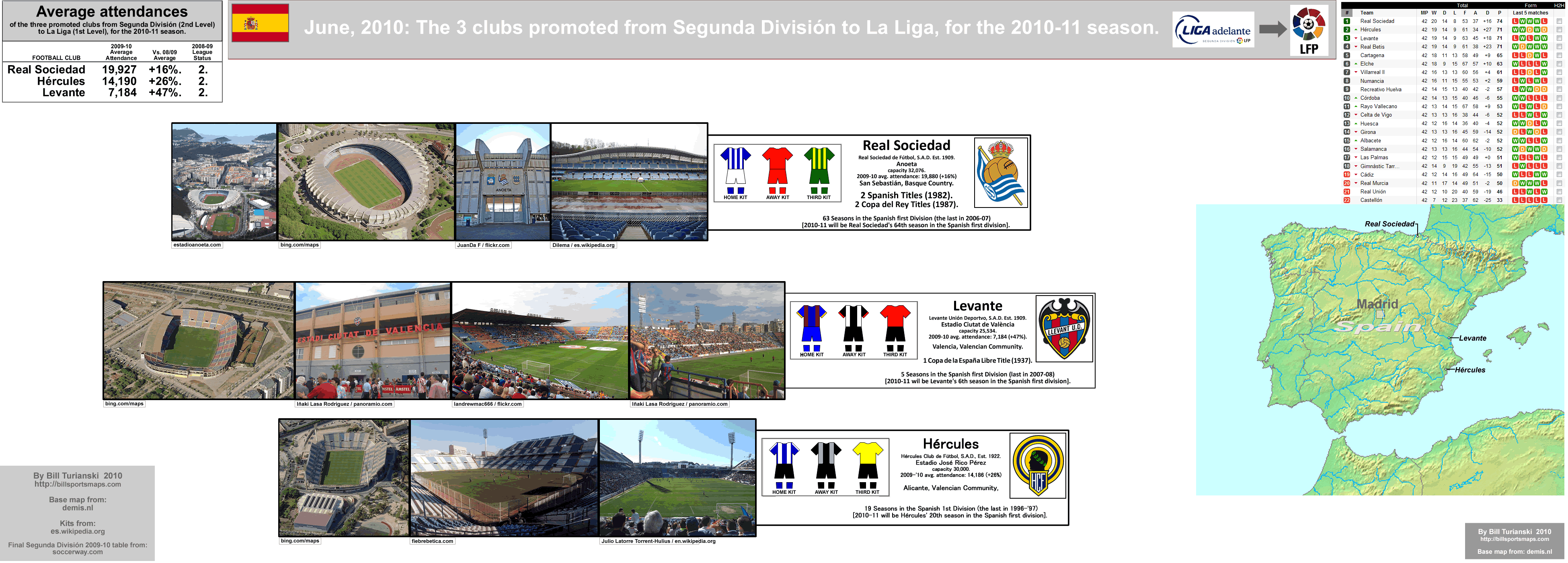
Spain: the 3 promoted clubs from Segunda División to La Liga, for the 2010-11 season.

Filed under: Football Stadia,Spain — admin @ 6:28 pm

http://billsportsmaps.com/wp-content/uploads/2010/06/2010-promoted_spain_post.gif


La Liga official site…www.lfp.es [translated].

The map page shows the 3 clubs that were promoted in Spain, in June 2010, from the Segunda División to La Liga, for the 2010-11 season. 3 or 4 photos of each club’s stadium are shown on the map page, along with club info.
{2010-11 La Liga at en.wikipedoa.org}.
{Segunda División 2010-11 map from en.wikipedia.org}.

Real Sociedad won the 2009-10 Segunda División title and return to La Liga after 3 seasons in the second division. Real Sociedad de Fútbol are from the Basque Country city of San Sebastián, which is on the southern coast of the Bay Of Biscay.

San Sebastián has a metropolitan area population of around 393,000 {European Spatial Planning Network figure from 2007; see this list}. San Sebastián is the 17th largest metro area in Spain, and the fourth largest city in the Greater Basque Region [Bilbao is the largest Basque city {see this}]. The Greater Region of the Basque Country [as defined by Basque nationalists] {see this} includes two political divisions of Spain…the Basque Country, and the Autonomous Community of Navarre; as well as three small historical provinces in France (which is sometimes called the Northern Basque country)…Lower Navarre, Labourd, and Soule.

Real Sociedad were one of the founding members, in 1929, of the first season of La Liga (which had 10 clubs playing 18 matches, and was won by Barcelona) {1929 – first season of Primera División [aka La Liga]}.

Real Sociedad has played 63 seasons in La Liga, and have two national titles to their name…back-to-back La Liga championships in 1980-81 and 1981-82. Real Sociedad have won 2 Copa del Rey titles. The two were won almost 8 decades apart…their first in 1909 [which preceded the club's official formation, but this title is ascribed by most to Real Sociedad] , and their second in 1987.

In 2002-03, a third La Liga title was within Real Sociedad’s grasp, but the Txuri-Urdin, or white-blue, agonizingly lost first place to Real Madrid on the 37th match day. That Real Sociedad squad featured local talent and Spanish national team World Cup winner Xabi Alonso, and the Turkish striker Nihat Kahveci. The club never recovered from that… they finished 15th the following season, and then had finishes of 14th place, then 16th place, and then 19th place and relegation in 2007.

Real Sociedad have a pretty sizable fan base. In their failed title run of 2002-03, they averaged 27,743 per game, and when they got relegted 4 seasons later, they drew 23,076. Last season in their promotion campaign, they drew 19,927 per game, second highest in the Segunda División (behind only the faltering, underacheiving giants Real Betis, who drew 28,730 for their second season in their latest spell in the second tier).

Real Sociedad play at Anoeta, which opened in 1993. Anoeta is one of those faceless structures which is basically a concrete doughnut. The 32,000-capacity municipal facility is also marred by it’s running track. The club had attempted to have a redevelopment of Anoeta, including an expansion and a removal of the running track, but the city government rejected that proposal 6 years ago. Anoeta is also sometimes used by two Basque rugby clubs, Biarritz (who are based just across the border in France), and Bayonne (also based in France). Here is another photo of Anoeta, from the Soccerway.com site {Real Sociedad/Venue at www.soccerway.com}.

The other two clubs promoted to the 2010-11 La Liga are both from the Valencian Autonomous Community… Levante UD, who are from the city of Valencia, and Hércules CF, who are from the city of Alicante.
{Valencian Community [en.wikipedia.org]} ; {Valencian Community @ All About Spain site}.

Second place in the 2009-10 Segunda División were Valencian club Levante. [Valencia is the fourth largest city in Spain, and the third-largest metropolitan area. Valencia has a city population of around 814,000 {2009 figure}, and, as Valencia-Sagunto, it has a metro area population of around 1.5 million {ESOPN figure, 2007}.

Levante UD have only played 5 seasons in La Liga, and their fan base is dwarfed by local rivals Valencia CF...Levante drew only 7,814 per game last season, and during their last 2-season-spell in the top flight, they drew 16,799 per game in 2006-07 and 12,330 per game in 2007-08. If that 07/08 figure looks pretty low compared to the 06/07 figure, that's because most everyone knew that Levante were doomed to be relegated in 2008, seeing as how they were in a huge financial mess, and evidently had only been paying their players around 20% of their wages (wages were eventually payed via a quasi-testimonial match). Levante play at the municipal stadium, Ciutat de Valencia, which has a capacity of 23,500 and looks like it would be nice place to see a match, with deecnt, backed seats in stands pretty close to the pitch; and for a dry part of Spain it still does feature a certain percentage of covered seats (the second link right below shows a photo with a roofed part of the stand). Here is a good panoramic photo of 'Nou Estadi Ciutat de Valencia (Levante UD) ', by Sascha Drenth at Panoramio.com . {Levante/Venue at Soccerway.com}.

Levante do have one major title to their name, but seeing as they won the Copa de La España Libre title back in 1937, which was during the Spanish Civil War, and which ended up being a one-time only competition that comprised just 4 teams, you might want to put an asterisk next to that trophy. There were no La Liga seasons for three years (1936-37, 1937-38, and 1938-39), and there was no Cop del Rey competrition in 1937 and 1938. In 1937 Franco's army controlled several areas of the country (in the north and the south) which meant clubs from Seville (Real Betis and Sevilla), the Basque Country (Athletic Bilbao and Real Sociedad), and Galicia (Celta Vigo and Deportivo La Coruña) were cut off from clubs in the Republican-controlled areas. There were just 12 clubs in La Liga back then, so that meant half the league was cut off from the other half. The Republican strongholds included 3 of the 4 major cities...Madrid, Barcelona, and Valencia, and a good portion of the surrounding countryside. So La Liga was suspended for 3 seasons, and the Copa del Rey for 2 seasons. In the place of the League was the Mediterranean League (1937, won by Barcelona) and then the Catalan League (never completed). In place of the national Cup in 1937 was the Copa de la España Libre. Barcelona (wisely , I would say) opted to not enter this competition, and FC Barcelona toured Mexico that summer. In their place went Levante, and Levante went on the beat Valencia 1-0 in the final at Monjuic in Barcelona on 18 July, 1937. The 4 clubs that competed in the Copa de la España Libre {see this} were Valencia, Espanyol, Levante, and a small club from the Catalonian city of Girona, Girona FC. [Girona have never been in the top flight and are currently in Segunda División. Girona is 85 km. northeast of Barcelona].

Hércules, who have played 19 seasons of La Liga football, won the third promotion spot, and will return to La Liga after a 13-year absence (which included 5 seasons in the third division from 2000 to 2005). Hércules CF are from the Valencian Community city of Alicante, which is part of the Alicante-Elche metropolitan area, and is the 8th largest metro area in Spain, with a metro population of around 793,000 {ESOPN figure, 2007}. The city of Alicante itself has a population of around 335,000 {2009 figure}. Alicante is 125 km. (78 miles) south-west of Valencia. Hérclues play at the 30,000-capacity Estadio José Rico Pérez, which might seem rather large for a club that has yet to play two decades worth of seasons in the top top flight (a third division club, Alicante CF, also uses the stadium). But the Estadio José Rico Pérez (built in 1974) is that large because it was one of the venues for the 1982 World Cup. Anyway, seeing as how Hércules drew 14,186 per game last season, and factoring in the inevitable post-promotion-attendance-increase, I don’t think the stadium will be that empty this season. Here is another photo of the stadium {Hércules/Venue at Soccerway.com}. It looks like a stadium in Argentina, with the one tall and steep stand, and all the stands so close to the pitch.
-
Thanks to the contributors to the pages at en.wikipedi.org and es.wikipedia.org,
2010-11 La Liga.
Primera División de España [es.wikipedia.org].
Thanks to Soccerway.com, for the 09/10 final table.
Thanks to Demis.nl, for the blank map of Spain. demis.nl/home.
Thanks to E-F-S site, for attendance figures, E-F-S, attendances/Espana.

June 15, 2010

2010 FIFA World Cup: Spain, 23-man roster.

Filed under: FIFA World Cup, 2010,Spain — admin @ 11:44 am

Note: if you want to see my latest post on Spanish 1st division football (aka La Liga), click on the following…http://billsportsmaps.com/?category_name=spain.
.
.
.
.
.
.
.
.
.
.
.
.
.
.
.
.
.
.
.
.
.
.
.
.
.
.
.
.
.
.
.
.
.
.
.
.
.

spain_2010-world-cup-squad_post_c.gif
Spain 2010 World Cup squad.


The map shows the birthplaces of the players on the Spain national football team which played in South Africa for the 2010 FIFA World Cup. Spain went on to win their first World Cup title, defeating the Netherlands 1-0 in the final, with the winning goal scored by MF Andrés Iniesta in the 116th minute of AET.
At the bottom left of the map page are photos of all the Spain national team players who made appearances in the 2010 World Cup (20 player photos, all in the gear of each player’s professional club). International appearances (aka caps) and international goals are up to date as of 11th July, 2010 (that is, the close of the 2010 World Cup).
-
Professional clubs of the Spain squad…
In Spain:
FC Barcelona – 8 players.
Real Madrid CF – 5 players.
Valencia CF – 3 players.
Athletic Club [Bilbao] – 2 players.
Sevilla FC – 1 player.
Villarreal CF – 1 player.

In England:
Liverpool FC – 2 players.
Arsenal FC – 1 player.
-
From the Guardian.co.uk/The Knowledge, from 7 July, 2010, by John Ashdown, ‘ Are Spain the most one-club reliant team in World Cup history?‘.
-
Thanks to the contributors to the pages at en.wikipedia.org, Spain national football team.
Thanks to Demis.nl, for the base map of Spain. Thanks to UK Soccer Shop.com, for the Spain jerseys.
Thanks to DirtyTackle site, for the star-above-the-crest idea.

August 26, 2009

Spain, La Liga 2009-2010 season: Map and chart, with cities represented; and attendances from 08/09.

Filed under: Spain — admin @ 4:18 pm

spain_la-liga_2009-2010_cities_with-clubs08-09-attendance_post_b.gif


Note: to see my latest post on Spanish football, click on the following, category: Spain.

At the far right,  average attendances from last season are shown via proportionally sized club crests.  At the lower right-center is the list of the cities in Spain which have clubs in the 2009-2010 La Liga season.  Here is the list I used for city/metro area population and rank {click here (‘List of metropolitan areas in Spain by populatiion’,  from en.wikipedia.org)}. 

The 09/10 La Liga season starts on Saturday,  29th August,  with two matches;  and Sunday the 30th,  with 8 matches.  Here are fixtures {click here (BBC)}.

‘La Liga 2009-2010: A Season Preview (Part One)’, by Andy Pineda at La Liga Talk.com {click here}.  (Part Two), {click here}.

Thanks to the European Football Statistics site,  for the attendance figures {click here}.   Thanks to the contributors to the pages at Wikipedia {click here (set at La Liga 2009-10 page)}.   Thanks to European Spatial Planning Observation Network (ESOPN) {click here}. 

June 13, 2009

Spain: the 3 promoted clubs in the 2008-09 season, from the Segunda Division to La Liga.

Filed under: Football Stadia,Spain — admin @ 4:02 pm

2009promoted-spain_post.gif


One more weekend remains in Spain’s Segunda Division,  but all 3 clubs at the top have clinched promotion…CD Tenerife,  Xerez CD,  and Real Zaragoza. 

CD Tenerife are the most successful football club from the Canary Islands. The club plays in the city of Santa Cruz de Tenerife, the second-most populous city in the autonomous community of the Canary Islands. Its metro-area has a population of 399,000 (2008 estimate).  CD Tenerife count a significant amount of English expatriates as supporters;  see this site { http://www.armadasur.com/cd-tenerife-football-supporters-club/ }.  CD Tenerife have spent 12 seasons in La Liga. Tenerife’s second-to-last spell in La Liga included two impressive UEFA Cup runs (making it to the round of 16 in 1992,  and to the semi-finals in 1995),  but they were relegated in 1999.  Tenerife gained promotion two seasons later,  but were relegated the next year.  They drew 16,684 in 2001-02,  their last season in La Liga.  Tenerife will probably surpass that figure in 2009-10,  seeing as how they drew in the high 15,000′s this season in the 2nd division.     

Xerez CD are from Jerez de la Frontera, Andalusia,  57 miles from Gibraltar.  The region got an early start in football,  in the late nineteenth century (owing to the sherry production in the area,  which drew an English presence),  and Xerez Fútbol Club was founded in 1909.  This club merged with Club Deportivo Jerez in 1947 to create Xerez Club Deportivo.   The club has never been in the first division.  Xerez drew 9,110 per game in 2008-09.

Real Zaragoza bounces straight back to La Liga after one season in the Segunda Division.  The club is from the city of Zaragoza,  which is in the autonomous community and former kingdom of Aragon.  The city is the fifth largest in Spain, with a population of 682,000,  and a metropolitan population of 783,000 (2006 estimates).  The club has spent 54 seasons in the first division,  and the La Liga all-time table has Real Zaragoza in the 9th position {see this}.  The club could be described as cup specialists,  as they have never really challenged for the La Liga title (with just one second place finish),  but have won the Copa del Rey 6 times (most recently in 2004).  Zaragoza play at La Romareda,  which has a capacity of 34,596.  The club drew 30,711 in 2007-08,  their last season in La Liga.  

Thanks to  WorldFootball.net,  for Segunda Division attendance figures {click here}.   Thanks to the contributors to the pages at Wikimedia {click here (2009-2010 La Liga page)}.

« Newer PostsOlder Posts »

Powered by WordPress