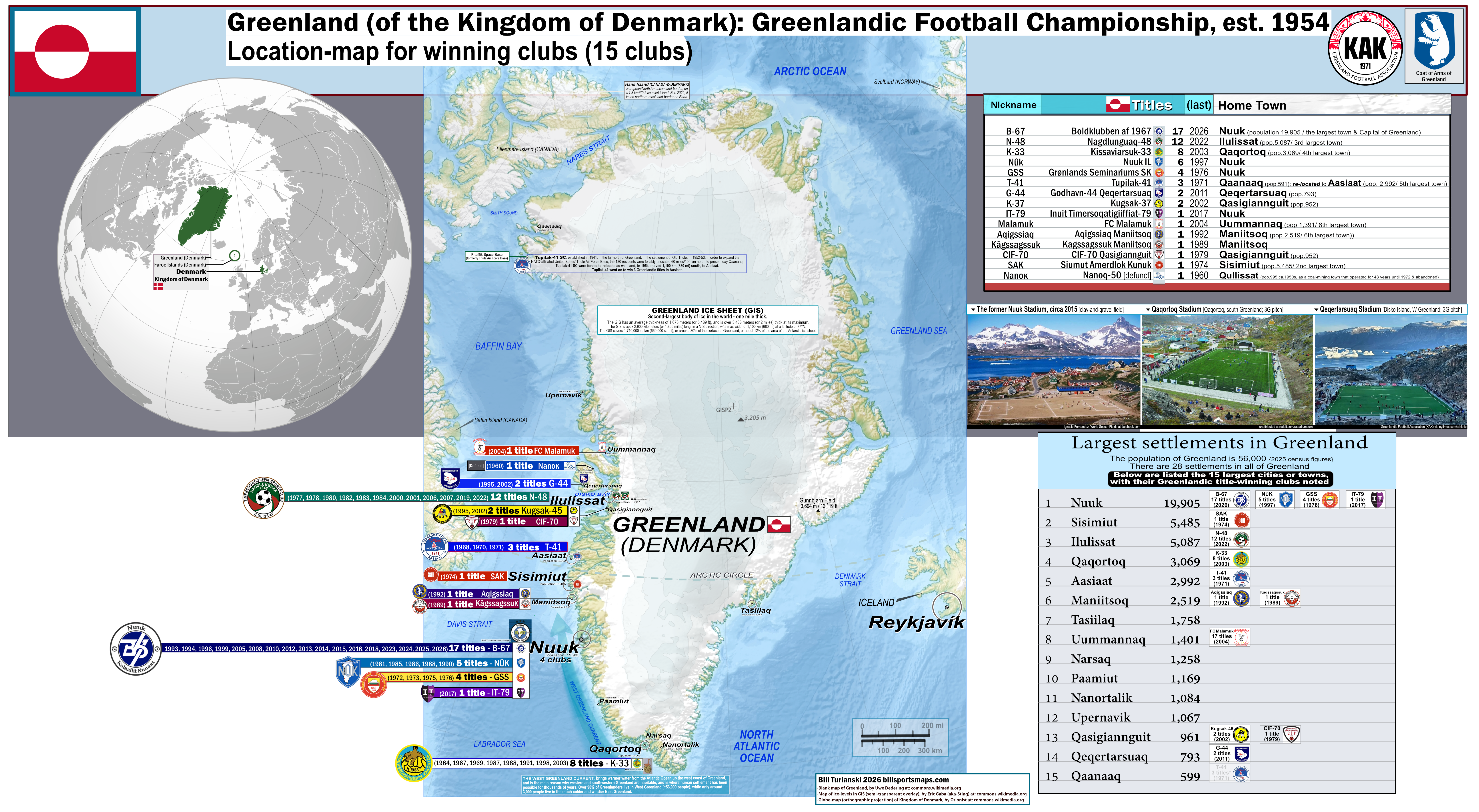
Greenland: Greenlandic Football Championship, est.1954 – Location-map for winning clubs (15 clubs)
…
…
By Bill Turianski on 12 October 2026; twitter.com/billsportsmaps.
Links…
-Greenlandic Football Championship (en.wikipedia.org).
-This Is Soccer in Greenland, potentially CONCACAF’s newest member: ‘I think we are ready’ (from nytimes.com/athletic by Rory Smith [May 2024]).
-Football in Greenland means community – From icebergs to midnight sun matches (nss-sports.com/greenland-trump-football-history, Jan 2026).
-One Week, One Title: Football in Greenland (26 minute BBC video from Sept 2025). {Recommended.}
The Map…
To the left of the main map is a globe-map (an orthographic map) showing Greenland, part of the Kingdom of Denmark. The main map itself is a location-map, showing the home-towns (and current populations) of the 15 clubs that have won Greenlandic men’s football titles. The 14 largest settlements (and their populations) are also shown. Plus there are a few aspects that are unique to Greenland on the map: the West Greenland Current {see caption at the foot of the map}, and the Greenland Ice Sheet {see graphic overlay and caption in center of map}. Also there is a caption for the Old-Thule/Thule/Qaanaq-US-military-forced-native-relocation of 1951-54 (which involved an eventual title-winning club [Tupliak-41]). And there is a caption for the historic Hans-Island-Canada/Denmark-land-border agreement of 2022 [Hans Island is a formerly-contested small island in the Nares Strait between north-west Greenland and Ellsmere Island, Nunavut, Canada].
(Note: Greenland is not a sovereign state…Greenland is an autonomous territory of the Kingdom of Denmark, and the citizens of Greenland are also citizens of Denmark. ‘Greenland is not a member of FIFA and therefore cannot qualify for the FIFA World Cup. In addition, Greenland is neither a member of CONCACAF or UEFA – the regional governing bodies of North American and Europe, respectively. An artificial grass pitch was laid at Nuuk Stadium in 2016, which FIFA now allows, but the stadium still lacks other required features. Following the entry of Gibraltar into UEFA and later FIFA, Greenland may be the next to try to enter.’ {-from en.wikipedia}. Also, note that another of the 3 constituent parts of the Kingdom of Denmark, namely, the Faroe Islands, has been a member of FIFA and of UEFA for decades now.)
-
The Greenlandic Football Championship began in 1954.
The Greenlandic Football Championship was first contested in 1954. But the tournament did not become an annual competition until 1969, and the tournament was not under the aegis of a national football association until 1971, with the formation of the KAK (the Football Association of Greenland).
This was (and still is) because of the difficulty and expense of travel on the huge, sparsely-populated, and largely-ice-covered island of Greenland. Greenland is gigantic – the island is more than three times the size of Texas. And only 56,000 people live there, 5,500 [or 9.5%] of which are registered football players. And Greenland has no roads between its 28 far-flung settlements. Meaning costly air travel, or lengthy sea travel, is required for football teams to travel. There is something else that is needed to be mentioned with respect to football in Greenland…this is what the pitches looked like until very recently {click on the following: Summer football in Upernavik 2007}. In Greenland, they mostly play their football matches on nice modern 3G pitches now, but as recently as a decade ago, and since the 1950s, Greenlanders had played their football on fields of clay and gravel. And the players, many in seal-skin leggings, would come prepared with bandages for the skin-shredded aftermath of matches.
The Greenlandic Football Championship is formatted with local qualifying rounds, leading to a final 8-team tournament, which is played within a week’s time, in a single host location, in mid-August. The tournament is held in a different town each year, but given the vast size of Greenland, no matter where it is held there will be logistical problems for the clubs to compete.
And, post-COVID (since the 2022 tournament), impacted by financial reasons, the qualifying stages have only been sporadically held. And this year {2026 tournament}, there were only 8 registered teams that had been able to renew their annual GM license with KAK, and those 8 teams ended up being reduced to just 4, after the 4 other teams withdrew due to a lack of players.
The 4 teams that remained in the 2026 tournament can give you a quick insight into the Greenland football hierarchy. And then I will run through the rest of the 15 clubs that have won the Greenlandic men’s football title (in no particular order).
But first, here are the top 3 most successful Greenlandic football clubs…
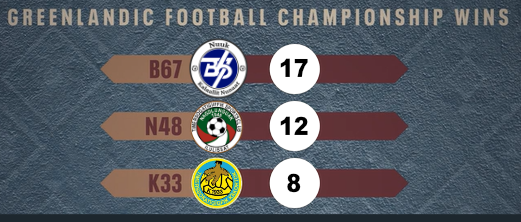
Image above: screenshot from BBC.com/sport/football/videos.
…
Greenlandic title-winning clubs (15 clubs):

-B-67 [Nuuk, W Greenland]. Established in 1967, B-67 are from the largest town, and capital-city of Greenland, Nuuk. B-67 are the big club of Greenland. The dark-blue-clad B-67 are sort of like the Bayern Munich of Greenland, with 10 titles won in the last 20 years (including 2026), and Boldklubben 1967 have won 17 titles in total. The club was trophy-less for 25 years, and then in the mid-1990s, B-67 expanded their facilities in Nuuk, and began recruiting more elite Nordic players. And then they started filling their trophy case. B-67 boast, as an alumni, the Ilulissat-W-Greenland-born Nemo Thomsen, a former player who, in June 2026 became the first ever male Greenlandic player to sign a professional football contract (with the 1st-/-2nd-division club FC Frederica, of Denmark). B-67 sport a nice alternate badge (w/map of Greenland on the crest), which you can see on the map.

-IT-79 [Nuuk, W Greenland]. A newer club from Nuuk (est 1979), they wear purple gear. In 2017, IT-79 won their first and only title, in an aet/penalty shootout versus B-67. IT stands for Inuit Timersoqatigiiffiat, with the second word being the Greenlandic term for football club. (The club’s IT-name also refers to Internet Technology [probably].)

-G-44 (Godhavn-44 Qeqertarsuarmi timersoqatigiiffik) [Qeqertarsuaq, Disko Island, W Greenland]. Est 1944, the blue-and-red-clad G-44 hail from the Disko Island/Disko Bay region of West Greenland (which is a crucial part of Greenland, as it is home to a wide range of species due to the nutrient-rich waters). G-44 have won 2 titles, in 1995 and in 2002. Which is pretty impressive, seeing as how the club’s home town of Qeqertarsuaq has a population that is less than 800. The town of Qeqertarsuaq was historically known as Godhavn, and that is why the club is known as G-44. G-44 sport a spartan, yet quite smart badge, which features a map of Disko Island on a shield.

-Aqigssiaq Maniitsoq [Maniitsoq, W Greenland]. Est 1971, and hailing from the 6th-largest town in Greenland (Maniitsoq, population 2.5-K), the blue-clad Aqigssiaq won the 1992 Greenlandic title. Starting in the early 2000s, Aĸigssiaĸ Maniitsoq’s football squad had to take a hiatus of more than two decades. The town of Maniitsoq has produced another title-winning club {see below}.

-Kagssagssuk Maniitsoq [Maniitsoq, W Greenland]. Est 1937, and the 3rd-oldest football club in Greenland. Kagssagssuk won the title in 1989, just 3 years before local rivals Aqigssiaq won it as well. Back then, Maniitsoq was thriving, but in the three decades since, the town has seen industries within the region dry up or fail to materialize, leading to young-population-flight (to Nuuk, or Denmark). Kâgssagssuk are named after a traditional Greenlandic mythological orphan boy who was abused by his community before a spirit granted him supernatural strength to seek revenge {see more on this at visitgreenland.com/articles/greenlands-myths-legends.} Kagssagssuk wear dark-garnet-red, and sport Reindeer-antlers on their garnet-red-and-white-in-Greenlandic-flag-motif circular crest.

-Kissaviarsuk-33 (aka K-33) [Qaqortoq, southern Greenland]. Est 1933, K-33 are the oldest sports club, and the 3rd-most successful football club, in Greenland. K-33 have won 8 titles (their last title having been won 23 years ago, in 2003). K-33 are from the southern-most and most tourist-visited settlement in Greenland, Qaqortoq (which has a population of 3-K). Kissaviarsuk is the Greenlandic word for Gyr Falcon. {Gyr Falcon Falco Rusticolus (natur.gl).} The Arctic-based Gyr Falcon is the largest falcon in the world; Inuit people hunt these birds for food and feathers, which they use for clothing and religious purposes. The white-and-blue-clad K-33 have a gyr-falcon-claw-clutching-football device on their logo. Their bold jersey-badge {which you can see on the map} features just the claw and the ball.

-Tupilak-41 [Aasiaat, W Greenland]. Est 1941. 3-time title-winners Tupilak-41 hail from Aasiaat (the 5th-largest town in Greenland, w/ a population of 2.9-K). But the club originally came from the far north of Greenland, in the remote settlement of Old Thule. A decade after Tupilak-41′s formation, in 1951, in order to expand the Cold-War-era-and-NATO-affiliated United States’ Military Base there in Thule, the 130 native residents of Old Thule were forcibly relocated 60 miles further north, to Qaanaaq {see map}. Tupilak-41 SC were forced to relocate as well, and in 1954, the club moved 880 miles/1,200 km south, to Aasiaat. The resilient Tupilak-41 went on to win 3 Greenlandic titles in a 4-year span (in 1968, 1970, and ’71). The blue-and-red-clad Tupilak-41 have a pretty wild crest – it depicts a Tupilak, an avenging monster-spirit from traditional Greenlandic Inuit religion. {Also see this, The Tupilaq: Ancient Vengeance Monster of the Inuit (umass.edu).}

-N-48 (Nagdlunguaq-48) [Ilulissat, W Greenland]. Hailing from Ilulissat, the 3rd-largest town in Greenland (with a population of 5,000), the green-clad N-48 are the second-most successful football club in Greenland, with 12 titles. From 1987 to 1984, N-48 was totally dominant, winning 5 titles in 6 years. Then a title drought. Then, 15 years later, N-48 began another titles-run, with 4 titles in 8 years. At that point in time (2007), N-48 were the most-successful Greenlandic team. But a decade later, Nuuk’s B-67 had supplanted N-48 as the dominant team. (This was following B-67′s 8 titles in 11 years). Since then, N-48 have won two more titles – right before, and right after COVID (in 2019 and in 2022). And, currently, N-48 are the last club, besides B-67, to be champions. In the Greenlandic, Nagdlúnguaĸ means ‘sweet little dear’.

- NÛK [Nuuk]. Est 1934, NÛK are the 2nd-oldest football club in Greenland. Their heyday was the 1980s, with 5 titles won between 1981 and 1990. Nuuk-34 wear Copenhagen blue (aka Prussian blue) gear.

-GSS-Nuuk (Grønlands Seminariums Sportklub) [Nuuk]. Est 1944, as the football club of the Greenland’s Teacher Training College, in Godthåb [now called Nuuk]. The yellow-with-red-&-green-clad GSS won 4 titles in 5 years, circa 1972 to ’76. So, right when the tournament was finally getting established as an annual event, the dominant side in Greenland was not comprised of, say, seal- or whale-hunters, but of school-teachers. Grønlands Seminariums Sportklub’s badge shows a glacier-backed, long, 19-windowed-and-dormer-roofed teachers’-college, rendered in divergent-perspective.

-Kugsak-45 [Qasigiannguit, Disko Bay, W Greenland]. The yellow-and-black-clad Kugsak have won 2 titles, in 1995 and 2002. Kugsak hail from the Disko Bay region, about 90 miles south of Ilulissat. Their home-town of Qasigiannguit has a population of 1,000. Kugsak-45′s unique crest depicts two hunters, one in a red parka, and one in a blue parka, fighting over a seal. (Qasigiannguit is a town historically known for its shrimp and seal industries.) Qasigiannguit is home to another Greenlandic champion {see below}.

-CIF-70 (Christianshåb Idrætsforening 70) [Qasigiannguit, Disko Bay, W Greenland]. Also from Qasigiannguit, the dark-red-clad CIF-70 were the 1979 champions.

-SAK (Siumut Amerdlok Kunuk) [Sisimiut, W Greenland]. Est 1951. The 1974 title-winners are from Sisimiut, Greenland’s 2nd-largest settlement (w/ a population of 5.9-K). SAK are the only club from Greenland’s second-city to have won the title.

-Nanoq-50/defunct [Qullissat, a former settlement on Disko Island, W Greenland]. Nanoĸ won the 1959-60 Greenlandic title. The club was from the coal-mining town of K’utdligssat (Qullissat), which was abandoned in 1972. Nanoq-50 last played in 1969.

-FC Malamuk [Uummannaq, Uummannaq Island, W Greenland]. Est 1979. 2004 title-winners. The red-clad Malamuk are from Uummannaq Island (which has a population of 1,400, and is the 8th-largest town). Uummannaq is located 367 miles/590 km north of the Arctic Circle {see map}. This makes FC Malamuk the northernmost Greenlandic title-winners.
___
Sources / Thanks to all listed below…
-Blank map of Greenland, by Uwe Dedering at commons.wikimedia.org/wiki/File:Greenland_edcp_relief_location_map.jpg.
-Map of ice-levels in GIS (semi-transparent overlay), by Eric Gaba (aka-Sting) at: File:Greenland ice sheet AMSL thickness map-en.png.
-Globe-map of Danish Realm aka Kingdom of Denmark, by Orionist at File:Kingdom of Denmark (orthographic projection).svg.
3 photos of Greenlandic football venues>: -Clay-and-gravel field [former field at Nuuk, ca. 2015] photo by Ignacio Fernandez /World Soccer Fields at facebook.com. -Qaqortoq Stadium [south Greenland], photo unattributed at reddit.com/r/stadiumporn/comments/1m1ogt [Qaqortoq Stadium]. -Qeqertarsuaq Stadium, [Disko Island, west Greenland], photo by Greenlandic Football Association (KAK) via nytimes.com/athletic/[greenland-soccer-concacaf-fifa].
-This recounting of the forced relocation, by the US military, of Old Thule’s population ca. 1952, reddit.com/r/greenland/[qaanaaq].
-B-67 alternate jersey badge from footballkitarchive.com/b-67-nuuk-2020-home-kit-135722/.
-K-33 jersey badge from the BBC doc {see Links at top of post}.
-N-48 jersey badge from N-48/store, n48.sportyfied.com
-The badge of the defunct 1960 Greenlandic champions, Nanoq-47, I could only find at a great Brazilian site called EscudosFC.br, but, currently, that site is unfortunately down.
-Titles list, foundation dates & archaic Greenlandic football club nomenclature (such as NÛK, and Nanoĸ, and K’utdligssat), from these page at the invaluable RSSSF, Greenland – List of Champions; Greenland – List of Foundation Dates.
-Anyone & everyone, such as every Greenlander and Dane, who has ever told Tr*mp and his ilk to go f*ck off [Blue Wave forever].
…
…
-
Denmark, 2026-27 Danish SuperLiga: Location-map for the 12 clubs, with 2025-26 attendance figures
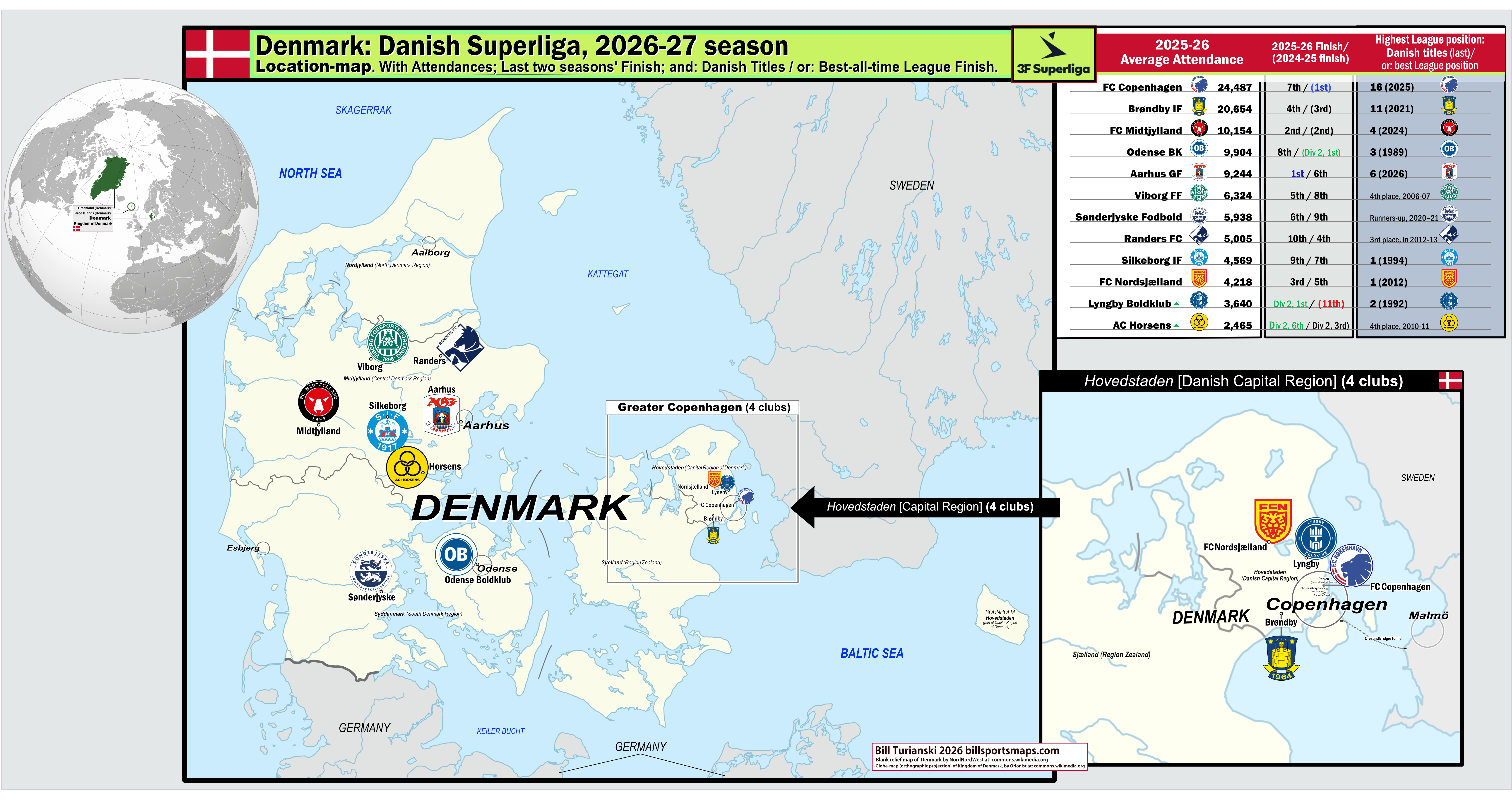
Denmark, 2026-27 Danish SuperLiga: Location-map for the 12 clubs, with 2025-26 attendance figures
Links…
-Danish SuperLiga 2026-27 (en.wikipedia.org).
-Tables, scores, fixtures, attendance, etc…
___
-Blank map by NordNordWest at sco.wikipedia.org File:Denmark adm location map.svg.
-Globe-map of Danish Realm aka Kingdom of Denmark, by Orionist at File:Kingdom of Denmark (orthographic projection).svg.
…
…



.svg)
