billsportsmaps.com

December 19, 2024

Spain: 2024-25 La Liga – Location-map, with 3 charts: Attendance [current], Seasons-in-1st-Division & Spanish titles list./ +Promoted to La Liga in 2024: Valladolid, Leganés, Espanyol.

Filed under: Spain — admin @ 6:51 pm

spain-la-liga_2024-25_location-map-of-the-20-clubs_current-attendance-december-16-2024_spanish-titles-list_seasons-in-1st-div_post_d_.gif
Spain: 2024-25 La Liga – Location-map, with 3 charts: Attendance [current], Seasons-in-1st-Division & Spanish titles list


By Bill Turianski on 19 December 2024; twitter.com/billsportsmaps.
Links…
-2024-25 La Liga (en.wikipedia.org).
-Spain » Primera División 2024/2025 (worldfootball.net).
-La Liga – Summary: matches, table, players, etc (soccerway.com).
-Sid Lowe at theguardian.com/football [Spanish football coverage] (theguardian.com/profile/sidlowe).

The map. The map page shows a location-map for the 20 clubs in the 2024-25 La Liga, with recently-promoted and -relegated teams noted. (Promoted in 2024: Valladolid, Leganés, Espanyol. Relegated in 2024: Cádiz, Almería, Granada.)

The map also shows the 17 Autonomous Communities of Spain, and the 20 largest Spanish metropolitan areas. Those 20 largest Spanish metro-areas, with their 2018 population estimates, are listed at the top-centre of the map-page.

The 3 charts
A). A chart showing Current Attendance (up to week 17; 19 Dec 2024) plus 2024-25 finish, and with teams playing in Europe noted. There are also columns listing Venue-capacities and Percent-capacities. Note: For 2023-24, and for 2024-25 up to Feb 2025, FC Barcelona are playing at Estadi Olímpic Lluís Companys, due to Camp Nou redevelopments. Barcelona’s home capacity is thus reduced by around 43,400. (Camp Nou capacity: 99,354. Estadi Olímpic Lluís Companys capacity: 55,926.)
B). A chart showing Seasons-in-La Liga by club, with consecutive seasons listed. This is the 94th La Liga season. Three La Liga founding members – Real Madrid, Barcelona, and Athletic Club [Bilbao] have never been relegated.
C). A chart showing the All-time Spanish professional titles list (1929 to 2023-24).


    Spanish clubs promoted in 2024…

2024: Valladolid, promoted back to La Liga after 1 year…
Real Valladolid Club de Fútbol are from Valladolid, in the autonomous community of Castile and León, located, by road, 101 miles (162 km) NW of Madrid. The elevation of Valladolid is 2,290 ft [or 0.4 miles] (698 m). Valladolid’s metro-area population is around 369,000 {2018 figure}. Valladolid is the 20th-largest city in Spain.

Valladolid wear violet-&-white vertical stripes. Valladolid first played in La Liga in 1948-49. Valladolid have played 47 seasons of 1st division football, which is the 13th-most in Spain. Their best finish was 4th place, in 1962-63. A yo-yo club since 2020-21: Valladolid have been relegated, then promoted, the last 4 seasons. (Relegated in 2021/Promoted in 2022/Relegated in 2023/Promoted in 2024.) Valladolid play in the 42-year-old 27-K-capacity Estadio José Zorrilla, which is a whole lot nicer of a venue since 2019, when the dry-moat that encircled the pitch was removed. Valladolid are currently [19 Dec 2024] in the relegation zone (yet again), and are drawing 21.3-K-per-game (77.2%-capacity).
valladolid_promoted-2024_estadio-jose-zorilla_h_.gif
2024-25 Valladolid home jersey, from uksoccershop.com. Stadium photo unattributed at skyscrapercity.com/[Valladolid - Estadio José Zorrilla Expansion, May 2023 post].


2024: Leganés, promoted back to La Liga after 4 years…
CD Leganés are from Leganés, a southern suburb of Madrid. (Leganés is located, by road, 9 miles (15 km) SSW of central Madrid.) In the 1950s, and all the way into the early 1990s, Leganés were a 4th or a 3rd tier team. They finally made it to the 2nd division in 1993, but it took them 23 more seasons to get promoted to La Liga. Leganés first played in La Liga in 2016-17. They played four seasons in the top flight, then were relegated back to Segunda División in 2020. Leganés wear dark-blue-&-white vertical stripes. Leganés play at the 12.4-K-capacity Estadio Municipal de Butarque, and they have been paying there since the stadium opened in 1998. Leganés recently (16 Dec) had a 0-1 upset win over Barcelona, and are currently [19 Dec 2024] in 15th place, and are drawing 10.7-K-per-game (86.3%-capacity).

leganes_promoted-2024_estadio-municipal-butarque_c_.gif
2024-25 Leganés home jersey, from dhgate.com. Estadio Municipal de Butarque, photo from cdleganes.com/noticias.


2024: Espanyol, promoted back to La Liga after 1 year…
Reial Club Deportiu Espanyol de Barcelona wear blue-&-white vertical stripes. RCD Espanyol are the 6th-longest serving club in La Liga, having played in 88 of the 94 La Liga seasons. But Espanyol have never won a Spanish title. And Espanyol are considerably overshadowed by their local rivals, FC Barcelona. Part of that has to do with Espanyol’s distancing itself from the Catalan independence movement (the fanbase of Espanyol is generally perceived as being much more right-wing than Barcelona’s fanbase). But part of it also has to do with the fact that Espanyol’s fanbase is a fraction of the size of Barcelona’s: Espanyol can only half-fill their award-winning, but too-large, 40-K-capacity stadium.

Espanyol were a founding member of La Liga in 1929 (one of 10 teams). Espanyol have been relegated 6 times, but each time, they won promotion straight back to La Liga (1961-63, 1968-70, 1988-90, 1992-94, 2019-21, 2022-24). Espanyol have won 4 Copa del Rey titles (1929, 1940, 2000, 2006).

Espanyol are currently [19 Dec 2024] back in the relegation zone, and are drawing 22.8-K-per-game (which is a league-worst 55.8%-capacity), at their 40,000-seat RCDE Stadium.

espanyol_promoted-2024_rcde-stadium_f_.gif
Photo credits above – 2024-25 Espanyol home jersey, from subsidesports.com. RCDE Stadium, aerial photo unattributed at guidetourism.net.


___
Thanks to all at the following links
-Blank map of Spain, by NordNordWest at File:Spain location map.svg;
-Globe-map of Spain, by Rob984 at File:EU-Spain (orthographic projection).svg;
-Map of the Community of Madrid, by Miguillen at File:Spain Madrid location map.svg (en.wikipedia.org).
-Map of Canary Islands, by Miguillen at File:Canarias-loc.svg (commons.wikimedia.org).
-Largest metropolitan areas in Spain (2018 European Spatial Planning Observation Network figures) (en.wikipedia.org).
-en.wikipedia.org/wiki/La_Liga#Clubs.
-Autonomous communities of Spain;
-List of metropolitan areas in Spain (en.wikipedia.org).
-Attendance, worldfootball.net/attendance/esp-primera-division-2024-25.

December 4, 2024

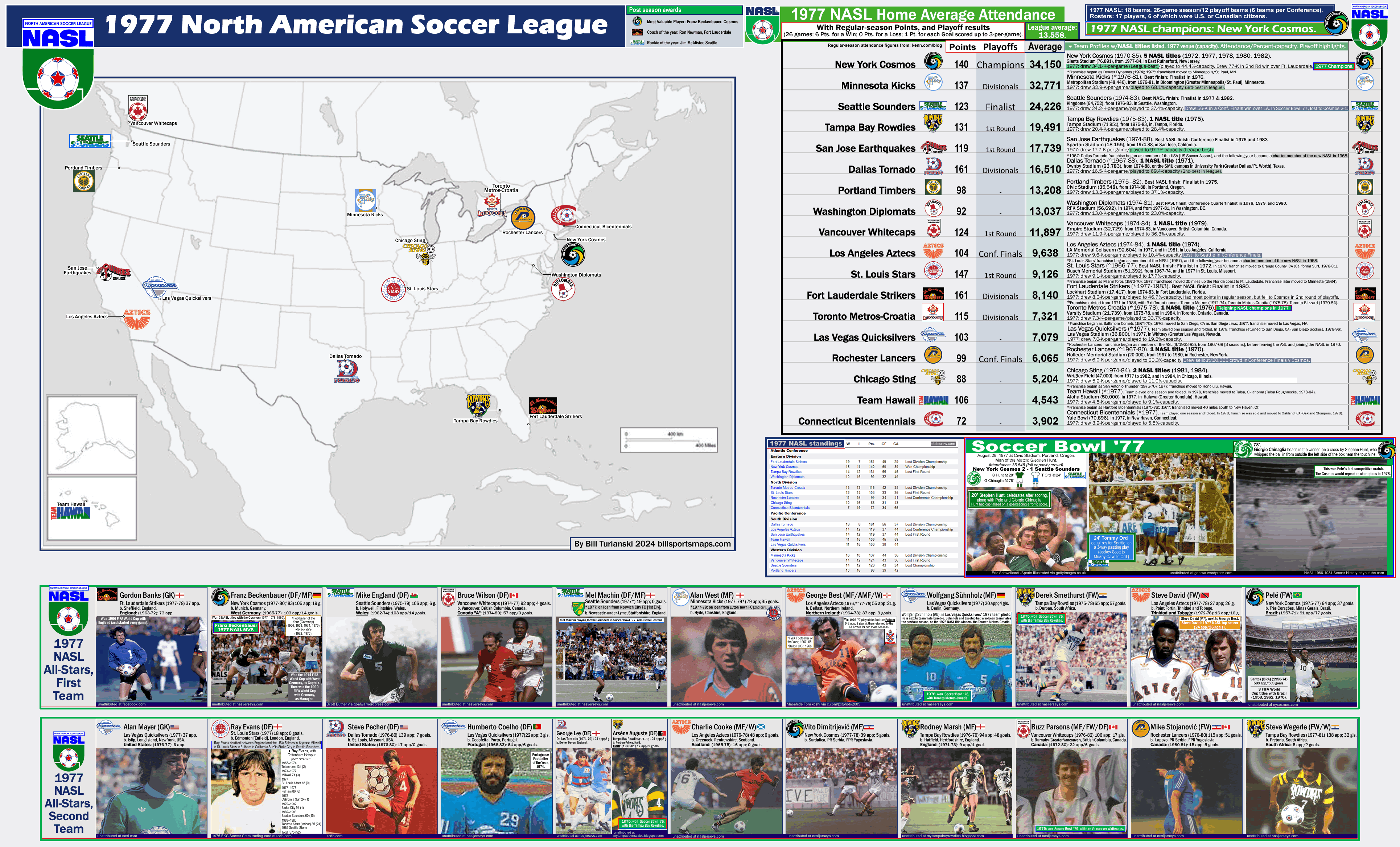
1977 NASL map: the 18 teams of the 1977 North American Soccer League, with attendances; plus 1977 NASL All-Stars (1st and 2nd Teams)./+ Chart of NASL Attendance and Champions (1967-1984).

/nasl_north-american-soccer-league_map_1977-season_18-teams_champions_ny-cosmos_w-1st-and-2nd-team-all-stars_post_m_.gif
1977 NASL map: the 18 teams of the 1977 North American Soccer League, with attendances; plus 1977 NASL All-Stars (1st and 2nd Teams)


By Bill Turianski on the 4th of December 2024; twitter.com/billsportsmaps.
Links…
-1977 North American Soccer League season (en.wikipedia.org).
-NASLjerseys.com. {Recommended.}
-Kits: NASL 1977 (kitbliss.co.nz).

Note: This is the first of a series. I have also completed a 1978 NASL map, and a 1979 NASL map (both slightly expanded), and intend to continue on.

The map is a location-map of the 18 teams of the 1977 North American Soccer League.
To the right of the map is a chart of 1977 NASL Home Average Attendance, by team. Teams’ regular-season-points totals and playoffs results are listed.

In the upper-right corner there is a section that shows thumbnail team profiles (years the team existed [including franchise-shift information], NASL titles, venue & capacity, location, 1977 average attendance & percent-capacity, 1977 playoff highlights). Below that are the 1977 NASL standings. And next to that is a section for Soccer Bowl ’77 (New York Cosmos 2, Seattle Sounders 1, in front of a full capacity crowd of 35,548 at Civic Stadium in Portland, Oregon, on August 28, 1977).

At the foot of the map-page is a long horizontal chart showing the 1977 NASL All-Stars, First Team & Second Team (23 players shown, with brief player-profiles).

At the center of the top banner there is listed the 1977 NASL post-season awards: Most Valuable Player: Franz Beckenbauer of the Cosmos. Coach of the year: Ron Newman of the Ft. Lauderdale Strikers. Rookie of the year: the Seattle, Washington-born Jim McAlister of the Seattle Sounders.


nasl-1977_logos_d_.gif
Unattributed at pinterest.com.

    1977 NASL season

18 teams (including 2 teams from Canada). 26-game season/12 playoff teams (6 teams per Conference). Rosters: 17 players, 6 of which had to be either U.S. or Canadian citizens. New rule: matches that ended in a draw were decided by a 5-second/35-yard-penalty-shoot-out.

2 franchises folded (Boston Minutemen, and the 1973 NASL champions, the Philadelphia Atoms). 4 franchises moved: San Antonio to Hawaii (Team Hawaii, who only lasted one year), San Diego to Nevada (Las Vegas Quicksilvers, who also only lasted one year), Hartford to New Haven (Connecticut Bicentennials, who folded after the season), and Miami to Ft. Lauderdale (Fort Lauderdale Strikers). 1 name-change: as befitting their Diva-like status, the New York Cosmos were to be now known as simply “the Cosmos” (that lasted two years).

The Miami Toros franchise moved 25 miles up the Florida coast to become the Fort Lauderdale Strikers. The Strikers wore striking amber-and-orange-horizontally-striped gear; they drew modestly, at 8 thousand per game, but were the surprise of the 1977 NASL regular season, as regular-season champions. Fort Lauderdale’s coach was Ron Newman, newly arrived from the semi-pro ASL, and he was given the Coach of the Year award. The Strikers’ goalkeeper was 1966 World Cup champion Gordon Banks, and Fort Lauderdale had the best defense in the league (29 goals allowed in 28 games).

But in the playoffs, the Strikers would have to face the Cosmos, who had been in disarray early on, with warring clubhouse factions. But the Cosmos began performing well after West German World Cup winner and two-time Ballon d’Or winner Franz Beckenbauer arrived in May (followed soon after by a coaching change in the form of South Africa-born Eddie Firmani). (Beckenbauer was 1977 MVP.) Ft. Lauderdale got a bye in the playoffs 1st round, then in the Atlantic Conference divisional championships’ 1st leg, the Strikers got blown out 8-3 by the Cosmos in front of an astounding league-record crowd of 77,691 at Giants Stadium, in East Rutherford, New Jersey. In the 2nd leg, before 14-thousand at Lockhart Stadium in Ft. Lauderdale, Florida, the Strikers and the Cosmos were knotted 2-2, so it went down to the shoot-out, and the Cosmos prevailed.

Meanwhile in the Pacific Conference, the Dallas Tornados were the top team going into the playoffs. But Dallas lost to the Los Angeles Aztecs in the first round. The Aztecs had a league-best 64 goals, and boasted 2 of the 3 top scorers in the NASL that year – Trinidad-born striker Steve David, and legendary ex-Manchester United player and 1968 Ballon d’Or winner George Best.

nasl_1977_conference-finalists_ny-cosmos_rochester-lancers_la-aztecs_seattle-sounders_f_.gif

In the Atlantic Conference Finals, the Cosmos would face the Rochester Lancers. To get to the conference finals, the underdog Rochester Lancers had first beaten the St. Louis Stars (in a shoot-out). And then, in the divisional finals’ 2nd leg, the Lancers, down to 9 men, beat their hated rivals, Toronto Metros-Croatia (the reigning champions). In the Conference Finals’ 1st leg, the Cosmos beat the Lancers 2-to-1 in Rochester, NY in front of an overflow-capacity crowd of 20,005 at Holleder Stadium. And in the 2nd leg, in front of 74-thousand at Giants Stadium, the Cosmos won 4-1.

In the Pacific Conference Finals, the LA Aztecs would meet the Seattle Sounders. The Sounders had a squad that was packed with British players, players who had been on 1st or 2nd or 3rd tier clubs in England (two of whom made the 1977 NASL First Team: Newcastle-born MF Mel Machin, and Flintshire, Wales-born DF Mike England). To get to the conference finals, the Seattle Sounders had beaten the Vancouver Whitecaps, and then the Soccer Bowl ’76 finalists the Minnesota Kicks. In the Conference Finals’ 1st leg, in front of an embarrassingly paltry crowd of 9-thousand at the vast Memorial Coliseum in Los Angeles, the Sounders beat the Aztecs 3-to-1. In the 2nd leg up in Seattle, at the 66-K-capacity Kingdome, the Sounders beat the Aztecs 1-0, in front of a massive crowd of 56-thousand.

Soccer Bowl ’77
nasl_soccer-bowl-77_chinaglia_pele_mel-machin_b_.gif
Photo by Peter Robinson/EMPICS via Getty Images) via oregonlive.com.

-The New York Cosmos Win Soccer Bowl ’77 (3:11 video uploaded by NASL 1968-1984 Soccer History at youtube.com).

Soccer Bowl ’77 was played at the Portland Timbers’ home field, Civic Stadium in Portland, Oregon (which had been built as a Triple-A minor league baseball stadium). Soccer Bowl ’77 was played in front of an overflow-capacity crowd of 35,548. 170 miles up the road, in Seattle, there had been a very big demand for tickets, but only 10,000 were allocated to the Sounders, so many Sounders fans had to buy scalped tickets. And many Sounders fans went there without tickets, hoping to get lucky – and some certainly did. Because although the announced attendance at the game was the exact same figure as the official soccer-capacity of the stadium, the actual amount of people there was considerably more. You can definitely see that in photos from the game. Civic Stadium that day ended up being so packed, that fans were sitting on the field, only a few feet from the touchlines. In the photo above, you can see examples of the this: a couple fans are sitting on top of the outfield fence, and there are several fans visible sitting directly on the field. This here is an example of how popular the NASL had become by 1977.

The Cosmos beat the Seattle Sounders 2-1. In the 20th minute, the Cosmos’ Stephen Hunt capitalized on a goalkeeping error to score (the Seattle ‘keeper had been rolling the ball a little to close to Hunt). But just 4 minutes later, the workman-like Sounders engineered an equalizer via a neat 3-way passing play (Jocky Scott to Mickey Cave to Tommy Ord). It stayed knotted until the 78th minute, when Giorgio Chinaglia headed in the winner, on a cross by Stephen Hunt, who had whipped the ball in from outside the left side of the box near the touchline. Stephen Hunt got the MVP award for the game. This was Pelé’s last competitive match. The Cosmos would repeat as champions in 1978.

1977 was a pretty successful year for the NASL. Attendance was up 33%, to 13,558 per game. And despite poor playoff crowds in LA, teams averaged an impressive 29,251 per game in the playoffs. Regular season: Cosmos averaged 34.1-K (in their first year at Giants Stadium in New Jersey). The Minnesota Kicks (who had been Soccer Bowl ’76 finalists) drew an amazing 32.7 thousand per game, up in Bloomington, Minnesota [just down the road from the Twin Cities]. Third-best draw were the Seattle Sounders, at 24.2-K-per-game. And there were 6 more teams that drew in double figures: Tampa Bay Rowdies (19.4-K), San Jose Earthquakes (17.7-K), Dallas Tornado (16.5-K), Washington Diplomats (13.0-K), and Vancouver Whitecaps (11.8-K). The following year of 1978 would see the ambitious NASL expand from 18 to 24 teams.


NASL Regular Season Attendance – 1967 to 1984
Listed: Number of Teams / League Average / Median Average / Best-drawing Team / Champions…
nasl_attendance-figures_1967-1984_d_.gif"
Chart by billsportsmaps.com. Attendance figures from kenn.com/blog/soccer/all-time-nasl-attendance-2/.

The North American Soccer League (NASL) existed from 1968 to 1984. The NASL’s glory years were between 1975 and 1981. As you can see in the chart above, yearly attendance figures show that as the 1970s went on, the NASL was steadily attracting more paying customers. By 1974 four teams were averaging over 10,000 attendance (San Jose Earthquakes, Seattle Sounders, Philadelphia Atoms, Vancouver Whitecaps). By 1975, the San Jose Earthquakes were drawing 17,927 per game. Boosted by the huge impact of Brazilian star Pele’s 3-year career with the New York Cosmos (1975 to ’77), the NASL broke the 10,000-per-game mark in 1976. And 3 teams in 1976 drew over 20,000 per game (Seattle Sounders, Minnesota Kicks, Portland Timbers).

In 1977, the Cosmos won the second of their 5 NASL titles, and drew a then-league-record 34-thousand per-game. In 1978, the NASL expanded to 24 teams (some would say that the league over-expanded). And in 1978, the New York Cosmos drew a league-record 47,856 per game. By 1979, the NASL’s median average attendance was 10,772. In 1980, the NASL’s attendance peaked at 14,440 per game. Also in 1980, 16 of the 24 NASL teams drew above 10-K per game. At that point, the Cosmos had been the highest-drawing team for 4 straight seasons, and the Cosmos had won 3 of the previous 4 titles (the other title in that 4-year-span went to the Vancouver Whitecaps, in 1979).

But the owners of many of the franchises aped the Cosmos, chasing the success that the Cosmos had in signing such world-renowned players as Pele, Franz Beckenbauer, and Carlos Alberto. In other words: overspending on aging internationals and letting young domestic talent languish on the bench. When the crowds fell off, the owners bolted. And the recession of the early 1980s hurt the league. And so in 1981, the league began contracting (from 24 teams to 21). In 1981, the league’s median average attendance peaked, at 11,465. But meanwhile, 7 of the 21 teams folded, so the league went from 21 teams in ’81, to 14 teams in ’82. Some believe that when, in March 1983, FIFA awarded the 1986 World Cup to Mexico, instead of the USA, it hastened the league’s demise. The NASL contracted even more, until the league limped through the final season of 1984 with just 9 teams.

For the American fan (such as myself) the NASL was an interesting league to follow, with colorful characters and cool teams. And live games had an energy and excitement that was abetted by the offense-friendly rules that the NASL invented. (Those rules included: A 35-yard-line offside rule. Points in the standings for goals [6 pts. for a win, 0 pts. for a loss but 1 point for each goal up to 3]. No ties [draws]…matches that ended in a draw were decided by a frenzied 5-second/35-yard-penalty-shoot-out.)

The NASL laid the foundations for soccer in the United States and Canada. Which helped lead to both the hosting the 1994 FIFA World Cup and the establishment of Major League Soccer (MLS) in 1996, as well as creation the Canadian Premier League (Can PL) in 2019. The NASL ultimately contributed to the overall improvement of the quality of American and Canadian players, and their national teams. The US national team has been transformed from also-rans to a competitive force. After a 36-year drought, Canada finally qualified for a World Cup (in 2022). And no American ever played in the English 1st Division before the NASL. Now, American- and Canadian-born players regularly play on the squads of big first-division clubs in Western Europe and elsewhere.

Credits on map page…
-Blank map of North America, unattributed at pinterest.com.
-NASL attendance from kenn.com/the_blog.
-1977 NASL standings, from statscrew.com/soccer/standings/l-NASL/y-1977.
Soccer Bowl ’77…-20′ Stephen Hunt, with Pele (at left), Giorgio Chinaglia (#9), and Tony Field (#7), celebrating after scoring (20′): photo by Eric Schweikardt /Sports Illustrated via Getty Images at gettyimages.co.uk. -24′ Tommy Ord equalizes for Seattle, on a 3-way passing play (Trevor Hockey to Mickey Cave to Tommy Ord.): photo unattributed at goalwa.wordpress.com. -(78′) Giorgio Chinaglia heads in the winner, on a tight cross by Alan Hunt from just outside the left side of the box: screenshot of video uploaded by NASL 1968-1984 Soccer History at youtube.com.

Photo credits of 1977 NASL All-Stars…
First Team…
-Gordon Banks, Ft. Lauderdale Strikers (GK), photo unattributed at facebook.com/naslisfifty.
-Franz Beckenbauer, New York Cosmos (DF), photo unattributed at nasljerseys.com/[Beckenbauer, Franz].
-Mike England, Seattle Sounders (DF), photo (from 1976 pre-season) by Scott Butner via goalwa.wordpress.com.
-Bruce Wilson, Vancouver Whitecaps (DF), photo unattributed at nasljerseys.com/[Wilson, Bruce].
-Mel Machin, Seattle Sounders (DF/MF), photo (from Soccer Bowl -77 in Portland, OR), unattributed at nasljerseys.com/[Machin, Mel]/
-Alan West, Minnesota Kicks (MF), photo unattributed at nasljerseys.com/Players/[West, Alan].
-George Best, Los Angeles Aztecs (MF/AMF/W), photo by Masahide Tomikoshi via x.com/[@tphoto2005].
-Wolfgang Sühnholz (MF), Las Vegas Quicksilvers, photo unattributed at nasljerseys.com/Rosters/Quicksilvers.
-Derek Smethurst, Tampa Bay Rowdies (FW), photo unattributed at nasljerseys.com/[Smethurst, Derek].
-Steve David, Los Angeles Aztecs (FW), nasljerseys.com/[David, Steve].
-Pelé, New York Cosmos (FW), photo unattributed at nycosmos.com/news.
Second Team…
-Alan Mayer, Las Vegas Quicksilvers (GK), photo unattributed at nasl.com/news.
-Ray Evans, St. Louis Stars (DF), photo from 1975 FKS Soccer Stars trading card at tcdb.com/[Gallery-Ray-Evans].
-Steve Pecher, Dallas Tornado (DF), photo from tcdb.com/[Gallery-Steve-Pecher].
-Humberto Coelho, Las Vegas Quicksilvers (DF), photo unattributed at nasljerseys.com/Rosters/Quicksilvers.
-George Ley, Dallas Tornado (DF), photo unattributed at nasljerseys.com/[Ley, George].
-Arsène Auguste, Tampa Bay Rowdies (DF), photo unattributed at mytampabayrowdies.blogspot.com.
-Charlie Cooke, Los Angeles Aztecs (MF/W), photo unattributed at nasljerseys.com/[Cooke, Charlie].
-Vito Dimitrijević, New York Cosmos (MF), photo unattributed at nasljerseys.com/[Dimitrijevic, Vito].
-Rodney Marsh, Tampa Bay Rowdies (MF), photo unattributed at mytampabayrowdies.blogspot.com.
-Buzz Parsons, Vancouver Whitecaps (FW), photo unattributed at nasljerseys.com/Rosters/Whitecaps.
-Mike Stojanović, Rochester Lancers (FW), photo unattributed at nasljerseys.com/[Stojanovic, Mike].
-Steve Wegerle, Tampa Bay Rowdies (FW), photo unattributed at nasljerseys.com/[Wegerle, Steve].


November 19, 2024

2024-25 FA Cup, 2nd Round Proper: location-map, with fixtures list & current league attendances./+ The two biggest upsets in the 1st Round: Kettering Town over Northampton, and Tamworth over Huddersfield.

Filed under: 2024-25 FA Cup — admin @ 7:01 pm

2024-25_fa-cup_2nd-round_map_w-league-attendances_w-fixtures_post_e_.gif
2024-25 FA Cup, 2nd Round Proper: location-map, with fixtures list & current league attendances


By Bill Turianski on the 19th of November 2024; twitter.com/billsportsmaps.
Links…
-The competition…FA Cup (en.wikipedia.org).
-2024-25 FA Cup (en.wikipedia.org).
-BBC’s page on the competition…bbc.com/fa-cup.

    Saturday 2 Nov 2024: Biggest upset in FA Cup 1st Round: Kettering Town beat Northampton, 2 to 1

-A league-placement difference of 4 levels and 79 league-places.
Kettering Town, established 1872, are the fifth-oldest club in England, and own the record for most goals in the FA Cup – 922 goals [the second-most is Tottenham with 911 goals, and third-most is Manchester United with 907 goals; see this video {at 0:25} Back On The Map - Kettering Town's FA Cup 1st Round win at Northampton Town (02/11/2024)]. Kettering Town are nicknamed the Poppies.

In 1980-81, Kettering Town, drawn from the Southern League, were a founding member of the original 5th level in England, the Alliance Premier League. (The Alliance Premier League morphed into the Football Conference 8 years later, instituting Promotion/Relegation in 1986-87 between the 5th tier and the Fourth Division of the Football League.)

Kettering Town played 22 straight seasons in the 5th tier, from 1980 to 2001. The closest Kettering ever came to getting promoted into the League was finishing in 2nd place, twice (in 1988-89, when they missed out on the Conference title to Maidstone United by 6 pts; and in 1993-94, when they missed out on the Conference title to Kidderminster by 3 pts.) Kettering Town would draw above 2-K-per-game in those title-chasing seasons, their peak attendance being 2,506 per game in 1988-89. Kettering Town have played 27 seasons in the 5th tier.

But after losing their Rockingham Road ground in 2011, the club went into administration during the 2011–12 season, and played 8 miles down the road in Irthlingborough. Kettering finished in last place and were demoted two levels, down to the Southern League. Then they played 8 miles up the road in Corby in the next season of 2012-12. Their attendance plummeted to 354 per game when they played in Corby. The next season of 2013-14, Kettering Town moved for the 3rd straight year, to Burton Latimer (3 miles down the road), and into the 2,400-capacity Latimer Park. For the next decade, Kettering were unable to draw above 1 thousand per game at Latimer Park, the closest being in 2018-19, when they drew 838 per game and got promoted to the National League North. But the next winter COVID struck. Then Kettering were relegated back down to the 7th tier in 2023. In February 2024, Richard Lavery was appointed manager of Kettering Town; they finished in 15th. In 2024-25, by late September, Kettering Town were near the top of the table in the Southern Central, and they began drawing crowds in the 1.4-K-range. They advanced through the FA Cup qualifying rounds, and then drew local rivals Northampton Town in the 1st Round. (Kettering is located, by road, just 17 miles (27 km) NE of Northampton.)

On Saturday 2 November, Kettering were top of the 7th-tier Southern League Central. While 4 levels above them, Northampton Town were in 18th place in League One. The match was being televised live on BBC Two.

There was a full capacity crowd of 7,104 at Sixfields Stadium, on the west side of Northampton. In the 28th minute Northampton took the halftime lead, when Kettering captain Connor Johnson deflected the ball into the net after a shot by Northampton FW Tariqe Fosu. In the second half, in the 66th minute, four minutes after coming on as a substitute, Kettering-born teenager Luca Miller (MF) scored on a header to equalise. Assist was by DF Ben Hart, making a brilliant 45-degee-angle cross from the right that curled back to the top of the box, where Luca Miller had timed his run to deftly head the ball inside the right post. The score remained knotted at the whistle, and so it went to AET, where less than 2 minutes in, former Newcastle striker Nile Ranger headed in the winner, off a corner kick by Luca Miller.

It was the first time that Kettering Town had beaten their local rivals Northampton Town in the FA Cup. So Kettering will play in the FA Cup 2nd Round for the first time since 2009 (15 years ago, when they went all the way to the 4th Round). Kettering Town will host 3rd-tier side Doncaster Rovers on Sunday the 1st of December 2024, at Latimer Park. The match is sold out, of course, and it will be televised on BBC-Two.

-Northampton Town v Kettering Town | Key Moments | First Round | Emirates FA Cup 2024-25 (2:45 video uploaded by The Emirates FA Cup at youtube.com).
-FA Cup – 1st Round: Northampton Town 1 -2 Kettering Town AET (bbc.com/sport/football/live).

kettering-town-nov-2024_fa-cup_upset-win_over-northampton_sixfields_luca-miller_nile-ranger_richard-lavery_latimer-park_h_.gif
Photo credits above -
Kettering Town 2024-25 jersey, from store.hopeandglorysportswear.co.uk. 1st goal (og) and Luca Miller goal from Northampton Town v Kettering Town | Key Moments | First Round | Emirates FA Cup 2024-25 (Video uploaded by The Emirates FA Cup at youtube.com). Nile Ranger goal from bbc.com/sport/football/live. Kettering Town FC’s Latimer Park Stadium, aerial shot by John Fielding at flickr.com/photos/john_fielding. Richard Lavery, Kettering Town manager, photo by Peter Short at northantstelegraph.co.uk/sport.


    Friday 1 Nov 2024: Second-biggest upset in FA Cup 1st Round: Tamworth beat Huddersfield, 1-0.

-A league-placement difference of 2 levels and 57 league-places.
Tamworth is in the south-east part of Staffordshire, within 6 miles of both the West Midlands and north Warwickshire. And Tamworth is located, by road, 14 miles (23 km) NE of Birmingham. Tamworth FC are nicknamed the Lambs. Tamworth have played 9 seasons of 5th division football, and were last relegated out of the National League in 2014. Four years later, in 2018, Tamworth were relegated out of the National League North, down into the 7th tier. It took Tamworth four years to get out of the Southern League Central, and that happened 15 months after Andy Peakes had been hired as Tamworth manager. Then, with Tamworth back in the National League North in ’23-24, Andy Peaks led Tamworth to their second-straight promotion. Tamworth had an impressive 600-per-game attendance increase last season (going from an average of 767 in ’22-23 to 1,418 in ’23-24). The Northampton-born Andy Peaks is the only manager in the fifth tier not in a full-time role. Tamworth are now back in the National League for the first time in eleven years, and are currently in 15th place. Tamworth is one of the few clubs in the 5th division that has a squad comprised of part-time players.

On Friday the 1st of November, at The Lamb Ground, in Tamworth, Staffordshire, there was full house: a crowd of 3,533. The match was being televised live on BBC Two. Tamworth’s opponents, Huddersfield were a Premier League side as recently as 2019.

Tamworth kept Huddersfield off-balance with a solid work-rate, impressive ball-control, and direct balls hurled into the box. Walsall-born Tamworth MF Tom Tonks, known as the non-League Rory Delap, produced the game’s only goal with one of his trademark 35-yard throw-ins. This throw in, at the 44th minute, sailed all the way to the center of the goal-mouth, where a scrum of players rattled Huddersfield goalkeeper Chris Maxwell, who deflected the ball off his gloves and into the net. In the second half, Tamworth efficiently kept Huddersfield at bay. Although the Tamworth keeper, the Birmingham-born Jas Singh, had to make a couple of clutch saves, including close-range leg-block. And so Tamworth has qualified for the FA Cup 2nd Round, for the first time since 2013.

On Sunday the 1st of December 2024, Tamworth will play away vs. League One’s Burton Albion. This is a local derby: Burton, Staffordshire is located, by road, just 17 miles (25 km) north of Tamworth.

-Tamworth v Huddersfield Town | Key Moments | First Round | Emirates FA Cup 2024-25 (2:18 video uploaded by The Emirates FA Cup at youtube.com).
-Tamworth stun Huddersfield in FA Cup upset after Tom Tonks causes chaos (by PA Media via theguardian.com/football).

tamworth-fc_fa-cup-2024-25_1st-round_upset-win_over-huddersfield_the-lamb-ground_tamworth_tom-tonks_andy-peaks_c_.gif
Photo credits above -
Tamworth 2024-25 jersey, from
footballkitarchive.com. The Lamb Ground, photo unattributed at spennymoortownfc.co.uk. Tom Tonks’ goal-scoring throw-in, photo by Bradley Collyer / PA Images / Profimedia via flashscore.co.uk/news. Video uploaded by The Emirates FA Cup at youtube.com, Tamworth v Huddersfield Town | Key Moments | First Round | Emirates FA Cup 2024-25. Andy Peakes, Tamworth manager, photo


___
Sources…
Thanks to all, at the links below…
-Blank map of English Metropolitan and Non-Metropolitan Counties, by Nilfanion, at File:English metropolitan and non-metropolitan counties 2010.svg (commons.wikimedia.org).
-Blank relief map of Greater London, by Nilfanion (using UK Ordnance Survey data), at File:Greater London UK relief location map.jpg.
-Blank relief map of Greater Manchester, by Nilfanion (using Ordnance Survey data), at File:Greater Manchester UK relief location map.jpg.
-Fixtures list: screenshot from bbc.com/fa-cup.
-FA Cup (en.wikipedia.org).
Attendance figures…
-Soccerway (current average attendances for the 3rd division and the 4th division).
-nonleaguematters.co.uk (current average attendances for the 5th division, and the 6th, and the 7th levels).

October 30, 2024

2024-25 FA Cup, 1st Round Proper: location-map, with fixtures list & current league attendances./+ The two clubs making their debut in the FA Cup 1st Round: Harborough Town, and Rushall Olympic.

Filed under: 2024-25 FA Cup — admin @ 12:37 pm

2024-25_fa-cup_1st-round_map_w-league-attendances_w-fixtures_post_b_.gif
2024-25 FA Cup, 1st Round Proper: location-map, with fixtures list & current league attendances


By Bill Turianski on the 30th of October 2024; twitter.com/billsportsmaps.
Links…
-The competition…FA Cup (en.wikipedia.org).
-2024-25 FA Cup (en.wikipedia.org).
-BBC’s page on the competition…bbc.com/fa-cup.

The FA Cup – the oldest football tournament in the world – begins its 144th edition on Friday the 2nd of November 2024. The number of teams entered has increased from 732 to 745, and the growth of the 9th tier is the reason for the increase. The lowest-placed team to make it to the 1st Round this year is Hednesford Town (of south Staffordshire), who are in the 8th tier, in the Northern Premier League D1-West, and who are currently drawing an impressive 1,265 per-game (in home league matches).

Televised matches are: Friday, Tamworth (5) v Huddersfield Town (3). Saturday, Northampton Town (3) v Kettering Town (7). Sunday, Sutton United (5) v Birmingham City (3). Sunday late, Harrogate Town (4) v Wrexham (3). Monday, Chesham United (6) v Lincoln City (3).

2024-25: FA Cup 1st Round debut for Harborough Town (a 7th-tier side from Leicestershire in the East Midlands)…
Harborough Town will face 6th-tier side Tonbridge Angels (of Kent), away, on 2 November, 3 pm Greenwich Time. In the 4th qualifying round, Harborough Town beat Bury in front of a sell-out 1,600-crowd at their Bowden Park (aka the Bee Hive). The winner was scored by Leicester-born Ben Stephens from the penalty spot. Harborough are currently [30 Oct 2024] in 16th place in the Southern Premier Central, 2 pts above the relegation zone. They are drawing 365 per game (which is the lowest average attendance of all the teams which have qualified for the FA Cup 1st round this year).

-Harborough’s ‘anti-football’ heroes create Cup buzz (by Pat Grunhil at bbc.com/sport/football).

harborough-town-fc_fa-cup-1st-round_debut_2024-25_bowden-park_mitch-austin_leicestershire_d_.gif
Photo credits above – footballgroundmap.com/photos/bowden-park/harborough-tow. Mitch Austin (manager), photo by RB Images via bbc.com/sport/football. harboroughtownfc.org.


2024-25: FA Cup 1st Round debut for Rushall Olympic (a 6th-tier side from Walsall in the West Midlands)…
Rushall Olympic will host EFL League Two (4th-division) side Accrington Stanley (of Lancashire), at Dales Lane in Rushall, on 2 November, 3 pm Greenwich Time. In the 4th qualifying round, Rushall Olympic held fellow 6th-tier side Peterborough Sports to a 1-1 draw, in front of 886 at Rushall’s Dales Lane. In the re-play, Rushall Olympic beat Peterborough Sports 0-0/5-4 on penalties. Rushall Olympic, in just their second-ever season in the 6th tier, are currently [30 Oct 2024] in the relegation zone in the National League North, 3 points below safety. Rushall are drawing 474 per game (which is the second-lowest average attendance of all the teams which have qualified for the FA Cup 1st round this year).

-‘Village club’ Rushall relish Accrington cup date (bbc.com/sport/football).

rushall-olympic-fc_fa-cup-1st-round_debut_2024-25_dales-lane_adam-stevens_rushall-walsall_e_.gif
Photo credits above – Kafuffle at commons.wikimedia.org/wiki/File:DalesLane.jpg. Adam Stevens (manager), image from video uploaded by Rushall Olympic FC at youtube.com. Aerial drone shot of Dales Lane from rofc.co.uk/news. rofc.co.uk/gallery [12-10-'24 FA Cup 4th qualifying round v Peterborough Sports].
___
Sources…
Thanks to all, at the links below…
-Blank map of English Metropolitan and Non-Metropolitan Counties, by Nilfanion, at File:English metropolitan and non-metropolitan counties 2010.svg (commons.wikimedia.org).
-Blank relief map of Greater London, by Nilfanion (using UK Ordnance Survey data), at File:Greater London UK relief location map.jpg.
-Blank relief map of Greater Manchester, by Nilfanion (using Ordnance Survey data), at File:Greater Manchester UK relief location map.jpg.
-Fixtures list: screenshot from bbc.com/fa-cup.
-FA Cup (en.wikipedia.org).
Attendance figures…
-Soccerway (current average attendances for the 3rd division and the 4th division).
-nonleaguematters.co.uk (current average attendances for the 5th division, and the 6th, 7th and 8th levels).

October 15, 2024

France: 2024-25 Ligue 1 – Location-map with 3 Charts (Attendance/finish; Seasons-in-1st-Division; French Titles list)./+ the 3 promoted clubs (Angers, Auxerre, and Saint-Étienne).

Filed under: France — admin @ 1:41 pm

france_ligue-1_2024-25_location-map_w-3-charts_attendance_seasons-in-1st-div_french-titles-list_post_b_.gif
France: 2024-25 Ligue 1 – Location-map with 3 Charts (Attendance/finish; Seasons-in-1st-Division; French Titles list)


By Bill Turianski on the 15th of October 2024; twitter.com/billsportsmaps.
Links…
-2024-25 Ligue 1 (en.wikipedia.org).
-Ligue 1 – Summary: matches, table, players, etc. (soccerway.com).
-Get French Football…your home of French football in English (getfootballnewsfrance.com).
-Football en France: Histoire, stats et classement sur la Ligue 1 (pari-et-gagne.com).

The map shows the 18 clubs in the current season of the French Ligue 1 [2024-25]. The map features the locations and crests of the 18 current Ligue Un clubs, plus the recently-promoted and -relegated teams are noted. (Promoted in 2024: Angers, Auxerre, and Saint-Étienne; relegated in 2024: Metz, Lorient, Clermont.) Also shown on the map are the 10 largest French cities, and the 13 Regions of Metropolitan France (aka European France). {Largest French cities’ metropolitan area populations from 2016 census, here}. The major French rivers are also shown on the map, and at the foot of the map the 10 longest rivers in France are listed (with brief descriptions).

The first chart shows the consecutive seasons each club has currently spent in the 1st division…
Paris Saint-Germain are the current longest-serving member of Ligue 1, with 51 straight seasons (PSG have also won 10 of the last 12 French titles, including 2023-24). Second-longest top-flight tenure belongs to Lyon, with 36 straight seasons (Lyon won 7 straight French titles from 2002 to ’08). The 3rd-longest top-flight tenure belongs to Rennes [of Brittany], with 31 straight seasons (Rennes is the best-supported French club without a Ligue 1 title). Fourth-longest top-flight tenure belongs to Olympique Marseille, with 29 straight seasons (OM have won 9 titles; last in 2010). And the 5th-longest top-flight tenure belongs to Lille, with 25 straight seasons (Lille have won 4 French titles, their last title won four seasons ago in 2020-21).

The second chart is the All-time French professional titles list…
Paris Saint-Germain have won the most French titles, with 12. Paris Saint-Germain are by far the most wealthy club in the country, to the point of making a mockery of any notion of a balanced competition. (PSG are owned by a subsidiary of the slave-owning Gulf state Qatar’s sovereign wealth fund.) Just-promoted Saint-Étienne have won the second-most French titles, with 10. (Saint-Étienne’s last title came 44 seasons ago, in 1981.) Marseille have won the third-most French titles, with 9. (Marseille last won it in 2010.) The most recent club to have won their first Ligue 1 title was Montpellier, in 2011-12.

The third chart is on the left-hand side of the map page: it shows 2023-24 attendance for the 18 current Ligue 1 clubs…
Olympique Marseille, perennial top-draw in France, were yet again the highest-drawing club, at 60.7-K per game. 2nd-best draw, again, were PSG at 47.3-K per game. Lyon were third-best draw at 43.6-K per game. Fourth-best draw was Lille, at 39.9-K per game. Lille’s nearby rival Lens were 5th-best draw, at 37.7-K per game.

The attendance chart also lists each club’s 2023-24 finish. Also noted are the 6 European qualifiers from France for this season, and the 3 promoted clubs. The 6 European qualifiers from France for this season [2023-24] are:
-2 teams in the Champions League Group Stage (PSG, Monaco); and 1 team in CL 3rd QR (Lille).
-2 teams in the Europa League Group Stage (Nice, Lyon).
-1 team in the Europa Conference play-off round (Lens).

    The 3 promoted clubs

2024: Auxerre, promoted back to Ligue 1 after one year…
Auxerre is a small city in Burgandy, located, by road, 104 miles (168 km) SE of Paris. AJ Auxerre first played in Ligue 1 in 1980-81. Fifteen years later, Auxerre were Ligue 1 champions (in 1995-96). Auxerre also won the Coupe de France that year, for the Double. Auxerre had a one-season-spell in Ligue 1 in 2022-23, then were promoted straight back up in ’23-24. Counting 2024-25, Auxerre have played 34 seasons of 1st division football. The small city of Auxerre (population of around 34,000) is one of the smallest in Europe to ever have been the home of a top-flight champion.
auxerre_promoted-in-2024_stade-de-l-abbe-deschamps_c_.gif
Photo credits above – 2024-25 Auxerre home jersey, from macron.com/eu/[auxerre]. Stade de l’Abbé-Deschamps, Thierry Lindauer via lyonne.fr.

2024: Angers, promoted back to Ligue 1 after one year…
Angers (pronounced Ohn-zhee) is in Pays de la Loire, in western France. Angers is located, by road, 190 miles (298 km) SW of Paris. Angers was the capital of the Duchy of Anjou (1360-1482), and the province of Anjou (1482-1791). Angers has a city-population of around 157,000 {2021 figure}, and it is the 18th-largest city in France. Angers SCO first played in Ligue 1 in 1956-57. Angers’ last spell in Ligue 1 was for 8 seasons (from 2015 to 2023). Counting 2024-25, Angers have played 32 seasons of 1st division football.
angers-sco_promoted-in-2024_stade-raymond-kopa_k_.gif
Photo and Illustration credits above – Angers 2024-25 jersey, by fmslovakia.com via footballkitarchive.com. Angers, photo unattributed at leshuttle.com. Stade Raymond Kopa [aerial shot], unattributed at pinterest.com.

2024: Saint-Étienne, promoted back to Ligue 1 after two years…
The city of Saint-Étienne has population of around 172,000 {2021 figure}. Saint-Étienne is the 14th largest city in France. Saint-Étienne is located, by road, 39 miles (62 km) SW of Lyon; and Saint-Étienne is located, by road, 342 miles (550 km) SE of Paris. Saint-Étienne is 6 miles east of the right bank of the upper river Loire. It is located in the eastern edge of the highlands area known as the Massif Central, in south-central France. The elevation there is an average of 516 meters (1,693 feet, or 0.3 miles).

AS Saint-Étienne was founded in 1913. Saint-Étienne first played in Ligue 1 in 1938-39 (which was the 6th season of Ligue 1 [est. 1932-33]). Counting 2024-25, Saint-Étienne have played 70 seasons of French 1st division football [the 2nd-most in France, behind only Marseille].

Saint-Étienne have won 10 French titles [the 2nd-most in France, behind only Paris Saint-Germain]. The club won all of its 10 titles in a 25-year span (from 1956-57 to 1980-81). Further below is an illustration showing the managers and the top players for Saint-Étienne during that 25-year span…
saint-etienne_promoted-in-2024_stade-geoffroy-guichad_c_.gif


saint-etienne_10-french-titles_in-25-years_1956-57-to1980-81_d_.gif
Photo and Illustration credits above – 2024-25 Saint-Étienne home jersey, unattributed at footyheadlines.com. Aerial photo of Saint-Étienne, unattributed at informationfrance.com/st-etienne. Stade Geoffroy-Guichard, unattributed at estadiosfc.com. ’56-57 Saint-Étienne team photo, unattributed at pari-et-gagne.com/[1956-57]. -Eugène N’Jo Lé, photo unattributed at unfp.org. -Rachid Mekhloufi, photo by Presse-Sports-Explorer [Lausanne, Switzerland], via footballyesterdayandtoday.blogspot.com. -René Domingo, photo unattributed at pesmitidelcalcio.com. -Robert Harbin, photo unattributed at poteaux-carres.com. -Andre Guy, from cafr.ebay.ca. 1966-67 team photo, unattributed at soccerfootballwhatever.blogspot.com. -Hervé Revelli, unattributed at footballdatabase.eu. -Salif Keïta, unattributed at afrik-foot.com. -1969-70 Saint-Étienne, unattributed at beyondthelastman.com. -1973-74 team photo, unattributed at asse-stats.com/saison-1973-1974. ’73-74 ASSE jersey, from footballkitarchive.com. -Georges Bereta, unattributed at unfp.org. ASSE jersey badge circa 1980-82, illustration by switchimageproject.blogspot.com/[saint-etienne-1980-81-home]. 1980–81 Saint-Étienne jersey, from footballkitarchive.com. -Michel Platini (celebrating a goal at Stade Geoffroy-Guichard in ’80-81), unattributed at asse.fr.
___
Thanks to all at the links below…
-Blank map of France by Superbenjamin at File:France location map-Regions and departements-2016.svg (en.wikipedia.org).
-Globe-map of France by Rob984 at File:EU-France (orthographic projection).svg (commons.wikimedia.org).
-Seasons-in-1st-division data, from pari-et-gagne.com/[Bilan historique Ligue 1].
-Longest rivers in France, from worldatlas.com/[longest-rivers-in-france].
-Largest French cities (2016 census figures of metropolitan-areas), from insee.fr via en.wikipedia.org/wiki/Urban_area_(France)#List_of_France’s_aires_urbaines_(metropolitan_areas).
-2024-25 Ligue 1 (en.wikipedia.org and fr.wikipedia.org).
-Attendance: worldfootball.net/attendance/[Ligue-1-2023-24].

September 24, 2024

Italy: Serie A, 2024-25 season – Location-map, with 3 charts: Attendance (2022-23), Seasons-in 1st-Division [current clubs] & All-time Italian Titles list./+ The 3 promoted clubs (Parma, Como, Venezia).

Filed under: Italy — admin @ 6:17 pm

italy_2024-25_serie-a_map_w-seasons-in-1st-div_italian-titles-list_post_b_.gif
Italy: Serie A, 2024-25 season – Location-map, with 3 charts: Attendance (2022-23), Seasons-in 1st-Division [current clubs] & All-time Italian Titles list


By Bill Turianski; twitter.com/billsportsmaps.

Links…
-2024-25 Serie A (en.wikipedia.org).
-Serie A page at WorldFootball.net.
-Table, fixtures, results, stats, etc…Serie A/summary (soccerway.com).
-English-speaking coverage of Italian football…Forza Italian football.com.

The map page has a location-map of the 2024-25 Serie A, along with 3 charts.
The location-map features each club’s home kit [2024-25]. The map also shows the 20 Regions of Italy. And the map also shows the 11 largest cities in Italy (2020 metropolitan-area figures) {Metropolitan cities of Italy}. The cities’ population figures can be seen at the top of the location-map. Also, the map shows the locations of both the 3 promoted clubs and the 3 relegated clubs from 2024…Promoted to Serie A for 2024-25: (Parma, Como, Venezia); relegated to Serie B for 2024-25: (Frosinone, Sassuolo, Salernitana).

The 3 Charts…
The Attendance chart shows 2023-24 home domestic league average attendance, and lists each club’s 2023-24 finish. Also noted are the 8 European qualifiers from Italy for this season, and the 3 promoted clubs. The 8 European qualifiers from Italy for this season [2024-25] are:
-5* teams in the Champions League Group Stage (Inter, Milan, Juventus, Atalanta, Bologna).
-2 teams in the Europa League Group Stage (Roma, Lazio).
-1 team in the Europa Conference play-off round (Fiorentina).
*Serie A gained an additional Champions League place as a result of Italy finishing as one of the two associations with highest coefficient in 2023–24 (the other one was Germany). So in Italy, 5th-place Bologna were the beneficiaries of that. And so Bologna made its Champions League Group Stage debut in 2024-25.

The chart on the upper-right-hand side of the map page shows Seasons-in-1st-Division [current clubs/2024-25]. Also shown are each club’s consecutive seasons in Serie A. Or, with the case of the 3 promoted clubs, the chart shows when they were last in the top division: Parma returns to Serie A after 3 seasons; Como returns to Serie A after 21 seasons; Venezia returns to Serie A after 2 seasons. (2024-25 is the 93rd season of Serie A.)

The chart at the lower-right-hand side of the map page shows the All-time Italian Titles list (1898-1915; 1920-43; 1946-2024). Reigning champions Inter now have won 20 Italian titles, one more than their stadium-share rivals Milan (who were last champions in 2022), and 16 less titles than Juventus (who were last champions in 2020).


Promoted clubs…

2024: Parma, promoted back to Serie A after 3 years…
Parma first played in Serie A in 1990-91. Parma have won 3 Coppa Italia titles (1992, 1999, 2002). Parma have won 2 UEFA Cup titles (1995, 1999). Counting 2023-24, Parma have played 28 seasons of 1st division football.

parma_promoted-2024_stadio-ennio-tardini_e_.gif
Photo credits above – 2024-25 Parma home jersey, from shop.parmacalcio1913.com. Stadio Ennio Tardini, photo unattributed at x.com/[@CalcioEngland].

2024: Como, promoted back to Serie A after 21 years…
Como first played in Serie A in 1949-50. Counting 2024-25, Como have played 14 seasons of 1st division football.
como_promoted-2024_stadio-giuseppe-sinigaglia_d_.gif
Photo credits above – 2024-25 Como home jersey, photo unattributed at footyheadlines.com. Stadio Giuseppe Sinigaglia, photo unattributed at vibrasi.co.

2024: Venezia, promoted back to Serie A after 2 years…
Venezia first played in Serie A in 1939-40. Venezia have won 1 Coppa Italia title (1941). Counting 2024-25, Venezia have played 14 seasons of 1st division football.
venezia-fc_promoted-2024_stadio-pier-luigi-penzo_e_.gif
Photo credits above – 2024-25 Venezia home jersey, image by grhaer9 at fifakitcreator.com via footyheadlines.com. Stadium image from screenshot of drone video uploaded by Stadiums from the Sky at youtube.com.

___
Thanks to all at the following links…
-Blank map of Italy by TUBS, at File:Italy provincial location map.svg.
-Globe-map of Italy by Rob984 at commons.wikimedia.org/wiki/File:EU-Italy_(orthographic_projection).svg.
-Populations of Italian cities’ metro-areas from Metropolitan cities of Italy (en.wikipedia.org).
-Attendance figures, worldfootball.net/attendance/[Italy].
-Seasons in Italian 1st division, from it.wikipedia.org/wiki/Serie_A#Le_squadre.
-General info, crests, kit illustrations, from 2024-25 Serie A (en.wikipedia.org).

September 3, 2024

Germany: 2024-25 Bundesliga – Location-map, with 3 Charts: Attendance, Seasons-in-1st-Division & All-time German Titles list./+ Illustration for: Bayer Leverkusen – first-time Bundesliga champions./+ The 2 promoted clubs (FC St Pauli, Holstein Kiel).

Filed under: Germany — admin @ 8:07 pm

germany-bundesliga_2024-25_location-map-of-the-18-clubs_w-3-charts_attendance_titles_seasons-in-1st-div_post_k_.gif
Germany: 2024-25 Bundesliga – Location-map, with 3 Charts: Attendance, Seasons-in-1st-Division & All-time German Titles list


By Bill Turianski ; twitter.com/billsportsmaps.
Links…
-2024-25 Bundesliga (en.wikipedia.org).
-World Football.net site…worldfootball.net/bundesliga.
-All the new Bundesliga jerseys for the 2024/25 season (from bundesliga.com/en).

The map page shows a location-map for the 18 clubs in the 2024-25 Bundesliga, with recently promoted and relegated teams noted. (Promoted in 2024: FC St. Pauli, Holstein Kiel; relegated in 2024: FC Köln, Darmstadt.) The map also shows the 16 Federal States of Germany, and the 14 largest cities in Germany, with 2021 population estimates listed at the the top of the map.

The 3 charts are…
A) 2023-24 Attendance & 2023-24 finish, with teams playing in Europe noted. There are also columns listing Venue-capacities and Percent-capacities.
B) Seasons-in-Bundesliga by club, with consecutive seasons listed.
C) All-time German titles list (including the pre-1963-64/pre-Bundesliga amateur era), with current level [2024-25] of each title-winning club listed.

    Bayer Leverkusen – first-time Bundesliga champions…

Manager Xabi Alonso’s Leverkusen went undefeated, and won the club’s first Bundesliga title, supplanting the 11-consecutive-title-winning Bayern Munich. Leverkusen won the title with 5 games to spare, on the 14th of April, when they beat Werder Bremen 5-0. Leverkusen finished 28-6-0, with a +65 goal-difference, and 17 pts above 2nd-place finishers Stuttgart.

Xabi Alonso had taken over Leverkusen in October 2022, when the team was in the relegation-zone after 8 weeks; Alonso then led Leverkusen to a 6th-place finish. For 2023-24, Alonso had Leverkusen play 3-4-3, with the focus on passing and counter-attacking. Leverkusen ended up with a 51-game unbeaten run.

Alonso was linked to become the new manager of former clubs Bayern Munich, Real Madrid, and Liverpool, but he spurned those offers and, commendably, remains with Leverkusen for 2024-25.

bayer-leverkusen_2023-24-german-champions_bay-arena_x-alonso_v-boniface_f-wirtz_j-hofmann_a-grimaldo_j-frimpong_e_.gif
Photo credits above – 2022-23 Leverkusen home jersey, from footzilla.shop. BayArena, photo by H005 at File:BayArena neu 2009.jpg (commons.wikimedia.org). -Xabi Alonso, celebrating a win with squad, photo by Powerpics/Alamy Stock Photo via medium.com/@m.warde1/[deciphering-xabi-alonsos-winning-formula-at-bayer-leverkusen]. -Victor Boniface, photo by Ina Fassbender/AFP via guardian.ng/sport. -Florian Wirtz, photo unattributed at dgmu.ru. -Jonas Hofmann, photo by Imago via transfermarkt.co.za. -Jeremie Frimpong, photo unattributed at caughtoffside.com. -Álex Grimaldo, photo by Andreas Pohl/Bild at bild.de/sport/fussball.


2024: FC St. Pauli, promoted to the Bundesliga after an absence of 13 years…
St. Pauli is just west of Hamburg city centre, situated on the right bank of the Elbe river, near the Landungsbrücken (the northern part of the Port of Hamburg). FC St. Pauli’s ground in the dock area is also near Hamburg’s famous Reeperbahn (the centre of the city’s night life and its red-light district).

Despite limited success on the pitch, FC St. Pauli is world-renowned for its distinctive social culture – their supporters basically fly their freak-flag wide and high. FC St. Pauli is 100%-supporter-owned. FC St. Pauli supporters are known for their social activism and their resolute support of left wing politics. FC St. Pauli has a large popularity, and is one of Germany’s “Kult” clubs.

FC St. Pauli clinched promotion with 1 week to spare. It was their 6th promotion to the Bundesliga. In 2024-25, FC St Pauli will play their 9th season of top-flight football. And for the first time ever, in 2023-24, FC St Pauli finished higher in the table than their cross-city rivals, Hamburg SV.
fc-st-pauli_promoted-2024_millerntor-stadion_f_.gif
Photo credits above – 2024-25 FC St. Pauli jersey, unattributed at footballkitarchive.com. Millerntor-Stadion, photo by Pixathlon via focus.de/sport/fussball. Flying a St. Pauli rainbow/Skull-and-Crossbones flag, at the pitch invasion at Millerntor-Stadion, on 12 May 2024, following FC St. Pauli’s promotion-clinching win – photo by Christian Charisius/Associated Press via sandiegouniontribune.com. Screenshot of 2.Bundesliga table [2023-24], from worldfootball.net.

2024: Holstein Kiel, promoted to the Bundesliga for the first time…
Kiel is located, by road, 61 miles (98 km) N of Hamburg. Kiel is located, by road, around 60 miles (96 km) SE of the border with Denmark. Kiel was founded in 1233. It was then-situated only a few km south of the Danish border. Kiel is located on the SE of the Jutland peninsula, and on the SW shore of the Baltic Sea. This location has made Kiel one of Germany’s major maritime centres.

Holstein Kiel won a German title a little over a century ago, in 1912, beating Karlsruher 1-0. (This was back when the German title was decided by the regional winners playing in a round-robin format.) Kiel regularly made the national playoffs in the 1920s. In 1930, Kiel almost won their second national title, losing in the final 5-4 to Hertha Berlin. But since the Bundesliga was instituted in 1963-64 and the lower leagues were re-organized, Kiel has been primarily a third-or-fourth-tier side. Kiel have only played 10 seasons of 2nd-division football – a 3 season-spell from 1978-81, and the past 7 seasons from 2017-24. With their promotion to the top tier, Holstein Kiel are the northern-most club to play in the Bundesliga, replacing Hansa Rostock.
holstein-kiel_promoted-2024_holstein-stadion_f_.gif
Photo credits above – 2024-25 Holstein Kiel jersey, unattributed at footballkitarchive.com. Port of Kiel, aerial photo unattributed at bioplasticsnews.com. Holstein-Stadion, photo by Ichwarsnur at File:Holstein-Stadion Luftbild 2019.jpg (commons.wikimedia.org).
___
Thanks to all at the following links
-Blank map of Germany, by NordNordWest at File:Germany location map.svg (Wikimedia Commons).
-Globe-map of Germany by Rob984 at File:EU-Germany (orthographic projection).svg.
-Populations of 14 largest German cities from List of cities in Germany by population (en.wikipedia.org).
-Bundesliga; -List of German football champions (en.wikipedia.org).
-(West) Germany – List of Champions (rsssf.com).
-2023-24 attendance figures from: soccerway.com. 2023-24 capacity figures: from 2023-24 Bundesliga/Stadiums and locations (en.wikipedia.org).

August 13, 2024

2024-25 Premier League – Location-map, with 3 charts (Average attendance; Seasons-in-1st-Division; English titles list)./+ The 3 promoted clubs (Leicester City, Ipswich Town, Southampton).

2024-25_premier-league_map_w-attendance-chart_-post_b_.gif
2024-25 Premier League – Location-map, with 3 charts (Average attendance; Seasons-in-1st-Division; English titles list)


By Bill Turianski, on the 13th of August 2024; twitter.com/billsportsmaps.
Links…
-2024-25 Premier League (en.wikipedia.org).
-Table, fixtures, results, stats, attendances, etc…Summary – Premier League [2024-25] (soccerway.com).

2024-25 Premier League – Location-map, with 3 charts (Attendance; Seasons-in-1st-Division; English titles list).
The map is a basic location-map, with an inset map of Greater London. Also shown are small labels which point out both the three promoted clubs (Leicester City, Ipswich Town, Southampton), and the three relegated clubs (Luton Town, Burnley, Sheffield United). And there are three charts…

The Attendance chart, at top-centre of the map page, shows 4 things for each of the 20 current Premier League clubs…A) 2023-24 finish (with promotions noted). B) 2023-24 average attendance [from home league matches]. C) Stadium capacity [2023-24]. D) Percent-capacity [2023-24].

At the right-hand side of the map page are two more charts. The chart at the top-right shows Seasons-in-1st-Division for the 20 current Premier League clubs. Also shown are consecutive top-flight-seasons, and first season of current spell. (Counting 2024-25, there have been 126 seasons of English 1st division football; the English 1st division was established in 1888-89, with seasons played from 1888-89 to 1914-15; from 1919-20 to 1938-39; and from 1946-47 to 2024-25.)

Everton have played the most seasons in the top flight – 122 – and Everton have been in the top tier without relegation since 1954-55 (71 straight seasons). There are four other clubs that have played over 100 seasons in the English top flight: Aston Villa (111 seasons), Liverpool (110 seasons), Arsenal (108 seasons), and Manchester United (100 seasons). Arsenal are the club with the longest spell in the top tier – 99 seasons (since 1919-20). Of the three newly-promoted sides, both Leicester City and Southampton return back to the top flight after one year. And Ipswich Town returns back to the Premier League after a 22 year absence.

The final chart, at the right-hand foot of the map-page, shows the all-time English Title Winners list (1889 to 2024 / 125 titles). Manchester United has won the most English titles, with 20 (last in 2013); Liverpool has won the second-most titles, with 19 (last in 2020). Arsenal have won the third-most titles, with 13 (last in 2004). Reigning champions Manchester City have won the fourth-most titles – 10. Man City have now won 6 of the last 7 titles. Twenty four clubs have won the English title. The most recent club to win their first title was Leicester City, in 2016.


Top 10 clubs that filled their stadium the best in 2023-24. (Clubs with best Percent-Capacity figures.)…
1. Arsenal, at 99.7%-capacity (the Gunners drew 60.2-K-per-game in their 60.3-K-capacity Emirates’ Stadium).
2. Brentford, at 99.0%-capacity (the Bees drew 17.0-K-per-game in their 17.2-K-capacity Brentford Community Stadium).
3. Newcastle United, at 98.8%-capacity (the Magpies drew 52.1-K-per-game in their 52.7-K-capacity St James’ Park).
4. Brighton & Hove Albion, at 98.7%-capacity (the Seagulls drew 31.4-K-per-game in their 31.8-K-capacity Falmer Stadium [the Amex]).
5. Aston Villa, at 97.8%-capacity (Villa drew 41.8-K-per-game in their 42.7-K-capacity Villa Park).
6. Tottenham Hotspur, at 97.7%-capacity (Spurs drew 61.4-K-per-game in their 62.8-K-capacity Tottenham Hotspur Stadium).
7. West Ham United, at 97.0%-capacity (the Hammers drew 62.5-K-per-game in the 64.4-K-capacity London Stadium).
8. Manchester City, at 96.8%-capacity (City drew 53.3-K-per-game in their 55.0-K-capacity Etihad Stadium).
9. Manchester United, at 96.4%-capacity (the Red Devils drew 73.5-K-per-game in their 74.0-K-capacity Old Trafford).
10. Everton, at 96.2%-capacity (the Toffees drew 39.0-K-per-game in their 40.5-K-capacity Goodison Park).

Links to other recent posts…
-Here is a chart I made which shows the best Percent-capacity figures last season (in the Premier League & the EFL)…England: Best Percent Capacity figures in 2023-24 – all clubs that drew above 80%-capacity (41 clubs).
-Here is a map I posted earlier this summer…England (including Wales) – Map of all clubs drawing above 1,000 per game (2023-24 attendance figures): 152 clubs, including 60 non-League clubs.

    The 3 promoted clubs…

2024: Leicester City, promoted back to the Premier League after 1 year…
leicester-city-fc_promoted-2024_king-power-stadium_i_.gif
Photo credits above – Leicester City 2024-25 jersey, from shop.lcfc.com. King Power Stadium, photo from lcfc.com.

2024: Ipswich Town, back in the Premier League after 22 years, following back-to-back promotions, from the 3rd division to the 1st division…
ipswich-town-fc_promoted-2024_portman-road_h_.gif
Photo credits above – Ipswich Town 2024-25 jersey, from shop.itfc.co.uk. Portman Road, aerial photo by John Fielding at flickr.com/photos/john_fielding.

2024: Southampton, promoted back to the Premier League after 1 year…
southampton-fc_promoted-2024_st-marys-stadium_b_.gif
Photo credits above – Southampton 2024-25 jersey, from southamptonfc.com/en/news. St Mary’s Stadium, photo from dailyecho.co.uk/news.

___
Thanks to all at the following links…
-Blank map of English Metropolitan and Non-Metropolitan Counties, by Nilfanion, at File:English metropolitan and non-metropolitan counties 2010.svg (commons.wikimedia.org).
-Blank relief map of Greater London, by Nilfanion (using UK Ordnance Survey data), at File:Greater London UK relief location map.jpg (en.wikipedia.org).
-2023-24 attendance figures, and venue-capacities from: soccerway.com.
-Seasons in Football League by Club: Club League Divisional History Summary 1888-89 to 2023-24 (myfootballfacts.com); fchd.info (Football Club History Database); England – First Level All-Time Tables 1888/89-2018/19 (rsssf.com).
-Distances: mapdevelopers.com/distance_from_to.php (mapdevelopers.com).

August 1, 2024

England: Best Percent Capacity figures in 2023-24 – all clubs that drew above 80%-capacity (41 clubs).

Filed under: 2024-25 English football — admin @ 11:19 am

By Bill Turianski, on the 1st of August 2024; twitter.com/billsportsmaps.
Links…
-2024-25 Premier League (en.wikipedia.org).
-Table, fixtures, results, stats, attendances, etc…Summary – Premier League [2024-25] (soccerway.com).

The chart is for English football clubs
(all divisions). It shows the clubs that filled their stadium the best in 2023-24. Listed on the chart are all clubs that drew above 80 Percent-Capacity (41 clubs). At the foot of the chart there is a short article. (Click on image below for a full-screen view.)
england_2023-24_best_percent-capacity-figures_clubs-that-filled-their-stadium-the-best_d_.gif
Chart by billsportsmaps. Attendance data from soccerway.com.


Generally, Premier League clubs can be expected to draw above 90%-capacity, and last season, only Wolves drew less (and only just, at 89.6%-capacity). Arsenal filled their stadium best, drawing 60.2-K-per-game at the Emirates Stadium, to 99.7%-capacity. So that means that in Arsenal’s 60-thousand-seat venue, there only were around 150 empty seats each game. Arsenal missed out on the title by 2 points.

Second-best at filling their stadium was 16th-place finishers Brentford, who have now played 4 seasons of Premier League football (and 9 seasons overall, of 1st division football). Brentford drew 17.0-K-per-game at their 17.2-K-capacity Brentford Community Stadium in West London, to 99.3%-capacity. (Brentford Community Stadium opened 4 year ago, in September 2020.) That means that in Brentford’s 17.2-thousand-seat venue, there only were around 170 empty seats each game. Going back a decade or so, the club eventually realized they would have to move out of their much-loved but inadequate and too small of a ground, the 12.3-K-capacity Griffin Park. So the question was, how much bigger to build their new ground? And now it looks like Brentford FC nailed it. They correctly estimated their potential ticket-paying fanbase, when they decided on their new ground’s seated capacity: about 5-thousand seats larger than Griffin Park.

Third-best at filling their stadium was 7th-place finisher Newcastle United, who drew 52.1-K-per-game at St James’ Park, to 99.0%-capacity. Fourth-best at filling their stadium was 11th-place finisher Brighton & Hove Albion, who drew 31.5-K-per-game at Falmer Stadium, to 98.8%-capacity. And fifth-best at filling their stadium was Birmingham’s Aston Villa, who drew 41.8-K-per-game at Villa Park, to 98.7%-capacity. Villa finished in 4th place, meaning in 2024-25 they will play in the Champions League Group Stage for the first time.

14 clubs in the EFL Championship drew above 80 Percent Capacity. Best at filling their stadium in the 2nd tier was East Anglian side Ipswich Town, who, en route to winning their second straight promotion, drew 28.8-K-per-game at Portman Road, to 95.1%-capacity. (Ipswich Town returns to the Premier League after an absence of 22 years.) Second-best at filling their stadium in the 2nd tier was another East Anglian side, the 6th-place finisher Norwich City, who drew 26.0-K at Carrow Road, to 94.4%-capacity. Third-best at filling their stadium in the 2nd tier was Queens Park Rangers. 18th-place finisher QPR drew 16.7-K-per-game, and played to 91%-capacity at their band-box of a ground in West London, Loftus Road. Also at 91%-capacity was the promoted Leicester City, while the promoted Southampton played to 89.8%-capacity. (Both Leicester and Southampton bounced right back up to the Premier League.) The other 9 clubs that drew above 80%-capacity in the 2nd division were: Leeds United, the relegated Rotherham United, Hull City, West Bromwich, Watford, Plymouth Argyle, Sunderland, Bristol City, and Millwall.

4 clubs in EFL League One drew above 80 Percent Capacity. Best at filling their stadium in the 3rd tier was Hampshire-based Portsmouth, who, en route to winning promotion, drew 18.9-K-per-game at Fratton Park, to 91.0%-capacity. Portsmouth returns to the 2nd division after an absence of 11 years. The other 3 clubs that drew above 80%-capacity in the 3rd division were: Northampton Town, Leyton Orient, and the promoted Derby County.

3 clubs in EFL League Two drew above 80 Percent Capacity. Best at filling their stadium in the 4th tier was Greater Manchester side Stockpot County, who, en route to winning promotion, drew 9.3-K-per-game at Edgeley Park, to 85.9%-capacity. Stockport County returns to the 3rd division after an absence of 15 years. The other 2 clubs that drew above 80%-capacity in the 4th division were: AFC Wimbledon, and the promoted Mansfield Town.

Club with the worst percent-capacity figure in the Football League? The absolute worst at filling their stadium in the League was, fittingly, Milton Keynes Dons (for the second straight season). Milton Keynes Dons, who stole Wimbledon’s place in the League in 2004, drew 6.8-K-per-game in their 30.5-K-capacity white elephant of a ground, Stadium MK, up in Buckinghamshire. So in 2023-24, Milton Keynes played to a paltry 22%-capacity. In other words, on average, Milton Keynes played to over 23,000 empty seats each game. No other football club in the League played to anywhere near that amount of vacancy (the closest was Port Vale, at 35%-capacity). And for the first time, Milton Keynes drew less than AFC Wimbledon…one-thousand-per-game less than AFC Wimbledon.

July 6, 2024

1971 MLB Location-map with Jersey-logos & Attendances, featuring the ’71 World Series champions the Pittsburgh Pirates & AL and NL Stats Leaders.

Filed under: Baseball,Baseball-1971 MLB season,Retro maps — admin @ 1:55 pm

mlb_1971_map-of-mlb-1971_24-teams_ws-champions-pittsburgh-pirates_1971-mlb-attendances_1971-mlb-stats-leaders_post_c_.gif
1971 MLB Location-map with Jersey-logos & Attendances, featuring the ’71 World Series champions the Pittsburgh Pirates & AL and NL Stats Leaders


By Bill Turianski on the 6th of July 2024; twitter.com/billsportsmaps.
Links…
-1971 MLB season (en.wikipedia.org).
-1971 MLB (baseball-reference.com).
-Year in Review: 1971 American League (baseball-almanac.com).
-Year in Review: 1971 National League (baseball-almanac.com).
-1971 MLB logos (sportslogos.net).

1971 MLB Location-map with jersey-logos with 1971 attendances, featuring the 1971 World Series champions: the Pittsburgh Pirates.
This is my fifth in a series. Here are links to the first four posts in this series:
1967 MLB Location-map with Jersey-logos & Attendances, featuring the ’67 World Series champions: the St. Louis Cardinals;
1968 MLB Location-map with Jersey-logos & Attendances, featuring the ’68 World Series champions: the Detroit Tigers.
1969 MLB Location-map with Jersey-logos and Attendances, featuring the ’69 World Series champions: the New York Mets.
1970 MLB Location-map with Jersey-logos & Attendances, featuring the 1970 World Series champions: the Baltimore Orioles.

The map shows the locations of the 24 MLB teams of 1971.
On the map, next to each MLB team’s location-dot there are 3 things: their cap-logo, one of their 1971 jersey-logos (either home or away jersey), and a rectangular box (listing: ballpark, win total in 1971, and home average attendance in ’71). All but one of the jersey-logos are from photos of the old jerseys (see 23 photo credits at the foot of this post); one jersey-logo – the Detroit Tigers’ 1971 away jersey-logo – I drew myself.

The jersey-logo: sized to reflect that team’s 1971 average attendance. The larger the jersey-logo, the higher their attendance. Any other logos on the team’s uniforms in 1971 are also shown. Specifically, shoulder-patch-logos, of which there were 9 of such in 1971: the White Sox [in 1971-75 colors: red-white-powder blue], the Angels, the Astros, the Braves, the Cubs, the Royals, the Indians, the Mets, and the Twins.

1971 Team Average Attendance: shown at the right-hand side of the map-page. For the third straight year, the best-drawing MLB team in 1971 was the New York Mets, who drew 27.9-K per game at the then-8-year-old Shea Stadium in Queens, New York City, NY. This year was the peak of the Mets’ outdrawing the then-moribund New York Yankees: 1971 was the second-straight year the Mets were drawing double that of the Yankees (Mets at 27.9-K-per-game, the Yankees at a meager 13.2-K). From the mid-Sixties to the mid-Seventies, the Mets ended up outdrawing the Yankees for 12 seasons (1964 to ’75). Second-best drawing ball club in 1971 was the Los Angeles Dodgers, at 25.4-K-per-game. Two other teams drew above 20-K: the Boston Red Sox and the Chicago Cubs.

The worst drawing clubs in 1971 were the Padres, the Indians, the Senators, and the Brewers, all of whom drew below 10-K. It was worrying that two of these poor-drawing teams were only two or three years, old (Padres, est. 1969; Brewers est. 1970). And the twelve-year-old Washington Senators (II), who drew 8.0-K in 1971, would depart the nation’s capital after the ’71 season, and move to Dallas/Fort Worth, Texas, as the Texas Rangers (est. 1972). On the map-page here, I have shown the 1972-franchise-shift of Washington Senators (II) to Texas Rangers, using a long pale-gray line-segment with arrows pointing to their new location in Arlington, Texas.

Section for the 1971 MLB champions, the Pittsburgh Pirates: at the top of the map-page. I featured photos of the 13 players on the ’71 Pirates with the highest WAR [Wins Above Replacement], plus the their manager, Danny Murtaugh. Photo credits are at the foot of this post. The players are: Willie Stargell (LF & HoF), Roberto Clemente (RF & HoF), Manny Sanguillén (C), Bob Robertson (1B), Steve Blass (RHP), Al Oliver (OF/1B), Gene Clines (OF/PH), Dave Cash (2B/3B), Nelson Briles (RHP), Richie Hebner (3B), Dock Ellis (RHP), Rennie Stennett (2B/PH), Milt May (C).

1971 MLB Statistical Leaders: at the foot of the map. (In both the American League and the National League.) Leaders in the following categories: ERA, Wins, WAR for Pitchers; Batting Average, Home Runs, RBIs, WAR for Position Players. A photo of each player is shown, with stats; photo credits are at the foot of this post.


    1971 World Series – Pittsburgh Pirates beat Baltimore Orioles in 7 games.

The Baltimore Orioles, the reigning MLB champs, had just completed their third straight AL playoff series sweep (twice over the Minnesota Twins, and then in ’71 over the Oakland A’s). And the Orioles had just finished their third straight season with over 100 wins. The O’s were tied with the NY Mets for the best team-ERA in 1971 (at 2.99), and featured four pitchers who were 20-Game Winners: Dave McNally, Mike Cuellar, Pat Dobson, and future-Hall-of-Famer Jim Palmer (10th-best ERA in ’71 at 2.63). Baltimore scored the second-most Runs in 1971, and their offense was powered by two sluggers: future-Hall-of-Famer Frank Robinson (OF), and Boog Powell (1B). In 1971, two Orioles were in the top 7 of American Leaguers for WAR [Position players]: Frank Robinson and OF/PH Merv Rettenmund. And the Orioles had a solid defensive unit, with future-Hall-of-Famer Brooks Robinson at Third Base, and 8-time Gold Glove-winner Mark Belanger at Shortstop. Baltimore’s manager was the wily Earl Weaver (who managed the Orioles for 17 years (1968–1982; 1985–86). The Baltimore Orioles were the heavy favorites to win the ’71 World Series.

The Pittsburgh Pirates had last won the World Series in 1960 (in an upset win over the NY Yankees). In ’71, Pittsburgh won the NL East by 7 games over St. Louis; in the playoffs they beat San Francisco 3 games to 1.

On September 1 1971, the Pirates had fielded the first all-minority line-up (Rennie Stennett, Gene Clines, Roberto Clemente, Willie Stargell, Manny Sanguillen, Dave Cash, Al Oliver, Jackie Hernandez, Dock Ellis and Bob Veale). Which was a long 24 years after Jackie Robinson had first broke the color barrier, back in 1947. This came as a result of the fact that Pirates front office and General Manager Joe L. Brown ignored the de-facto rule of the day, of racial quotas. MLB teams put a few black and Latin players in starting roles, leaving benches of MLB teams full of white players. In the MLB in the 1950s and the ’60s, teams had two or three or four minority players, maybe five or six, but almost always, never more than six (an exception being the NL-pennant-winning San Francisco Giants of 1962, who had 8 minority players on their roster, including Willie Mays, Felipe Alou, Juan Marichal, Orlando Cepeda, and José Pagán, all 5 of which were in the SF Giants top-12-for-WAR that year).

In The Team that Changed Baseball – Roberto Clemente and the 1971 Pittsburgh Pirates, Bruce Markusen writes, ‘In general, very few African-American and Latino players made major league rosters as utility players. It was clear that most teams in the fifties and the sixties were operating under another unwritten rule: an African American or Latino had to be considered a star, or at least good enough to make it as a starter, to be included on the roster – at all.”

The Pirates refused to follow that vestige of segregation. The Pirates scouted extensively in the Caribbean and in Central America for black and Latin players to fill any role (including leadership roles), and at any position, and not just as marquee players. Joe L. Brown was Pirates GM from 1955 to 1976. Brown took over the General Manager’s job in Pittsburgh from Branch Rickey, in November 1955, when Rickey retired. Branch Rickey is the man who was the most instrumental in breaking the color barrier, by convincing the Brooklyn Dodgers Board of Directors to start looking for a black ballplayer to sign (this was in 1943), and then signing Jackie Robinson for the Brooklyn Dodgers in 1946.

In 1971, the list of the 12 top players on each MLB team (as measured by WAR), showed almost all MLB teams having 3 or 4 minority players in their top-12-for-WAR. Two teams had 5 minority players in their top-12-for-WAR: the Minnesota Twins and the San Francisco Giants. The Pittsburgh Pirates had 8 minority players in their top-12-for-WAR.

The 1971 Pirates were not especially dominant in terms of pitching, with the 11th-best ERA (5th-best in the NL). They featured 19-game winner Dock Ellis, 15-game winner Steve Blass (2.85 ERA) and closer Dave Giusti (with the most Saves in the NL, 30). The real strength of the ’71 Pirates was in their offense: they scored the most Runs and had the best Slugging Percentage. They featured three sluggers: future-Hall-of-Famer Willie Stargell in Left Field (.295, 48, 125), Bob Robertson at 1st Base (.271, 26, 72) and Richie Hebner at 3rd Base (.271, 17, 67). And they featured 3 who could hit for average: future-Hall-of-Famer Roberto Clemente in Right Field (.341, 13, 86), Al Oliver in Center (.282, 14, 64), and the Panama-born Manny Sanguillen behind the plate (.319, 7, 81). On the 1971 Pirates’ roster were two players who remained from their 1960 championship team, Roberto Clemente, and, in a utility role, the 1960 World Series MVP Bill Mazeroski (2B) [inducted into the Hall of Fame in 2001]. The 1971 Pirates’ manager was the same who had led the team in 1960 – the Chester, Pennsylvania-born Danny Murtaugh, who was well liked by players. Murtaugh would serve for 15 seasons, in 4 stints, as the Pirates’ skipper (the gap-years being for health reasons) (1957-64, 1967, 1970-71, 1973-76).

1971_world-series_pittsburgh-pirates_v_baltimore-orioles_pirates-win-in-7-games_three-rivers-stadium_e_.gif
Photo and Image credits above – Aerial shot of Three Rivers Stadium [circa 1970], photo by Pittsburgh Post-Gazette at post-gazette.com/sports. -Exterior shot of Baltimore’s Municipal Stadium, 1971 NBC World Series broadcast, screenshot from video uploaded by Stephen Alexander at youtube.com. -Merv Rettenmund, screenshot from video uploaded by Stephen Alexander at youtube.com. -Jim Palmer, screenshot from video uploaded by Stephen Alexander at youtube.com. -Bob Robertson, photo unattributed at ebay.com. -Bruce Kison, screenshot from video uploaded by Stephen Alexander at youtube.com. -Nelson Briles, photo by Focus on Sport via Getty Images via gettyimages.com. -Brooks Robinson, photo by Tony Triolo/Sports Illustrated via Getty Images via gettyimages.com. -Steve Blass, photo from National Baseball Hall of Fame and Museum at baseballhall.org. -Roberto Clemente, photo unattributed at bucsdugout.com. -Pirates players celebrating after the final out, screenshot from video uploaded by Stephen Alexander at youtube.com.

Game 1: Orioles win, 5-3.
Merv Rettenmund hit a 3-run HR in the 3rd inning, and Dave McNally pitched a 3-hit, 3-run Complete Game. Win: Dave McNally.

Game 2: Orioles win, 11-3
The Orioles pounded the six Pirates pitchers w/ 14 hits (all singles). Jim Palmer went 8 innings, the first 7 scoreless. Win: Jim Palmer; Save: Dick Hall.

Game 3: Pirates win, 5-1
Bob Robertson hit a 3-run HR in the 7th inning, and Steve Blass pitched a 3-hit, 1-run Complete Game. Win: Steve Blass.

Game 4: Pirates win, 4-3
First-ever World Series night game. O’s scored 3 in the 1st; then Bruce Kison pitches 6⅓ scoreless innings. Game-winning-RBI by backup-C Milt May. Win: Bruce Kison; Save: Dave Giusti.

Game 5: Pirates win, 4-0
Nelson Briles pitched a 2-hit shutout, and had an RBI. Bob Robertson hit his 2nd HR of the Series. Win: Nelson Briles.

Game 6: Orioles win, 3-2 (10)
The Orioles win it in 10 innings, on a sacrifice fly by Brooks Robinson, with Frank Robinson scoring on a close play at the plate. Win: Dave McNally (2-0).

Game 7 Pirates win, 2-1, and win the Series 4 games to 3
A pitcher’s duel between the Orioles’ lefty Mike Cuellar, and the Pirates’ Steve Blass. In the 4th inning, Series MVP Roberto Clemente hit his 2nd HR. In the top of the 8th, Pirates backup-3B José Pagán doubled to score Willie Stargell. In the bottom of the 8th, the O’s got their only run, on a ground-out-RBI by Don Buford. Winning Pitcher: Steve Blass, who went all 9 innings, again, and finished the Series at an MVP-worthy 2-0, 18 IP, 1.00 ERA.

Roberto Clemente: 1971 World Series MVP
12-29, 3 R, .414 BAvg, 2 2B, 1 3B, 2 HR, 4 RBI, 1.210 OPS.


Jersey-logo photo credits -
-Atlanta Braves 1970 home jersey, photo from Heritage Auctions at sports.ha.com.
-Baltimore Orioles 1971 jersey, photo from customthrowbackjerseys.com.
-Boston Red Sox 1971 road jersey, photo from Heritage Auctions at sports.ha.com.
-California Angels 1971 road jersey, photo from Heritage Auctions at sports.ha.com.
-Chicago Cubs 1970 road jersey, from Heritage Auctions at sports.ha.com.
-Chicago White Sox 1970 road jersey, photo from Heritage Auctions at sports.ha.com.
-Cincinnati Reds 1970 home jersey photo from Heritage Auctions at sports.ha.com.
-Cleveland Indians 1970 home jersey, photo from worthpoint.com.
-Houston Astros 1971 road jersey, photo from Heritage Auctions at sports.ha.com.
-Kansas City Royals 1971 road jersey, photo from goldinauctions.com.
-Los Angeles Dodgers 1971 road jersey, photo from lofty.com.
-Milwaukee Brewers 1970 road jersey, photo from Heritage Auctions at sports.ha.com.
-Minnesota Twins home jersey circa 1968-71, photo from lelands.com.
-Montreal Expos 1970 road jersey, photo from goldinauctions.com.
-New York Mets 1970 jersey, photo from Heritage Auctions at sports.ha.com.
-New York Yankees road jersey circa 1967-71, photo from customthrowbackjerseys.com.
-Oakland A’s road uniform-logo, photo from worthpoint.com.
-Philadelphia Phillies 1971 road jersey, photo from Heritage Auctions at sports.ha.com.
-Pittsburgh Pirates 1971 home jersey, photo from robertedwardauctions.com.
-San Diego Padres 1970 road jersey, from lelands.com.
-San Francisco Giants 1970 home jersey, photo from Heritage Auctions at sports.ha.com.
-St. Louis Cardinals 1971 road jersey, photo from Heritage Auctions at sports.ha.com.
-Washington Senators 1970 home jersey, photo from Heritage Auctions at sports.ha.com.


1971 Pittsburgh Pirates players: photo and image credits…
-1971 Pittsburgh Pirates home jersey, from robertedwardauctions.com. 1971 Pittsburgh Pirates road jersey, from mlbshop.com/pittsburgh-pirates. -Willie Stargell, photo by Focus on Sport via Getty Images via gettyimages.es. -Roberto Clemente, photo unattributed at cowlatinamerica.voices.wooster.edu. -Manny Sanguillén, photo by Focus on Sport via Getty Images via gettyimages.com. -Bob Robertson, photo by Focus on Sport via Getty Images via gettyimages.com. -Steve Blass, 1971 Sports Illustrated cover via mbird.com. -Al Oliver, unattributed at pinterest.com. -Gene Clines, photo unattributed at history.pittsburghbaseball.com. -Dave Cash, 1971 Topps card via vintagecardprices.com. -Nelson Briles, photo from Pittsburgh Pirates via oldbucs.blogspot.com. -Richie Hebner, photo unattributed at pinterest.com. -Dock Ellis, photo unattributed at gameusedonly.com. -Rennie Stennett, photo unattributed at pinterest.com via usdaynews.com. -Milt May, photo unattributed at ebay.com. -Danny Murtaugh (manager), photo by Focus on Sport via Getty Images via gettyimages.in. -1971 Pittsburgh Pirates uniforms [illustrations], by Marc Okkonen at exhibits.baseballhalloffame.org/dressed_to_the_nines.


Photos of 1971 MLB leaders on map page…
-Vida Blue, photo unattributed at dglsports.ca.
-Tom Seaver, 1971 Topps card, at pinterest.com.
-Mickey Lolich, photo by Focus on Sport/Getty Images via gettyimages.com.
-Ferguson Jenkins, August 20 1971 Sports Illustrated cover, via gettyimages.com.
-Wilbur Wood, photo by Diamond Images/Getty Images via southsidesox.com.
-Tom Seaver, photo by Malcolm Emmons/USA Today Sports via amazinavenue.com.
-Tony Oliva, photo by SPX/Diamond Images via Getty Images via gettyimages.com.
-Joe Torre, 1972 Street and Smith’s Baseball magazine, photo by Sporting News via Getty Images via gettyimages.com.
-Bill Melton, photo by Doug McWilliams/National Baseball Hall of Fame and Museum at baseballhall.org.
-Willie Stargell, photo by Tony Tomsic/Getty Images via gettyimages.com.
-Harmon Killebrew, photo unattributed at baberuthmuseum.org.
-Joe Torre, photo unattributed at pinterest.com.
-Graig Nettles, photo unattributed at pristineauction.com.
-Willie Stargell, August 2 1971 Sports Illustrated cover, from sicovers.com.
___
Thanks to all at the following links…
-Base map, by US federal government employee at commons.wikimedia.org/wiki/File:StatesU.svg.
-Baseball-Reference.com.
-1971 Major League Baseball season (en.wikipedia.org).

« Newer PostsOlder Posts »

Powered by WordPress