billsportsmaps.com

December 24, 2020

Scotland national team – starting line-up from match which clinched their qualification for the UEFA Euro 2020 competition – from 12 November 2020: Serbia 1-1 Scotland (Scotland wins 5-4 on penalties). Scotland lineup & substitutions profiled.

Filed under: Scotland — admin @ 4:15 pm

By Bill Turianski on 24 December 2020; twitter.com/billsportsmaps.
Links…
-Scottishfa.co.uk.
-Scotland national football team (en.wikipedia.org).
-Marshall save ends Scotland’s long wait as they pip Serbia to Euro 2020 finals (by Louise Taylor on 12 November 2020 at theguardian.com/football).


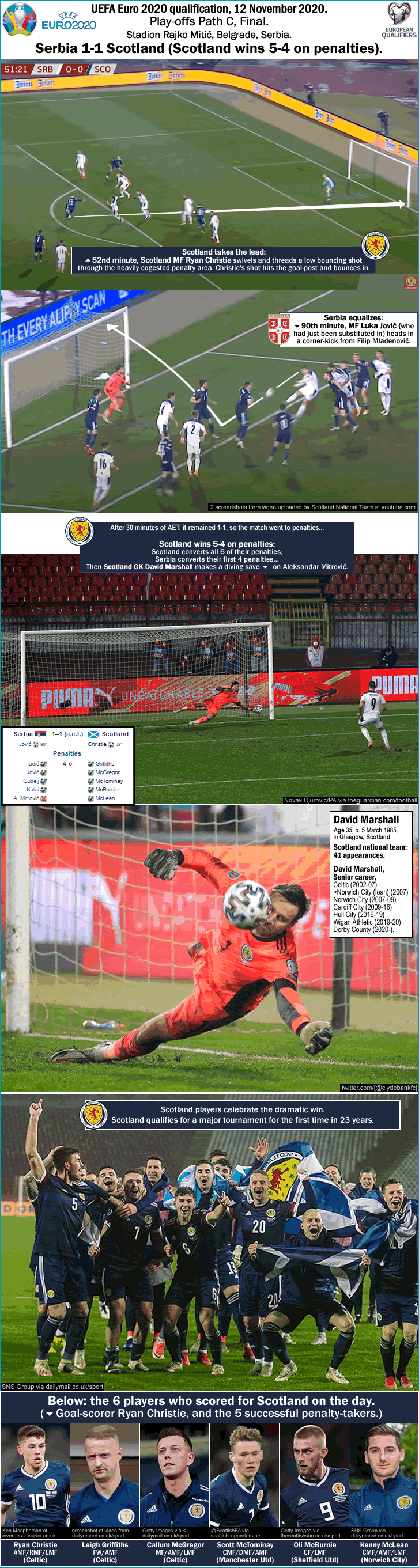
UEFA Euro 2020 qualification, 12 November 2020: Play-offs Path C, Final.
Stadion Rajko Mitić, Belgrade, Serbia.
Serbia 1-1 Scotland (Scotland wins 5-4 on penalties)…
uefa-euro-qualifying2020_scotland-beats-serbia_on-penalties_12-nov-2020_ryan-christie_david-marshall_r-christie_l-griffiths_c-mcgregor_s-mctominay_o-mcburnie_k-mclean_e_.gif
Photo and Image credits above – 2 screenshots from video uploaded by Scotland National Team at
youtube.com. David Marshall makes game-winning penalty save, photo by Novak Djurovic/PA via theguardian.com/football. Screenshot of image of box-score of match, from en.wikipedia.org//UEFA_Euro_2020_qualifying_play-offs#Serbia_v_Scotland. David Marshall making the match-winning save, photo from twitter.com/[@clydebankfc]. Close-up shot of David Marshall’s game-winning penalty save, from twitter.com/[@clydebankfc]. Scotland players celebrate, photo by SNS Group via dailymail.co.uk/sport. Ryan Christie, photo by Ken Macpherson at inverness-courier.co.uk. Leigh Griffiths, screenshot of video from dailyrecord.co.uk/sport. Callum McGregor, photo by Getty Images via dailymail.co.um/sport. Scott McTominay, photo by @ScottishFA via scottishsupporters.net. Oli McBurnie, photo by Getty Images via thescottishsun.co.uk/sport. Kenny McLean, photo by SNS Group via dailyrecord.co.uk/sport.


Please note: by clicking on the illustration below, you can place it in an enlargeable separate page.

    Scotland national team – Squad that won qualification for UEFA Euro 2020
    Starting line-up (plus substitutions) from match which clinched their qualification for the UEFA Euro 2020 competition….
    12 November 2020, in Belgrade, Serbia: Serbia 1-1 Scotland, aet (5-4 to Scotland on penalties).

scotland_national-team_uefa-euro-2020-qualifying_steve-clark_squad-that-qualified_12-nov-2020_serbia-1_1-scotland_scotland-wins-on-penalties-5-4_s_.gif
Photo and Image credits above -
Illustration of Scotland kits (2020), from en.wikipedia.org/Scotland_national_football_team. 2020 Scotland jersey, photo from soccerpro.com. Blank map of United Kingdom, by Daniel Dalet at d-maps.com. Blank map of Scotland, by: Eric Gaba, NordNordWest, Uwe Dedering at File:Scotland relief location map.jpg. Steve Clarke talking to the Scotland squad prior to extra time during the UEFA Euro 2020 qualifier between Serbia and Scotland at the Stadion Rajko Mitic on November 12, 2020, in Belgrade, Serbia, photo by Nikola Krstic/SNS Group via scotsman.com/sport/football. Steve Clarke, photo by Craig Williamson/SNS via thetimes.co.uk.
Squad…
Goalkeeper…David Marshall (Derby County), photo unattributed at derbycounty.news.
Defenders…Scott McTominay (Manchester Utd), photo by Getty Images via manchestereveningnews.co.uk/sport. Declan Gallagher (Motherwell), photo unattributed at scotsman.com/sport. Kieran Tierney (Arsenal), photo from premierleague.com/news.
Midfielders/Defensive Midfielders…Stephen O’Donnell (Motherwell), photo by Ross MacDonald / SNS Group / Getty Images via gettyimages.co.uk. Ryan Jack (Rangers), photo unattributed at heraldscotland.com/sport. Callum McGregor (Celtic), photo from SNS Group via glasgowlive.co.uk/sport/football. Andrew Robertson (Liverpool), photo from AFP via sports.ndtv.com.
Attacking Midfielders and Forwards…Lyndon Banks (QPR), photo by Andy Rowland / PRiME Media Images/Alamy Live News at alamy.com. John McGinn (Aston Villa), photo by Getty Images via leeds-live.co.uk/sport. Ryan Christie (Celtic), photo by Mark Runnacles/Getty Images via 90min.com. Andrew Robertson, photo from premierleague.com/news.
Substitutions...Callum Paterson (Sheffield Wednesday), photo from examinerlive.co.uk/sport. Leigh Griffiths (Celtic), photo by PA via thescottishsun.co.uk/sport. Kenny McLean (Norwich City), photo from twitter.com/[@NorwichCityFC]. Oli McBurnie (Sheffield United), photo unattributed at theathletic.com.


December 7, 2020

Germany: 2020-21 Bundesliga – Location-maps, with Seasons-in-1st-Division for the current 18 clubs & All-time German Titles list./+ Illustrations for the 18 venues in 2020-21 Bundesliga.

Filed under: Germany — admin @ 5:55 pm

germany-bundesliga_2020-21_location-map-of-the-18-clubs_attendance_titles_seasons-in-1st-div_post_d_.gif
Germany: 2020-21 Bundesliga – Location-maps, with Seasons-in-1st-Division for the current 18 clubs & All-time German Titles list

By Bill Turianski on 7 December 2020; twitter.com/billsportsmaps.

Links…
-2020-21 Bundesliga (en.wikipedia.org).
-World Football.net site…worldfootball.net/bundesliga.
-Official site of Bundesliga (English)…bundesliga.com/en/bundesliga.
-Deutsche Welle [in English]…DW/en/sports.


germany-2020-21-bundesliga_map_f_.gif
Credits above – Location-map by Bill Turianski. Blank map of Germany, by NordNordWest at File:Germany location map.svg (Wikimedia Commons).

    2020-21 German Bundesliga venues – the home stadiums of the 18 current Bundesliga clubs
    (Shown in order of the league table, from 8 December 2020 (after 10 weeks of the season)…

1st place, Bayern Munich: Allianz Arena, in Munich, Bavaria.
bayern-munich_allianz-arena_f_.gif
Photo credits above – Diego Delso at File:Allianz Arena, Múnich, Alemania, 2013-02-11, DD 16.JPG (commons.wikimedia.org). Inset aerial photo, by Shutterstock via techwireasia.com.

2nd place, Bayer Leverkusen: BayArena, in Leverkusen [Greater Cologne], North Rhine-Westphalia (part of the Rhine-Ruhr metropolitan region).
bayer-leverkusen_bayarena_d_.gif
Photo credit above – Arne Müseler at File:Bayarena Leverkusen 2020.jpg (commons.wikimedia.org).

3rd place, RB Leipzig: Red Bull Arena, in Leipzig, Saxony.
rb-leipzig_red-bull-arena_c_.gif
Photo credit above – Steffen Schellhorn/Imago via rblive.de/leipzig-stadion.


4th place, Borussia Dortmund: Westfalenstadion [aka Signal-Iduna Park], in Dortmund, North Rhine-Westphalia (part of the Rhine-Ruhr metropolitan region).
borussia-dortmund_westfalenstadion_aka-signal-iduna-park_d_.gif
Photo credit above – screenshot of video image uploaded by Borussia Dortmund at youtube.com.

5th place, VfL Wolfsburg: Volkswagen Arena, in Wolfsburg, Lower Saxony.
wolfsburg_volkswagen-arena_b_.gif

Photo credit above – signify.com.

6th place, Union Berlin: Stadion An der Alten Försterei, in Köpenick, south-eastern Berlin.
union-berlin_stadion-an-der-alten-forsterei_d_.gif
Photo credit above – Ralf Roletschek at Datei:19-08-17-Stadion-an-der-alten-Foersterei-DJI 0275.jpg (de.wikipedia.org).

7th place, Borussia Mönchengladbach: Borussia-Park, in Mönchengladbach, North Rhine-Westphalia (part of the Rhine-Ruhr metropolitan region).
monchengladbach_borussia-park_d_.gif
Photo credit above – nuernbergluftbild.de/luftbilder/[stadion-borussia-park-moenchengladbach].


8th place, VfL Stuttgart: Mercedes-Benz Arena, in Stuttgart, Baden-Württemberg.
/stuttgart_mercedes-benz-arena_b_.gif
Photo credit above – Carsten Reidl via tagblatt.de

9th place, Eintracht Frankfurt: Waldstadion [aka Deutche Bank Park], in Frankfurt am Main, Hesse.
eintracht-frankfurt_waldstadion_b_.gif
Photo credit above – unattributed at br.pinterest.com.

10th place, Hoffenheim: Rhine-Neckar Arena, in Sinsheim, in the Rhine-Neckar metro-region in Baden-Württemberg.
hoffenheim_rhein-neckar-arena_b_.gif
Photo credit above – unattributed at usports.in.

11th place, FC Augsburg: Augsburg Arena [aka WWK Arena], in Augsburg, Swabia, Bavaria.
augsburg_augsburg-park_c_.gif
Photo credit above – Ulrich Wagner/Archivfoto via augsburger-allgemeine.de/sport.


12th place, Hertha Berlin: Olympiastadion, in the Charlottenburg-Wilmersdorf district of the city-state of Berlin - the home of Hertha, Berliner Sport-Club.
hertha-berlin_olympiastadion_c_.gif
Photo credit above – stadionbetreiber.de/[berlin-olympiastadion].

13th place, Werder Bremen: Weser-Stadion, in Bremen, Free Hanseatic City of Bremen (city-state).
hwerder-bremen_weser-stadion_b_.gif
Photo credit above – bremen.eu/weser-stadium.

14th place, Freiburg: Schwarzwald-Stadion, in Freiburg im Breisgau, Baden-Württemberg.
freiburg_shwarzwald-stadion_b_.gif
Image credit above – screenshot of video uploaded by Google Earth Stadium Flights at youtube.com.

15th place, FC Köln: Rhein Energie Stadion in Cologne, North Rhine-Westphalia (part of the Rhine-Ruhr metropolitan region).
koln_rhein-energie-stadion_b_.gif
Photo credit above – rundschau-online.de.


16th place, Arminia Bielefeld: Bielefelder Alm, in Bielefeld, North Rhine-Westphalia.
arminia-bielefeld_bielefelder-alm_b_.gif
Photo credit above – arminia-bielefeld.de.

17th place, Mainz 05: Opel Arena, in Mainz, Greater Frankfurt, Rhineland-Palatinate.
mainz-05_opel-arena_c_.gif
Photo credit above – allgemeine-zeitung.de.

Last place, Schalke 04: Veltins-Arena, in Gelsenkirchen, North Rhine-Westphalia (part of the Rhine-Ruhr metropolitan region).
schalke-04_veltins-arena_b_.gif
Photo credit above – PA via offthepitch.com.

___
Thanks to all at the following links
-Blank map of Germany, by NordNordWest at File:Germany location map.svg (Wikimedia Commons).
-Map with Federal States of Germany from States of Germany (en.wikipedia.org).
-14 largest German cities from List of cities in Germany by population (en.wikipedia.org).
-Bundesliga;
-List of German football champions (en.wikipedia.org).
-(West) Germany – List of Champions (rsssf.com).

November 25, 2020

2020-21 FA Cup, 2nd Round: location-map, with fixtures; with attendances from the previous season./+ Illustration for Marine AFC, who had the biggest upset in the 1st Round (8th-level side Marine beats 4th-level side Colchester United [90 league places and 4 league-levels difference].)

Filed under: 2020-21 FA Cup — admin @ 10:00 pm

http://billsportsmaps.com/wp-content/uploads/2020/11/2020-21_fa-cup_2nd-round_map_w-fixtures_post_d_.gif
2020-21 FA Cup, 2nd Round: location-map, with fixtures; with attendances from the previous season


By Bill Turianski on the 25th of November 2020; twitter.com/billsportsmaps.
Links…
-The competition…FA Cup (en.wikipedia.org).
-BBC’s page on the competition…bbc.com/fa-cup.

FA Cup Second Round matches are set for Friday the 27th through Monday the 30th of November.
But before that, there is one 1st round match still to be played: Barrow AFC versus AFC Wimbledon, on Thursday the 26th of November. (That match, which had been scheduled for the 7th of November, had been postponed due to several AFC Wimbledon players being tested positive for COVID-19.) I will adjust the map page accordingly, following the outcome of that match.

    The biggest Cup-upset in 2020-21 FA Cup 1st Round…
    Marine AFC (8th level) beats Colchester United (4th division)…

Marine are from Crosby in Merseyside, 6 miles (by road) north of Liverpool. Marine are an 8th-level club playing in the Northern Premier League Division One North West. On Saturday the 7th of November, Marine traveled down to Essex to face 4th-division side Colchester United. In the 22nd minute, Marine DF Anthony Miley scored, on a rebound off the post from a free kick {see photos and captions below}. In the 64th minute, Colchester equalised with a goal from their captain, MF Harry Pell. At the final whistle, the match remained at 1-1. So it went to aet, and after that, it went to penalties. All 5 Marine players converted their penalty shots {see them below}. And so Marine AFC beat a club 4 League-levels and 90 League-places above them. In the Second Round, Marine have been drawn to play versus 6th-tier side Havant & Waterlooville, at their Rossett Park in Crosby. That match will be the late game on Sunday the 29th, and it will be televised. {Televised matches.}
marine-afc_2020-21-fa-cup-1st-round_win-over-colchester-utd_rossett-park_neil-young_t_.gif
Photo and Image credits above – Photo of Marine’s home ground, Rossett Park, from liverpoolecho.co.uk/sport. Neil Young (Marine AFC manager), photo from marinefc.com. Modified badge of Marin AFC (old-gold background), from marinefc.com/video. Screenshot of Anthony Miley goal, from video uploaded by The Emirates FA Cup at youtube.com. Photo of Marine players congratulating Anthony Miley after his goal in FA Cup, photo unattributed at bbc.com/sport. Screenshot of Michael Howard scoring the winning penalty kick, from video uploaded by The Emirates FA Cup at youtube.com. Photo of Michael Howard scoring winning penalty kick, by Ray Lawrence/TGS Photo/Rex via dailymail.co.uk. Marine players celebrate after penalty shootout win over Colchester, photo from bbc.com/sport/live/football. Anthony Miley, photo frommarinefc.com. Momodou Touray, photo from clwbpeldroed.org/2019/09/03/momodou-touray-barry-town-cymru-premier. Adam Hughes, photo from Marine FC via theanglingrev.com. Neil Kengnie, photo by Susan Nugent at twitter.com/[@SusanNugent2]. David Raven, photo by Susan Nugent at twitter.com/[@SusanNugent2]. Michael Howard, photo from marinefc.com.


___
Sources…
Thanks to all, at the links below…
-Blank map of English Metropolitan and Non-Metropolitan Counties, by Nilfanion, at File:English metropolitan and non-metropolitan counties 2010.svg (commons.wikimedia.org).
-Blank relief map of Greater London, by Nilfanion (using UK Ordnance Survey data), at File:Greater London UK relief location map.jpg.
-Blank relief map of Greater Manchester, by Nilfanion (using Ordnance Survey data), at File:Greater Manchester UK relief location map.jpg.
-Fixtures list: screenshot from bbc.com/fa-cup.
Attendance figures…
-European-Football-Statistics.co.uk (2019-20 average attendances for the 3rd and 4th division.)
-nonleaguematters.co.uk. (2019-20 average attendances for all non-League clubs on the map, from the 5th division to the 8th division.)

November 13, 2020

2020 Copa Libertadores: map of Final Stages (16 teams)./+ Illustrations for 2020 Libertadores Round of 16 venues – all sixteen of the Round-of-16 stadiums.

Filed under: Copa Libertadores — admin @ 8:36 pm

conmebol_copa-libertadores_2020_location-map_final-stages_16-teams_post_c_.gif
2020 Copa Libertadores: map of Final Stages (16 teams)

By Bill Turianski on the 13th of November 2020; twitter.com/billsportsmaps.
Links…
-2020 Copa Libertadores/Final Stages (en.wikipedia.org).
-Summary – CONMEBOL Libertadores – Final Stages [2020] (soccerway.com).


The Round of 16
The first legs of the 2020 Copa Libertadores Round of 16 will be played on the 24th, 25th, and 26th of November {click on the links above for the fixtures}.

Brazil led with six teams in the final 16, followed by Argentina and Ecuador with three teams each, Paraguay with two teams, and Bolivia and Uruguay with one team each. The big surprises here were A) the fact that a Bolivian team advanced to the round of 16 (Jorge Wilstermann), and B) that for the first time ever, three Ecuadorian teams have made it to the round of 16. Those three teams from Ecuador are: LDU Quito (who won the Libertadores title in 2008), Independiente del Valle (who were a Libertadores finalist in 2016), and newcomers Delfín (who have now advanced to the round of 16 in only their 3rd-ever Libertadores appearance). You can see the stadiums of these three teams, as well as all the others, below.

(Teams/venues below listed by Seeds {2020 Libertadores Round of 16/Qualified teams/seeds {en.wikipedia.org}.)

    Below: 2020 Libertadores Round of 16 venues – all 16 clubs’ stadiums…

Seed #1: Palmeiras (Brazil) – Allianz Parque [aka Palestra Itália Arena], in São Paulo, Brazil.
palmeiras_allianz-parque_sao-paulo-brazil_e_.gif
Image credit above – screenshot from video uploaded by One Man Wolfpack at youtube.com.

Seed #2: Santos (Brazil) – Vila Belmiro (aka Estádio Urbano Caldeira), in Santos, São Paulo state, Brazil.
santos-fc_vila-belmiro_santos-brazil_h_.gif
Image credit above – screenshot from video uploaded by Helder Almeida at youtube.com.

Seed #3: Flamengo (Brazil) – Maracanã [aka Estádio Jornalista Mário Filho], in Rio de Janeiro, Brazil.
flamengo_maracana_rio-de-janeiro-brazil_b_.gif
Image credit above – screenshot from video uploaded by Discovery Channel Southeast Asia at youtube.com.

Seed #4: Club Nacional (Uruguay) – Gran Parque Central, in Montevideo, Uruguay.
club-nacional_gran-parque-central_montevideo-uruguay_b_.gif
Photo credit above – unattributed at br.pinterest.com.


Seed #5: Boca Juniors (Argentina) – La Bombonera (‘the Chocolate Box’), in La Boca district of Buenos Aires FD, Argentina.
boca-juniors_la-bombonera_buenos-aires-argentina_d_.gif
Photo credit above – worldstrides.com.

Seed #6: River Plate (Argentina) – El Monumental, in the Belgrano district of Buenos Aires FD, Argentina.
river-plate_el-monumental_buenos-aires-argentina_c_.gif
Photo credit above – Fulviusbsas at File:RiverPlateStadium.jpg (commons.wikimedia.org).

Seed #7: Grêmio (Brazil) – Arena do Grêmio, in Porto Alegre, Rio Grande do Sul state, Brazil.
gremio_arena-do-gremio_port-alegre-brazil_b_.gif
Photo credit above – unattributed at deville.com.br/blog.

Seed #8: CD Jorge Wilstermann (Bolivia) – Estadio Sudamericano Félix Capriles, in Cochabamba, Bolivia.
wilstermann_estadio-felix-capriles_cochacambra-bolivia_b_.gif
Photo credit above – unattributed at regupol.com.


Seed #9: Racing (Argentina) – El Cilindro, in Avellaneda, Greater Buenos Aires, Argentina.
racing_el-cilindro_avelleneda-greater-buenos-aires-argentina_d_.gif
Photo credit above – unattributed at radiomitre.cienradios.com/cilindro-avellaneda-festeja-68-anos-vida.

Seed #10: Club Guaraní (Paraguay) – Estadio Rogelio Livieres, in Asunción, Paraguay.
guarani_estadio-rogelio-s-livieres_asuncion-paraguay_b_.gif
Photo credit above – File photo from abc.com.py/deportes.

Seed #11: Independiente del Valle (Ecuador) – Estadio Rumiñahui, in Sangolquí, Ecuador
independiente-del-vallee_estadio-ruminahui_sangolqui-greater-quito-ecuador_b_.gif
Image credit above – screenshot of photo by Daniel Corella [March 2019] at google.com/maps.

Seed #12: LDU [Quito] (Ecuador) – La Casa Blanca, in Quito, Ecuador.
du-quito_estadio-rodrigo-paz-delgado_quito-ecuador_c_.gif
Photo credit above – unattributed at m.facebook.com via skyscrapercity.com.


Seed#13: Athletico Paranaense (Brazil) – Arena da Baixada (aka Estádio Joaquim Américo), in Curitiba, Paraná, Brazil.
athletico-paranaense_arena-da-baixada_curitiba-parana-brazil_b_.gif
Image credit above – screenshot from video uploaded by Wassmansdorff at youtube.com.

Seed #14: Internacional (Brazil) – Estádio Beira-Rio, in Porto Alegre, Rio Grande do Sul state, Brazil.
http://billsportsmaps.com/wp-content/uploads/2020/11/internacional_estadio-beira-rio_porto-alegre-brazil_c_.gif
Photo credit above – unattributed at pinterest.com.

Seed #15: Delfín (Ecuador) – Estadio Joacay, in Manta, Ecuador.
delfin-sc_estadio-jocay_manta-ecuador_d_.gif
Photo credit above – eldiario.ec.

Seed #16: Libertad (Paraguay) – Tuyukuá, in Asunción, Paraguay.
libertad_tuyukua_asuncion-paraguay_b_.gif
Photo credit above – LN via hoy.com.py/deportes.
___
Thanks to all at the links below…
-Globe-map of South America by Luan at File:South America (orthographic projection).svg (en.wikipedia.org/[South America]).
-Blank map of South America by Anbans 585 at File:CONMEBOL laea location map without rivers.svg (en.wikipedia.org/[2018 Copa Libertadores]).
-2020 Copa Libertadores (en.wikipedia.org).
-Copa Libertadores 1960-2019 Club Histories (rsssf.com).
-Libertadores titles list {en.wikipedia.org/wiki/Copa_Libertadores#Performances_by_club}.

October 31, 2020

2020-21 FA Cup, 1st Round: location-map, with fixtures; with attendances from the previous season./+ Illustrations for the 3 clubs which are making their FA Cup 1st Round debuts…Cray Valley (PM) FC, King’s Lynn Town FC, South Shields FC (III).

Filed under: 2020-21 FA Cup — admin @ 6:54 pm

2020-21_fa-cup_1st-round_map_w-fixtures_post_f_.gif
2020-21 FA Cup: location-map, with fixtures; with attendances from the previous season


By Bill Turianski on 31 October 2020; twitter.com/billsportsmaps.
Links…
-The competition…FA Cup (en.wikipedia.org).
-BBC’s page on the competition…bbc.com/fa-cup.

First Round matches are set for Friday the 6th through Monday the 9th of November.
The opening match on Friday the 6th will feature the lowest-placed club still alive in the competition, 9th-level side Skelmersdale United of Lancashire. Skelmersdale play in the North West Counties League, and are the first NWCL club to reach the First Round in 23 years (since 1997). Skelmersdale will travel to North Yorkshire to play Harrogate Town (who are a 4th-division side newly promoted to the Football League for the first time). This match will be televised {televised matches, here}.

The map page has a new template…the map now features only England & Wales (I have cropped out Scotland). I did this to give the map-area more space.

And I sure was glad I did make the map larger, when I saw the results of the Fourth Qualifying Round. Because there are two examples of clubs qualifying for this year’s FA Cup 1st Round that are located less than 3 miles apart…
•Two clubs have qualified from Canvey Island, on the north shore of the Thames Estuary in Essex. Both Concord Rangers FC (a 6th-tier club in the National League South) and Canvey Island FC (an 8th-level club in the Isthmian League North) have qualified for the 1st Round. As near as I could ascertain, these two clubs’ grounds are around 1.7 miles (or 2.8 km) apart.
•And 36 miles west of that, on the south side of the River Thames, two clubs from the Borough of Greenwich in South East London, have qualified for the 1st Round. One of them you would certainly have heard of: League One/3rd-division side Charlton Athletic FC. The other club you might very likely never have heard of: Cray Valley Paper Mills FC (an 8th-level side in the Isthmian South-East). As near as I could ascertain, these two clubs’ grounds are around 2.4 miles (or 3.9 km) apart.
(Note: the two clubs from Oxford that have qualified for the 1st Round – 6th-tier side Oxford City (in the north-east of Oxford) and League One/3rd-division side Oxford United (in the south-east of Oxford) are located about 4.1 miles (6.6 km) apart.)

This is Cray Valley’s first-ever appearance in the FA Cup 1st Round, so I put together an illustration for them below, along with illustrations for this season’s other two 1st-Round first-timers: King’s Lynn Town FC (a 5th-division side) and South Shields FC (a 7th-tier side). On Sunday the 8th of November, Cray Valley will travel to Hampshire to face 6th-tier side Havant & Waterlooville (at 12:45 GMT).

    The 3 clubs making their first appearance in the FA Cup First Round…Cray Valley Paper Mills, King’s Lynn Town, South Shields.

Cray Valley (PM) FC – FA Cup 1st Round debut in 2020-21, for the 101-year-old club…
cray-valley-pm_badgers-sports-ground_eltham-greenwich-se-london_fa-cup-1st-round-debut2020_m_.gif
Photo an Image credits above – Nash’s Cray Valley Paper Mills, aerial photo (circa 1930s) unattributed at cvths.wordpress.com/2014/05/24/nashs-paper-mill-war-diary. Main Stand, photo by the Wycombe Wanderer at footygrounds.blogspot.com. Cray Valley (PM) manager Kevin Watson, photo from pitchero.com/clubs/crayvalleypmfc. Ade Yussef celebrates his brace with teammates and fans, photo by Dave Cumberbatch at crayvalleypmfc.com. Francis Babalola after scoring the winner versus Maidenhead United, photo by Dave Cumberbatch via 853.london. Cray Valley players run to celebrate with the few supporters allowed into the ground, photo by Dave Cumberbatch via kentonline.co.uk.


King’s Lynn Town FC – FA Cup 1st Round debut in 2020-21, for the 10-year-old phoenix-club…
kings-lynn-town-fc_the-walks_norfolk_fa-cup-1st-round-debut2020_r_.gif
Photo and Image credits above – Aerial shot [satellite image], screenshot from bing.com/maps. Main Stand, photo by Owen Pavey at footballgroundguide.com/king-lynn-town-the-walks. Standing crowd in front of fully-occupied Main Stand [photo circa August 2019], photo by Ian Burt at edp24.co.uk/sport/kings-lynn-town Ian Culverhouse, photo by Geoff Moore at edp24.co.uk/sport. Adam Marriott, photo from lynnnews.co.uk/sport.


South Shields FC (III) – FA Cup 1st Round debut in 2020-21, for the 46-year-old phoenix-club…
south-shields-fc-iii_1st-cloud-arena-aka-mariners-park_south-shields_tyne-and-wear_fa-cup-1st-round-debut2020_k_.gif
Photo an Image credits above – view of South Shields, photo by David Dixon at geograph.org.uk. Aerial image of Mariners Park from bing.com/maps/[birds-eye view]. Crowd at Mariners Park circa 2019, three-deep in the standing, with Clock Stand in background, photo from southshieldsfc.co.uk. Darius Osei scores in 4th QR, photo by Ken Wilson at flickr.com/southshieldfcimages. Robert Briggs doubles the lead in 4th QR, screenshot from video uploaded by South Shields FC at youtube.com. Post-match, 4th QR: Dual-managers Lee Picton and Graham Fenton celebrate with players and staff after the win, screenshot from video uploaded by South Shields FC at youtube.com.

___
Sources…
Thanks to all, at the links below…
-Blank map of English Metropolitan and Non-Metropolitan Counties, by Nilfanion, at File:English metropolitan and non-metropolitan counties 2010.svg (commons.wikimedia.org).
-Blank relief map of Greater London, by Nilfanion (using UK Ordnance Survey data), at File:Greater London UK relief location map.jpg.
-Blank relief map of Greater Manchester, by Nilfanion (using Ordnance Survey data), at File:Greater Manchester UK relief location map.jpg.
-Fixtures list: screenshot from bbc.com/fa-cup.
Attendance figures…
-European-Football-Statistics.co.uk (2019-20 average attendances for the 3rd and 4th division.)
-nonleaguematters.co.uk. (2019-20 average attendances for all non-League clubs on the map, from the 5th division to the 9th division.)
-Thanks to Dave Cumberbatch at crayvalleypmfc.com/photos, for the 3 photos.
-Thanks to Cray Valley (PM) FC, for retweeting my tweet; twitter.com/[@CrayValleyPM].

October 13, 2020

2020-21 UEFA Champions League Group Stage: Location-map, with chart showing UEFA CL Group Stage appearances & titles for the 32 clubs.

Filed under: UEFA Champions League — admin @ 4:55 pm

uefa_champions-league_2020-21-group-stage_map_with-titles-and-group-stage-appearances-by-club_post_f_.gif
2020-21 UEFA Champions League Group Stage: Location-map, with chart showing UEFA CL Group Stage appearances & titles for the 32 clubs


By Bill Turianski on the 13th of October 2020; twitter.com/billsportsmaps.

I haven’t made a Champions League map in a while (6 years), and so I decided to make this one.

The map is a standard location-map showing the locations of the 32 qualified teams in the 2020-21 UEFA Champions League Group Stage.

There are several other aspects to the map page…
1). Groups A through H
At the very top of the map are the eight 4-team groups of the Group Stage, arranged with with each club’s home-country flag shown alongside.

2). Allocations vs. Qualified teams, by country
At the left side of the map page, Allocations (by member-nations) are shown, via a list of the top 33 UEFA Member-Associations in their current [2020-21] Country Co-efficient ranking. I stopped at 33 (out of the 55 total UEFA member-nations) because #33 is the current ranking of Hungary, and Hungary’s Ferencváros was the club from the lowest-ranked country to qualify for this season’s tournament. Hungary is currently ranked below Leichtenstein, for crying out loud, so congratulations to Ferencváros for qualifying (for the first time in 25 years, no less).

3). Average Attendances of the 32 clubs (home domestic league matches from previous season)…
Flanking the western-edge of the map is the most recent ‘normal’ attendance figures for the 32 clubs…attendances from last season’s home domestic league matches (2019-20 season), pre-COVID, ie pre-15th March (or so). In other words, with regards to the matches from last season that had zero attendance because they were played post-COVID and behind closed doors…those zero-attendance matches were not counted in the average attendance figures. I added the previous sentence because some sites, like Soccerway.com and WorldFootball.net, have decided to include the post-COVID/closed-door-matches to each club’s attendance average figures. Thankfully, the excellent European Football Statistics site did not adhere to this, and discounted closed-door/zero-attendance matches…and that site’s figures are used here for the average attendance column on the map page. {Here is the European Football Statistics.co.uk site.}


4). 2020-21 UEFA Champions League Group Stage: List of 2020-21 UEFA CL Group Stage teams by CL GS appearances, including European titles…
At the far right-hand side of the map page, all 32 clubs in the Group Stage are shown, by total Group Stage appearances, with consecutive appearances -/- or, previous appearance. Please note: the Group Stage aspect of this competition did not begin with the re-branding of the tournament in 1992-93…it began one season earlier. Here…1991-92 UEFA European Cup (en.wikipedia.org)…the last European Cup tournament in 1991-92 featured a Group Stage (of 8 teams; two of which are in the 2020-21 iteration – FC Barcelona and Dynamo Kyiv). Wikipedia doesn’t include the 1991-92 tournament in their total-Group-Stage-appearances list. But RSSSF does {here: Champions League – All-Time Table [(1991/92-2013/14]}. The competition didn’t change with the re-branding from the European Cup to the Champions League in 1992-93…the name just changed. Yes, the competition has evolved, but it had already evolved into a Group Stage, one year before the re-brand.

5). UEFA European Titles list
At the lower-right-hand corner of the map page is a list showing all of the 22 European title-winning clubs, listed by total titles won. (65 European titles: European Cup titles, 1955-56 to 1991-92; Champions League titles, 1992-93 to 2019-20.)

Here is the breakdown of UEFA European titles by Country (1956-2020)…
Spain: 18 titles, won by 2 clubs. (Real Madrid, 13 titles; FC Barcelona, 5 titles.)
England: 13 titles, won by 5 clubs. (Liverpool, 6 titles; Manchester United, 3 titles; Nottingham Forest, 2 titles; Chelsea, 1 title; Aston Villa, 1 title.)
Italy, 12 titles, won by 3 clubs. (Milan, 7 titles; Internazionale, 3 titles; Juventus, 2 titles.)
Germany: 8 titles, won by 3 clubs. (Bayern Munich, 6 titles; Borussia Dortmund, 1 title; Hamburger SV, 1 title.)
Netherlands: 6 titles, won by 3 clubs. (Ajax, 4 titles; PSV Eindhoven, 1 title; Feyenoord, 1 title.)
Portugal: 4 titles, won by 2 clubs. (FC Porto, 2 titles; Benfica, 2 titles.)
France: 1 title. (Olympique Marseille.)
Yugoslavia: 1 title. (Red Star Belgrade.)
Romania: 1 title. (Steaua Bucharest.)
Scotland: 1 title. (Celtic.)
___
Thanks to all at the following links…
-Blank map, by Alexrk2 at File:Europe laea location map.svg (commons.wikinedia.org).
-Attendances, from european-football-statistics.co.uk.
-UEFA Champions League (en.wikipedia.org).

September 24, 2020

2020-21 EFL Championship location-map, with 2019-20 Modified table, with attendances + Seasons-in-1st-division & Seasons-in-2nd-division (current EFL Championship clubs)./ Plus, illustrations for the 3 promoted clubs (Coventry City, Rotherham United, Wycombe Wanderers).

Filed under: 2020-21 English football,Eng-2nd Level/Champ'ship — admin @ 8:03 pm

2020-21_efl-championship_map_with_2019-20-modified-table_2019-20-crowds_all-time-seasons-in-1st-div-and-2nd-div-for-the-24-clubs_all-time-titles-list_post_b_.gif
2020-21 EFL Championship location-map, with 2019-20 Modified table, with attendances + Seasons-in-1st-division & Seasons-in-2nd-division (current EFL Championship clubs)


By Bill Turianski on the 24th of September 2020; twitter.com/billsportsmaps.

    Below are illustrations for the 3 newly-promoted clubs in the EFL Championship (Coventry City, Rotherham United, Wycombe Wanderers).

    Below: the 2020 EFL League One champions: Coventry City (the homeless Coventry City returns to the 2nd tier, after an 8-year spell in the lower Leagues)…
    coventy-city_promoted-2020_ricoh-arena-dispute-with-map-of-ccfc-venues_mark-robins_matt-godden_jordan-shipley_fankaty-dabo_liam-walsh_f_.gif
    Photo and Image credits above – Blank map of UK metroploitan & non-metropolitan counties, by Nilfanion at commons.wikimedia.org. Aerial shot of Ricoh Arena unattributed at psam.uk.com. Illustrations of the three 2019-20 Coventry City jerseys: illustrations by footballshirthistory.weebly.com/[Coventry City]. Mark Robins, photo from ccfc.co.uk/news. Matt Godden, photo by Marc Atkins/Getty Images via portsmouth.co.uk/sport. Jordan Shipley, photo from PA Wire via newschain.uk/sport. Fankaty Dabo, photo by AMA Sports Photo Agency via coventrytelegraph.net/sport. Liam Walsh, photo from ccfc.co.uk/news


    Below: Rotherham United: 2nd place finish in the 2019-20 EFL League One (Rotherham are promoted straight back to the 2nd division)…
    rotherham-united_promoted-2020_new-york-stadium_paul-warne_freddie-ladapo_matt-crooks_michael-smith_michael-ihiekwe_daniel-barlaser_e_.gif
    Photo and Image credits above – Aerial shot of the New York Stadium, photo from burgesscommercial.co.uk/properties. Exterior shot of the New York Stadium, from yorkshirepost.co.uk/sport. Illustrations of the three 2019-20 Rotherham United jerseys: illustrations by footballshirthistory.weebly.com/[Rotherham United]. Paul Warne, photo from rotherhamadvertiser.co.uk/news. Freddie Ladapo, photo from rotherhamadvertiser.co.uk/news. Matt Crooks, photo by JR Brailsford via facebook.com. Michael Smith, photo from themillers.co.uk/news. Michael Ihiekwe, photo from thestar.co.uk/sport. Daniel Barlaser, photo by Nigel French/PA Images via Getty Images via gettyimages.com.


    Below: Wycombe Wanderers: 2020 EFL League One Play-off Final winners (Wycombe are promoted to the 2nd division for the first time in the club’s 133-year history)…
    wycombe-wanderers_promoted-2020_adams-park_gareth-ainsworth_joe-jacobson_adebayo-akinfenwa_anthony-stewart_matt-bloomfield_i_.gif
    Photo and Image credits above – Shot of Adams Park from wycombewanderers.co.uk/news. Pre-game scene outside Adams Park (Chairboys Village), photo from twitter.com/[@wwfcofficial]. Stained-glass window at High Wycombe Guildhall, marking the end of the First World War [made circa 1919], photo by Thorskegga Thorn at flickr.com. 3 Wycombe Wanderers chained-goose crests (1930s, 1990s, 1999) from hisoricalkits.co.uk/Wycombe_Wanderers. Illustrations of the two 2019-20 Wycombe Wanderers’ jerseys, by footballshirthistory.weebly.com/w—y/category/wycombe-wanderers. Gareth Ainsworth, photo by PRiME Media Images via bucksfreepress.co.uk/sport. Joe Jacobson, photo from skysports.com/football/news. Adebayo Akinfenwa, photo from bucksfreepress.co.uk/sport. 1st goal in Play-off Final (Anthony Stewart), image from screenshot from video uploaded by EFL at youtube.com. Anthony Stewart and teammates celebrate 1st goal, photo from twitter.com/[@wwfcofficial]. Joe Jacobson scores 2nd goal from penalty spot, photo by Getty Images via bbc.com/sport/football. Post-match celebration (Captain Matt Bloomfield and Adebayo Akinfenwa lift the trophy), image from screenshot from video uploaded by EFL at youtube.com.

___
Thanks to all at the following
-Blank map of UK historic counties, by Nilfanion (using UK Ordnance Survey data), at File:United Kingdom police areas map.svg (commons.wikimedia.org).
-Blank relief map of Greater London, by Nilfanion (using UK Ordnance Survey data), at File:Greater London UK relief location map.jpg.
-Club histories, from Football Club History Database at fchd.info/[index].
-Seasons in 1st division (all-time), from RSSSF at England – First Level All-Time Tables 1888/89-2018/19 (rsssf.com).
-Seasons in 2nd division, 3rd division, 4th division (all-time), from myfootballfacts.com – Club League History Summary 1888-89 to 2020-21.
-2019-20 kit illustrations from footballshirthistory.weebly.com.
-Thanks to the contributors at EFL Championship (en.wikipedia.org).

September 7, 2020

2020-21 Premier League location-map, with 2019-20 league table, incl. top 6 finishers from 2nd division, with 2019-20 Attendances + Seasons-in-1st-division (current clubs) & All-time English Titles list./ Plus, illustrations for reigning champions Liverpool FC, and the 3 promoted clubs (Leeds, West Bromwich, Fulham).

2020-21_premier-league_map_post_b_.gif
2020-21 Premier League location-map, with 2019-20 league table, incl. top 6 finishers from 2nd division +Attendances from 2019-20 + Seasons-in-1st-division & English Title-winners list


By Bill Turianski on the 7th of September 2020; twitter.com/billsportsmaps.

    2020-21 Premier League location-map, with 2019-20 league table, incl. top 6 finishers from 2nd division, with 2019-20 Attendances + Seasons-in-1st-division (current clubs) & All-time English Titles list.

The location-map is the same as before, but the 3 charts on the map page are all new. Because of the COVID pandemic, I have de-emphasised attendance data (for obvious reasons). So, where before I had listed teams by average attendance, I now have listed the teams by last season’s finish.

So the current [2020-21] Premier League clubs are listed by 2019-20 finish, in a modified table.
The modified table features five things: #(Rank in English Pyramid), Matches, Goal Difference, Points, and Average Attendance (from 2019-20 home league matches before 15 March). This modified table includes the 6 top finishers from the 2nd division last season (and that is where Rank in English Pyramid comes in). And that’s where you will find the three newly promoted clubs, shown with bright-green bars (automatic -promotion-winners, Leeds United and West Bromwich Albion; and the Championship Play-off winner, Fulham). The 3 teams relegated from the top flight last season are only listed on the modified table, and are not shown on the map, and are shown on the modified table with pale-red bars (relegated clubs were: Bournemouth, Watford, Norwich City). Also shown on the modified table but not shown on the map are the three top-6-finishers from last season’s 2nd tier who failed to win promotion (Brentford, Cardiff City, Swansea City).

Also shown in the modified table are the teams who qualified for Europe. Royal blue bars in the modified table indicate UEFA Champions League qualification (top 4 finishers: Liverpool, Manchester City, Chelsea, Manchester United). Pale-blue bars indicate UEFA Europa League qualification (5th- and 6th-place finishers, plus FA Cup winner: Leicester City, and Tottenham Hotspur, plus Arsenal).

The second chart shows All-time Seasons in the 1st division (Current clubs).
This chart shows 4 things: All-time Rank, Seasons in the 1st division, Consecutive Seasons in the 1st division, and 2020-21 Jersey. (Counting 2020-21, there have now been 122 seasons of 1st division football in England.) Illustrations of the Jersey-segments are all from the excellent Historical Football Kits site {historicalkits.co.uk}. Data from RSSSF at this page {rsssf.com/tablese/engalltime.html}.

The third chart simply shows the All-time English Titles list. (Football League titles from 1889 to 1992; Premier League titles from 1993 to 2020.)
This chart shows 3 things: Titles won, Last title won, and Most-recent season in 1st division (ie, Current, or otherwise). There have been 24 clubs that have won an English title; 15 of those clubs are currently in the top flight. The clubs that have won English titles but are not currently in the 1st division are: Sunderland, Sheffield Wednesday, Blackburn Rovers, Huddersfield Town, Derby County, Portsmouth, Preston North End, Nottingham Forest, and Ipswich Town.

Below are illustrations for 4 teams: reigning champions Liverpool, plus the 3 newly-promoted clubs.

    Below: the 2020 Premier League champions: Liverpool (their first English title in 30 years)…

liverpool-fc_champions2020_anfield_jurgen-klopp_m-salah_s-mane_r-firmino_t-alexander-arnold_a-robertson_v-van-dijk_j-henderson_c_.gif
Photo and Image credits above – Aerial shot of Anfield [April 2020], photo by Getty Images via liverpoolfc.com/news. Premier League trophy, photo from barclaycardtravel.com. Illustrations of the three 2019-20 Liverpool jerseys: illustrations by footballshirthistory.weebly.com/[Liverpool]. Jürgen Klopp, photo brightonandhoveindependent.co.uk/sport. Mohammed Salah, photo from liverpoolfc.com/news. Sadio Mané, photo by Paul Ellis/AFP via thestatesman.com/sports. Trent Alexander-Arnold, photo unattributed at liverpoollatestnews.com. Roberto Firmino, photo unattributed at rushthekop.com. Andrew Robertson, photo unattributed at squawka.com. Virgil van Dijk, photo by Getty Images via no.shotoe.com. Jordan Henderson, photo unattributed at mightyceeblog.com.


    Below: the 3 promoted clubs (Leeds United, West Bromwich Albion, Fulham)…

Leeds United AFC: promoted to the Premier League, as winners of the 2019-20 EFL Championship
leeds-united-afc_promoted-2020_elland-road_marcelo-bielsa_p-bamford_p-hernandez_m-klich_j-harrison_m_.gif
Photo and Image credits above – Aerial shot of Elland Road, photo by the Football Architect UK via picfair.com. Illustrations of the three 2019-20 Leeds United jerseys: illustrations by footballshirthistory.weebly.com/[Leeds United]. Marcelo Bielsa, photo unattributed at ninetyminutesonline.com. Patrick Bamford, photo unattributed at footballleagueworld.co.uk. Pablo Hernández, photo unattributed at thisisfutbol.com. Mateusz Klich, photo by Alex Dodd – CameraSport/Getty Images via tbrfootball.com. Jack Harrison, photo by Tony Johnson via yorkshireeveningpost.co.uk/sport.


West Bromwich Albion: promoted as 2nd-place finishers in 2019-20 EFL Championship
west-bromwich-albion_promoted-2020_the-hawthorns_slaven-bilic_m-pereira_g-diangana_m-phillips_c-austin_h-robson-kanu_m_.gif
Photo and Image credits above – Aerial shot of the Hawthorns by Webb Aviation at webbaviation.co.uk. 19/20 WBA jersey, photo unattributed at footballkitnews.com. Illustrations of the three 2019-20 West Bromwich jerseys: illustrations by footballshirthistory.weebly.com/[West Bromwich]. Slaven Bilić , photo by AMA via expressandstar.com/sport. Matheus Periera, photo by AMA via expressandstar/sport. Grady Diangana, photo by Robbie Jay Barratt – AMA/WBA FC via Getty Images via football.london. Matt Phillips, photo unattributed at soccersouls.com. Charlie Austin, photo unattributed at birminghammail.co.uk/sport. Hal Robson-Kanu, photo by PA via walesonline.co.uk/sport.


Fulham FC: promoted, as winners of the 2020 EFL Championship Play-off Final (Fulham 2-1 Brentford (aet).)
fulham-fc_promoted-2020_craven-cottage_scott-parker_a-mitorvic_i-cavaleiro_t-cairney_j-bryan_i_.gif
Photo and Image credits above – Aerial shot of Craven Cottage, photo by Getty Images via independent.co.uk/sport. Illustrations of the three 2019-20 Fulham jerseys: illustrations by footballshirthistory.weebly.com/[Fulham]. Scott Parker, photo by Naomi Baker/Getty Images via theguardian.com/football. Joe Bryan’s 1st goal in Play-off Final, screenshot from video uploaded by EFL at youtube.com. Joe Bryan’s 2nd goal, photo by Javier Garcia/BPI/Rex via dailymail.co.uk/sport. Aleksandar Mitrović, photo unattributed at footballleagueworld.co.uk. Ivan Cavaleiro, photo unattributed at fulham.fandom.com. Tom Cairney, photo by Jacques Feeney/MI News/NurPhoto via Getty Images via soccer.nbcsports.com. Joe Bryan, photo unattributed at footballleagueworld.co.uk.


___
Thanks to all at the following…
-Blank map of UK historic counties, by Nilfanion (using UK Ordnance Survey data), at File:United Kingdom police areas map.svg (commons.wikimedia.org).
-Blank relief map of Greater London, by Nilfanion (using UK Ordnance Survey data), at File:Greater London UK relief location map.jpg.
-Attendances from E-F-S site, european-football-statistics.co.uk/attn.htm.
-Jersey illustrations from Historical Football Kits site at historicalkits.co.uk.
-Club histories, from Football Club History Database at fchd.info/[index].
-Seasons in 1st division (all-time), from RSSSF at England – First Level All-Time Tables 1888/89-2018/19 (rsssf.com).
-2019-20 kit illustrations from footballshirthistory.weebly.com.
-Thanks to the contributors at Premier League (en.wikipedia.org).

August 23, 2020

NFL 1963 season, map with helmets/jerseys & final standings + offensive stats leaders; champions: Chicago Bears.

Filed under: NFL>1963 map/season,NFL/ Gridiron Football,Retro maps — admin @ 9:50 am

nfl_1963_map-with-helmets_1963-standings_offensive-stats-leaders_home-jerseys_chicago-bears-champs_post_e_.gif
NFL 1963 season, map with helmets/jerseys & final standings + offensive stats leaders; champions: Chicago Bears


By Bill Turianski on the 23rd of August 2020; twitter.com/billsportsmaps.
Links…
-1963 NFL season
-1963 NFL Championship Game (en.wikipedia.org).
-1963 NFL season (pro-football-reference.com).

-The Chicago Bears win the 1963 NFL Championship (by Larry Kart at chicagotribune.com).

1963 NFL title game: Chicago Bears 14, New York Giants 10 (Bears win their 8th title, and their first title in 17 years)…
The 1963 NFL Championship Game (December 29 1963) was played at Wrigley Field, with a full house of 45,801 on hand, despite the windy and freezing 8°F temperature [-13° Celsius].

The game pitted the NFL’s best offense (the Giants) against the league’s best defense (the Bears).

The 1963 Chicago Bears defense had conceded a then-record low of only 10.2 points-per-game, and finished 11-1-2 to win the Western Conference. Two of the Bears’ eleven wins came against the defending champions, Vince Lombardi’s Green Bay Packers, and the Bears ended up beating out the Packers for the Western title by just half a game (the Packers finished 11-2-1). The heart of the Bears’ crushing defense was their linebacker trio of Bill George (MLB), Larry Morris, and Joe Fortunato.

The 1963 New York Giants, who finished 11-3, also narrowly won their conference, over-taking and eventually edging out the Cleveland Browns by one game, for the Eastern title. The ’63 Giants were an explosive offensive juggernaut, led by veteran QB YA Tittle and a host of scoring threats, including Del Shofner (End) and Phil King (HB). YA Tittle had won the NFL’s 1963 Most Valuable Player award: Tittle had thrown for 36 TD passes for the Giants that year (setting an NFL record).

The Bears won the 1963 NFL title game by wearing down the Giants’ vaunted offense. YA Tittle took so many hits from the blitzing Bears defense that he was nullified. The Bears made 5 interceptions, two of which set up both of their touchdowns. Both of the turnovers which led to the Bears’ TDs were pick-offs from screen passes. Tittle had not given up a screen-pass-interception in all of the 1963 regular season, but in the title game that year he was picked off on screens twice by the Bears. And that was what decided it.

The Giants took an early 7-0 lead, and were clicking well on offense despite the icy conditions. So the Bears switched tactics and started blitzing. Late in the first quarter, Bears LB Larry Morris hit Tittle’s left knee with his helmet as the quarterback threw. The injured Tittle was much less effective for the rest of the game. Near the end of the 1st quarter, Larry Morris intercepted a Tittle screen pass, and returned the ball 61 yards to the Giants 6-yard line. Two plays later, Bears QB Billy Wade scored a touchdown on a two-yard quarterback sneak, to even the score at 7-7. Then 9:49 into the 2nd quarter, New York retook the lead, 10–7, on a 13-yard FG. But on the Giants’ next drive, Tittle hurt his left knee again, from another hit by Morris. Backup rookie QB Glynn Griffing replaced Tittle, to little effect. The score stayed 10-7 Giants at halftime.

In the 3rd quarter, Tittle was back in, shored up by novocaine and cortisone and heavy bandages. But Tittle could not throw off his bad foot, and his passing was erratic. This led to the second screen pass intercepted by the Bears. Late in the 3rd quarter, on the Giants’ own 35-yard-line, Tittle tried to float a screen pass as the Bears blitzed. But Bears DE Ed O’Bradovich anticipated the pass, intercepted, and ran 10 yards to the Giants’ 14. Three plays later, Billy Wade hit TE Mike Ditka for a quick toss that Ditka bulled to the 1 yard line. Then Wade pulled off his second QB-sneak, for a 1-yard-TD, and the Bears led 14-10. That score held, and LB Larry Morris was named the MVP of the game.

And the Bears had won their first NFL title in 17 years, and their 8th NFL title overall. And the New York Giants had thus lost 5 NFL title games in 6 years (and would not win another NFL title until the 1984 season). It was another 22 years until the Bears won another NFL title (in the 1985 season).

chicago-bears_1963-nfl-championship-game_wrigley-field_bears-14_giants-10_george-halas_billy-wade_larry-morris_ed-obradovich_joe-fortunato_doug-atkins_d_.gif
Photo and Image credits above -
Aerial shot of Wrigley Field for the 1963 NFL Championship Game: photo unattributed at twitter.com/[@OTBaseballPhoto]. Screenshot of Bears QB Billy Wade and Bears owner/head coach George Halas, from video uploaded by Classic Sports Pictures at youtube.com. Larry Morris, 1964 Kahns trading card via footballcardgallery.com. Bears linebacker Larry Morris returns interception 61 yards, screenshot from video uploaded by Classic Sports Pictures at youtube.com. Larry Morris upends Giants RB Joe Morrison, photo unattributed at pinterest.com. Bears DE Doug Atkins (#81), LB Larry Morris (#33) and LB Joe Fortunato (#31) blitz Giants QB YA Tittle: photo by Robert Riger/Getty Images via nytimes.com. Interception on a screen pass by Bears DE Ed O’Bradovich (#87), photo unattributed at goldenrankings.com/nflchampionshipgame1963. QB Bily Wade’s title-winning 1-yard TD run, photo from chicago.suntimes.com/bears. George Halas in the final minutes of the game, photo unattributed at twitter.com/[@sigg20].


Bears players on map page,
Reproduction of early-1960s Chicago Bears helmet, photo from ebay.com. Segment of NFL-logo-themed playing cards [from 1964], from grayflannelsuit.net/blog. Billy Wade [photo circa 1964], photo by Robert Riger/Getty Images via bleacherreport.com. Mike Ditka [photo from 1963], photo by Malcolm Evans/USA Today via articles.chicagotribune.com. Mike Ditka [action-photo circa 1963], unattributed at pinterest.com. Joe Marconi [photo circa 1963], unattributed at goldenrankings.com. Johnny Morris [1964 Philadelphia card], from amazon.com. Stan Jones [photo circa 1964], unattributed at sportscollectibles.com. Doug Atkins [photo circa 1963], unattributed at sportsmockery.com. Joe Fortunato [1964 Philadelphia card], from tradingcarddb.com. Bill George [photo circa 1963], photo by Robert Riger/Getty Images via nflspinzone.com. Rosey Taylor [photo circa 1963], unattributed at pinterest.co.uk. Richie Petitbon [1963 Topps card], from tradingcarddb.com.

Offensive stats leaders on map page,
YA Tittle (Giants) [photo circa 1962], unattributed at unclemikesmusings.blogspot.com.
Johnny Unitas (Colts) [photo from 1963], photo by Robert Riger/Getty Images at gettyimages.com.
Jim Brown (Browns) [photo circa 1965], unattributed at ebay.com.
Bobby Mitchell (Washington) [photo circa 1963], unattributed at sportsecyclopedia.com.
Terry Barr (Lions) [photo circa 1964], unattributed at worthpoint.com.
___

Thanks to all at the following links…

-Blank map by anonymous US federal government employee, at File:StatesU.svg (commons.wikimedia.org).
-Thanks to the contributors at pro-football-reference.com
-Thanks to the contributors at NFL 1963 season (en.wikipedia.org).
Special thanks to Tim Brulia, Bill Schaefer and Rob Holecko of The Gridiron Uniform Database, for giving billsportsmaps.com the permission to use football uniforms illustrations from Gridiron Uniform Database {GUD}.

August 3, 2020

England (incl. Wales): Historic Counties location-map of the 1920-21 Football League, when the League expanded to a 22-club Third Division (66 clubs total); Champions: Burnley FC.

Filed under: >England-1920-21 map,Retro maps — admin @ 7:52 am

1920-21_map_with-historic-counties_england_football-league_66-clubs_champions_burnley-fc_post_k_.gif
England (incl. Wales): Historic Counties location-map of 1920-21 Football League (66 clubs); Champions: Burnley FC


By Bill Turianski on the 3rd of August 2020; twitter.com/billsportsmaps.

    The map shows the Football League in 1920-21, when the first First Division champions were Burnley FC (their first English title), and when the Third Division was introduced.

Table of Contents:

Part 1). Description of Map page.

Part 2). A synopsis of Burnley’s title-winning season of 1920-21.

Part 3). History of Football League expansion from 1888 to 1921: A section which includes a timeline of the Football League’s first 29 seasons [1888-1921], the creation of the Third Division in 1920-21, and then creation of the two Third Divisions (North and South) in 1921-22.

Part 4). Notes on the First Division attendance in the early years, and the impact of adding two 3rd division leagues by 1921-22 (with bar graph of League attendance 1890-1950).

Part 5). Top Flight teams of 1920-21… Where are those clubs now, 100 years later..?

Part 6). Historic County boundaries of England (pre-1975), compared to the modern County boundaries.

    Part 1: The map shows the Football League of 1920-21, when the Third Division was introduced, and when Burnley FC were the champions of England.

The main map, including a separate London-area map, shows all 66 clubs in the Football League (22 First Division clubs, 22 Second Division clubs, 22 Third Division clubs).

The First Division clubs are shown with their home kits, arranged by region in separate boxes, flanking each side of the main map.
They are arranged in 7 regional sections.
Here is a list of those seven regional sections, including names on each club’s home ground (and years they played there)…

    1920-21 First Division: clubs by Historic Counties

Lancaster [including the cities of Manchester and Liverpool]: (9 First Division clubs)
∙ Blackburn Rovers: played at (and still play at) Ewood Park (1881; and since 1890).
∙ Bolton Wanderers: played at Burnden Park (from 1895 to 1997).
∙ Burnley: played at (and still play at) Turf Moor (since 1883).
∙ Everton: played at (and still play at) Goodison Park (since 1892).
∙ Liverpool: played at (and still play at) Anfield (since 1892).
∙ Manchester City: played at Hyde Road (1887-1923).
∙ Manchester United: played at (and still play at) Old Trafford (since 1910).
∙ Oldham Athletic AFC: played at (and still play at) Boundary Park (since 1904).
∙ Preston North End: played at (and still play at) Deepdale (since 1878).

Yorkshire [the 3 Ridings of Yorkshire]: (5 First Division clubs)
∙ Bradford City: played at (and still play at) Valley Parade (since 1903).
∙ Bradford Park Avenue: played at Park Avenue (from 1907 to 1973).
∙ Huddersfield Town AFC: played at Leeds Road (from 1908 to 1994).
∙ Middesbrough: played at Ayresome Park (from 1903 to 1995).
∙ Sheffield United: played at (and still play at) Bramall Lane (since 1889).

Northeast [Northumberland and Durham]: (2 First Division clubs)
∙ Newcastle United: played at (and still play at) St James’ Park (since 1892).
∙ Sunderland AFC: played at Roker Park (from 1898 to 1987).

Birmingham area: [Warwikshire/Worcestershire/Staffordshire]: (2 First Division clubs)
∙ Aston Villa: played at (and still play at) Villa Park (since 1897).
∙ West Bromwich Albion: played at (and still play at) the Hawthorns (since 1900).

Derbyshire: (1 First Division club)
∙ Derby County: played at the Baseball Ground (from 1895 to 1997).

London area [County of London and Middlesex]: (3 First Division clubs)
∙ Arsenal: played at Highbury (from 1913 to 2006).
∙ Chelsea: played at (and still play at) Stamford Bridge (since 1905).
∙ Tottenham Hotspur: played at White Hart Lane (from 1899 to 2017).

Next to the 22 1st division clubs’ home kits are each club’s current (2020) badge. The 22 First Division clubs also have home-jersey segments next to their location-dots on the map. The 22 Second Division clubs have slightly smaller home-jersey segments next to their location-dots on the map. And the 22 Third Division clubs have even smaller home-jersey segments next to their location-dots on the map. The source of the illustrated kits and jersey-segments is the excellent site Historical Football Kits (historicalkits.co.uk).

Note on the location-dots…a black dot shows the location of the club’s home ground in 1920-21; grey dots show future grounds the club would go on to play in. Listed next to each location-dot is the date that the club played at each of their grounds (in tiny 10-point type).

The main map and the London area map both show the borders of the Historic Counties (pre-1975). {See Part 6, a section on Historic Counties, further below.} Any Historic County in England (or Wales) which had a Football League club in 1920-21 is shown on the map(s) with a tinted overlay.

At the top-centre of the map page is a section devoted to the 1921 title-winners, Burnley FC of Lancashire {see more on this in Part 2, below}. Below that, in the centre of the map-page, is a section devoted to the 5 top scorers in the First Division in 1920-21.

At the right-hand side of the map page are the tables for the 3 divisions of the 1920-21 Football League. Next to each club is their 1920-21 home-jersey segment, and the club’s current (2020) badge. If the club in 1920-21 wore a badge on their jersey, that is also shown (but very few clubs wore badges on their jerseys back then). The tables include the usual (Wins, Draws, Losses, Points) plus Goal Average. (Goal Average was Goals Scored divided by Goals Conceded. It was used as a tiebreaker from 1888 to 1976. It was replaced by Goal Difference in 1976-77. The problem with goal average was that it encouraged lower scoring games, as this page at Wikipedia shows, Goal Difference v. Goal Average.) At the far right-hand side of the 1920-21 Football League tables are each club’s home league average attendance.

Finally, at the lower left-hand side of the map page, next to the map’s Legend, is a list of the 30 largest cities in England in 1921. {Source: List of towns and cities in England by historical population (en.wikipedia.org).} The 14 largest cities in England in 1921 are shown on the map…London, Birmingham, Liverpool, Manchester, Sheffield, Leeds, Bristol, Bradford, Hull, Newcastle, Nottingham, Portsmouth, Stoke-on-Trent, Leicester.


    Part 2: The 1920-21 season, when Burnley FC, of Burnley, Lancashire, were the football champions of England.

Most successful clubs and top-drawing clubs circa 1920…
1920-21 was the 29th season of the Football League, and the second season back after World War I. Aston Villa was the most successful English club to that point in time, with 6 titles. Aston Villa had last won the title in 1910 (six seasons earlier). The second-most successful club was Sunderland, with 5 titles. Sunderland had last won the title in 1912 (four seasons earlier).

The best drawing clubs circa 1920 were Newcastle United and Chelsea {year-by-year attendance, here}. Both Newcastle and Chelsea were drawing at or near 40 thousand per game. In 1920-21, there was phenomenal and record-breaking attendance through all three divisions. The 1st division overall average attendance in 1920-21 would not be surpassed for another 26 years (not until 1946-47). The 1st division as a whole averaged an astounding 29.2 K per game. The 2nd tier drew also drew very well, with an average crowd of 16.7 K. And the new 3rd tier, comprised almost entirely of formerly non-League sides all from the south of England (and of Wales), drew an impressive 10.6 K per game. The following season of 1921-22 would see another 3rd division added, this time comprised of formerly non-League sides all from the north of England (and Wales). {For more on that, see Part 3, below, which includes a timeline of Football League expansion from 1888 to 1921.} {More on attendance in part 4, further below.}

In 1920-21, Burnley, a founding member of the Football League in 1888, were playing in their 15th season in the First Division, and were in their 4th consecutive top flight season. (Burnley had won promotion back to the First Division in 1913). Burnley’s Manager John Haworth was starting his 11th season at the helm. John Haworth had previously led Burnley to promotion in 1913, and to the FA Cup title in 1914.

As mentioned, the 1920-21 season was the second season back, after four Football League seasons were cancelled, due to the Great War [World War I]. The previous season of 1919-20 saw Burnley finish in 2nd place, 9 points behind the title-winners, West Bromwich Albion.

Burnley got off to a terrible start in 1920-21, losing their first 3 matches (losing at home to Bradford City, then losing away to Huddersfield Town, then losing away to Bradford City). So Manager John Haworth made several changes to the squad, including the reinstatement of both Goalkeeper Jerry Dawson and Defender/Captain Tommy Boyle. Then on the 6th of September 1920, Burnley beat Huddersfield 3–0, at home at Turf Moor; the goalscorers were Bob Kelly, Tommy Boyle, and Billy Nesbitt.

At that point in early September 1920, Burnley began an unbeaten run that would extend to a then-record 30 games. Burnley’s 30-game-unbeaten-run included 21 wins, and zero dropped points at Turf Moor. Burnley’s unbeaten run was an English first division record for 83 years, until it was bettered by Arsenal in 2003–04 (Arsenal’s unbeaten run went beyond a full season, to 49 games).

Burnley reached first place on 20 November 1920, with a 2-2 draw at Oldham. Burnley remained leaders for the rest of the season. The Clarets’ unbeaten run went all through October, November, December, January, and February. At Christmas time, Burnley led the league by 3 points. On 15 February, Burnley beat Blackburn 3-1 at Turf Moor, in front of a team season-high home attendance of 41,500. (Burnley drew an average of 31,535 to Turf Moor in 1920-21, which was a little over 2,000 more per game than the league average of 29,252.) {1920-21 First Division attendance figures can be seen at European-Football-Statistics.co.uk; also on the map page, at the far right hand side are average attendance figures for all 3 League divisions, and all 66 League teams.}

Burnley’s 30-game unbeaten run ended in late March, and it ended only when Burnley had to (ridiculously) play two games in two days. Burnley finally lost a match on 26 March, to title-challengers Manchester City, 3-0 away – which was just one day after they had beaten Manchester United 1-0 at Turf Moor. At that point, Burnley were 7 points clear at the top of the table. Burnley then beat Man United away and Man City at home, and the title was just one good result away. But then, mirroring their early season problems, Burnley finished the season winless in their last 6 games. But they had built up enough of a lead that a 1-1 draw, away to Everton, on the 23rd of April, clinched the title for them, with 3 games to spare.

The key players in Burnley’s title-winning season of 1920-21 were Goalkeeper Jerry Dawson, Forward Joe Anderson, Forward Bob Kelly and Captain/Defender Tommy Boyle. The Renfrewshire, Scotland-born Joe Anderson had 25 goals in league games that season (6th-best in the league). Bob Kelly, born near Wigan in Lancashire, scored a league-10th-best 20 goals that season. Tommy Boyle, who was born near Barnsley in Yorkshire, had previously captained two teams to the FA Cup title: Barnsley in 1912 and Burnley in 1914. As mentioned earlier, Boyle had started the season on the bench, but manager Haworth put him back in the squad on the same game that started their 30-game unbeaten run. Tommy Boyle led all Burnley defenders with 7 goals in 1920-21. {Joe Anderson, Bob Kelly, Tommy Boyle and Jerry Dawson can be seen in photos on the map page, in the Burnley section at the top-center; there is also a photo of Secretary/Manager John Haworth, an aerial shot of Turf Moor from the late 1920s, two team photos, and a banner from the Burnley matchday programme of 2 April 1921.}

    Part 3: In 1920-21, the Football League expanded from 44 teams to 66 teams, with the addition of a Third Division.

Before that is discussed, here is a timeline of the Football League, from its creation in 1888-89, up to 1920-21…
{Note: all seasons listed below are linked to their pages at en.wikipedia.org (click on the date).}
1888-89: 12 teams… the Football League is established with 12 clubs from the Midlands and the North of England…Accrington FC [defunct], Aston Villa, Blackburn Rovers, Bolton Wanderers, Burnley, Derby County, Everton, Notts County, Preston North End, Stoke FC [present-day Stoke City], West Bromwich Albion, Wolverhampton Wanderers. {See this: One letter, two meetings and 12 teams – the birth of league football (by Paul Fletcher at bbc.com/sport/football from Feb. 2013).}
1890-91: 14 teams…in its 4th season, the League expands by two teams, to 14 teams.
1892-93: 28 teams…in its 5th season, the Football League expands to a second division and is now comprised of 28 teams (with the First Division now comprising 16 teams). Some of the arriving clubs in the new 12-team Second Division come into the League from the failed rival-league the Football Alliance (1889-92). Promotion and relegation is to be decided by test matches between the bottom 3 finishers in D-1 and the top three finishers in D-2. Also, the bottom four finishers in D-2 must pass re-election by League members, or be demoted out of the League (later changed to bottom 3 finishers).
1893-94: 31 teams…in its 6th season, the Football League expands by 3 teams to 31 teams, with the addition of 3 more teams to the now-15-team Second Division.
1894-95: 32 teams…in its 7th season, the Football League expands by one team to 32 teams, with the addition of another team to the now-16-team Second Division.
1898-99: 36 teams…in its 11th season, the Football League expands by 4 teams to 36 teams, with the addition of 2 teams to each division, making D-1 and D-2 both 18-team leagues. ALSO, Promotion-and-Relegation replaces Test Matches…now, the bottom 2 finishers in D-1 would be relegated down to D-2, while the top 2 finishers in D-2 would be promoted up to D-1 (and the bottom 3 finishers in D-2 still had to pass re-election to stay in the League).
1905-06: 40 teams…in its 18th season, the Football League expands by 4 teams to 40 teams, with the addition of 2 teams to each division, making D-1 and D-2 both 20-team leagues. ALSO, clubs from the South of England enter the League for the first time: the first two southern-England-based clubs to join the League were Chelsea, and Clapton Orient [present-day Leyton Orient].
1915: football is suspended in England following the outbreak of the Great War [WW I]. Four seasons of the Football League are lost (1915-16 to 1918-19).
1919-20: 44 teams…with the return of football in England, the Football League expands by 4 teams to 44 teams, with the addition of 2 teams to each division, making D-1 and D-2 both 22-team leagues.
1920-21: 66 teams…in its 20th season, the Football League expands by 22 teams to 66 teams, with the creation of a Third Division. ALSO, clubs from Wales enter the League for the first time: four clubs, all from South Wales, join the League (Cardiff City into the Second Division; Swansea Town [Swansea City], Newport County, and Merthyr Town into the Third Division).

1920-21 was the second season that the Football League was back in play, following World War I. This was when the League expanded once again – into a third division. In 1920-21, that new 3rd tier was comprised of teams almost exclusively from the heretofore-under-represented South of England (and Wales)…all but one were located south of Birmingham (see next few sentences). 23 of the 24 of the clubs in the new 1920-21 Third Division were teams which had been, previously, in the [non-League] 1919-20 Southern League Division One {league table, here}. The only club from the 1919-20 Southern League Division One that did not join the new Football League Third Division was Cardiff City, who were elected straight into the Football League Second Division. And to make room for that, the last-place finisher of the 1919-20 Football League Second Division was relegated into the new 3rd division. That club was Grimsby Town. Why did Cardiff City, Wales’ biggest football club (then and now), receive such special treatment (ie, an immediate promotion)?… ‘As Cardiff City was long considered a potential entrant for the Second Division due to their FA Cup exploits and Southern League dominance, they were sent directly into the Second Division’…{excerpt from en.wikipedia.org/Football_League_Third_Division}. Some might say that was simply blatant favoritism, and I don’t disagree. However, it must be pointed out that the 1920-21 Cardiff City squad was a strong enough team to finish in second place in their debut season in the League (and thus win promotion to the 1921-22 First Division). So Cardiff City went from non-League football, to the top flight, in one season (and were the last team to ever do so).

The 66-teams set-up in the Football League lasted exactly one season (1920-21).
One year later (1921-22), the new south-ward imbalance of the lower part of the Football League was corrected, when another Third Division in the Football League was established. Since there was no northern equivalent to the Southern League, this new 1921-22 Third Division North was comprised of teams from the most prominent of the non-League leagues in the Midlands and the North. Those leagues which supplied teams into the new Football League Third Division North in 1921-22 were: the Midland League, the Central League, the North Eastern League, the Lancashire Combination, and the Birmingham Combination.

So, in 1921-22, there was the newly-established Third Division North and there was the newly-established Third Division South (each with 22 teams, and each being parallel 3rd divisions). That made it 88 teams in the Football League. This 88-team Football League set-up, including two equal 3rd tier leagues, existed for twenty one seasons (1921-22 to 1949-50). Then, in 1950-51, the whole Football League set-up expanded slightly more, to 92 teams. So, in 1950-51 there were: 22 teams in the 1st Division, 22 teams in the 2nd Division, 24 teams in the 3rd Division North and 24 teams in the 3rd Division South. (That number of teams – 92 – still stands today, in concept, if not legal framework.) Then, in 1957-58, the two regional 3rd divisions were eliminated, with the creation of a new national Third Division and a new national Fourth Division. This set-up existed all through the 1960s and the 1970s and the 1980s, and only changed when the Premier League ‘evolved’ from the old First Division, in 1992-93. The now-20-team 1st division…aka the Premier League…might be a separate legal entity from the Football League, but it is still the top tier of the English football league system. And the Football League’s three tiers still sit below that. So, in England (including Wales), there are still 92 teams in the four leagues above the vast non-League Pyramid.

    Part 4: Notes on the First Division attendance in the early years, and the impact of adding two 3rd division leagues by 1921-22.

As mentioned in part 2, 1920-21 was the 29th season of the Football League. The Football League had grown remarkably, with crowds now nearing a 30-thousand-per-game average in the top tier. And the Football League had grown from a single 12-team league to a three-tier 66-team set-up. It had fought off an early rival league – the Football Alliance: The Football Alliance existed from 1889-92, with its 12 members merging into the Football League in 1892, joining the newly formed Second Division of the Football League.

England: Football League Average Attendance, 1988-89 to 1949-50 – League averages, by Division…
Click on image below for full-size chart
england_football-league_attendance-1889-to-1950_bar-chart_f_.gif
Graph by billsportsmaps.com; attendance figures from european-football-statistics.co.uk.

The first season of 1888-89 saw crowds averaging only 4,600 per game. {Year-by-year English League-average attendance figures from european-football-statistics.co.uk, here.} Growth was slow at first. 5 years on, in 1892-93 (when the Football Alliance clubs came over to augment the new Second Division), attendance was at 7,000 per game in the 1st tier, and 2,200 in the new 2nd tier. The creation of a second division did not seem to negatively affect top flight crowds, though, of course, if the League had not created the Second Division, attendances might have increased. But then again, another rival-league like the Alliance might have threatened the League, so you could say expansion to the Second Division was inevitable. (One could also make the same argument for the League’s expansion into the two 3rd divisions.)

It took eleven seasons for the First Division to reach 10-K-per-game, in 1898-99 (with the Second Division drawing 4.2-K per game). And even then, the next season of 1900 saw a slight decrease in crowd size (of 0.5-K-per-game). It took 19 seasons for the 1st division to make an attendance increase of 2,000-per-game…that happened in 1906-07, when average crowds increased by 2.1-K-per-game: from 13.4-K in 1906, to 15.5-K in 1907.

Twenty-thousand per game was finally reached in the 1913-14 season, and that season also saw the 2nd division draw 10-K per-game for the first time. The outbreak of World War I was in June 1914, and the next season of the Football League in 1914-15 saw a drop in attendance as the war loomed. Then there were the 4 seasons lost to World War I. The first season after the war – 1919-20 – saw a large increase in average crowd size: 24.0-K in the 1st tier and 12.8-K in the 2nd tier. Those are very solid numbers. And in 1920-21, attendance continued to skyrocket, to a phenomenal 29,200 per game. And an impressive 16.3-K per game in the 2nd tier. And a remarkable 10.8-K per game in the new Third Division. Ten thousand per game in the new 3rd division! That’s how starved for League football fans in the south of England were (because 21 of the 22 teams in the new 3rd division in 1920-21 were southern clubs).

It bears mentioning that the 29.2-K-per-game attendance that the 1st division drew in 1920-21 was not surpassed for 26 years. It wasn’t until 1946-47, the first season back after World War II, that there was better attendance in the top flight than in 1920-21 (20 seasons). (In 1946-47, the 1st division averaged a then-record 32.2-K, then two seasons later in 1948-49 the 1st division reached its all-time record attendance of 38.7-K per game. Which has almost, but not quite, been bested by the Premier League in 2019-19 and in 2019-20. Again, see attendances by year, here.)

Why did the 1st division’s overall attendance drop after 1920-21, and why did top flight attendance continue to plateau all through the rest of the 1920s and all of the 1930s? Well, the global Depression of the 1930s certainly contributed to flat attendance in that decade, but what about in the 1922-to-’29 time period? That is to say, when the economy was fine, and the League had just experienced its two best-drawing seasons.

I would say it was because of the introduction of the second, parallel 3rd division in 1921-22. Because that added 22 Northern-or-Midlands-based clubs into the League, and many of the people attending matches of those new 3rd-Division-North League clubs would have been going to other northern-based Football League matches in previous seasons. By the same token, there is a reason why the season of 1920-21 saw considerable attendance increase despite the creation of the new 3rd tier. It was because all those new League clubs in the new 3rd tier in 1920-21 were southern-based clubs (except for Grimsby Town). And the 1st division had just 3 southern-based clubs back then in 1920-21 (Spurs, Arsenal, Chelsea), and the 2nd division had only four clubs located in the south back then (Cardiff City [of Wales], Bristol City, Clapton [Leyton] Orient, Fulham).

So in 1920-21, in the south of England (and Wales), there was a vast untapped market for League football – even 3rd division League football. But in the following season (1921-22), when the Football League created a parallel 3rd division comprised entirely of northern-based clubs, there was a much smaller market for 3rd division League football up north. Because there were so many big League clubs already up there in the North and in the Midlands. The Football League football market was pretty saturated up there (and it still is today, especially around Greater Manchester, Merseyside, and Lancashire).

Want more proof that the over-saturation of League football in the North hurt attendance figures? Well, in all of the 28 seasons that the dual-North/South-3rd-division set-up existed (from 1921 to ’57), the Third Division North never had higher attendance than the Third Division South. It was never even close: never in any of those 28 seasons was the 3rd-North’s overall attendance within 2.0-K-per-game of the 3rd-South’s. Again, see the chart above (and click on it for an enlarged image) or see the E-F-S site’s England page {here}.

After 1921-22, for nearly two decades, 1st division football attendance did not increase. There was no 1st division crowd-size increase for 18 consecutive seasons, from 1921-22 to 1938-39.


    Part 5: Notes on the Top Flight teams of 1920-21… Where are those clubs now, 100 years later..?

Each of the 22 top flight teams of 1920-21 are below shown in order of finish, with the following information…
# in 1920-21. Club. 100 years later…2019-20 league finish (#in league pyramid). Seasons played in 1st division (consecutive seasons in 1st div/or: last time in 1st div). English titles (last). FA Cup titles (last). Average attendance*
*Average attendance is for 2019-20 from domestic home league matches played up to 15 March 2019; post-March 15 closed-door (ie, zero attendance) matches discounted from attendance average.
(Note: for all the clubs listed below, Top flight seasons & Consecutive seasons includes the season starting in September 2020 [2020-21].)
(Note: there have been 122 seasons of English 1st Division/Premier League, including 2020-21.)

1920-21 First Division
∙1st place in 1920-21: Burnley FC.
100 years later…2019-20: 10th place in Premier League (#10 in league pyramid). 58 seasons in 1st division (5 consecutive top flight seasons). 2 English titles (last in 1960); 1 FA Cup title (1914). 20,260 avg attendance in 2019-20 (30th best attendance in English football in 2019-20).

∙2nd place: Manchester City FC.
100 years later…2019-20: 2nd place in Premier League (#2 in league pyramid). 92 seasons the in 1st division (19 consecutive top flight seasons). 6 English titles (last in 2019); 6 FA Cup titles (last in 2019). 54,219 avg attendance in 2019-20 (5th best).

∙3rd place: Bolton Wanderers FC.
100 years later…2019-20: 23rd place (last place) in League One (3rd division) (#67 in league pyramid)/relegated to 4th division. 73 seasons in the 1st division (relegated out in 2012). 4 FA Cup titles (1958). 11,480 avg attendance in 2019-20 (46th best).

∙4th place: Liverpool FC.
100 years later…2019-20: 1st place in Premier League (#1 in league pyramid) (English champions). 106 seasons in the 1st division (59 consecutive top flight seasons). 19 English titles [2nd-best All-time] (2020). 7 FA Cup titles (2006). 53,143 avg attendance in 2019-20 (6th best).

∙5th place: Newcastle United FC.
100 years later…13th place in Premier League (#13 in league pyramid). 89 seasons in the 1st division (4 consecutive top flight seasons). 4 English titles (1927). 6 FA Cup titles (1955). 48,248 avg attendance in 2019-20 (7th best).

∙6th place: Tottenham Hotspur FC. (Note: Tottenham won the 1921 FA Cup title, beating Wolverhampton 1–0.)
100 years later…2019-20: 6th place in Premier League (#6 in league pyramid). 86 seasons in the 1st division (43 consecutive top flight seasons). 2 English titles (1961). 8 FA Cup titles (1991). 59,384 avg attendance in 2019-20 (4th best).

∙7th place: Everton FC.
100 years later…2019-20: 12th place in Premier League (#12 in league pyramid). 118 seasons in the 1st division [All-time English record] (67 consecutive top flight seasons). 9 English titles (1987). 5 FA Cup titles (1995). 39,150 avg attendance in 2019-20 (10th best).

∙8th place: Middlesbrough FC.
100 years later…2019-20: 17th place in EFL Championship (2nd division) (#37 in league pyramid). 62 seasons in the 1st division (relegated out in 2017). 19,933 avg attendance in 2019-20 (31st best).

∙9th place: Arsenal FC.
100 years later…2019-20: 8th place in Premier League (#8 in league pyramid). 104 seasons in the 1st division last in 2017 (96 consecutive top flight seasons [All-time English record]). 13 English titles [3rd-best All-time] (2004). 14 FA Cup titles [All-time English record] (2020). 60,279 avg attendance in 2019-20 (2nd best).

∙10th place: Aston Villa FC.
100 years later…2019-20: 17th place in Premier League (#17 in league pyramid). 107 seasons in the 1st division [2nd-best All-time] (2 consecutive top flight seasons). 7 English titles (1981). 7 FA Cup titles (1957). 41,661 avg attendance in 2019-20 (8th best).

∙11th place: Blackburn Rovers FC.
100 years later…2019-20: 11th place in EFL Championship (2nd division) (#31 in league pyramid). 72 seasons in the 1st division (relegated out in 2012). 3 English titles (1995). 6 FA Cup titles (1928). 13,873 avg attendance in 2019-20 (40th best).

∙12th place: Sunderland AFC.
100 years later…2019-20: 8th place in EFL League One (3rd division) (#52 in league pyramid). 86 seasons in the 1st division (relegated out in 2017). 6 English titles (1936). 2 FA Cup titles (1973). 19,933 avg attendance in 2019-20 (31st best).

∙13th place: Manchester United FC.
100 years later…2019-20: 4th place in Premier League (#4 in league pyramid). 96 seasons in the 1st division (46 consecutive top flight seasons). 20 English titles [All-time English record] (2013). 12 FA Cup titles [2nd-best All-time] (2016). 73,393 avg attendance in 2019-20 (Best attendance in England).

∙14th place: West Bromwich Albion FC.
100 years later…2019-20: 2nd place in EFL Championship (2nd division) (#22 in league pyramid)/promoted automatically to Premier League for 2020-21. 81 seasons in the 1st division (had been relegated out in 2019/promoted back in 2020). 1 English title (1920). 5 FA Cup titles (1968). 24,053 avg attendance in 2019-20 (22nd best).

∙15th place: Bradford City AFC.
100 years later…2019-20: 9th place in EFL League Two (4th division) (#76 in league pyramid). 12 seasons in the 1st division (relegated out in 2001). 1 FA Cup title (1911). 14,309 avg attendance in 2019-20 (38th best).

∙16th place:Preston North End FC.
100 years later…2019-20: 9th place in EFL Championship (2nd division) (#29 in league pyramid). 46 seasons in the 1st division (relegated out in 1961). 2 English titles (1890). 2 FA Cup titles (1938). 13,579 avg attendance in 2019-20 (43rd best).

∙17th place: Huddersfield Town AFC.
100 years later…18th place in EFL Championship (2nd division) (#38 in league pyramid). 33 seasons in the 1st division (relegated out in 2019). 3 English titles (1926). 1 FA Cup title (1922). 21,748 avg attendance in 2019-20 (27th best).

∙18th place: Chelsea FC.
100 years later…3rd place in Premier League (#3 in league pyramid). 86 seasons in the 1st division (32 consecutive top flight seasons). 6 English titles (2017). 8 FA Cup titles (2018). 40,453 avg attendance in 2019-20 (9th best).

∙19th place: Oldham Athletic AFC.
100 years later…2019-20: 19th place in EFL League Two (4th division) (#86 in league pyramid). 12 seasons in the 1st division (relegated out in 1994). 3,466 avg attendance in 2019-20 (85th best).

∙20th place: Sheffield United FC.
100 years later…9th place in Premier League (#9 in league pyramid). 62 seasons in the 1st division (2 consecutive top flight seasons). 1 English title (1898). 4 FA Cup titles (1925). 30,869 avg attendance in 2019-20 (14th best).

∙21st place: Derby County FC (relegated to the 2nd division for 1921-22).
100 years later…10th place in EFL Championship in 2019-20 (#30 in league pyramid). 65 seasons in the 1st division (relegated out in 2008). 2 English titles (1975). 1 FA Cup title (1946). 26,727 avg attendance in 2019-20 (20th best).

∙22nd place: Bradford Park Avenue FC (relegated to the 2nd division for 1921-22).
100 years later…22nd place [last place] in National League-North (6th level)/would have been relegated to the 7th level but were reprieved due to Coronavirus pandemic rendering all English leagues below the 6th level to be null & void for 2019-20 [ie, relegations below 6th level were cancelled] (~#137 in league pyramid). 3 seasons in the 1st division (relegated out in 1921). 484 avg attendance in 2019-20 (180th best in English football).

+1920-21 Second Division promoted clubs:
∙1st place in Second Division in 1920-21: Birmingham FC/promoted to First Division for 1921-22. (Note: the name Birmingham City FC was adopted in 1943).
100 years later…20th place in EFL Championship in 2019-20 (#40 in league pyramid). 57 seasons in the 1st division (relegated out in 2011). 20,412 avg attendance in 2019-20 (29th best).

∙2nd place in Second Division in 1920-21: Cardiff City FC/promoted to First Division for 1921-22 [becoming the first Welsh club to play in the English 1st division].
100 years later…5th place in EFL Championship in 2019-20/lost in play-offs semifinals (#25 in league pyramid). 17 seasons in the 1st division (relegated out in 2019). 1 FA Cup title (1927 [the only Welsh club to win an FA Cup title]). 22,822 avg attendance in 2019-20 (25th best).

    Part 6: Historic Counties of England before the late 20th century boundary-changes…

Note: this interactive map was very helpful in making my 1920-21 map here, and I imagine many of you would enjoy looking through it…Wikishire.co.uk/interactive map of Historic Counties of the British Isles .

Basically, everything, County-wise, was much more convoluted back then. ‘Back then’ generally meaning before 1975, but with London, before 1965…and specifically meaning before the changes made in April 1974 which were the result of The Local Government Act of 1972. That Act of Parliament led to the creation of such things as Greater Manchester and the West Midlands (both of which were officially instituted in April 1974). Before this, the outlying areas of England’s three biggest cities – London, Birmingham, and Manchester – were split among different County jurisdictions. As were the outlying areas around Liverpool, and also Newcastle.

One might ask why were the Historic Counties were done away with circa 1972-74? The answer is that they were changed to streamline administrative purposes. For example, imagine today having all of sprawling urban London under six different local government jurisdictions (County of London/Essex/Kent/Surrey/Middlesex/Hertfordshire). Or having all of urban Birmingham being under three separate jurisdictions (Warwickshire/Staffordshire/Worcestershire). In the major cities of Great Britain, the County borders had been established long before the patterns of urban development had become apparent. The changes made between 1965 and 1975 were aimed at combining the urban areas into single jurisdictions. ‘The Local Government Act 1972 sought generally to unite conurbations within a single county, while retaining the historic county boundaries as far as was practicable.’ {-excerpt from Historic counties of England/1965 and 1974 (en.wikipedia.org).

But to many people, eradicating the Historic Counties has left them rootless. -Britons Feeling Rootless After Changes to England’s Historic Counties (by Simon Worrall from November 2014 at nationalgeographic.com.

You could say that the Historic Counties in Britain functioned in the same way as the states in the United States of America. Each – in both cases – have unique characteristics, and each give residents there an identity. Imagine the uproar if two small American states like Connecticut and Rhode Island were merged. Or if New Jersey was abolished and diced up to better suit the local governments of New York City and Philadelphia. Or if north-western Indiana was grafted onto Illinois, to make the city of Chicago’s government more streamlined. No way those things would go down well. However, in Britain they did do things like that.

Introduction of the 6 Metropolitan Counties…
The changes made in county borders from 1965 through 1974 saw the introduction of a separate category of County: the Metropolitan county. There are 6 Metropolitan counties…Greater London, Greater Manchester, the West Midlands (ie, greater Birmingham including Wolverhampton and Coventry), Tyne and Wear (greater Newcastle including Sunderland, as well as Gateshead and South Shields), Merseyside (greater Liverpool including St Helens and the Wirral Peninsula, as well as Southport), West Yorkshire (greater Leeds including Bradford, Huddersfield, and Halifax), and South Yorkshire (greater Sheffield including Barnsley, Rotherham, and Doncaster). {Here is a small chart showing the Metropolitan counties that were created in April 1974 (en.wikipedia.org).}

London (Greater London)…
Back before 1966, there was the County of London (1889-1965), but that was much smaller than the sprawling present-day Greater London. All of East London, for example, was still part of Essex (including where West Ham once played and now play, and where Leyton Orient still play).

And much of West London and North London was actually not ‘in London’, but was part of Middlesex (including where both Spurs and Brentford once played and where both now play). The County Middlesex does not officially exist anymore, but there are many who still keep the concept alive – just one example being the ‘County of Middlesex’ signs still standing in Brentford and Enfield.

Before 1966, a large section of South West London was still part of Surrey (including where Crystal Palace still play). Also, a large section of South East London was still part of Kent (such as where Charlton Athletic once played and still play).

Birmingham, and the introduction of the West Midlands…
Before 1975, the region surrounding Birmingham was part of three different counties. Pre-1975, most of Birmingham was in Warwickshire, but north-east parts of the already-sprawling greater Birmingham were in a narrow northeastern-pointing arm of Worcestershire. And the western part of the greater Birmingham region…from West Bromwich on towards Wolverhampton and the Black Country…that was all part of Staffordshire. The West Midlands did not exist before April 1974 – there was just the vague concept of the Midlands. The Midlands was well established culturally, as a distinct region of England, but before 1975 the Midlands was not established in any jurisdictional form. Warwickshire lost a great deal of territory after 1974: Warwickshire lost not only the city of Birmingham, but Warwickshire also lost the area just east of that (Sutton Coldfield, Solihull, and the city of Coventry). The Historic county of Warwickshire had a generally circular-shape, but now Warwickshire is an odd oblong-crescent shape. So, before the sweeping changes of April 1974, Aston Villa were situated in Warwickshire, while just 3 miles west of Villa Park there is West Bromwich Albion’s home ground of the Hawthorns. But the Hawthorns was situated in Staffordshire before 1975.

Other former Counties (like Middlesex)…
Back then, there were also some other counties (like Middlesex) that do not exist anymore – like Huntingdonshire, which was just south of Peterborough, and which eventually became part of Cambridgeshire. And there were two Counties that no longer exist up in the Northwest of England: Westmorland and Cumberland. These two former counties now comprise most of present-day Cumbria (including most of the the Lake District, and the city of Carlisle up near the Scottish border).

Lancashire (which back then included the cities of Liverpool and Manchester), and Cheshire…
A southern section of present-day Cumbria originally belonged to Lancashire – Lancashire had a significant detached enclave on the Furness Peninsula, on the north shore of Morecambe Bay, around Barrow-in-Furness (home of Barrow AFC). Before 1975, Lancashire was a great deal larger…the city of Manchester and the city of Liverpool were both part of Lancashire back then. But also, some parts of both cities’ outer areas were not ever in Lancashire and were actually part of Cheshire. Specifically: Warrington and Widnes were in Cheshire before 1975, and are now part of Merseyside; and Stockport, Altrincham, Hyde, Dukinfield, and Stalybridge were in Cheshire before, and are now part of Greater Manchester. Lancashire lost about two-fifths (40%) of its land after 1974 – around 700 square-miles. There is one section that Lancashire gained after 1974: some sparsely-populated area just north of Blackburn and Burnley, and just south-west of the Yorkshire Dales.

Manchester…
The Metropolitan county of Greater Manchester did not exist before April 1974. Manchester United, Manchester City, Bolton Wanderers, and Wigan Athletic (as well as Oldham and Rochdale) all played in, and still play in, areas that were once part of Lancashire. You can see a stubborn vestige of Lancashire-identification in Bolton Wanderers’ recent crest-change. Because their badge once again includes a Red Rose of Lancashire, despite the fact that the town of Bolton, and where the Wanderers now play (in Horwich, 6 miles west of Bolton) are both part of Greater Manchester.

Liverpool…
Liverpool was part of Lancashire before 1975; now Liverpool is part of the Metropolitan county of Merseyside. And Merseyside – that is to say Greater Liverpool including the Wirral Peninsula – that jurisdiction did not exist before 1975. The Wirral, where Tranmere Rovers play [in Birkenhead], was part of Cheshire back then. Merseyside stretches up the Lancashire coast a bit as well, to Southport.

Newcastle…
Up in the Northeast, back before April 1974, the Metropolitan county of Tyne and Wear did not exist. Newcastle was part of Northumberland. And Sunderland was part of County Durham, along with other parts of urban north-east Durham (Gateshead and South Shields). Without Newcastle, Northumberland (the northern-most county in England), is now one of the least-populated counties.

Yorkshire (the largest Historic county)…
The Historic County of Yorkshire was once, over a thousand years ago, a part of the Viking kingdom of Jórvík (Danish York, from 867 to 954). The Historic County of Yorkshire was one vast county that was subdivided into 3 Ridings, plus an obscure section west of the city of York called the Ainsty of York. (Riding is an Old Norse term – Threthingr – which means: one-third part of a thing.) Two of the three old Ridings of Yorkshire correspond – generally – with the modern-day (post-1974) counties. The North Riding of Yorkshire morphed into North Yorkshire, which is now a large mushroom-shaped county (with the city of York in the mushroom-shape’s stem). Also generally unchanged is the East Riding of Yorkshire (which includes Hull, there on the north shore of the Humber Estuary). But the West Riding of Yorkshire changed quite a bit after 1974…the West Riding of Yorkshire, after 1974, was basically divided into two. Now there is West Yorkshire, which has the city of Leeds, and just west of that, the city of Bradford, as well as Huddersfield and Halifax towards the west, and then to the border at the Pennine Chain. (The Penninnes are the low mountain range that has traditionally separated Yorkshire from Lancashire and Northwest England.) And now there is South Yorkshire, which was also created in April 1974, and which is where Sheffield, as well as Barnsley, Rotherham, and Doncaster, are located. As mentioned at the top of this section, the counties of West Yorkshire and South Yorkshire are two of the 6 counties that are designated as Metropolitan counties.

With the term ‘Yorkshire’, one can perhaps best see how, in some ways, the old Historic county set-up never really went away. I say this because people from there will usually simply describe themselves as ‘from Yorkshire’, not differentiating which of the four modern-day Yorkshire counties they are actually from.
___
Thanks to all at the following links…
Sources:
Football League…
-English Football League (en.wikipedia.org).
-A complete history of the Football League, of which Derby County were a founder member (dcfc.co.uk).
-1920-21 Football League (en.wikipedia.org).
-The 1920-21 English Football League First Division…Table Standings; Top 10 Goal Scorers (melaman2.com). [Note: only source I could find for Top Scorers in 1920-21.]
-Historical Kits.co.uk…English_Football_League [kits, by club, through the years].
-European Football Statistics.co.uk…[Attendance] {To access, click on England; click on 1920-21.}
-File:England location map.svg (en.wikipedia.org).
-Map of the Thames River Basin District (gre.ac.uk).
Historic Counties of England (and Wales)…
-Historic Counties of England (en.wikipedia.org).
-Wikishire.co.uk/map…https://wikishire.co.uk/map/#/centre=52.917,-4.500/zoom=7 [interactive map] (wikishire.co.uk/map).
-County of London [1889-1965] [Before the much larger Greater London was instituted in 1965, there was the County of London (1889-1965).] (en.wikipedia.org).
-Know Your London.wordpress.com…London – The Counties (knowyourlondon.wordpress.com from Sept. 2017).
-Middlesex County Press.com…But Where Exactly is it Again? (middlesexcountypress.com).
-File:Middlesex 1851 and 1911.png [Boundaries of former County of Middlesex.] (commons.wikimedia.org).
-Historic Surrey [With map showing parts of the County of Surrey lost & gained after 1965.] (exploringsurreyspast.org.uk).
-Gloucestershire…File:Gloucestershire_1832_Map [Shows Bristol as part of Gloucestershire.] (en.wikipedia.org/[History of Gloucestershire]).
-File:Yorkshire_Wapentakes.svg [Ainsty of York, a region of the Historic County of Yorkshire which was a separate jurisdiction from the Three Ridings of Yorkshire.] (wikishire.co.uk).
-1911 map of the County of Berkshire [Shows Berkshire when it was a larger County, and before it included Slough.](upload.wikimedia.org).
-Historic Counties of Wales (en.wikipedia.org).
Blank maps…
-File:English metropolitan and non-metropolitan counties 2010.svg (en.wikipedia.org).
-File:Greater London UK relief location map.jpg (en.wikipedia.org).
[Note: I erased the present-day County boundaries for the main map, drawing in Historical County boundaries {see links above}; I used both the present-day Greater London boundary and the present-day London Borough boundaries as an under-layer backdrop for the London map.]
Populations of cities…
List of towns and cities in England by historical population (en.wikipedia.org).

Photo and image credits on map page…
Burnley section:
Aerial photo of Turf Moor (1929) by unknown photographer for Burnley Express via en.wikipedia.org. 1920-21 Burnley FC official programme banner [April 1921], from clarets-mad.co.uk. Team photo of Burnley FC (1922) [1922 Chums trading card], via doingthe92.com/["Chums" football teams (1922)]. Joe Armstrong [1921], unattributed at vintagefootballers.com. John Haworth, from burnleyfootballclub.com. Burnley FC team photo (1921), unattributed at clarets-mad.co.uk. Burnley 1920-21 kit, illustration by historicalkits.co.uk. Jerry Dawson [1922 Sport and Adventure Famous Footballers trading card], from doingthe92.com.
Tommy Boyle [Captain], (1922 Gem trading card) from doingthe92.com/[The Gem Library "Special Real Photo" (1922)]. Bob Kelly (1922 trading card by DC Thomson), from doingthe92.com/[DC Thomson "British Team of Footballers" (1922)]. Joe Armstrong [1921], unattributed at vintagefootballers.com.

Section for Top scorers in 1920-21 First Division:
Data: The 1920-21 English Football League First Division…Table Standings; Top 10 Goal Scorers (melaman2.com). [Note: this was the only source I could find for an actual list of the Top Scorers in 1920-21.]
Joe Smith (Bolton), unattributed at twitter.com/[@MemorabiliaMal. Tommy Browell (Man City), 1922 Gem trading card from doingthe92.com/[The Gem Library "Special Real Photo" (1922)]. Charlie Buchan (Sunderland), colorized photo unattributed at Sunderland message board site at readytogo.net. Billy Walker (Aston Villa), 1923 trading card from doingthe92.com/[The Gem Library "Autographed Action Series" (1923)]. George Elliott (Middlesbrough), 1914 colorized photo from an unattributed trading card at vintagefootballers.com.

Base maps:
both are by Nilfanion…
-File:English metropolitan and non-metropolitan counties 2010.svg (en.wikipedia.org).
-File:Greater London UK relief location map.jpg (en.wikipedia.org).

-Illustrations of Kits:
Historical Kits.co.ukEnglish_Football_League [kits, by club, through the years].
-1920-21 Football League attendance figures from european-football-statistics.co.uk/[1921 England Attendance].

Legend for Map & the Banner at foot of map:
-Compass rose from de.123rf.com.
-Banner Segments from these sources: The Scroll [from cover of 1920-21 FA Cup Final programme] via co.pinterest.com; Text and the old-style Ball image are from 10footballs.com/the-programmes-192122-2/.

« Newer PostsOlder Posts »

Powered by WordPress