billsportsmaps.com

May 7, 2008

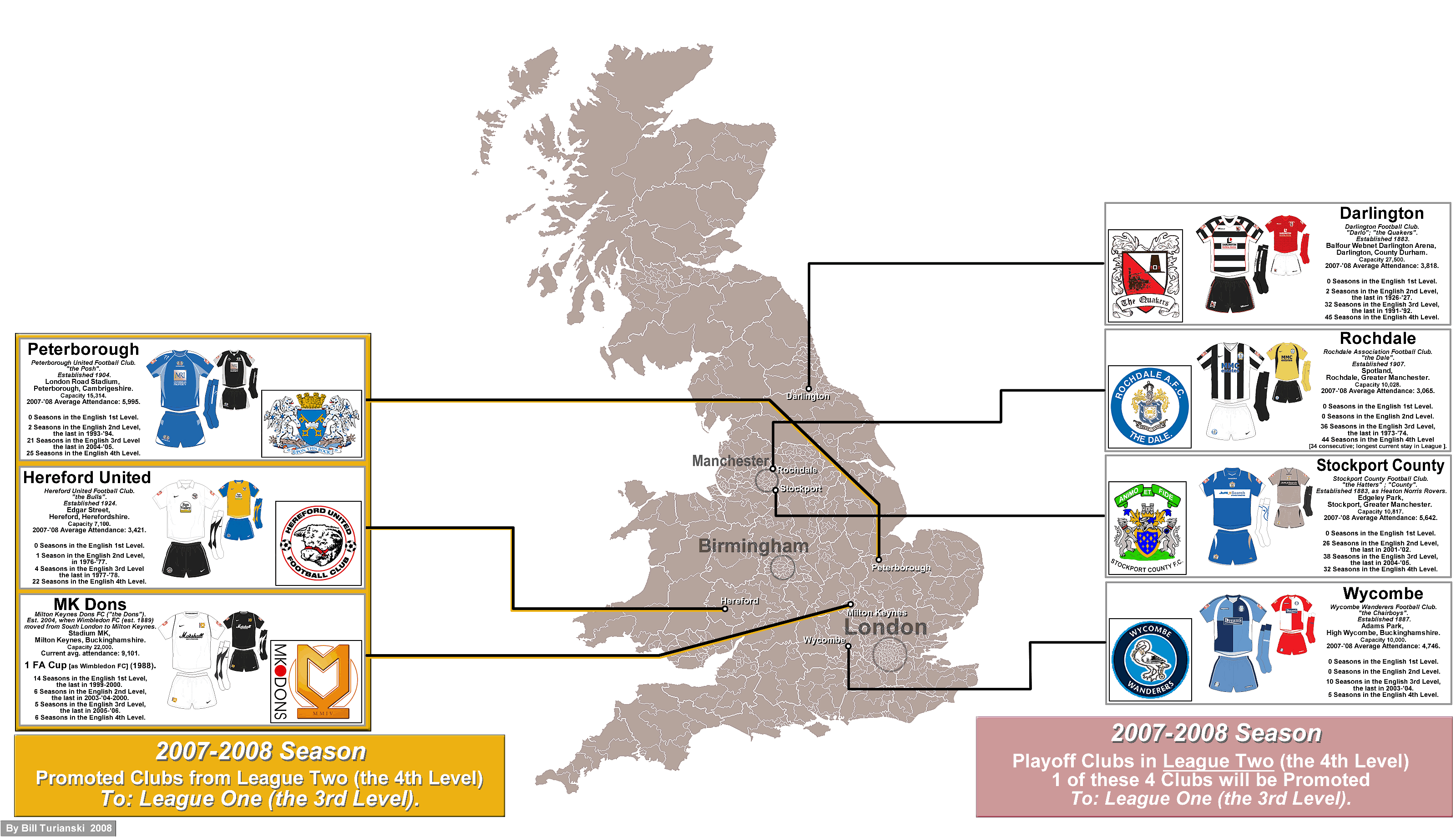
England, League One, 2007-’08: the 2 Promoted Clubs, and 4 Playoff Contenders.

Filed under: Eng-3rd Level/League One,Engl. Promotion Candidates — admin @ 5:28 pm

league1_promotionplayoffs2008_post.gif


In League One (the 3rd Level of English football), Swansea City and Nottingham Forest have finished in 1st and 2nd place, and will be automatically promoted to the League Championship (the 2nd Level). 

For Swansea City, this will be their second promotion in four seasons.  As they have a relatively new stadium (opened in 2005),  promotion could really expand this Welsh club’s fan base.  Since moving into Liberty Stadium (and being promoted from League Two to League One), the Swans have seen their average gate rise from 8,458 (2005) to 13,673 (this season).  A decade ago, in 2003, Swansea was mired at the bottom of the old Division Three: they finished just two places above relegation from the League, at 21st,  while averaging 5,160 (and only 3,690 in 2002).  Swansea will definitely have an uphill battle, trying to stay afloat next season, in the League Championship.  Their leading scorer this season was Trinidad-born 29-year-old Jason Scotland, who led League One in scoring, with 23 goals (28 goals in all competitions)   {see this (from an independant site);  and see this}.  

Nottingham Forest are simply too big a club to be in the third tier of English football (they averaged 19,955 per game, this season).   The club has never really come close to their pinnacle, as English National champions in 1978, and European Champions in 1979, and 1980.  But they should be able to establish themselves next year in the League Championship.   Their leading scorer this season was 28-year old Junior Agogo (born in Accra, Ghana), with 13 league goals {see this}.  Nathon Tyson had 9 league goals (12 total)  {see this};  Nottinghamshire-born Kris Commons, a 24-year-old winger, had 8 league goals (9 total) {see this}.

In the Playoffs, #6 Southend United will take on # 3 Doncaster Rovers on Friday 09 May,  for the first leg, at Roots Hall {see this, on Roots Hall, from the Internet Football Grounds Guide}.    The second leg is on the following Friday, in Yorkshire.   Southend United aims to jump right back into the second level, after relegation last season.  Traditionally a 3rd Level club,  Southend has actually spent more of the last two decades in the 2nd Level (7 seasons), and the 4th Level (8 seasons).  They enjoy good fan support for such a medium/small sized club.  Their leading scorer this season was midfielder Nick Bailey {see this, from the Southend Utd Official site}. 

The Doncaster Rovers have came a long way in 5 seasons…from the Conference (the 5th Level) to a club which is in the playoff places of the 3rd Level.  Plus, they have a new ground, Keepmoat Stadium {see this, from the Internet Football Ground Guide}.  Their leading scorer this season was Isle Of Wight-born James Hayter, with 7 league goals, and 10 overall {see this}.

The Roots Hall fixture on Friday is the opening match for the Playoffs, in all 3 Divisions of the (English) Football League.  Here in the USA, Setanta Broadband will be carrying most of these matches live, and archived.

roots_hall-southend.gif

On Monday, 12 May, #4 Carlisle United will play #5 Leeds United, up in Cumbria, with the second leg just 3 days later at Elland Road.  Carlisle United is another club in this playoff group that was in the Conference recently:  just 3 seasons ago.  The club could make it 3 promotions in 4 years if they win the Playoffs.  Their leading scorers were Danny Graham, with 14 league goals (16 overall) {see this, from the Carlisle Utd Official site};  and Joe Garner, also with 14 goals {see this}.  Brunton Park {see this} is the northwestern-most ground in the Football League.

Leeds United hopes their first-ever season in the 3rd Level will be their last.  As recently as 2001, this huge club, Yorkshire’s largest, was drawing 39,000 per game, and were in the Champions League Semi-Finals.  Their leading scorer this season was Jermaine Beckford, with 20 league goals {see this}.  Elland Road: {see this}. 

The 2 promoted clubs had the 2nd highest (Nottingham Forest) and 3rd highest (Swansea City) attendances in League One. The highest  attendances were at Leeds, with an average of 26,546,  which is pretty impressive for the third tier of English football.  The other 3 playoff clubs Doncaster (8,066), Southend (7,885). and Carlisle(7,835) were the 6th, 7th, and 8th highest draws.  Two clubs finished with a higher average gate than 3 of the playoff clubs.  They were Huddersfield Town (at 9,318 per game), and Milwall (at 8,815)… {click here, for the League One Attendance Table (SoccerStats site)}.

Thanks to (http://www.colour-of-football.com)  for the kits.

May 4, 2008

Major League Baseball: the National League West- Map and Chart.

Filed under: Baseball: 2008 MLB div's — admin @ 9:07 am

mlb_nl_west_post.gif


This post begins a new series…Major League Baseball Divisions.   Each post will feature a map showing the ball clubs of one of 6 MLB Divisions.  Featured here is the National League West Division.   It includes the two ball clubs that moved from New York City to California, in 1957 (the Brooklyn Dodgers and the New York Giants).  The pair became the Los Angeles Dodgers and the San Francisco Giants.  They abandoned New York City, and their fans, because California was just too lucrative to pass up.  If the two clubs had weathered a few more years of indifferent political power brokers, they would have gotten new stadiums on the tax payers dime.  But the lure of free, soon-to-be valuable land in the Golden State, was irresistible.  It tore the heart out of Brooklyn, and it took 3 decades for the Borough to recover.  I know there were over-arching socio-ecomomic conditions that made continued tenancy in Brooklyn, and northern Manhattan, a real problem,  but it just killed the fans.  There is no way you can tell me it was justified to rip two huge, successful, well-supported clubs out of the capital of Baseball, New York City.  O’Malley and Stoneham (the Dodgers and Giants owners) sold out, and turned their backs on the fans who made the clubs huge in the first place {see this, and look at the 5th paragraph}.  And the salve provided by National League, of a new team, 5 years later, in the form of the New York Mets, was hardly adequete…just go to Shea Stadium, home of the Mets, and try to relax and watch a ball game, while jet airplanes are roaring above, every 3 minutes (what a hole, Shea Stadium is).  But I digress.

Also in this division are the San Diego Padres (est. 1969);  the Colorado Rockies (est. 1993);  and the Arizona Diamondbacks (est. 1998).

In addition to a list of each ball club’s origins, and titles, I show each club’s cap logo, and the script logos on their primary home and away uniforms.  The map functions mainly as a locator. 

The main graphic display is on the Auxillary Chart (see below),  which shows each ball club’s uniforms, and logos, through the years (with choice alternate logos also shown, depending on space).  **Click on the segment below.**

mlb_nl_west_aux-chart-seg.gif

On the Auxillary Charts,  I will have mini-essays,  at points where I decided that just a description of the uniform or logo didn’t do the image, and the time period,  justice.  Basically, all the old storied franchises will get a little write-up on the Charts.  On this Chart, that means the Brooklyn Dodgers  {click her, for photos & team history}, and the New York (Baseball) Giants  (click here, for photo & team history).  [ these two links are to the sports e-cyclopedia site ].

The plan is to post one of these every two weeks.

Thanks to the SSUR site (http://www.sportscolors.org).

Thanks to Chris Creamer’s Logo Site.   Thanks to the Logo Shak site.   Thanks to the National Baseball Hall Of Fame’s “Dressed To The Nines” site.   Thanks to the Logoserver site.   Thanks to Marc Okkonen,  for his incredible book, “Baseball Uniforms of the 20th Century”, 1991, by Sterling Publishing Co, NY.

April 30, 2008

Argentina: 2008 Clausura- Zoom Map.

Filed under: Argentina,Zoom Maps — admin @ 6:03 pm

argentina_zoom_post_b3.gif


The Argentine Superclasico: 4th May, 2008.  
By Sam Kelly  [of the "Hasta El Gol Siempre" site (http://www.hastaelgolsiempre.com).]

Sunday, 4th May will be a special day for football in 2008.  For perhaps the first occasion this year- and it’s likely to be one of the only occasions all year- the eyes of the wider footballing world will be paying real attention to a club match that isn’t taking place in Europe.  There are fierce rivalries all over the planet, of course,  at local and at international level,  but this weekend sees one of the biggest- possibly the  biggest, bar none.  Because this weekend, by the docks of Buenos Aires,  River Plate (top of the Argentine league, and in with a good shot at their first league title in four years)  visit Boca Juniors.  Only one country could have the gall to refer to it’s biggest rivalry not as a simple clasico,  but as the superclasico.

supercalsic07.gif

The pair are Argentina’s two biggest clubs by a long way:  River claim slightly under one-third of football fans in the country;  Boca slightly over one-third.  And these figures are supported by numerous polls conducted independently of the two clubs,  by newspapers and other media outlets.  Popular myth has it that the rivalry was born when the two sides, both founded in the early years of the twentieth century in the dockside area of La Boca,  played a match to decide who would stay there, and who had to move out.  Quite why they couldn’t live side-by-side,  popular myth doesn’t explain.  Boca won the match, and River upped sticks,  first to Palermo, and then still further north to Nunez, where they’re located today.  The truth behind the move may have been a little more rooted in the availability of playing space,  at a time when Buenos Aires was undergoing a massive growth in population…but Boca did indeed win the first match between the clubs, 2-1, in August 1908.  Since then, it’s been 100 years of pure hatred.

la_bombonera.gif

Historically, Boca have had the upper hand ever since,  and their fans refer to River as ‘hijo’  (or ‘son’)- claims of fatherhood are often the chosen method of lording it over one’s rivals in South America.   In 323 meetings, in all matches (including friendlies),  Boca have won 117 and River 105, with 101 draws.  In the league it’s a little closer:  65-61 in Boca’s favor, with 55 draws.  In recent seasons, River have been gradually clawing the deficit back a little, not having lost to Boca in competitive matches since the 2005 Torneo Clausura- since when River have a five match unbeaten league run against their great rivals.  During this same period, River haven’t won any trophies (their last was the 2004 Clausura title), and their victories in superclasicos have been the only consolation for the drought.

river_plate_el-monumental.gif

This time around, that could be changing.  Under new manager Diego Simeone (whose short management career has already taken in one title win, with Estudiantes, in 2006),  River have a new effectiveness in their play, and such a good goalkeeper in Juan Pablo Carrizo that an (at times) incredibly shaky backline doen’t seem to affect results.  They’re joint top with Estudiantes, four clear of Boca after the latter lost another classico  this Sunday just gone, 1-0, to San Lorenzo.

River wins in La Bombonera are rare- the recent unbeaten spell has included a few draws there- but one this weekend could define the sides’ seasons,  even more so since the match is sandwiched between the two legs of the Copa Libertadores last sixteen. 

And speaking of the Copa, it could provide revenge for whoever comes out worse this weekend.  If both sides continue far enough, they’ll resume the planet’s fiercest rivalry in the Semi-Final, for the 3rd time this century.  Just think:  in Britain, the press ask us to believe Chelsea vs. Liverpool is exciting… 

**Click here, for an article on Boca Juniors’ stadium worries, by the BBC’s Tim Vickery.

Thanks to Sam Kelly, of course…check out his site (http://hastaelgolsiempre.com)

Thanks to the Colours Of Football site (http://www.colours-of-football.com), for the kits.

Thanks to (http://www.football-wallpapers.com).

Thanks to (http://www.daylife.com).

April 27, 2008

Germany: Bundesliga, 2007-08 Season-Zoom Map.

Filed under: Germany,Zoom Maps — admin @ 1:16 am

 german_bundesliga08_post_c.gif


[Note: to see my most recent map-&-post of Bundesliga, click on the the following, category: Germany.

On this map, in deference to the quite impressive attendance figures of the Bundesliga,  I have included a column listing percentage of capacity, on the average attendances list.  Those Germans really know how to pack ‘em in.  Plus their stadia generally seem to be very fan-friendly, with almost zero ugly track-and-field ovals, good site lines, and seats right up on top of the action.  And this being Germany, after all, I am quite sure that the beverages are top notch.  Plus, I understand that the ticket prices are very reasonable.   With all these incentives,  fans flock to Bundesliga matches…ten clubs are averaging over 40,000 per game (and 3 clubs in Bundesliga-2: FC Koln,  Borussia Monchengladbach,  and 1860 Munich,  are averaging over 37,000 per game). 

This map shows all the German Tiltles, since 1903,  although there was no unified pro football league in Germany until 1963-’64.  That was when the Fussball-Bundesliga was formed.

Up until that point, football in post-war Germany was divided into 5 separate leagues, or Oberligen (meanwhile, Soviet-occupied East Germany had it’s own, corrupt,  league).  In West Germany, there were the North,  South,  West,  Southwest,  and Berlin Oberligen.

In 1962, the decision was made to consolidate, in emulation of the English Football League structure.  46 clubs applied for membership in the new, nationwide, top tier.  16 were selected, on basis of prior achievements  {see this, from Wikipedia}.  The Bundesliga began in the autumn of 1963.

Since then only one team has remained in the Bundesliga continuously:  Hambuger SV  (usually called Hamburg, in the English-speaking world,  probably because no one wants to conjure up the image of a ground beef sandwich).  But this club from that northern port city has not won the crown for 25 years running.  

Since the Bundesliga’s formation, one club has stood out, in terms of success:  FC Bayern Munchen  (ie, Bayern Munich).  Again, this season, the giant club from Bavaria will win the championship.  It will be their 21st German Title, and, amazingly, their 20th Bundesliga crown.  That will amount to 20 Bundesliga Titles, out of a total of 45 Bundesliga seasons.  And their success now has a shining new monument (literally):  the Allianz Arena  {see this imagesee this Wikipedia entry}.   It has been sold out the entire season.

Thanks to http://www.colours-of-football.com. for the kits.  

April 23, 2008

Pro Soccer in America, Canada, and the Caribbean: Map of the MLS, the USL, and USL-2.

usa_soccer_3leagues_post_b.gif


[This map was made in collaboration with the This is American Soccer website, where it first appeared.   http://www.thisisamericansoccer.com .]

**Click here, for a write-up about the 2008 MLS season, from the Culture of Soccer site

Thanks to Adam, at TiAS, for initiating the project, and input.  Thanks to Jeremy, at Albion Road website, for recommending me (http://albionroad.com).  Thanks to David, at the Culture of Soccer site (http://www.cultureofsoccer.com) , for the article.  Thanks to SoccerLens (http://soccerlens.com), for the ’08 MLS jerseys.

April 20, 2008

Scottish Premier League, 2007-’08 Season: Zoom Map.

Filed under: Scotland,Zoom Maps — admin @ 6:46 am

scotland_zoom_post_b.gif


The Scottish Premier League was formed in 1998, following the example set 6 years earlier by England’s Premier League.  There are 12 clubs in the league.  Last place is relegated.  The winner qualifies for the Champions League;  2nd place gets a spot in the 3rd round Qualifiers for the Champions League;  3rd place enters the UEFA Cup;  as does the Scottish Cup winner ( the other Cup finalist gets that spot,  if the Cup winner finishes in the top 3).  Scotland’s domestic league is currently ranked #10 by UEFA for European competitions {see this}. 

The Title this season is pretty much sewn up by Rangers, even though they lost to 2nd place Celtic last Thursday, allowing the Hoops to pull within 2 pts.  That’s because Rangers have 3 games in hand.  The season is in it’s rather strange, final Split phase, when the 12-team league splits in half, to play 5 final games within it’s half {see this}.

This map show the 12 clubs in the 2007-’08 SPL season.  Both major domestic trophies are listed:  the National Title (Scottish First Division Title/ Scottish Premier Division Title/ Scottish Premier League Title); and the Scottish Cup.   Seasons in the first division, and consecutive seasons there, are also listed.

Rangers and Celtic, both from Glasgow (and often referred to as the Old Firm) have dominated the Scottish football world.  Rangers have 51 National Titles,  Celtic have 41.  The third highest tally is 4 Titles, won by three clubs:  Hearts and Hibernian (both from Edinburgh);  and Aberdeen.   In spite of Rangers’ higher domestic tally, it is Celtic who have had the success in Europe, winning the European Cup in 1967, famously with a squad comprised entirely of players born within 30 miles of Celtic Park.  

Celtic also has a larger fan base than Rangers, drawing around 57,000;  Rangers draw around 49,000;  no other club in Scotland draws over 20,000 per game.  Hearts averages around 16,000;  Hibs around 14,000;  and Aberdeen around 12,000.  After that, the clubs in the league have fan bases similar to clubs in the 3rd or 4th Level in England, drawing well below 10,000. 

For a while, in the mid 1980′s, it looked like the grip the Old Firm has on the Scottish game was weakening, as Aberdeen won 3 Titles, and Dundee United won 1.  But there has been no winner other than Rangers or Celtic since 1985, when the crown was won by Aberdeen.

Click the following, for the SPL table: http://www.soccerstats.com/leaguetable.asp?league=scotland

**Click here, for the Scottish Premier League website:  (http://www.scotprem.premiumtv.co.uk

Click here, for Scottish Premier League attendances (SPL website).

Click here, for Wikipedia’s entry on Rangers FC.

Click here, for Wikipedia’s entry on Celtic FC.

Thanks to Colours-Of-Football site, for the kits (http://www.colours-of-football.com).

April 16, 2008

Baseball of the Upper Midwest, circa 1992.

Filed under: Baseball,Hand Drawn Maps — admin @ 6:48 pm

baseball_upper_midwest_post2.gif


I drew this map around 15 years ago, in autumn 1992 through to early 1993.  I ended up doing 3 of this type of map: one of the Northeast (which I’ve already posted);  this one;  and one, of the South, that I will post later this spring.  These maps combine Big League ball clubs with all of the minor-league ball clubs in the region. 

The Major League Baseball clubs in this map are the Chicago Cubs, the Chicago White Sox, the Cincinnat Reds, the Cleveland Indians, the Detroit Tigers, the Kansas City Royals, the Milwaukee Brewers, the Minnesota Twins, and the St. Louis Cardinals.  The Toronto Blue Jays, and the Pittsburgh Pirates emblems are also shown: those two cities are just east of where this map is cut off. 

All the other ball clubs on the map are minor league baseball teams.  These teams are all affiliated with a Major League Baseball parent-club.  [A few of these clubs are defunct; and some have changed names, and/or affiliation] .  The affiliations are indicated on the map by the smaller MLB-club-icons, next to each minor league team’s logo.

To see my map: “Baseball of the Northeast, 1992,” click here. 

To see more of my hand-drawn baseball maps, go to the Categories section on the upper right of the screen, and click on “baseball.”

April 13, 2008

Portuguese Liga: 2007-’08 Zoom Map.

Filed under: Portugal,Zoom Maps — admin @ 10:41 am

portugal_zoom_post_re-do_b.gif


In Portugal, Porto has already clinched the Title.  It is Porto’s third straight championship, and fifth in the last six seasons {click here for Wikipedia’s entry on FC Porto}.

This weekend is the 26th of 30, in the Portuguese football season.  One interesting development this is that newly promoted Vitoria Guimaraes, the club with the country’s fourth largest fan base (but absolutely zero major titles), has a real chance of making it to the Champions League Qualifiers.  It could be at the expense of Sporting [Lisbon], who were just eliminated in the UEFA Cup Semi-Finals, by [the Glasgow] Rangers.  One has to think Sporting’s European run has eroded their domestic form, as the club has lost 3 of their last 8 league games.  Vitoria Guimaraes’ famously rabid fans will be screaming themselves hoarse, urging on their team to maintain their slim 2 point lead over Sporting.  **{Click here, for a video compilation of Vitoria Guimaraes’ fans in action  (@youtube).}.     {Click here, for Wikipedia’s entry on Vitoria Guimaraes.}

Update: Benfica was embarrassed by relegation-threatened Acedemica Coimbra 0-3, on Friday.  And on Saturday, Vitoria Guimaraes beat Boavista 1-0.  That means V. Guimaraes is now in 2nd place.   It looks like there’s going to be some new blood in the CL next fall.   Especially with Benfica imploding  {see this recent article, from the Pitch Invasion site}.

Ever since organized professional football has been played in Portugal, “os Tres Grandes,” or the Big 3,  (Benfica, Porto, and Sporting) have had a near-absolute dominance over the rest of the nation’s clubs.  It is more of a domination than even the Old Firm’s grip on the Scottish game.    In fact, Boavista’s fluke 2001 National Title, and the Title won by Belenenses in 1946, are the only two championships won outside of the Big 3.

And as far as gate figures go, there is a similar haves-and have-nots aspect.  The Big 3 are all able to pack them in: Benfica is drawing around 40,000 these days, Porto is at 37,000 or so, and Sporting pulls in 29,000 per game.  After that, there are just two clubs with medium-sized fan bases:  Vitoria Guimaraes, averaging around 17,000;  and Sporting Braga, averaging around 13,000.    After these five clubs, no other club in Portugal’s Liga is averaging more than 8,000 per game.  The only other clubs with halfway decent fan support are Acedemica Coimbra, at about 7,200, and Maritimo, at about 5,600.  

CS Maritimo, along with CD Nacional, are from the Atlantic Ocean island of Madeira {see this map}.  The island is part of an archipelago, also called Madeira, and is one of the 7 Regions of Portugal {see this}.  It is one of two Autonomous Regions in Portugal (the other is the Azores Islands, which is further west in the Atlantic: it’s biggest club is Santa Clara, which has spent 3 seasons in the top flight, the last in 2003.)  Madeira is where football superstar Christiano Ronaldo, of Manchester United, came from,  getting his start with Nacional.

Portugal’s domestic league is currently ranked #6 by UEFA, for European competitions.  3 clubs are awarded Champions League spots (1st and 2nd place finishers go directly to the coveted Group Stage, and 3rd place goes to the 3rd Round Qualifiers); 3 clubs are awarded UEFA Cup spots.    {Click here, for the Rankings for 2008-2009 UEFA Competitions.}   In 2006, The Poruguese Liga reduced it’s membership from 18 to 16 clubs.

{Click here, for the Portuguese Liga table (SocceerStats[dot]com).}

Here are 3 Google Earth shots of Premeira Liga Stadiums in Lisbon (click on each sentance below).

**Benfica’s “Stadium of Light.” [Note: the name refers to the neighborhood it is in: Luz, which translates as "light."]- Click here.

**Sporting’s Estadio Jose Alvalade-21st Century.-Click here.

**Belenenses’ Estadio do Restelo-Click here.

Thanks to http://www.colours-of-football.com. for the kits.  Thanks to (golftoday[dot]co[dot]uk) for the map.  Thanks to Jeremy, of the Albion Road site (http://www.albionroad.com),  for sending me the 3 Google Earth shots, and for information on the Portuguse Liga from his comprehensive website. 

April 9, 2008

The 2007-08 League Championship (England, 2nd Level of Football): Zoom Map.

Filed under: Eng-2nd Level/Champ'ship,Zoom Maps — admin @ 9:59 am

league_championship_zoommap_post.gif


Note: to see my latest map-&-post of the English 2nd division, click on the following, category: Eng-2nd Level/Champ’ship.

[Note: on this zoom map, I have added a new category, of total seasons in the 1st and 2nd Levels, with the last season each club was in the top flight noted.  I also added club nicknames, and original names of the clubs.] 

The (English) Football League was formed in 1888.  The founding members comprised 12 clubs, all of which came from north of Birmingham {see this}.   With the assimilation of the rival Football Alliance {see this}, in 1892, a second tier was created.   The two levels were the First Division, and the Second Division, each with 14 clubs.   At the end of each season, the bottom two clubs in the lower division were forced to apply for re-election to the League.  

In 1898, the League expanded to 36 clubs (18 in each division).   Automatic Promotion and Relegation was introduced, whereby the 1st and 2nd place clubs in the Second Division each season moved up to the top flight, and the bottom two clubs in the First Division were sent down to the Second Division  {see this}. 

{Click here for a brief history of the English Football League, from the Football Club History Database.}

Fast forward to today.  The 3 clubs in the 2nd Level of English football,  the League Championship {see this}, which are annually promoted to the top flight of English Football, the Premier League (est. 1992 {see this}),  each receive around 60 million pounds in new revenue (that’s about $110 million).  This is according to the accounting firm Deloitte.  Which makes the struggle for promotion such a huge matter. 

Tuesday, at Blackpool,  West Bromwich Albion provided another example of their high octane offense, with 3 late goals (including a brace by Kevin Phillips).   {See this article, from the Sky Sports site.}   The win vaulted the Baggies back to the top of the League Championship, knocking this season’s surprise team, Bristol City, to 2nd place.

West Brom’s loss to Portsmouth in the FA Cup Semi-Finals last weekend may prove to be a blessing in disguise, as the squad can now focus on their promotion bid.  They lead the league in scoring, with 84 goals (3rd place Stoke City has the second most goals, with 64), and their goal difference of +29 dwarfs the competition (Hull City, in 4th place,  has the next highest, at +18) .  But in this highly competetive second tier, WBA has struggled since the Holidays.  Now they are back in first, with a game in hand on half their main competitors for automatic promotion.

Realistically, it’s down to 5 clubs competing for the 2 automatic promotion spots:  1. West Bromwich Albion,  2. Bristol City,  3. Stoke City,  4. Hull City,  and 5. Watford.  Just 2 points separate the five clubs.  

In 6th place, 8 points off the automatic promotion places, is Crystal Palace, who beat Stoke 1-2 away, on Monday.  And right behind Palace are no less than 7 clubs within 6 points of the playoff places.  The clubs realistically out of the running for automatic promotion, and competing for the playoff places (of which there are four) are:   6. Crystal Palace   7. Wolves   8. Ipswich Town   9. Charlton Athletic   10. Plymouth Argyle   11. Burnley   12. Sheffield United   13. Cardiff City.

Thanks to http://www.colours-of-football.com, for the kits.

{Click here, for the League Championship table (SoccerStats[dot]com).}

April 6, 2008

Netherlands, Eredivisie 2007-’08-Zoom Map.

Filed under: Netherlands,Zoom Maps — admin @ 10:35 am

netherlands_zoom_post_c.gif


Professional football in the Netherlands has been played since the late 19th century, with the first National Title won by RAP Amsterdam, in 1898.  But it took another couple decades for the dominant clubs of today’s Dutch football to emerge:  Ajax (est. 1900) won their first Title in 1918;  Feyenoord (est. 1908) won their first Title in 1924;  PSV Eindhoven (est. 1913) won their first Title in 1929. 

PSV is on course for their fourth consecutive championship.  They have won the Title 6 out of the last 8 seasons.  The club has won 20 Dutch Titles, overall.  PSV stands for Philips Sports Vereniging (that last word means “Union”), and was formed as a sporting club of Philips, the electronics conglomerate.  They play in a swank 36,600-capacity stadium in Eindhoven, which is in the southern part of the country, in the province of North Brabent.  All the seats in the stadium are heated.  The red and white stripes on their jersey reflect a similar, horizontal pattern on the flag of  North Brabent.  PSV won the 1987-’88 Champions League, and the 1977-’78 UEFA Cup.  The current squad is still alive among the last 8 clubs in the 2007-’08 UEFA Cup, with their home leg v. Fiorentina coming up on 10th April (1-1 score, in the first leg).   {Click here, for Wikipedia’s entry on PSV Eindhoven.} 

The Eredivisie was formed in 1956.  Currently, there are 18 clubs in the league.  There are 1 to 2 clubs relegated each season, depending on the outcome of the relegation/promotion playoffs, which involves the 16th and 17th place finishers in the Eredivisie, and the top 8 (!) clubs in the Ereste Divisie (the second tier).  

{Click here, for Wikipedia’s entry on the Eredivisie.}

{Click here, for the Eredivisie Round-Up, from the Sky Sports site.}

The Netherlands domestic league is currently ranked #8 for European competitions by UEFA {see this: scroll down to third table on page}.   The National Champions automatically advance to the Champions League Group Stage.  2nd place through 5th place enter a playoff for the other Champions League spot (in the CL 3rd Round Qualifiers).  There is a similar playoff for 3 UEFA Cup spots {see this};  the winner of the KNVB Cup also gains entry to the UEFA Cup.   Overall, The Netherlands receives 2 Champions League spots, and 4 UEFA Cup spots.

**Click here, to see my attendance map of Netherlands football, circa 2007.   **Click here, for my Hand-drawn map of  Netherlands football, circa 2004.

Thanks to (colours-of-football[dot]com) for the kits.  Thanks to (demis[dot]nl) fot the base map.

« Newer PostsOlder Posts »

Powered by WordPress