billsportsmaps.com

April 4, 2023

1970 MLB Location-map with Jersey-logos & Attendances, featuring the 1970 World Series champions the Baltimore Orioles & AL and NL Stats Leaders.

Filed under: Baseball,Baseball-1970 MLB season,Retro maps — admin @ 5:29 pm

mlb_1970_map-of-mlb-1970_24-teams_ws-champions-baltimore-orioles_1970-mlb-attendances_1970-mlb-stats-leaders_post_b_.gif
1970 MLB Location-map with Jersey-logos & Attendances, featuring the ’70 World Series champions the Baltimore Orioles & AL and NL Stats Leaders


By Bill Turianski on the 4th of April 2023; twitter.com/billsportsmaps.
Links…
-1970 MLB season (en.wikipedia.org).
-1970 MLB (baseball-reference.com).
-Year in Review: 1970 American League (baseball-almanac.com).
-Year in Review: 1970 National League (baseball-almanac.com).
-1970 MLB logos (sportslogos.net).

1970 MLB Location-map with jersey-logos with 1970 attendances, featuring the 1970 World Series champions: the Baltimore Orioles.
This is my fourth in a series.
Here are links to the first three posts in this series:
1967 MLB Location-map with Jersey-logos & Attendances, featuring the ’67 World Series champions: the St. Louis Cardinals;
1968 MLB Location-map with Jersey-logos & Attendances, featuring the ’68 World Series champions: the Detroit Tigers.
1969 MLB Location-map with Jersey-logos and Attendances, featuring the ’69 World Series champions: the New York Mets.

The map shows the locations of the 24 Major League Baseball teams of 1970.
On the map, next to each MLB team’s location-dot there are 3 things: their cap-logo, one of their 1970 jersey-logos (either home or away jersey), and a rectangular box (listing: ballpark, win total in 1970, and home average attendance in ’70). All but one of the jersey-logos are from photos of the old jerseys (see 23 photo credits at the foot of this post); one jersey-logo – the Detroit Tigers’ 1970 away jersey-logo – I drew myself.

The jersey-logo for each team is sized to reflect that team’s 1970 average attendance: the larger the jersey-logo, the higher their attendance was that year. Any other team logos on the team’s uniforms in 1970 are also shown (specifically, shoulder-patch-logos, of which there were 8 of such in 1970: Angels [new State-with-halo logo (1971-85)], the Astros, the Braves, the Cubs, the Royals, the Indians, the Mets, and the Twins).

1970 Average Attendances are shown at the right-hand side of the map-page. Best-drawing MLB team in 1970 were the reigning champions, the New York Mets, who drew 32.8-K per game at the then-7-year-old Shea Stadium in Queens, NYC. For this time period, that was a rather impressive figure, as it was slightly more than ten thousand per game better than any other big league club that year. Second- best draw were the NL pennant-winners, the Cincinnati Reds, who drew 22.2-K per game in the 1970 season, half of which they played at their old Crosley Field, and half at their then-new venue Riverfront Stadium. Three other teams drew above 20,000 per game in 1970: the LA Dodgers, the Chicago Cubs, and the St. Louis Cardinals.

At the top of the map-page is a section for the 1970 MLB champions, the Baltimore Orioles. I featured photos of the 13 players on the ’70 Orioles with the highest WAR [Wins Above Replacement], plus the their manager, Earl Weaver. Photo credits are at the foot of this post. The players are: Jim Palmer (RHP & HoF), Paul Blair (CF), Boog Powell (1B & 1970 AL MVP), Frank Robinson (RF/1B & HoF), Merv Rettenmund (OF/PH), Don Buford (LF/Infield), Dave MacNally (LHP), Brooks Robinson (3B & HoF), Davey Johnson (2B), Pete Richert (LHP/Reliever), Mike Cuellar (LHP), Mark Belanger (SS), Elrod Hendricks (C/PH).

At the foot of the map-page are 1970 MLB Statistical Leaders (in both the American League and the National League), in the following categories: ERA, Wins, WAR for Pitchers; Batting Average, Home Runs, RBIs, WAR for Position Players. A photo of each player is shown, with stats; photo credits are at the foot of this post.

In 1970, there was an MLB franchise-move… after only one season, the just-formed Seattle Pilots of 1969 (AL) moved to Milwaukee, Wisconsin, as the Milwaukee Brewers. This strange affair resulted in two things. First it gave the city of Milwaukee a big-league ball club once again, after the city had lost their Milwaukee Braves to Atlanta, Georgia (following the 1965 season). Second, the abrupt departure of the Seattle Pilots resulted in the city of Seattle suing Major League Baseball for breach of contract. {See this, Seattle Pilots: Lawsuit (en.wikipedia.org).} The lawsuit was finally settled out of court 6 years later, when MLB awarded Seattle another expansion franchise: the Seattle Mariners of 1977. On the map-page here, I have shown the 1970-franchise-move of Seattle-Pilots-to-Milwaukee-Brewers, using a long pale-gray line-segment with arrows, and with the Pilots’ old gear shown in gray-tone.


    1970 World Series – Baltimore Orioles beat Cincinnati Reds in 5 games

The Baltimore Orioles were the dominant team in the American League in 1970, winning the AL East by 15 games. The 1970 Orioles featured no less than three 20-game-winners in their pitching rotation (Jim Palmer, Mike Cuellar, Dave McNally). Baltimore’s offense was powered by a couple of sluggers in Frank Robinson (OF) and the 1970 AL MVP Boog Powell (1B), plus Gold Glove winner Brooks Robinson (3B). In the playoffs, the O’s swept the Minnesota Twins 3-0 (again), and so Baltimore was headed back to the World Series, hoping to make amends for losing to the underdog NY Mets in the previous year’s Fall Classic.

The Cincinnati Reds were likewise the dominant team in the National League in 1970, winning the NL West by 14.5 games, and then sweeping the Pittsburgh Pirates in the playoffs. Compared to the Orioles, the Reds boasted more offensive firepower (with Johnny Bench, Lee May, Tony Pérez, and Pete Rose), but the Reds had a less commanding, and somewhat disabled, pitching staff.

Game 1. The Reds took a 3-0 lead with 1 run in the 1st inning, and 2 in the 3rd. But Orioles pitcher Jim Palmer settled down, and did not allow any more runs in his 8.2 innings. The Orioles evened up the 3-0 deficit, starting with a 2-run HR by Boog Powell in the 4th inning, and a solo shot by catcher Elrod Hendricks in the 4th. Then there was a huge fielding play by Brooks Robinson in the 6th inning: a back-handed grab of a hard grounder down the line by the Reds’ Lee May, with Robinson spinning to throw him out. It was one of several spectacular plays Brooks Robinson would make in the series. Also in the 6th inning there was a missed call by the home-plate umpire {see photo and caption below}, which prevented the Reds from reclaiming the lead. (Replays showed that in the collision at the plate, Orioles’ catcher Hendricks tagged Reds’ baserunner Bernie Carbo with an empty mitt.) The Orioles claimed the lead for good in the 7th, on a Frank Robinson HR. Orioles won 4-3; Win: Jim Palmer; Save: Pete Richert.

Game 2. Again the Reds took a lead, and again the Orioles rallied back. The Reds chased O’s starter Mike Cuellar after 2.1 innings. Trailing 4-0, the Orioles got one back in the 4th, on a Boog Powell HR. Then in the 5th inning, Baltimore scored 5 runs…the O’s hit 5 consecutive singles, followed by a 2-run double by Elrod Hendricks. The Reds got one back in the 6th, but Baltimore’s bullpen kept the lead. Orioles won 6-5; Win: Tom Phoebus [in relief]; Save: Dick Hall.

Game 3. Dave McNally and Brooks Robinson were the heroes of the day for the Orioles. Brooks Robinson made three spectacular fielding plays. In the 1st inning, he made a leaping grab of a Tony Pérez hopper, stepped on third and fired to first for the double play. In the 2nd, Robinson snagged a slow grounder by Tommy Helms, and threw him out. And in the 6th, he made a diving catch off a liner by Johnny Bench. With Baltimore leading 4-1, Brooks Robinson then led off the bottom of the 6th, and received a standing ovation from the home crowd; he then doubled. Three batters later, with the bases full, pitcher Dave McNally stepped up, and hit the ball out of the park. McNally became the first (and only) pitcher to hit a World Series grand slam. McNally pitched a complete game, and the O’s coasted to a 3-0 lead in the Series. Orioles won 9-3; Win: Dave McNally.

Game 4. The Reds avoided a Series sweep. Cincinnati came back from a 4-2 deficit, thanks to fine relief pitching by both rookie Don Gullett (2.2 innings), and veteran Clay Carroll (3.2 innings). The Reds won it on a game-winning 3-run HR, by Lee May, in the 8th inning. Reds won 6-5; Win: Clay Carroll.

Game 5. Mike Cuellar gave up 3 runs in the 1st inning, but settled down and shut the door, going the whole 9 innings. The Orioles scored 2 runs in each of the first three innings. Frank Robinson and Merv Rettenmund each hit homers, and both had 2 RBI, as did Davey Johnson. The Orioles won 9-3, and claimed their second World Series title in 4 years. Orioles won 9-3; Win: Mike Cuellar. Orioles won the World Series in 5 games.

Brooks Robinson won the World Series Most Valuable Player Award, thanks his clutch fielding, but also thanks to his offensive contributions: he hit .429, and he broke the record for total bases in a five-game series, with 17.

So in 1970, the Baltimore Orioles (established 1954) won their second World Series title in 4 years (they had swept the LA Dodgers in 1966). The Orioles would go on to their third straight World Series appearance in the following year of 1971 (losing to the Pittsburgh Pirates in 7 games). The Baltimore Orioles [as of 2022] have won 3 World Series titles (their third WS title was won in 1983, when they beat the Philadelphia Phillies in 5 games).

baltimore-orioles_1970-world-series-champs_memorial-stadium_brooks-robinson_boog-powell_elrod-hendricks_dave-mcnally_frank-robinson_f_.gif
1970 WS photo and image credits -
-Memorial Stadium (Baltimore), aerial photo unattributed at eutawstreetreport.com. -Orioles’ 1st Baseman Boog Powell holds the Reds’ Pete Rose at 1st, photo unattributed at twitter.com/[@sigg20]. -Orioles’ Catcher Elrod Hendricks tags out Reds’ Bernie Carbo at home (Game 1), photo unattributed (Sports Illustrated/Getty Images) at pinterest.com. -Brooks Robinson fielding a grounder, photo by Focus on Sport/Getty Images via gettyimages.com. -Dave McNally, pitching in game 3 of 1970 WS, photo by Focus on Sport/Getty Images via gettyimages.co.jp. -Frank Robinson, photo by SPX/Diamond Images/Getty Images via gettyimages.com. -Mike Cuellar hugs Brooks Robinson as Davey Johnson rushes to the mound in celebration, photo from Baltimore Orioles via pressboxonline.com.


___
Jersey-logo photo credits -
-Atlanta Braves 1970 home jersey, photo from Heritage Auctions at sports.ha.com.
-Baltimore Orioles 1970 jersey, photo from mitchellandness.com.
-Boston Red Sox 1970 road jersey, photo from Heritage Auctions at sports.ha.com.
-California Angels 1970 road jersey, photo from Heritage Auctions at sports.ha.com.
-Chicago Cubs 1970 road jersey, from Heritage Auctions at sports.ha.com.
-Chicago White Sox 1970 road jersey, photo from Heritage Auctions at sports.ha.com.
-Cincinnati Reds 1970 home jersey photo from Heritage Auctions at sports.ha.com.
-Cleveland Indians 1970 home jersey, photo from customthrowbackjerseys.com.
-Houston Astros 1970 home jersey, photo from lelands.com.
-Kansas City Royals 1970 jersey, photo from worthpoint.com.
-Los Angeles Dodgers 1970 jersey, photo from Heritage Auctions at sports.ha.com.
-Milwaukee Brewers 1970 road jersey, photo from Heritage Auctions at sports.ha.com.
-Minnesota Twins home jersey circa 1968-71, photo from lelands.com.
-Montreal Expos 1970 road jersey, photo from goldinauctions.com.
-New York Mets 1970 jersey, photo from Heritage Auctions at sports.ha.com.
-New York Yankees road jersey circa 1967-71, photo from customthrowbackjerseys.com.
-Oakland A’s 1970 home (gold) jersey, photo from worthpoint.com.
-Philadelphia Phillies 1970 road jersey, photo from Heritage Auctions at sports.ha.com.
-Pittsburgh Pirates 1970 home alternate jersey, photo from Heritage Auctions at sports.ha.com
-San Diego Padres 1970 road jersey, from lelands.com.
-San Francisco Giants 1970 home jersey, photo from Heritage Auctions at sports.ha.com.
-St. Louis Cardinals road jersey circa 1967-71, from scpauctions.com.
-Washington Senators 1970 home jersey, photo from Heritage Auctions at sports.ha.com.

Baltimore Orioles players: photo and image credits – 1970 Baltimore Orioles road jersey, from goldinauctions.com.1970 Baltimore Orioles home jersey, from mitchellandness.com. -Jim Palmer, photo by Focus on Sport/Getty Images via camdenchat.com. -Paul Blair, photo by Focus on Sport/Getty Images via gettyimages.com. -Boog Powell, photo by Getty Images via camdenchat.com. -Frank Robinson, photo unattributed at pinterest.com. -Merv Rettenmund, photo unattributed at pinterest.ie. -Don Buford, photo by Focus on Sport/Getty Images via camdenchat.com. -Dave McNally, photo unattributed at twitter.com/[@Orioles]. -Brooks Robinson, photo by Focus On Sport/Getty Images via gettyimages.ca. -Davey Johnson, photo unattributed at ebay.com. -Pete Richert, photo by Focus on Sport/Getty Images via gettyimages.co.uk. -Mike Cuellar, photo by Focus On Sport/Getty Images via gettyimages.in. -Mark Belanger, photo unattributed at pinterest.com. -Elrod Hendricks, Topps 1970 card, from psacard.com. -Earl Weaver (manager), photo unattributed at mlb.com.
-1970 Baltimore Orioles uniforms, illustration by Marc Okkonen at exhibits.baseballhalloffame.org/dressed_to_the_nines.

Photos of 1970 MLB leaders on map page…
-Diego Seguí, photo unattributed at pinterest.com.
-Tom Seaver, photo by Focus on Sport/Getty Images via nytimes.com.
-Mike Cuellar, photo unattributed at alchetron.com.
-Dave McNally, photo unattributed at whentoppshadballs.blogspot.com.
-Jim Perry, photo unattributed at classicminnesotatwins.blogspot.com.
-Bob Gibson, photo by Diamond Images/Getty Images via nytimes.com.
-Gaylord Perry, photo unattributed at lastwordonsports.com.
-Sam McDowell, photo by the Stanley Weston Archive/Getty Images via gettyimages.com.
-Bob Gibson, photo by Walter Iooss, Jr at si.com.
-Alex Johnson, photo unattributed at ebay.com.
-Rico Carty, photo by Focus on Sport/Getty Images via gettyimages.co.uk.
-Frank Howard, photo unattributed at pinterest.com.
-Johnny Bench, photo by Diamond Images/Getty Images via gettyimages.com.
-Frank Howard, Topps 1971 card, from pinterest.com.
-Johnny Bench, Sports Illustrated cover [July 13, 1970] at sicovers.com.
-Carl Yastrzemski, photo unattributed at ebay.com.
-Johnny Bench, photo by SPX/Diamond Images via Getty Images via gettyimages.com.
___
Thanks to all at the following links…
-Base map, by US federal government employee at commons.wikimedia.org/wiki/File:StatesU.svg.
-Baseball-Reference.com.
-1970 Major League Baseball season (en.wikipedia.org).

March 12, 2023

2023 NCAA Men’s Division I Basketball Tournament (aka March Madness) – Location-map, with 2021-22 average attendances by school (68 teams).

Filed under: NCAA Men's Basketball — admin @ 8:01 pm

2023_map_ncaa_basketball_tournament_aka-march-madness_68-teams_post_c_.gif
2023 NCAA Men’s Division I Basketball Tournament (aka March Madness) – Location-map, with 2021-22 average attendances by school (68 teams)


By Bill Turianski on the 12th of March 2023; twitter.com/billsportsmaps.

Links…
-Teams, etc…2023 NCAA Men’s Division I men’s Basketball Tournament (en.wikipedia.org).
-Scores…Div I college bk scores (espn.go.com).

The 68 Teams which qualified for the 2023 NCAA Men’s Division I Basketball Tournament [aka March Madness]
Listed by: Name. Conference. Location of arena(s)…
-Alabama Crimson Tide. SEC. Tuscaloosa, AL.
-Arizona Wildcats. Pac-12. Tucson, AZ.
-Arizona State Sun Devils. Pac-12. Tempe, AZ.
-Arkansas Razorbacks. SEC. Fayetteville, AR.
-Auburn Tigers. SEC. Auburn, AL.
-Baylor Bears. Big 12. Waco, TX.
-Boise State Broncos. Mountain West. Boise, ID.
-Colgate Raiders. Patriot. Hamilton, NY.
-College of Charleston Cougars. Colonial (CAA). Charleston, SC.
-Creighton Bluejays. Big East. Omaha, NE.
-Drake Bulldogs. Missouri Valley. Des Moines, IA.
-Duke Blue Devils. ACC. Durham, NC.
-Fairleigh Dickinson Knights. Northeast. Hackensack, NJ.
-Florida Atlantic Owls. Conference USA. Boca Raton, FL.
-Furman Paladins. Southern (SoCon). Greeneville, SC.
-Gonzaga Bulldogs. West Coast Conference. Spokane, WA.
-Grand Canyon Antelopes. WCC. Phoenix, AZ.
-Houston Cougars. American (AAC). Houston, TX.
-Howard Bison. MEAC. Washington, DC.
-Illinois Fighting Illini. Big Ten. Champaign, IL.
-Indiana Hoosiers. Big Ten. Bloomington, IN.
-Iona Gaels. MAAC. New Rochelle, NY.
-Iowa Hawkeyes. Big Ten. Iowa City, IA.
-Iowa State Cyclones. Big 12. Ames, IA.
-Kansas Jayhawks. Big 12. Lawrence, KS.
-Kansas State Wildcats. Big 12. Manhattan, KS.
-Kennesaw State Owls. A-Sun. Kennesaw [Greater Atlanta], GA.
-Kent State Golden Flashes. Mid-American (MAC). Kent, OH.
-Kentucky Wildcats. SEC. Lexington, KY.
-Louisiana Ragin’ Cajuns. Sun Belt. Lafayette, LA.
-Marquette Golden Eagles. Big East. Milwaukee, WI.
-Maryland Terrapins. ACC. College Park, MD.
-Memphis Tigers. American (AAC). Memphis, TN.
-Miami Hurricanes. ACC. Coral Gables, FL.
-Michigan State Spartans. Big Ten. East Lansing, MI.
-Mississippi State Bulldogs. SEC. Starkville, MS.
-Missouri Tigers. SEC. Columbia, MO.
-Montana State Bobcats. Big Sky. Bozeman, MT.
-Nevada Wolfpack. Mountain West. Reno, NV.
-North Carolina State Wolfpack. ACC.
-Northern Kentucky Norse. Horizon. Highland Heights, KY.
-Northwestern Wildcats. Big Ten. Evanston, IL.
-Oral Roberts Golden Eagles. Summit. Tulsa, OK.
-Penn State Nittany Lions. Big Ten. University Park, PA.
-Princeton Tigers. Ivy League. Princeton, NJ.
-Providence Friars. Big East. Providence, RI.
-Purdue Boilermakers. Big Ten. West Lafayette, IN.
-Saint Mary’s Gaels. West Coast (WCC). Moraga, CA.
-San Diego State Aztecs. Mountain West. San Diego, CA.
-Southeast Missouri State Redhawks. Ohio Valley. Cape Girardeau, MO.
-TCU [Texas Christian Univ.] Horned Frogs. Big 12. Fort Worth, TX.
-Tennessee Volunteers. SEC. Knoxville, TN.
-Texas Longhorns. Big 12. Austin, TX.
-Texas A&M Aggies. SEC. College Station, TX.
-Texas A&M–Corpus Christi Islanders. Southland. Corpus Christi, TX.
-Texas Southern Tigers. SWAC. Houston, TX.
-UCLA [Univ. California Los Angeles] Bruins. Pac-12. Los Angeles, CA.
-UConn [Univ. Connecticut] Huskies. Big East. Storrs, CT / Hartford, CT.
-UC Santa Barbara Gauchos. Big West. Santa Barbara, CA.
-UNC-Asheville Bulldogs. Big South. Asheville, NC.
-USC [Univ. Southern California] Trojans. Pac-12. Los Angeles, CA.
-Utah State Aggies. Mountain West. Logan, UT.
-VCU [Virginia Commonwealth Univ.] Rams. Atlantic. Richmond, VA.
-Vermont Catamounts. America East. Burlington, VT.
-Virginia Cavaliers. ACC. Charlottesville, VA.
-Virginia Tech Hokies. ACC. Blacksburg, VA.
-West Virginia Mountaineers. Big 12. Morgantown, WV.
-Xavier Musketeers. Big East. Cincinnati, OH.


___
-Thanks to AMK1211 for blank map of USA, ‘File:Blank US Map with borders.svg”>File:Blank US Map with borders.svg‘ (commons.wikimedia.org).
-Thanks to the contributors to the pages at en.wikipedia.org, ‘2023 NCAA Men’s Division I Basketball Tournament’.
-Thanks to NCAA for attendance figures, from 2022 NCAA MEN’S BASKETBALL ATTENDANCE (For All NCAA Men’s Varsity Teams) [pdf].
-Thanks to the Bracket Matrix site for bracket forecasting, bracketmatrix.com; twitter.com/@bracketproject.

February 25, 2023

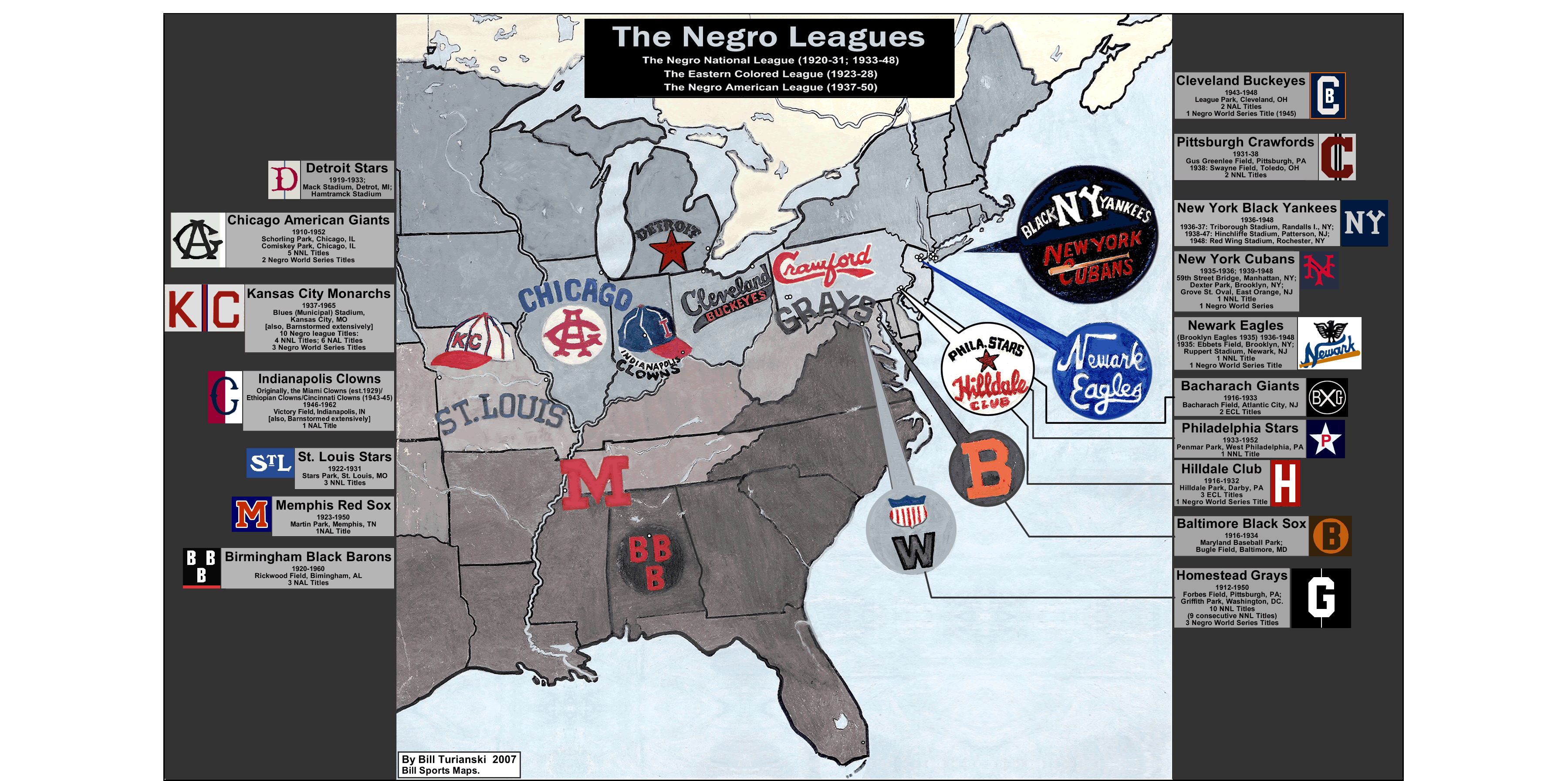
Billsportsmaps’ 15th anniversary throwback: Negro League Baseball, 1920-1950 (hand-drawn map) [first posted 26 November 2007].

By Bill Turianski on the 25th of February 2023; twitter.com/billsportsmaps.

Billsportsmaps.com had its 15th year anniversary, on the 17th of August 2022. So I am posting a series of maps from the early days of this blog. This hand-drawn map was originally posted in November 2007. I have re-posted now, for Black History Month [February].

negro-leagues_segment_c.gif
Negro Leagues map


Denied entrance into Major League Baseball by the color barrier, black ballplayers organized leagues of their own. These were the Negro Leagues, which existed between 1920 and 1957. The primary leagues were the Negro National League (1920-31; and 1933-48); the Negro Southern League, a minor-league (1920-40);  the Eastern Colored League (1923-28); and the Negro American League (1937-57). [For purposes of this map, records will only go to 1950, after which the Negro American League, the last negro league, essentially played exhibition games.] 

There were many standouts in the Negro Leagues, and 37 Negro League players (as of 2022) have been elected to the Baseball Hall Of Fame. The first five elected were Satchel Paige (the legendary right-handed pitcher);  Josh Gibson (catcher, and home run king); James ”Cool Papa” Bell (center fielder, and base-stealer extroardinaire);  Buck Leonard (first baseman, slugger); William “Judy” Johnson (third baseman, with a .349 lifetime batting average); and Oscar Charleston (outfielder, and slugger, with a blend of power and speed; and a .376 lifetime batting average). More information about the Negro Leagues can be found at www.blackbaseball.com, and at the Negro Leagues Baseball Museum at nlbm.com, among other good sites.

Negro League baseball was characterized by fleet-footed action, and hi-jinks, ranging from tomfoolery to deadly serious one-upsmanship. There was more base-stealing than in Major League Baseball, and there was a sense of “playing to the crowd.” The teams knew the fans (particularly the significant portion of white customers) were there to see a show, and the players didn’t disappoint. An example of this was the barnstorming (traveling) club called the Indianapolis Clowns, an outfit similar to the Harlem Globetrotters. But that did not mean that Negro League baseball was an inferior product. During this era, negro baseball squads often defeated white MLB squads in exhibition games. Seasons were generally around 60 to 70 games long. There were no real standardized schedules, and teams operated on a shoe-string budget. 

The Golden Age of the Negro Leagues can be seen as the period from 1933 to 1947. The Washington-Homestead Grays regularly outdrew the Major League Baseball team the Washington Senators in Griffith Park in Washington DC, as they racked up 9 straight Negro National League titles. The Chicago American Giants played in old Comiskey Park, home of the MLB team the Chicago White Sox. The Pittsburgh Crawfords played in the first entirely black-owned ball park, Greenlee Field, and traveled the country in style, in their custom-made bus. The Newark Eagles won the 1946 NNL title, under Effa Manley (the first woman owner-operator to win a championship; she became the first woman inducted into the Baseball Hall of Fame, in 2006). And the Kansas City Monarchs toured the continent with their state-of-the-art portable lighting system. The Kansas City Monarchs would set up shop most anywhere, playing to thousands on a nightly basis. The Monarchs began using lighting for night games in 1930, five years before MLB teams first did. The KC Monarchs ranged throughout the midwest, the upper midwest and Canada. The Monarchs ended up sending more players to Major League Baseball than any other Negro League team. Their star pitcher, Satchel Paige, made more money than most major leaguers. It was an amazing phenomenon, that only ended when blacks were finally able to play in the Major Leagues. In 1947, Jackie Robinson, of the Brooklyn Dodgers, broke the color barrier, and the Negro Leagues days were numbered. Owners saw their star talent go to the white ball clubs, with no financial compensation. By the mid 1950s, the few surviving Negro League clubs were basically playing exhibition games, and the whole era faded away under the public radar. But the legacy of the Negro Leagues cannot be overstated.

I drew the main map in 2001, using Swiss-made Caran d’Ache watercolor pencils and Rapidograph pens. In 2007, after scanning it, I added the flanking segments. I have included the 17 most prominent Negro Leagues ball clubs.


___

February 6, 2023

2023 Copa Libertadores: location-map for the 47-team tournament, with Club Histories (total Libertadores appearances & titles listed) + Population-chart of Cities with teams in 2023 Libertadores.

Filed under: Copa Libertadores — admin @ 1:06 pm

conmebol_copa-libertadores_2023_location-map_47-teams_post_b_.gif
Copa Libertadores 2023: 47-team map


By Bill Turianski on 6 February 2023; twitter.com/billsportsmaps.
Links…
-2023 Copa Libertadores (en.wikipedia.org).
-Summary: results, fixtures, standings (flashscore.co.uk).
-espn.com/[libertadores].

This is the 64th iteration of the Copa Libertadores, the most prestigious football tournament in South America. The 2023 tournament is the 7th since it was expanded in 2017, from 38 to 47 teams. Since then, no team from a country other than Brazil or Argentina has won the title (Brazilian teams have won it 5 times since the tournament-expansion, and an Argentinian team has won it once since then). And Brazilian sides have won the last four titles. (Copa Libertadores winner in 2022 was Flamengo, of Rio de Janeiro, Brazil. Copa Sudamericana winner in the 2022 tournament was Independiente del Valle, of Sangolquí, Greater Quito, Ecuador.)

This map includes the Preliminary-Stage teams: there are 19 preliminary-stage teams…and only four of those 19 teams will advance to the Group Stage. (Note: on the map-page, on the teams-by-country lists that flank the map, the 19 preliminary clubs are shown in italics, accented by a light tan-color.)

Schedule
-The first of three Preliminary stages starts on 7-to-9 February {2023 Copa Libertadores Qualifying stages}.
-The Group Stage starts on 4-to-6 April. The draw for the Group Stage is on the 22nd of March. {2023 Copa Libertadores, Group Stage (en.wikipedia.org)}.

Qualified teams by country:
•Brazil has 8 teams (7 + Copa Libertadores holder).
•Argentina has 6 teams.
•Ecuador has 5 teams (4 + Copa Sudamericana holder)
•The seven other countries all have 4 teams each, in the tournament (Uruguay, Colombia, Paraguay, Chile, Peru, Bolivia, Venezuela).

Cities with teams in the 2023 Copa Libertadores
This is the second time on one of my Copa Libertadores maps that I have included a chart which shows all the cities with teams in the tournament, and their populations. The chart is at the top-centre of the map-page. It includes the ten largest metropolitan areas in South America (nine of which have teams in the 2023 Copa Libertadores). The list then shows all the other top-50-largest metro-areas in South America with Libertadores teams this year. And then the list shows the other metro-areas with Libertadores teams this year. {Populations…Cities with teams in 2022 Copa Libertadores: Metropolitan-area figures for 50 largest South American cities from, 2015 at: List of South American metropolitan areas by population (en.wikipedia.org); & Population figures for other cities with teams in tournament at: each city’s en.wikipedia page.}


___
Thanks to all at the links below
-Globe-map of South America by Luan at File:South America (orthographic projection).svg (en.wikipedia.org/[South America]).
-Blank map of South America by Anbans 585 at File:CONMEBOL laea location map without rivers.svg (en.wikipedia.org/[2018 Copa Libertadores]).
-2023 Copa Libertadores (en.wikipedia.org).
-Copa Libertadores 1960-2019 Club Histories (rsssf.com).
-Libertadores titles list {en.wikipedia.org/wiki/Copa_Libertadores#Performances_by_club}.

January 24, 2023

NFL 1964 season, map with helmets/jerseys & final standings + offensive stats leaders; champions: Cleveland Browns.

Filed under: NFL>1964 map/season,NFL/ Gridiron Football,Retro maps — admin @ 6:53 pm

nfl_1964_map-with-helmets_1964-standings_offensive-stats-leaders_home-jerseys_cleveland-browns-champs_post_d_.gif
NFL 1964 season, map with helmets/jerseys & final standings + offensive stats leaders; champions: Cleveland Browns


By Bill Turianski on 24 January 2023; twitter.com/billsportsmaps.
Links…
-1964 NFL season
-1964 NFL Championship Game (en.wikipedia.org).
-1964 NFL season (pro-football-reference.com).

1964 NFL title game: Cleveland Browns 27, Baltimore Colts 0.
In 1963, Blanton Collier replaced the Cleveland Browns’ 17-year head coach Paul Brown. Owner Art Modell had fired Paul Brown, after the team went 7-6-1 in 1962. This came about because by the early 1960s, Paul Brown had hardened into an autocratic leader unwilling to work with the owner, or to let others share the limelight. The power struggle between Modell (the owner), Paul Brown (the head coach and team founder), and the star player (Jim Brown) could only end one way, and that was for Paul Brown to go.

Collier had been an assistant coach under Paul Brown from 1946 to 1953, back in the glory days of the Browns in the AAFC (winning all four AAFC titles) and then in the NFL (winning the 1950 title in the Browns’ first NFL season). Circa the early 1950s, Blanton Collier had been the first coach in the NFL to utilize film analysis. Collier went on to coach the University of Kentucky Wildcats from 1954-61. Collier then went back to Cleveland in 1962, as offensive assistant. One year later, Collier was the Browns’ new head coach.

As head coach, Blanton Collier was a patient perfectionist who brought calm to the Browns’ locker room.
•In 1963, the Browns under Collier went 10-4, finishing 1 game behind the Giants in the NFL East.
•In 1964, the Browns under Collier went 10-3-1, finishing 1/2 game above the Cardinals, and winning the NFL East.

1964 NFL Championship Game, Sunday December 27 1964.
Municipal Stadium, Cleveland, OH. Attendance: 79,544 [overflow-capacity of 101.7%]. Game-time temperature was 32°F (0°C), with a strong 20-MPH wind off of Lake Erie, and occasional light snow flurries. The Baltimore Colts were heavily-favored. Oddsmakers had the Colts favored by 7 points, and virtually everyone in the national media - and the local Cleveland media - predicted a huge Colts victory. The Colts were led by second-year head coach Don Shula and QB Johnny Unitas, and featured the league-leader in TDs, HB Lenny Moore. The Colts had coasted to the Western Division title, going 12-2 and clinching their post-season berth with 3 games to spare, and had the highest-scoring offense and the least-scored-upon defense. Meanwhile, the Browns had struggled to win the Eastern Division, and squeaked into the post-season with only a half-a-game lead over the surprise St. Louis Cardinals. The Browns were led by second-year head coach Blanton Collier, QB Frank Ryan (the league-leader in TD passes), FB Jim Brown (the league-leader in rushing and in yards from scrimmage), and WRs Gary Collins and rookie Paul Warfield. This was the Browns’ eighth NFL championship game appearance since joining the NFL in 1950, but it was their first in seven years.

The first half went scoreless, with both teams unable to move the ball. Late in the 3rd Quarter, with the Browns up 3-0, Jim Brown broke open for a 46-yard run {see photo below}. (Jim Brown ran for 114 yards in the game.) That run set up the Browns’ first TD, on the next play: an 18-yard pass from Browns QB Frank Ryan to WR Gary Collins {see photo below}. Then late in the 3rd quarter, Ryan found Collins again, on a 42-yard pass. That gave the Browns a 17-0 lead {see photo below}. In the 4th quarter, Ryan found Collins yet again, on a 51-yard pass play that carried Gary Collins into the end zone standing-room-only crowd {see photos below}. Gary Collins’ 3 TD pass receptions in an NFL title game is a record that still stands (as of 2022). The Cleveland Browns’ 1964 title was the only NFL title that Jim Brown won. It was the Browns’ 4th NFL title. And 58 years later, it is still the last NFL title that the Cleveland Browns have won.

cleveland-browns_1964-nfl-championship-game_municipal-stadium_browns-27_colts-0_blanton-collier_frank-ryan_gary-collins_jim-brown_f_.gif
Photo and Image credits above -
Screenshot of exterior of Municipal Stadium’s “Home of the Cleveland Browns” banner, from video uploaded by jstube36 at youtube.com. Interior shot of Municipal Stadium for 1964 NFL title game (Sunday December 27, 1964 in Cleveland, Ohio), shot from upper deck before game, photo unattributed at goldenrankings.com/nflchampionshipgame1964. Blanton Collier and Jim Brown [photo circa 1963], unattributed at fold3.com/[Blanton Collier]. Photo of Blanton Collier and QB Frank Ryan, unattributed from Cleveland Browns (II) at artsci.case.edu. Jim Brown running for 46-yard gain, photo unattributed at brownswire.usatoday.com. Screenshot of WR Gary Collins catching his 1st TD pass in end zone, from video uploaded by Cleveland Browns at youtube.com. Screenshot of WR Gary Collins catching his 2nd TD pass in end zone, from video uploaded by Cleveland Browns at youtube.com. Gary Collins after his record-setting 3rd TD pass reception, emerging from standing-room-only section behind endzone, photo unattributed via dawgsbynature.com/2019/12/26/21038201/where-are-your-former-browns-now-wr-gary-collins. Jim Brown immediately after the game, swarm by congratulatory fans, screenshot from video uploaded by NFL Films at youtube.com.


Browns players on map page,
Frank Ryan [photo circa 1965], unattributed at thedelite.com. Dick Schafrath [1965 Fleer card], from vintagecardprices.com. Jim Brown [photo from 1964], photo by Neil Leifer via pinterest.com. Paul Warfield [1965 Fleer card], from psacard.com. Gary Collins [photo from 1964 NFL Championship Game (Dec. 27 1964)], unattributed via dawgsbynature.com/2019/12/26/21038201/where-are-your-former-browns-now-wr-gary-collins. Brownie the Elf with crown (1964 NFL title-winners), photo from worthpoint.com.
Game-worn mid-1960s Cleveland Browns helmet (Paul Warfield), photo from helmethut.com/Browns/Warfield. Lou Groza [photo circa 1963], unattributed at gamedaysportsmemorabilia.com. Jim Houston [1962 Post Cereal card], from footballcardgallery.com. Dick Modzelewski [photo circa 1964], unattributed at clevelandbrowns.com. Bill Glass [photo from 1962], photo by Neil Leifer via gettyimages.com. Bernie Parrish [1965 Fleer card], from maaravamall.com. Segment of NFL-logo-themed playing cards [from 1964], from grayflannelsuit.net/blog.

Offensive stats leaders on map page,
Bart Starr QB (Packers) [photo circa 1963], 1964 Packers Yearbook from ebay.com
Charley Johnson QB (Cardinals) [photo from Jan. 1965], photo by Walter Iooss Jr via gettyimages.com.
Frank Ryan QB (Browns) [photo circa 1963], photo from Getty Images via pinterest.com.
Jim Brown FB (Browns) [photo circa 1964], photo unattributed at brownswire.usatoday.com.
Johnny Morris FL (Bears) [image from 1963], screenshot from video at chicagobears.com/video/chicago-bears-decade-series-1960-s.
Lenny Moore HB (Colts) [image circa 1965], screenshot from video uploaded by NFL Films at youtube.com/[#94: Lenny Moore | The Top 100: NFL's Greatest Players]
___

Thanks to all at the following links…
-Blank map by anonymous US federal government employee, at File:StatesU.svg (commons.wikimedia.org).
-Thanks to the contributors at pro-football-reference.com
-Thanks to the contributors at NFL 1964 season (en.wikipedia.org).
Special thanks to Tim Brulia, Bill Schaefer and Rob Holecko of The Gridiron Uniform Database, for giving billsportsmaps.com the permission to use football uniforms illustrations from Gridiron Uniform Database {GUD}.

January 12, 2023

Netherlands: 2022-23 Eredivisie – Location-map, with 3 charts: Attendance [current]; Seasons-in-1st-Division (current clubs) & Dutch professional titles list.

Filed under: Netherlands — admin @ 9:43 pm

netherlands_2022-23-eredivisie_location-map_attendance_seasons-in-1st-div_dutch-titles-list_post_c_.gif
Netherlands: 2022-23 Eredivisie – Location-map, with 3 charts: Attendance [current]; Seasons-in-1st-Division (current clubs) & Dutch professional titles list

By Bill Turianski on 12 January 2023; twitter.com/billsportsmaps.
Links…
-Summary – Eredivisie – Netherlands – results, fixtures, tables, stats, etc (soccerway.com).
-2022-23 Eredivisie (en.wikipedia.org).
-worldfootball.net/competition/[Eredivisie - Overview].

The map shows the 18 clubs in the 2022-23 Eredivisie, the top-flight of the Netherlands. The Eredivisie was founded in 1956, two years after the introduction of professionalism in the Netherlands. That makes this the 67th season of the competition. Currently [12 January 2023], after 15 of 36 rounds, Feyenoord leads, with Ajax and PSV 3 points back, and Twente and AZ 4 points back.

On the left-hand side of the map-page is an Attendance chart which features 3 things: current Average Attendance (to 9 January 2023, with 15 of 36 rounds played), Venue-capacity, and Percent-capacity.

Currently, the Dutch top flight is drawing very well. Eleven of the eighteen teams are drawing above 90%-capacity. Those 11 teams drawing above 90%-capacity are: Feyenoord Rotterdam, NEC [Nijmegen], Go Ahead Eagles [of Deventer], Ajax [Amsterdam], Twente [Enschede], Fortuna Sittard [of Limburg], just-promoted Excelsior [of Rotterdam], just-promoted Volendam [located just north of Amsterdam in Nord-Holland], Cambuur Leeuwarden [of Freisland], just-promoted Emmen [of Emmen in Drenthe], and Sparta Rotterdam. [Note: Feyenoord are currently playing to 100%-capacity at their stadium, De Kuip, but this is a limited capacity of 47,500, which is about 3,600 less than the total seated-capacity of the stadium.]

At the right-hand side of the map-page are two charts. The top chart shows the Seasons-in-1st-division for the current clubs. Also listed are the consecutive seasons each club has currently spent in the top-flight. Longest serving clubs are the big 3 of the Netherlands – Ajax (of Amsterdam), Feyenoord (of Rotterdam), and PSV (of Eindhoven). All 3 were founding members of the Eredivisie, and all 3 have never been relegated. The second chart is the all-time pro titles list for the Netherlands. As mentioned, the Eredivisie was established two years after Dutch clubs could turn pro. So I have included the winners of the final two 48-team Dutch National Championships, in 1954-55 (winner: Willem II [of Tilburg]) and 1955-56 (winner: Rapid JC [of Kerkrade]).

The map itself includes the 12 provinces, and the 14 largest cities of the Netherlands. At the foot of the map, the populations of those 14 largest Dutch cities are listed (with the provinces they are located in). Finally, I added all the major rivers and waterways of the Netherlands, including the main canals.
___
-Thanks to Lencer at en.wikipedia.org, for the blank map of Netherlands, File:Netherlands location map.svg.
-Thanks to Rob984 at File:EU-Netherlands_(orthographic projection).svg.
-Thanks to the contributors at Eredivisie (en.wikipedia.org).

January 3, 2023

2022-23 FA Cup, 3rd Round Proper: location-map, with fixtures list & current league attendances.

Filed under: 2022-23 FA Cup — admin @ 9:20 pm

2022-23_fa-cup_3rd-round_map_w-league-attendances_w-fixtures_post_c_.gif
2022-23 FA Cup, 3rd Round Proper: location-map, with fixtures list & current league attendances


By Bill Turianski on 3 January 2023; twitter.com/billsportsmaps.
Links…
-The competition…FA Cup (en.wikipedia.org).
-2022-23 FA Cup (en.wikipedia.org).
-BBC’s page on the competition…bbc.com/fa-cup.

The FA Cup is the oldest football tournament in the world. The 2022-23 FA Cup is the 142nd edition of the tournament. The FA Cup Third Round is when the teams from the top 2 divisions in England – the Premier League, and the EFL Championship – join the competition. The 20 Premier League teams and the 24 Championship teams join 20 other lower-leagues teams. This season, that breaks down to: 11 teams from EFL League One [the 3rd level], 6 teams from EFL League Two [the 4th level], and 3 teams from the non-League National League [the 5th level]. Those 3 non-League teams are: Wrexham, Chesterfield, and Boreham Wood.

The map shows the locations of the 64 teams in the 3rd Round, with the 32 home-venues listed. There are 3 inset maps: of Greater London-plus-surrounding-area (showing 11 clubs); of Greater Manchester (showing 4 clubs); and of the West Midlands-including-Birmingham (showing 6 clubs). Plus there is something new I’m trying out on the map…in small 10-point type I have shown the 32 home-venues for the 3rd Round. Finally, on the left-hand side of the map-page are home league average attendance figures of the 64 qualified clubs. And on the right-hand side is the 3rd Round fixtures list.

{Televised matches.}


Sources…
Thanks to all, at the links below…
-Blank map of English Metropolitan and Non-Metropolitan Counties, by Nilfanion, at File:English metropolitan and non-metropolitan counties 2010.svg (commons.wikimedia.org).
-Blank relief map of Greater London, by Nilfanion (using UK Ordnance Survey data), at File:Greater London UK relief location map.jpg.
-Blank relief map of Greater Manchester, by Nilfanion (using Ordnance Survey data), at File:Greater Manchester UK relief location map.jpg.
-Fixtures list: screenshot from bbc.com/fa-cup.
-FA Cup (en.wikipedia.org).
Attendance figures…
-Worldfootball.net.

December 23, 2022

Spain: 2022-23 La Liga – Location-map, with 3 charts: Attendance [current], Seasons-in-1st-Division & Spanish titles list.

Filed under: Spain — admin @ 10:01 pm

spain-la-liga_2022-23_location-map-of-the-20-clubs_current-attendance-nov-22_titles-list_seasons-in-1st-div_post_b_1.gif
Spain: 2022-23 La Liga – Location-map, with 3 charts: Attendance [current], Seasons-in-1st-Division & Spanish titles list


By Bill Turianski on 23 December 2022; twitter.com/billsportsmaps.
Links…
-2022-23 La Liga (en.wikipedia.org).
-La Liga – Summary: matches, table, players, etc (soccerway.com).
-Sid Lowe at theguardian.com/football [Spanish football coverage] (theguardian.com/profile/sidlowe).

The map page shows a location-map for the 20 clubs in the 2022-23 La Liga, with recently-promoted and -relegated teams noted. (Promoted in 2022: Almería, Real Valladolid, Girona; relegated in 2022: Granada, Levante, Alavés.) The map also shows the 17 Autonomous Communities of Spain, and the 20 largest Spanish metropolitan areas. Those 20 largest Spanish metro-areas, with their 2018 population estimates, are listed at the top-centre of the map-page.

The 3 charts
A) A chart showing Current Attendance (up to World Cup break of November/December) plus 2021-22 finish, with teams playing in Europe noted. There are also columns listing Venue-capacities and Percent-capacities. The team with the highest percent-capacity currently is newly-promoted Girona, at 91%-capacity. Worst at filling their stadium currently is Espanyol, at 48%-capacity (the stadium is simply too large for the club’s fanbase). Overall, post-Covid restrictions, Spanish football has rebounded pretty well. There are a whole lot of teams playing to ~80%-capacity (Rayo Vallecano, Betis, Cadiz, Valencia, Sevilla, Barcelona, Real Sociedad, Osasuna, Almería, Athletic Bilbao, Real Madrid). (Attendance in Spain is not as good as in Germany, but really, no top flight league (besides the Premier League) ever draws as well as the Bundesliga.)
B) A chart showing Seasons-in-La Liga by club, with consecutive seasons listed. This is the 92nd La Liga season. Three La Liga founding members – Real Madrid, Barcelona, and Athletic Club [Bilbao] have never been relegated.
C) A chart showing the All-time Spanish professional titles list (1929 to 2021-22). There are only 9 clubs which have won a La Liga title, which is a dismally small number, and is an example of how the Spanish game is unbalanced by the near duopoly of Real Madrid/Barcelona.

La Liga will re-start on 29-to-31 December, with the 15th match-week. {worldfootball.net/competition/esp-primera-division.}


___
Thanks to all at the following links
-Blank map of Spain, by NordNordWest at File:Spain location map.svg;
-Globe-map of Spain, by Rob984 at File:EU-Spain (orthographic projection).svg;
-Map of the Community of Madrid, by Miguillen at File:Spain Madrid location map.svg (en.wikipedia.org).
-Map of Canary Islands, by Miguillen at File:Canarias-loc.svg (commons.wikimedia.org).
-Largest metropolitan areas in Spain (2018 European Spatial Planning Observation Network figures) (en.wikipedia.org).
-en.wikipedia.org/wiki/La_Liga#Clubs.
-Autonomous communities of Spain;
-List of metropolitan areas in Spain (en.wikipedia.org).

December 12, 2022

Germany: 2022-23 Bundesliga – Location-map, with 3 Charts: Current Attendance, Seasons-in-1st-Division & All-time German Titles list.

Filed under: Germany — admin @ 10:01 pm

2022/11/germany-bundesliga_2022-23_location-map-of-the-18-clubs_w-3-charts_attendance_titles_seasons-in-1st-div_post_c_.gif
Germany: 2022-23 Bundesliga – Location-map, with 3 Charts: Current Attendance, Seasons-in-1st-Division & All-time German Titles list


By Bill Turianski on the 12th of December 2022; twitter.com/billsportsmaps.
Links…
-2022-23 Bundesliga (en.wikipedia.org).
-World Football.net site…worldfootball.net/bundesliga.
-Official site of Bundesliga (English)…bundesliga.com/en/bundesliga.
-Deutsche Welle [in English]…DW/en/sports.

The map page shows a location-map for the 18 clubs in the 2022-23 Bundesliga, with recently-promoted and -relegated teams noted. (Promoted in 2022: Schalke, Werder Bremen; relegated in 2022: Arminia Bielefeld, Greuther Fürth.) The map also shows the 16 Federal States of Germany, and the 14 largest cities in Germany, with 2015 population figures listed at the the top of the map.

The 3 charts are
A) Current attendance (up to World Cup break of November/December) & 2021-22 finish, with teams playing in Europe noted. There are also columns listing Venue-capacities and Percent-capacities. And, as you can see, the Bundesliga is currently playing to a whole lot of full stadiums, with 12 of the 18 clubs drawing above 90%-capacity, including four clubs drawing above 99%-capacity (Bayern Munich, Borussia Dortmund, Union Berlin, FC Köln).
B) Seasons-in-Bundesliga by club, with consecutive seasons listed.
C) All-time German titles list (including the pre-1963-64/pre-Bundesliga amateur era), with current level [2022-23] of each title-winning club listed.

The Bundesliga will re-start on the 20th of January 2023, with the 16th match-week. {worldfootball.net/competition/bundesliga.}


___
Thanks to all at the following links
-Blank map of Germany, by NordNordWest at File:Germany location map.svg (Wikimedia Commons).
-Globe-map of Germany by Rob984 at File:EU-Germany (orthographic projection).svg.
-Populations of 14 largest German cities from List of cities in Germany by population (en.wikipedia.org).
-Bundesliga;
-List of German football champions (en.wikipedia.org).
-(West) Germany – List of Champions (rsssf.com).
-Attendance figures from worldfootball.net/[Bundesliga Attendance, 2022-23)].

December 2, 2022

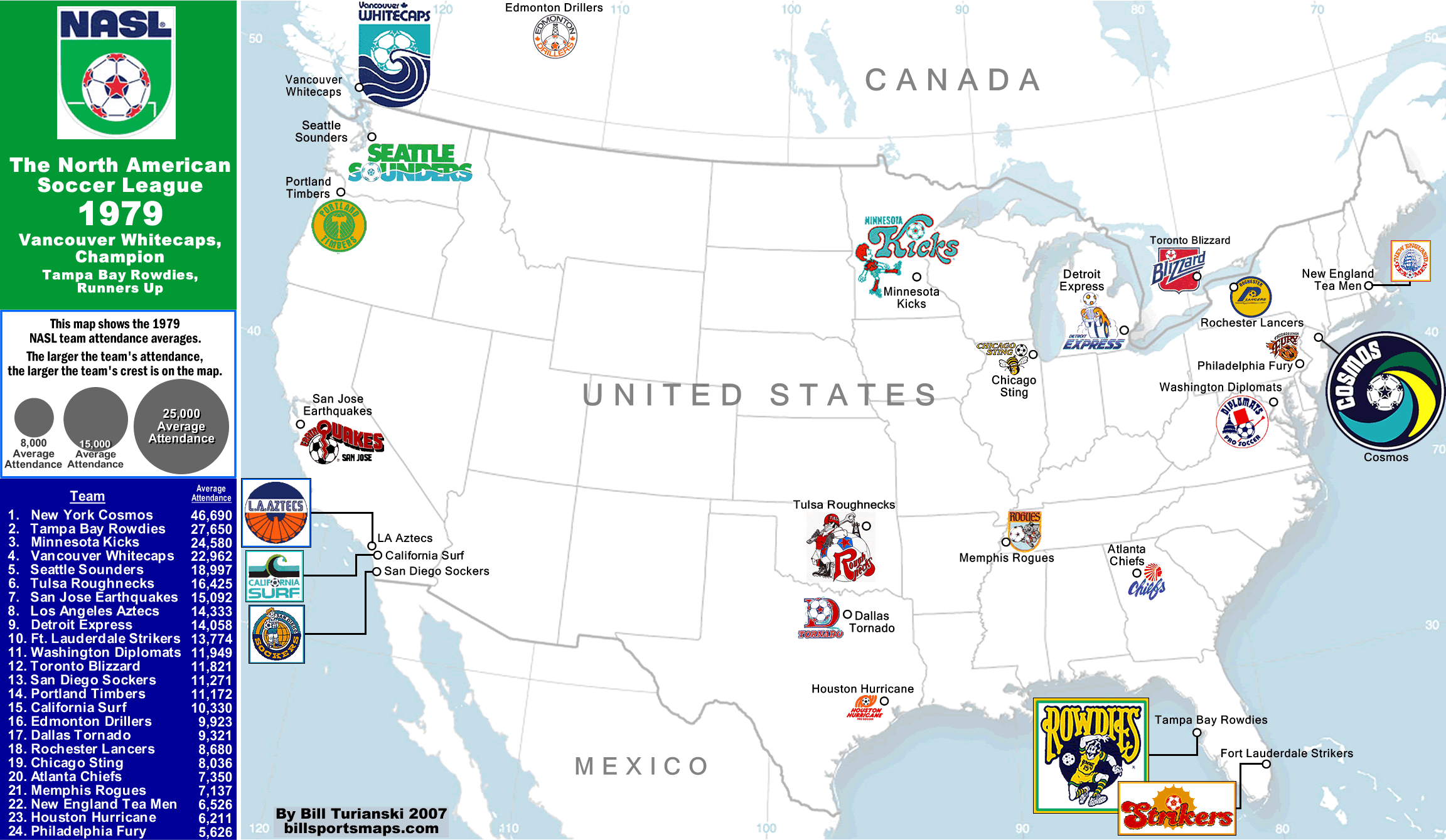
Billsportsmaps’ 15th anniversary throwback: The North American Soccer League – 1979 attendance map with logos [first posted 24 October 2007].

By Bill Turianski on the 2nd of December 2022; twitter.com/billsportsmaps.

nasl-1979-map_revised5_post_f_.gif
NASL 1979 Map with Attendance Figures

1979 NASL (en.wikipedia.org).


[Originally posted on 24 October 2007.]
This map shows the 1979 North American Soccer League, whose heyday was in the late 1970s. The NASL averaged 13,084 per game in 1979, and hit its high of 14,201 per game in the following year of 1980. The NASL is most famous for the New York Cosmos and their star-studded roster, but the Vancouver Whitecaps were champions in 1979. The Cosmos had won it in 1977 and 1978, and won it again in 1980. The Cosmos rise (and subsequent fall) was meteoric, to say the least. Before they signed Pele, in 1977, they were playing in a rundown stadium on Randalls Island, drawing 5,000 at best. In the short span of four years, 1974 to 1978, the Cosmos’ average gate went from 3,578 to 47,856.

In 1979 the Cosmos averaged 46,690. That same season, Tampa Bay, Minnesota, and Vancouver all drew very well, between 22,000 and 27,000. Seattle, and somewhat surprisingly, Tulsa, were drawing respectable crowds in the 16,000-18,000 range. San Jose drew 15,000; Los Angeles, though fielding Johann Cruyff, only drew 14,000. Also, Chicago averaged only 8,000, a poor showing considering the size of the city and the fact that the team was competitive. In retrospect, that last attendance figure could be seen as the writing on the wall. For if a decent team, in a huge city, in middle America, couldn’t pull 10,000 through the turnstiles, then the viability of the whole project was in doubt. Especially with the high salaries of the overseas players.

Growing up in Rochester, New York, I was a devout follower of the Rochester Lancers. Opposing players dreaded the barracks-like atmosphere of their crumbling concrete stadium and its potato patch field. This gave the scrappy, Slavic-heavy Lancers squad a solid home advantage. Before game time, me and my brothers would go up to the top of the stadium and watch the traffic pulling in, trying to will more fans through the turnstiles. In 1979, Rochester had its best gate, 8,600. But it wasn’t enough to keep them alive, and after the 1980 season, the Rochester Lancers of the NASL dissolved. The NASL was dead to me at that point. It died for real, 4 years later. It had existed from 1968 to 1984. Its most vibrant period was from around 1976 to 1981. Pele, Eusebio, Rodney Marsh, George Best, Franz Beckenbauer, Bobby Moore, Giorgio Chinaglia, Trevor Francis, Carlos Alberto, and many more world football legends graced the rosters of NASL teams. The stodgy rules of the game were relaxed, with a striker-friendly 35-yard offside line, and shootouts instead of penalty kicks. The shootouts were awesome. It was a 5-second-Chinese-fire-drill, with the goal keeper usually rushing towards the shooter. The shooter then had to decide whether to elude the keeper, rifle the ball low, or chip it. Offense was further encouraged by awarding points in the standings for goals scored. So even if you lost, you could gets points in the standings.

But the league over-expanded, diluting on-field quality. The league expanded from 16 to 24 teams in 1977, and many franchises shifted to other cities. The clueless new ownership of many franchises aped the Cosmos, overspending on aging internationals and letting domestic talent languish on the bench. When the crowds fell off, the owners bolted. Some also believe that when FIFA awarded the 1986 World Cup to Mexico, instead of the US, it hastened the league’s demise. Still, the NASL ultimately contributed to the overall improvement of the quality of American (and Canadian) players, and their national teams. The US national team has been transformed from also-rans to a competitive force. And no American ever played in the English 1st Division before the NASL. John Harkes was the first, with Sheffield Wednesday, in 1990. Today, the USA is represented in England by the likes of Brian McBride, Clint Dempsey, Carlos Bocanegra, and Kasey Keller on Fulham; Marcus Hanhnemann and Bobby Convey on Reading; Brad Friedel on Blackburn; Tim Howard on Everton; Jonathon Spector on West Ham United, and Jay Demerit on Watford.


« Newer PostsOlder Posts »

Powered by WordPress