billsportsmaps.com

January 2, 2014

2013-14 FA Cup, Third Round: location-map, and current average attendances of the 65 clubs still alive in the competition./ Plus: Update, a small chart showing the biggest upsets in the 3rd Round [chart posted Saturday the 4th of January].

Filed under: 2013-14 FA Cup — admin @ 11:17 am

2013-14_fa-cup_3rd-round_post_b.gif
2013-14 FA Cup, Third Round: location-map, and current average attendances


FA Cup – news, fixtures, results (bbc.co.uk/sport/football/fa-cup).
There are 65 clubs still alive in the competition, and not the 64 that the Third Round is supposed to have, because the Bristol Rovers v Crawley Town 2nd Round replay was abandoned due to a water-logged pitch (on 18 Dec. 2013 at the Broadfield Stadium in Crawley, West Sussex). The two will play Wednesday night the 8th of January. The Bristol Rovers/Crawley Town winner will play their 3rd Round match versus Birmingham City at St Andrew’s on either Tuesday night or Wednesday night the 14 or 15th January.
Televised matches: {see this, ‘2013–14 FA Cup/Broadcasting rights, Third Round Proper‘ (en.wikipedia.org).

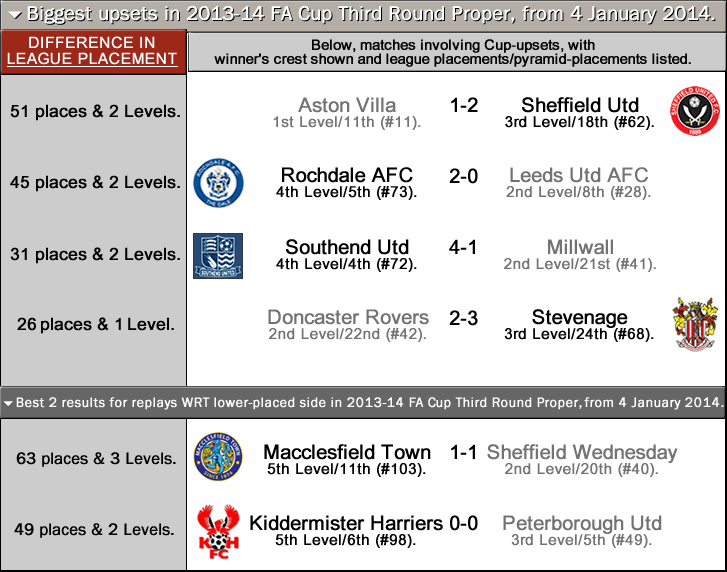
Below: Update – the biggest upsets in the 2013-14 FA Cup 3rd Round [posted Saturday the 4th of January].

2013-14_fa-cup_3rd-round_upsets_jan2014_c_.gif
___

Thanks to the following sites for average attendance figures -
1st Level/Premier League, soccerway.com/national/england/premier-league.
2nd Level/Football League One, football-league.co.uk/page/DivisionalAttendance [L2].
3rd Level/Football League One, football-league.co.uk/page/DivisionalAttendance [L3].
4th Level/Football League Two, football-league.co.uk/page/DivisionalAttendance[L4].
5th Level/Conference National, soccerway.com/national/england/conference-national.

Thanks to the FA site, for the [gold-colored] FA 150th Anniversary crest, from a banner at thefa.com.
Thanks to BBC.co.uk/football/fa cup, for the image of the fixtures list on the map page, bbc.com/sport/football/fa-cup/fixtures.
Thanks to the contributors to the pages at en.wikipedia.org, ‘2013–14 FA Cup‘.

December 30, 2013

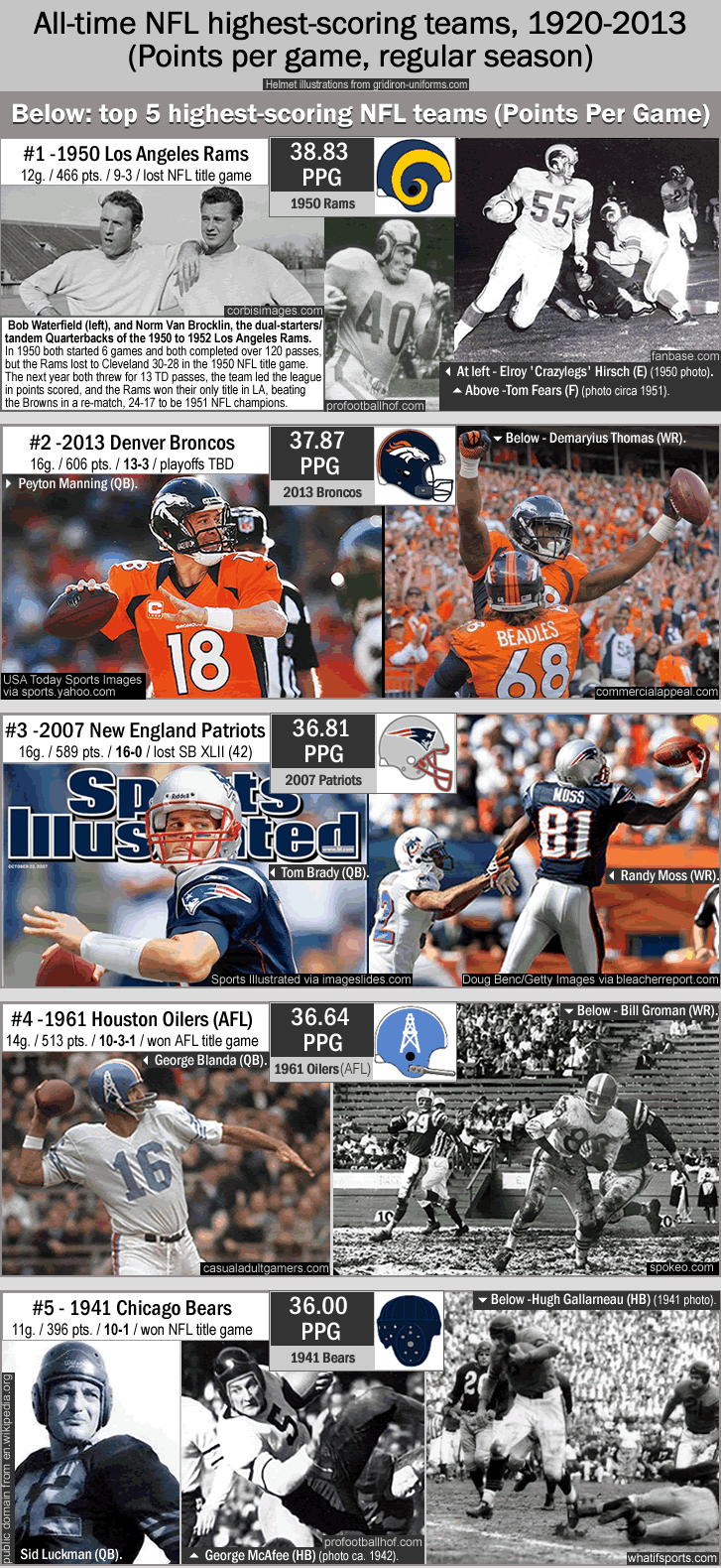
NFL – All-time highest scoring teams (1920 to 2013, regular season/points per game) – #1: 1950 Los Angeles Rams, #2: 2013 Denver Broncos, #3: 2007 New England Patriots, #4: 1961 Houston Oilers (AFL), #5: 1941 Chicago Bears.

Filed under: NFL/ Gridiron Football — admin @ 11:52 pm

Note, this illustration was included, after posting, into this post I made in November 2013 {click on the following, http://billsportsmaps.com/?p=24182}. That post talks about the highest-scoring teams and eras in the NFL. I made the illustration below afterwards, because in the interim, the 2013 Denver Broncos became one of the highest scoring NFL teams ever (second-highest after the 1950 Los Angeles Rams). I decided to make the illustration below also as a stand-alone post, so it would not get lost in the shuffle.


All-time highest scoring teams (1920 to 2013, regular season/points per game) -
#1: 1950 Los Angeles Rams, #2: 2013 Denver Broncos, #3: 2007 New England Patriots, #4: 1961 Houston Oilers (AFL), #5: 1941 Chicago Bears.
nfl_highest-scoring-teams_1950-la-rams_2013-denver-broncos_1967-afl-houston-oilers_1941-chicago-bears_e.gif
Photo and Image credits above –
Helmet illustrations,
helmet illustrations from The Gridiron Uniforms Database at gridiron-uniforms.com.
1950 Rams,
Bob Waterfield and Norm Van Brocklin photo, from Corbis at corbisimages.com/stock-photo/bob-waterfield-and-norm-van-brocklin-standing.
Crazy Legs Hirsch, action photo from profootballhof.com/fact-or-fiction-hall-of-famer-elroy-hirsch-was-nearly-stripped-naked-by-fans-after-a-game.
Tom Fears, action photo from fanbase.com/Tom-Fears/photo.
2013 Broncos,
Peyton Manning, photo from USA Today Sports Images sports.yahoo.com/blogs.
Demaryius Thomas, photo unattributed at commercialappeal.com.
2007 Patriots,
Tom Brady. photo from Sports Illustrated via imageslides.com/Sports/gallery/4345-Past-10-NFL-MVP-Winners#9 .
Randy Moss, photo by Doug Benc/Getty Images via bleacherreport.com/articles/722541-dallas-cowboys-all-time-biggest-draft-misses.
1961 Houston Oliers (AFL),
George Blanda, photo from casualadultgamers.com/thread-All-Time-Teams.
Bill Groman, photo from spokeo.com.
1940 Chicago Bears,
Sid Luckman, photo public domain from en.wikipedia.org.
George McAfee, photo from profootballhof.com/Bears-vs-Packers-in-1941-NFL-Playoff-Game.
Hugh Gallarneau, photo from whatifsports.com/article_1941BearsPackers.
___
Thanks to pro-football-reference.com.
Thanks to the Gridiron Uniform Database, for giving billsportsmaps.com permission to use their helmet illustrations, http://www.gridiron-uniforms.com/.

December 19, 2013

England and Wales: Premier League – 2013-14 home kit badges, with 13/14 location-map, and attendance data from the last 2.4 seasons. / Plus, illustrations for: the 2013-14 Everton crest controversy, the new 2013-14 Crystal Palace crest, and the 2012-14 Cardiff City jersey and crest controversy.

2013-14_premier-league_attendance-map_2013-14-kit-badges_post_b_.gif
Premier League – 2013-14 home kit badges, with 13/14 location-map, and attendance data from the last two-and-a-half seasons


(Note – to see my latest map-&-post of the Premier League, click on the following: category: Eng>Premier League.)

After 8 home games for all 20 Premier League clubs, the club which is currently filling its stadium the closest to full capacity is Norwich City, who are playing to 99.2 percent-capacity at their 27,033-capacity Carrow Road in Norwich, Norfolk. Last season (2012-13), Arsenal had the best percent-capacity at 99.5 {see this}; two seasons ago (2011-12) the best was a 3-way tie at 99.4 between Manchester United, Arsenal, and Tottenham {see this}.

The biggest numerical increases in attendance from 2011-12 (2.4 seasons ago)…
Crystal Palace, +8,054 per game versus 2011-12 average attendance.
Cardiff City, +5,378 per game versus 2011-12 average attendance.
Hull City AFC, +4,998 per game versus 2011-12 average attendance.
All 3 of those clubs were of course promoted to the Premier League last season (2012-13).

The clubs with the biggest numerical increases in attendance from 2011-12 which were not involved in a promotion since then are:
Everton, +3,276 per game versus 2011-12 average attendance.
Aston Villa, +3,100 per game versus 2011-12 average attendance.
Sunderland AFC, +2,833 per game versus 2011-12 average attendance.

The worst drop-offs in attendance:
Stoke City, down -1,646 per game since 2011-12.
Fulham, down -747 per game since 2011-12.

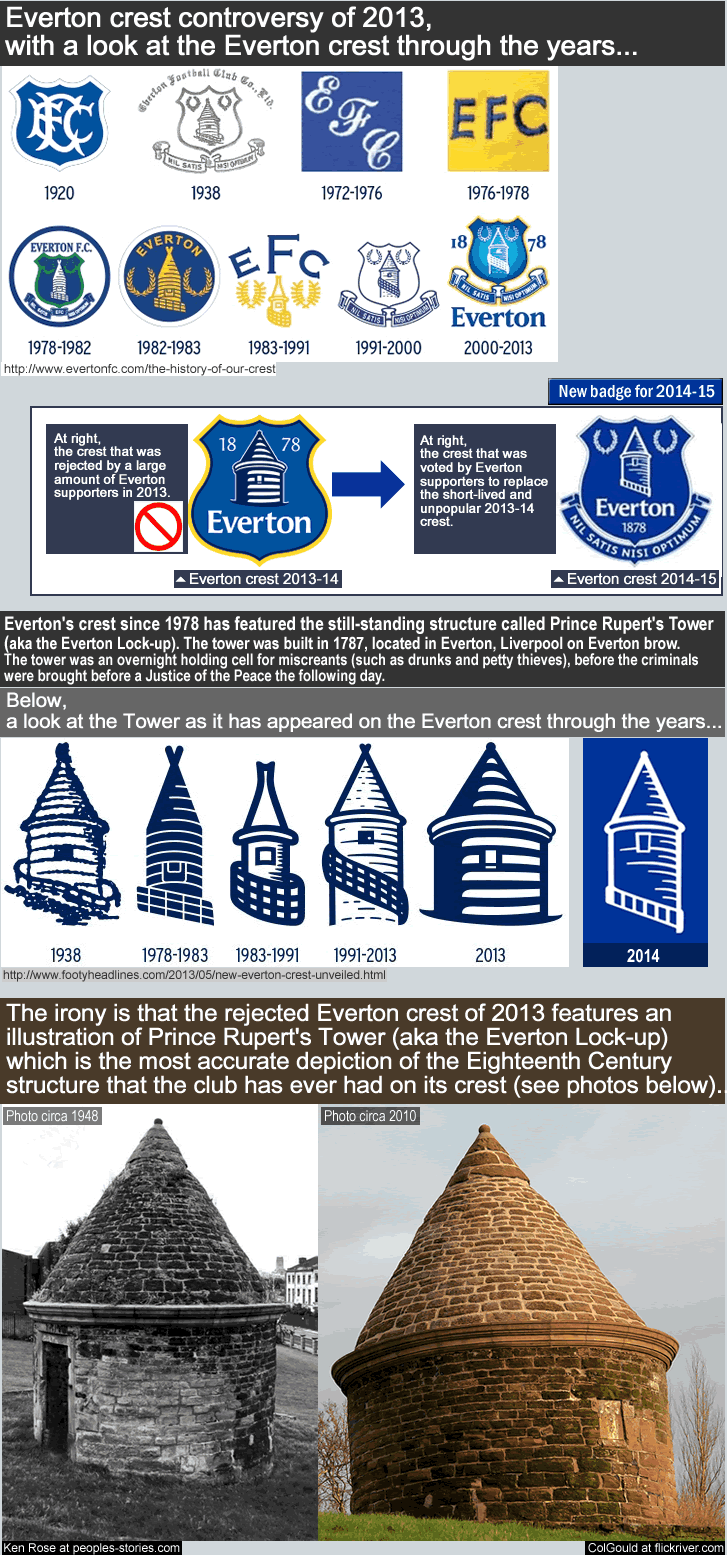
Below, Everton FC bows to fan pressure, and the club back-peddles on their crest change

From Daily Mail, from 3 October 2013, by Elliot Bretland, ‘Everton reveal new crest for 2014/15 season after original design was met with anger by Blues supporters‘ (dailymail.co.uk/sport/football).

With the ill-fated 2003-14 Everton crest re-design, the biggest issue most Everton supporters had was the dropping of the club motto, Nil satis nisi optimum, (which is Latin for ‘nothing but the best is good enough’). The club explained that they needed to re-design the crest because their crest was appearing in truncated forms at some media outlets, with the shield-shape shown but not the ‘Everton’ text block; and also that the color-shift in the centre of the shield (blue-to-lighter-blue) was not reproducing properly in some reproductions of the crest.

So Everton FC wanted to move the ‘Everton’ text element to within the shield, and streamline the whole image. On the then-new 2013-14 design, the motto wouldn’t fit (nor would the two wreaths). The 1878 formation date remained, as did Prince Rupert’s Tower (aka the Everton Lock-up, built in 1787 [as a holding cell for miscreants], on Everton brow in Everton, Liverpool, and is still standing today/ see below). For the then-new 2013-14 crest, the Tower illustration was also re-worked, and despite what one might think of the modernist detailing of the brick-work on the ill-fated 2013-14 crest, the actual depiction of Prince Rupert’s Tower on the 2013-14 crest was the first time the Tower was accurately drawn on an Everton badge – showing the correct roof details and the correct proportion of conic roof to cylindrical body (the turret). Previously, the turret of the Tower was drawn too tall and thin in the badges from the 1978 to 2013 time period (see below). And on the previous Everton crest before this season – the crest the club had been wearing for the last 22 seasons (1991-92 to 2012-13) – the Everton Lock-up is depicted as multi-storied, with the turret actually above and below a spiraled structure (which has never existed on the actual Everton Lock-up). That fictional spiral structure on the 1991-2013 crest looks for all the world like an exterior spiral staircase. I mean, come on, what else can it be? It is not a fence that is sitting on a slanted hill…because you can see part of the turret BELOW the diagonal staircase structure. That is not the Everton Lock-up on the 1991-2013 crest, that is a three-story structure with a spiral staircase running around the outside of it making it look like a castle’s turret. It is totally made up. The edifice shown on the 1991-2013 Everton badge is an extremely fictionalized depiction of the Everton Lock-up. So is the earlier one (the 1983 to 1991 Everton crest). That one has turned the flat conical roof of the Everton Lock-up into a baroque witches-hat design, the sort of architecture one would find in illustrated fairy tales.

Furthermore, on 2 of the 3 the previous crests (the 1978-1983 crest and the 1991-2013 crest), the pinnacle of the conical roof was depicted not with the actual thing which was and still is there on the Tower – a ball (or spherical-shaped top cap), but with two crossed diagonal bits forming a V-shape (which makes no sense if you convert that to three dimensions). That V-shape did not exist at the top of the Tower. In past centuries the Eveton Lock-up did have a short spire (or maybe a lightning rod) {see this (liverpoolhistorysocietyquestions.blogspot.com)}, but not a V-shaped ornament.

I was honestly starting to think that whomever drew the Tower for the 1978-1983 crest, or for the subsequent two Everton crests, did not even actually stroll over to the Everton brow and have a look at what the Tower really looks like, let alone take a look at any photo of the real Prince Rupert’s Tower. Either that, or the illustrators were told by EFC top brass to not let the depiction look too literal, and err on the side of a more-attractive-looking Tower (ie, taller, thinner, and looking more like a fairy-tale castle than a typical old English village lock-up). It is one or the other, and I am now inclined to believe that 35 years ago, and 30 years ago, and 22 years ago, and 3 months ago, Everton top brass were trying to sugar-coat the depiction of their iconic edifice on their crest by making it look more benign. In other words, they were trying to make the jail house (gaol house) that is on Everton’s crest look less like an old English overnight lock-up for recently arrested common criminals (which it was), and more like a nice-looking turret on some quaint old castle. Or made it look more like a lighthouse, which I initially thought it was when I first started following English football a decade ago.

To prove that there was no change in the shape nor in the pinnacle detail of the actual Prince Rupert’s Tower since those gussied-up and fanciful depictions of the Tower which existed on Everton’s badge from the 1978-2013 era, here is an old photo, ‘Old Police Lockup‘ (photo by Ken Rose at peoples-stories.com), from about 1948, that shows that same squat dimensions of the Tower and the ball at the pinnacle of Prince Rupert’s Tower, and not the fictional elongated tower-shape and the odd V-shape at the top of the Tower. Here is a photo that shows how short and squat the Everton Lock-up is, as you can see that the top of the lock-up’s doorway is only a few feet (not even a meter) from the roof-line {‘Prince Rupert’s Lock-Up‘, photo by Andrew Merryweather at flickr.com)}.

The new Everton crest for 2014-15 (voted for by Everton supporters in October 2013) restores the club motto and the wreaths to the crest. The Tower, however, is once again erroneously drawn as too tall and too thin, and the fact is for the new 2014-15 badge, the Everton Lock-up is depicted as a two-story structure. But at least the ball is up there at the pinnacle of the Tower like it always should have been.

From 29 May 2013, from The Football Attic – the Football Attic podcast #9, ‘Team Badges [with info and opinions on the Everton FC 2013-14 badge re-design]‘ (thefootballattic.blogspot.co.nz).
everton_badge_prince-ruperts-tower_everton-village-lockup_2013-badge-controversy_e.gif
Image and Photo credits above –
Everton crests through the years from evertonfc.com/the-history-of-our-crest.
Prince Rupert’s Tower images on Everton crests from footyheadlines.com/2013/05/new-everton-crest-unveiled.
Photo of Prince Rupert’s Tower by ColGould at flickriver.com.

Below, the Crystal Palace FC crest re-design for 2013-14

From Cafe Thinking blog, from 8 May 2013, ‘New Crystal Palace FC badge scores with the fans‘ (cafethinking.wordpress.com).

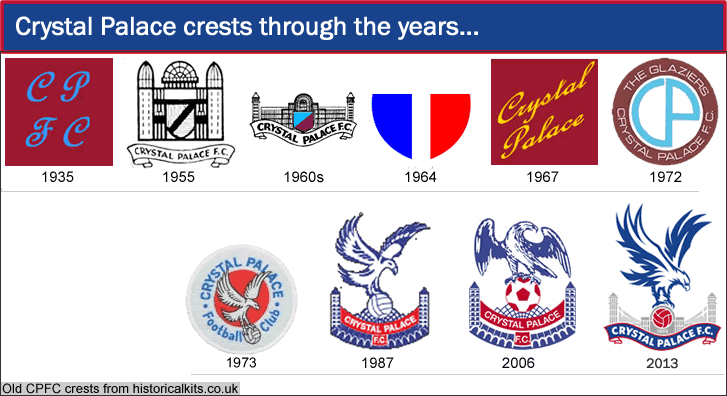
The new Crystal Palace crest was voted upon by Crystal Palace fans before the decision was made, not after, like at Everton, so no controversy ensued.

I like the 1955 Crystal Palace crest the best (see below). First of all, the eagle never existed in Crystal Palace FC tradition at all before 1973 – when the bombastic Malcolm Allison re-named the club’s nickname as ‘the Eagles’ instead of ‘the Glaziers’, and an eagle-with-football crest was introduced (the club also switched from white jerseys with claret-and-sky-blue trim to blue-and-red-vertical-striped jerseys in 1973-74). So for CPFC, the eagle really was just invented iconography and invented terminology, and is not an organic (or relevant) part of the club’s history, and smacks of the dreaded Americanization of English football nomenclature (see also, currently, the Hull Tigers controversy). And why does a club with so rich a history also need an eagle as a nickname and as the prominent crest element, when the club is named after a unique and storied and innovative and awe-inspiring Victorian era crystal-and-iron structure?

The Crystal Palace in South London was the first home of the club, and several members of the original squad were in fact glaziers and maintenance workers at The Crystal Palace back in the first decade of the 20th Century (ie, circa 1905). That to me is way more impressive than a random-but-supposedly-dignified nickname (the Eagles), which some big shot in a ridiculous big white hat (Allison) simply made up when he was in control there for a brief 3-and-one-quarter seasons spell in the Seventies. First off, he doesn’t deserve all the blame for being the manager who oversaw Crystal Palace’s relegation from the First Division in 1973 (Palace were too far behind that season too be realistically expected to survive the drop when Allison took over there in March 1973). However, Palace did lose 5 of their last 7 games that year, so he gets the blame for that I would imagine. Furthermore, the rest of Allison’s record as Crystal Palace needs to be pointed out. The following season, his first full season in charge at Palace, he got them relegated to the third division, in May 1974. So they went from the first division to the third division with Allison in charge. And they were still stuck in the third tier when he walked away from the job in 1976. And when Malcolm Allison was manager of the club for the second time, in 1980-81, when Crystal Palace were back in the First Division but were once again in a doomed relegation battle, Crystal Palace once again found themselves relegated with Allison at the helm. It must be pointed out that as in 1973, Palace in March 1981 were many points off safety when Allison took over. Palace were relegated to the second division, in May 1981. But then he waltzed off again. And that to me is the most damning. Talk about not being able to finish a job. So let me get this straight – this is the guy who gave Crystal Palace their nickname and their visual identity? A guy who dressed like a pimp and who got the club relegated three times in the 5 seasons he was in charge there at Selhurst Park? But then just left both times, with Palace worse off from when he started?

One could argue that The Crystal Palace is still there in the CPFC crest to this day (as you can see below). But I would counter that The Crystal Palace structure as it appears in the current CPFC crest has become a secondary aspect of the crest, by virtue of it being depicted in pale grey, at the bottom of the badge, dwarfed by the eagle.

Here is an excerpt from the Historical Kits page on Crystal Palace, written by Dave Moor,
{excerpt}…’FA Cup finals were staged at the Crystal Palace in South London a unique football venue set in extensive parkland, between 1895 and 1914. The original Crystal Palace was an enormous glass and cast iron structure built in Hyde Park for Prince Albert’s Great Exhibition in 1851 and represented Victorian engineering at its finest. When the exhibition closed, the palace was dismantled and rebuilt in South London where it formed the centrepiece of the world’s first entertainment theme park, surrounded by landscaped garden, lakes, spectacular fountains and concrete dinosaurs.’…{end of excerpt}.

Before Crystal Palace FC were allowed to join the Football League in 1920, and when the club was initially a member of the Southern League, the club played at The Crystal Palace in South London from the club’s inception in 1905 until mid-1915, when, at the onset of World War I, the ground was seized by the Admiralty (the British Navy) for the war effort. Crystal Palace FC found a ground nearby (at a velodrome), and a decade later the club moved into the nearby site where Selhurst Park was opened, in Croydon Park, South London, in August 1925. The Crystal Palace was destroyed by fire in 1936. ‘The Crystal Palace‘ (en.wikipedia.org).
crystal-palace_crests_1935-2013_b.gif
Old CPFC crests from http://www.historicalkits.co.uk/Crystal_Palace/Crystal_Palace.htm.

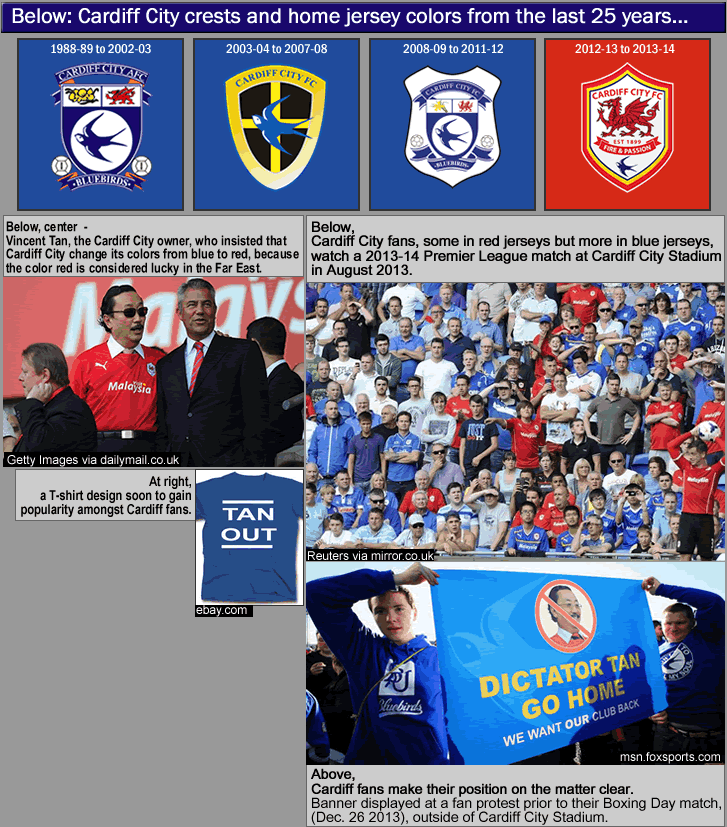
Below, the ongoing fiasco that is the divisive re-branding of Cardiff City FC

The Cardiff City jersey-and-crest controversy of 2012 can be summed up this way…as soon as Vincent Tan is gone, Cardiff City will wear blue again. End of story. I give it 2 more seasons, then when Tan realizes the extent of the enmity he has created and the lack of actual support he has within Cardiff, then the ego-inflated, sycophant-surrounded, football-clueless Malaysian will get bored with his new toy, sell the club, and slouch off back to the corrupt regime from whence he sprung. In the meantime, Tan’s juvenile insistence on changing Cardiff City from red to blue has distracted and divided the fans during what should be a joyful time for all Cardiff supporters, with the club’s first top flight appearance in 51 years.

From The Guardian, from 2 Nov. 2013, by Daniel Taylor, ‘Vincent Tan’s antics leave Cardiff’s faces as red as their shirts…We’ve seen the sort of boardroom buffoonery taking place before – and it rarely ends well for the fans‘ (theguardian.com/football/blog).
vincent-tan_cardiff-city-owner_blue-shirts-and-crests_red-shirt-and-crest_h.gif
Image and Photo credits above –
Old CCFC crests from kassiesa.nl/uefa/clubs/html/C; uefa.wikidot.com/england:cardiff-city-fc.
[Template for CCFC crests from last 25 years from http://en.wikipedia.org/wiki/Cardiff_City_F.C.#Club_logo_history.].
Photo of Tan, from Getty Images via dailymail.co.uk/sport/football/article-2402081/Cardiff-owner-Vincent-Tan-adds-teams-kit-shirt-tie-combo.
Photo of Cardiff City fans from Reuters via mirror.co.uk/sport/football.
Photo of ‘Tan Out’ T-shirt uploaded by mugitmugit at ebay.com, ebay.co.uk/itm/Tan-Out-Cardiff-City-Bluebirds-t-shirt.
Photo of Cardiff City fans’ protest banner from msn.foxsports.com/foxsoccer/premierleague/story/cardiff-fans-stage-protest-against-owner-vincent-tan-before-boxing-day-fixture.

Here are the photo credits for the jersey badges on the map page –
Photo of Arsenal 2013-14 home jersey badge from dreamsoccerjerseys.com/arsenal.
Photo of Crystal Palace 2013-14 home jersey badge, unattributed at footballkitnews.com/new-crystal-palace-kit-13-14-cpfc-home-away-shirts-2013-2014.
Photo of Everton 2013-14 home jersey badge, unattributed at footballkitnews.com/new-everton-kit-1314-nike-everton-fc-home-jersey-2013-2014.
Photo of Liverpool 2012-14 home jersey badge (liverbird with L.F.C in gold), by Pub Car Park Ninja at flicker.com; Pub Car Park Ninja’s photostream.
Photo of Manchester City 2013-14 home jersey badge, unattributed at footyheadlines.com/manchester-city.
Photo of Manchester United 2013-14 home jersey badge, unattributed at tsmplug.com/manchester-united.
Photo of Southampton 2013-14 home jersey badge from ssl.saintsfc.co.uk.
Photo of Sunderland 2013-14 home jersey badge from footyheadlines.com/sunderland.
Photo of Tottenham 2013-14 homes jersey badge from: dreamsoccerjerseys.com.
Photo of West Bromwich 2013-14 home jersey badge from footballshirtculture.com/west-bromwich-albion.

Thanks to the the contributors at en.wikipedia.org, ‘2013–14 Premier League‘.

Thanks to the following sites for average attendance figures -
Thanks to soccerway.com, for current attendance figures, int.soccerway.com/national/england/premier-league/20132014.
Thanks to european-football-statistics.co.uk, for 2012-13 Premier League attendance figures.
Thanks to the Football League official site for 2012-13 Football League Championship attendance figures, http://www.football-league.co.uk/page/DivisionalAttendance/0,,10794~20127,00.html.

Thanks to Chris O. and Rich J. at the Football Attic site and podcast, for pointing out that the ill-fated Everton 2013-14 badge actually has the most realistic depiction of Prince Rupert’s Tower that any Everton badge ever had (regardless of whether EFC fans liked it or not).
December 16, 2013

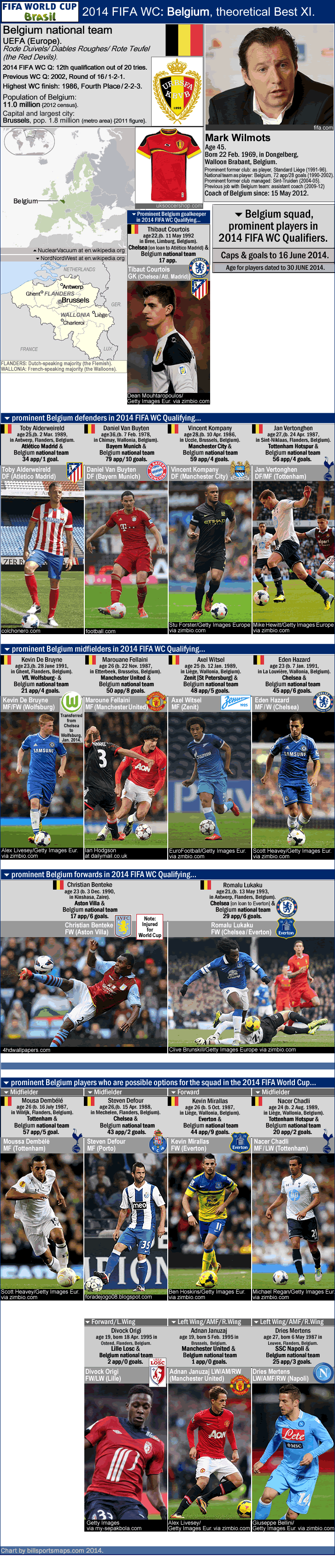
2014 FIFA World Cup teams: Belgium (UEFA), prominent players in 2014 FIFA World Cup Qualifying (theoretical best XI for Belgium, with 7 other player-options listed).

Filed under: Belgium — admin @ 8:53 pm


Belgium national team. UEFA (Europe). Nickname: Rode Duivels/ Diables Rouges/ Rote Teufel (Red Devils). Home jersey: red with yellow and black trim.
-Belgium is in Group H (with Algeria, South Korea, and Russia). ‘2014 FIFA World Cup Group H‘ (en.wikipedia.org).
FIFA World Cup qualification: 2014 is Belgium’s 12th qualification out of 20 tries.
Belgium has qualified for the World Cup in: 1930, 1934, 1938, 1954, 1970, 1982, 1986, 1990, 1994, 1998, 2002, 2014.
Previous World Cup appearance: 2002, Round of 16/ 1-2-1. Highest World Cup finish: 1986, Fourth Place / 2-2-3.

Population of Belgium: 11.0 million {2012 census}. Capital and largest city: Brussels, pop. 1.8 million (metro area) {2011 figure}.

-Coach of Belgium national team:, Marc Wilmots. ‘Marc Wilmots‘.
-Squad captain, Manchester City CB Vincent Kompany. Vincent Kompany.
From ESPN FC.com, by Roger Bennett, from 7 Sept. 2013, ‘Belgium has talent to spare, but can it win?‘ (espnfc.com/blog).

Below: Theoretical Best XI for Belgium (with 7 other player-options further below) -
[Note: players shown below reflect 2014 WC final roster selection, 'Belgium national football team/current squad' (en.wikipedia.org).]
belgium_2014-fifa-world-cup_squad_best-xi_alternate-options_m-wilmots_c_.gif
Photo and Image credits -
Map of Belgium/EU on globe, by NuclearVacuum at en.wikipedia.org/wiki/File:EU-Belgium
Map of Belgium, by NordNordWest at en.wikipedia.org.
Belgium home jersey, photo from uksoccershop.com/p-30549/2012-13-Belgium-Home-Football-Shirt.
Coach, Mark Wilmots, photo from fifa.com/worldcup/preliminaries/europe [Belgium team, gallery]
Goalkeeper, Thibaut Courtois, photo by Dean Mouhtaropoulos/Getty Images Europe via zimbio.com.
Defenders, Toby Alderweireld (Atlético Madrid), photo from colchonero.com.
Daniel Van Buyten (Bayern Munich), photo from football.com.
Vincent Kompany (Manchester City) , photo by Stu Forster/Getty Images Europe via zimbio.com.
Jan Vertonghen (Tottenham), photo by Mike Hewitt/Getty Images Europe via zimbio.com.
Midfielders, Kevin De Bruyne (Chelsea), photo by Alex Livesey/Getty Images Europe via zimbio.com.
Marouane Fellaini (Manchester Utd), photo by Ian Hodgson at dailymail.co.uk.
Axel Witsel (Zenit Saint Petersburg), photo by EuroFootball/Getty Images Europe via zimbio.com.
Eden Hazard (Chelsea), photo by Scott Heavey/Getty Images Europevia zimbio.com.
Forwards, Christian Benteke (Aston Villa), photo from 4hdwallpapers.com.
Romelu Lukaku (Everton), photo by Clive Brunskill/Getty Images Europe via zimbio.com
Other options for squad –
Mousa Dembélé (Tottenham), photo by Scott Heavey/Getty Images Europe via zimbio.com.
Steven Defour (Porto), photo from foradejogo08.blogspot.com.
Kevin Mirallas (Everton), photo by Ben Hoskins/Getty Images Europe via zimbio.com.
Nacer Chadli (Tottenham), photo by Michael Regan/Getty Images Europe via zimbio.com.
Divock Origi (Lille), photo by Getty Images via my-sepakbola.com/pencetak-gol-muda-di-ligue-1-prancis.
Adnan Januzaj (Manchester United), photo by Alex Livesey/Getty Images Europe via zimbio.com.

Dreis Mertens (Napoli), photo by Giuseppe Bellini/Getty Images Europe via zimbio.com.

Thanks to the contributors at ‘2014 FIFA World Cup qualification‘ (en.wikipedia.org).
Thanks to the contributors at ‘Belgium national football team‘ (en.wikipedia.org).
Thanks to http://www.transfermarkt.com/en/, for player-position details.

December 13, 2013

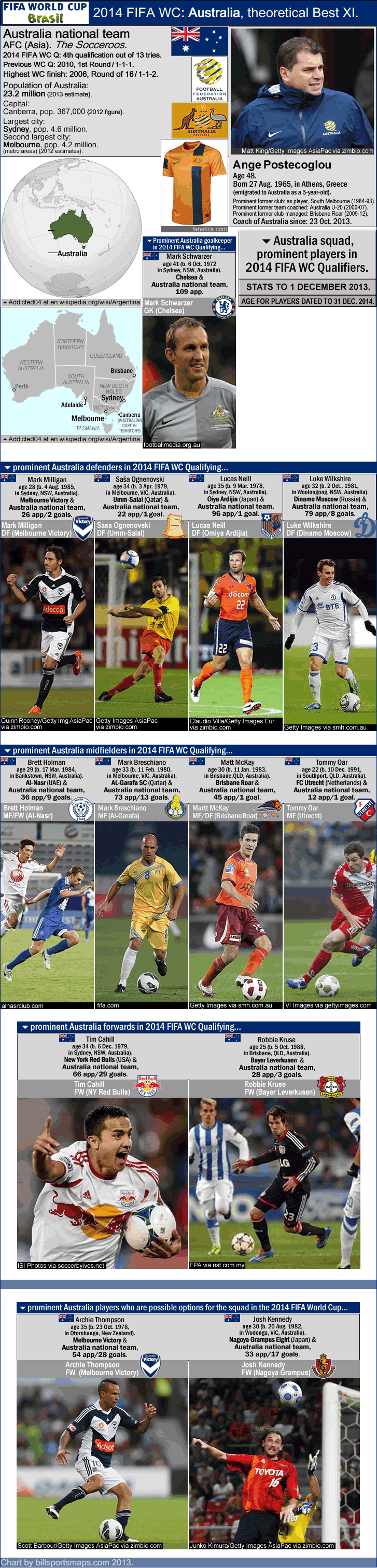
2014 FIFA World Cup teams: Australia (AFC), prominent players in 2014 FIFA World Cup Qualifying (theoretical best XI for Australia, with two other player options).

Filed under: Australia — admin @ 9:20 pm


Australia national association football team. AFC (Asia). Nickname: the Socceroos. Home jersey: gold (ie, yellow-orange), with green trim. Jersey badge features a kangaroo & emu crest.
Australia is in Group B (with Chile, Netherlands, and Spain). ‘2014 FIFA World Cup/Group B‘ (en.wikipedia.org).
FIFA World Cup qualification: 2014 is Australia’s 4th qualification out of 13 tries [Australia did not participate in FIFA WC Q prior to 1966 [meaning no participation in the first 7 World Cups from 1930 to 1962]).
Australia has qualified for the World Cup in: 1974, 2006, 2010, 2014.
Previous WC: 2010, Group Stage / 1-1-1.
Highest WC finish: 2006, Round of 16 / 1-1-2.

Population of Australia: 23.2 million {2013 estimate}. Capital: Canberra, pop. 367,000 {2012 figure}. Largest city: Sydney, pop. 4.6 million. Sydney, pop. 4.6 million. Second largest city: Melbourne, pop. 4.2 million. (metro areas) {2012 estimates}.

Coach of Australia: Ange Postecoglou. ‘Ange Postecoglou‘. Postecoglou won the 2011 A-League title as manager of Brisbane Roar. Before that, he had been the Socceroos’ U-20 team coach from 2000 to 2007. Postecoglou was hired to be the coach of Australia on 23 October 2013.
Captain of Australia squad: Lucas Neill. Lucas Neill. DF, age 35; current club, free agent [no club currently]; previous club: Omiya Ardijia (Japan). Prominent former clubs include: Millwall (1995-2001), Blackburn Rovers (2001-07), West Ham United (2007-09). From Australian Associated Press via Guardian/football, from 6 Dec. 2013, by , ‘Lucas Neill must play regularly before World Cup, warns Ange Postecoglou‘ (theguardian.com/football).

From dailytelegraph.com.au, from 7 Dec. 2013, by David Davutovic, ‘Ange Postecoglou undaunted by tough World Cup group, challenges players to ‘create history” [article, featuring 2 Fox Sports Australia videos, the first video (4:39) with reaction to Australia's tough Group Stage draw, incl. media asking Postecoglou questions/ plus another video (6:50) with commentators incl. Craig Moore analyzing Australia's group].

Below: Theoretical Best XI for Australia, with a couple of extra player-options -
australia_2014-fifa-world-cup_qualifying_squad_-xi_a-postecoglou_i.gif
Photos and Images above –
Socceroos’ jersey badge and 2012-13 jersey, photos from fanatics.com.
Australia on globe, map by Addicted04 at ‘File:AUS orthographic.svg‘ (en.wikipedia.org).
Australia map by Rycherr at ‘File:Australia states blank.svg‘ (en.wikipedia.org).
Coach,
Ange Postecoglou, photo by Matt King/Getty Images Asia-Pac via zimbio.com.
Socceroos’ jersey badge and 2012-13 jersey, photos from fanatics.com.
Goalkeeper,
Mark Schwarzer (Chelsea), photo from footballmedia.org.
Defenders,
Mark Milligan (Melbourne Victory), photo by Quinn Rooney/Getty Image AsiaPac via zimbio.com.
Saša Ognenovski (Umm-Salal), photo from Getty Images/Getty Images AsiaPac via zimbio.com.
Lucas Neill, photo by Koji Watanabe/Getty Images AsiaPac via zimbio.com.
Luke Wilkshire (Dinamo Moscow), photo from Getty Images via smh.com.au.
Midfielders,
Brett Holman (Al-Nasr), photo from alnasrclub.com.
Mark Bresciano (Al-Gharafa SC), photo from fifa.com.
Matt McKay (Brisbane Roar), photo from Getty Images via smh.com.au/sport/roar-talent-mckay-can-start-for-socceroos-says-ange.
Tommy Oar (Utrecht), photo by VI Images via Getty Images.
Forwards,
Tim Cahill (New York Red Bulls), photo by ISI Photos via soccerbyives.net.
Robbie Kruse (Bayer Leverkusen), photo from EPA via nst.com.my.
Other options for Australia squad…Forwards, Josh Kennedy (Nagoya Grampus Eight), photo by Junko Kimura/Getty Images AsiaPac via zimbio.com. Archie Thompson (Melbourne Victory), photo by Scott Barbour/Getty Images AsiaPac via zimbio.com.

Thanks to the contributors at ‘2014 FIFA World Cup qualification‘ (en.wikipedia.org).
Thanks to the contributors at ‘Australia national association football team’ (en.wikipedia.org).
Thanks to http://www.transfermarkt.com/en/, for player-position details.

December 8, 2013

2014 FIFA World Cup teams: Argentina (CONMEBOL), prominent players in 2014 FIFA World Cup Qualifying (theoretical best XI for Argentina, with 6 other player-options listed).

Filed under: Argentina — admin @ 10:26 pm


Argentina national team. CONMEBOL (South America). Nickname: La Albiceleste (The White and Sky Blue). Home jersey: sky blue and white vertical stripes, with black trim.
-Argentina is in Group F (with Bosnia, Iran, and Nigeria). ‘2014 FIFA World Cup/Group F‘ (en.wikipedia.org).
FIFA World Cup qualification: 2014 is Argentina’s 16th qualification out of 19 tries [note: Argentina withdrew from the qualifying for both the 1938 and for the 1950 World Cups, while in 1954 Argentina did not enter the qualifying for the World Cup at all. The only other time Argentina did not qualify for a WC tournament was for 1970. So technically, overall, Argentina have made it to the World Cup in 16 out of a possible 20 times].
Argentina has qualified for the World Cup in: 1930, 1934, 1958, 1962, 1966, 1974, 1978, 1982, 1986, 1990, 1994, 1998, 2002, 2006, 2010, 2014.
Previous WC Q: 2010, Quarterfinals / 4-0-1.
Highest World Cup finish:
1978, Champions / 5-1-1.
1986: Champions / 6-1-0.

Population of Argentina: 41.6 million {2013 estimate}. Capital (and largest city): Buenos Aires, pop. 12.8 million (metropolitan area) {2011 figure}.

-Coach of Argentina: Alejandro SabellaAlejandro Sabella‘. Sabella has had the job since July 2011. Sabella was a midfielder who played with River Plate, Sheffield United, Leeds United, and Estudiantes, winning Argentine titles with River in 1975, and with Estudiantes de La Plata in 1982 and ’83. He went on to coach as Daniel Passarella’s number two for many years (at Parma, the Uruguay national football team, Monterrey, and Corinthians). Sabella was hired to manage Estudiantes in March of 2009, with immediate success, guiding them to their winning of the 2009 Copa Libertadores title in July 2009, and, half-a-year later, the Argentine title for the 2012-Apertura.
-Captain of Argentina squad: Lionel Messi. FC Barcelona’s Lionel Messi, age 26 and born on 24 June 1987 in Rosario, Argentina, is the first player ever to win 4 Ballons d’Or (2009-12). He also has the Guinness World Records title for most goals in a season, with 91 goals scored during the 2011-12 season {see this, ‘BARCELONA STAR LIONEL MESSI SETS NEW GOAL-SCORING RECORD‘ (guinnessworldrecords.com)}.
-Squad:. Argentina has questions in defense but boasts a wealth of attacking options. They will probably play 4-3-3 for some of their World Cup matches in Brazil. Aside from the Higuaín/ Messi/ Agüero trio featured in the illustration below, coach Sabella also will likely utilize PSG striker Ezequiel Lavezzi, and maybe former Boca Juniors and current Internazionale forward Rodrigo Palacio. In the midfield, besides the di Maria/ Mascherano/ Maxi Rodríguez trio featured below, Sabella might also utilize Lazio defensive midfielder Lucas Biglia, as well as Boca Juniors defensive midfielder Fernando Gago. Gago, and Rodríguez (of Newell’s Old Boys), are the only two outfield players selected for the 2014 WC squad who play in the Argentine first division. Despite his solid season in Italy in 13/14 with Juventus, striker Carlos Tévez will not feature at all in the squad, as he has fallen out of favor with Sabella (and the coach does not want to risk upsetting the team’s chemistry and discomfiting Messi, the team’s talisman). Argentina are expected to advance far into the tournament, and have a real a shot of going all the way. Odds for an Argentine World Cup win are 9/2, which is the second-best odds behind hosts Brazil, at 3/1 {see this}.

[Note: squad chart caps & goals are updated to Argentina’s Semifinals match on 9 July 2014, with all Argentina players (19 players) who have appeared in the 2014 World Cup shown ‘Argentina national football team/Current squad’ (en.wikipedia.org).
Below: Theoretical Best XI for Argentina (with 8 other player-options further below) -
argentina_2014-fifa-world-cup_squad_best-xi_alternate-options_a-sabella_t_.gif
Photo and Image credits above -
Map of Argentina on globe, by Addicted04 at en.wikipedia.org/wiki/Argentina.
Map of Argentina with provinces by NordNordWest at en.wikipedia.org/wiki/File:Argentina_location_map.svg.
Argentina home jersey photo and photo of Argentina badge, from adidas.com/argentina-home-jersey.
Coach,
Alejandro Sabella, photo from AFP via conmebol.com.
Goalkeeper,
Sergio Romero (AS Monaco), photo from ligue1.com/joueur/romero-sergio.
Defenders,
Pablo Zabaletta (Manchester City), photo from uk.eurosport.yahoo.com.
Federico Fernández (Napoli), photo by Frank Augstein/AP Photo via bigstory.ap.org/photo-gallery/germany-soccer-champions-league-4.
Hugo Campagnaro (Inter), photo by Claudio Villa/Getty Images Europe via zimbio.com.
Ezequiel Garay (Benfica), photo by Getty Images Europe via metro.co.uk.
Midfielders,
Ángel di María, photo by Denis Doyle/Getty Images Europe via zimbio.com.
Javier Mascherano (Barcelona), photo by Jasper Juinen/Getty Images Europe via zimbio.com.
Maxi Rodríguez (Newells Old Boys), photo by Télam via utbolparatodos.com.ar.
Forwards,
Gonzalo Higuaín (Napoli), photo by Giuseppe Bellini/Getty Images Europe via zimbio.com.
Lionel Messi (Barcelona), photo by David Ramos/Getty Images Europe via zimbio.com.
Sergio Agüero (Manchester City), photo by Stu Forster/Getty Images Europe via zimbio.com.
Other options for squad -
Rodrigo Palacio FW/W (Inter), photo by Claudio Villa/Getty Images Europe via zimbio.com.
Ezequiel Lavezzi FW(PSG), photo by Harry Engels/Getty Images Europe via zimbio.com.
Lucas Biglia MF (Lazio), photo from spaziocalcio.it.
Fernando Gago DM (Boca Juniors), photo from labombonera.com.ar/fernando_gago.
Marcos Rojo CB/LB (Sporting CP), photo from zerozero.pt via media-cache-ak0.pinimg.com.
José María Basanta DF/LB (Monterrey), photo by Mexsport via deportes.terra.com/futbol/liga-mx.
Martín Demichelis CB/DM (Manchester City), photo by Laurence Griffiths/Getty Images Europe via zimbio.com.
Enzo Pérez CM/LM (Benfica), photo by Valerio Pennicino/Getty Images Europe via zimbio.com.

Thanks to the contributors at ‘2014 FIFA World Cup qualification‘ (en.wikipedia.org).
Thanks to the contriutors at ‘Argentina national football team‘ (en.wikipedia.org).
Thanks to http://www.transfermarkt.com/en/, for player-position details.
Thanks to Sam Kelly & company at Hand of Pod, for Argentina national team info, handofpod.wordpress.com.

December 4, 2013

2013-14 FA Cup, Second Round Proper: location-map, and current average attendances of the 40 clubs.

Filed under: 2013-14 FA Cup — admin @ 1:00 pm

2013-14_fa-cup_2nd-round_post_.gif
2013-14 FA Cup, Second Round Proper: location-map, and current average attendances of the 40 clubs


FA Cup – news, fixtures, results (bbc.co.uk/sport/football/fa-cup).
___

Thanks to the following sites for average attendance figures -
3rd Level/Football League One, football-league.co.uk/page/DivisionalAttendance [L3].
4th Level/Football League Two, football-league.co.uk/page/DivisionalAttendance[L4].
5th Level/Conference National, soccerway.com/national/england/conference-national.
6th Level/Conference North, soccerway.com/conference-n & Conference South, soccerway.com/conference-s.
7th Level & 8th Level/Southern League, southern-football-league.co.uk/attendances.

Thanks to the FA site, for the [gold-colored] FA 150th Anniversary crest, from a banner at thefa.com.
Thanks to BBC.co.uk/football/fa cup, for the image of the fixtures list on the map page, bbc.com/sport/football/fa-cup/fixtures.
Thanks to the contributors to the pages at en.wikipedia.org, ‘2013–14 FA Cup‘.

November 30, 2013

2014 FIFA World Cup teams: Algeria (CAF), prominent players in 2014 FIFA World Cup Qualifying (theoretical best XI for Algeria).

Filed under: Algeria — admin @ 9:50 pm


Algeria national team. CAF (Africa). Nickname: Les Fennecs (The Foxes). Home jersey: white with green and red trim.
-Algeria is in Group H (with Belgium, South Korea, and Russia). ‘2014 FIFA World Cup/Group H‘ (en.wikipedia.org).
FIFA World Cup qualification: 2014 is Algeria’s 4th qualification out of 19 tries.
Algeria has qualified for the World Cup in: 1982, 1986, 2010, 2014. Previous World Cup appearance: 2010, 1st Round / 0-1-2. Highest World Cup finish: 1982, 1st Round / 2-0-1.
Population of Algeria: 37.9 million {2012 estimate}. Capital and largest city: Algiers, pop. 3.4 million {2011 figure} [location of Algiers shown on globe-map below].

Coach of Algeria national team: Vahid Halilhodžić. ‘Vahid Halilhodžić‘. Halilhodžić was born in the former People’s Republic of Yugoslavia – he is an ethnic Bosnian, and his primary residence is in Lille, France. A former Velež Mostar and Nantes forward, he helped Nantes win the 1983 French title and was leading scorer in France two seasons later {‘1984–85 French Division 1′}. Halilhodžić’s coaching career includes stints at Lille, Rennes, PSG, and Trabzonspor, and he was Ivorry Coast coach from 2008-10 (following Ivory Coast’s poor showing in the 2010 Africa Cup of Nations, he was fired four months before the start of the 2010 World Cup, and replaced by Sven-Göran Eriksson). After one year in charge of Dinamo Zagred, Halilhodžić was given the Algeria job in June 2011.

Captain of Algeria squad: DF Madjid Bougherra. ‘Madjid Bougherra‘. Like many players on the Algeria squad, the 31-year-old Bougherra was born in France – in Longvic, in the Burgundy region in east-central France – and he grew up in nearby Dijon. Bougherra opted to play for Algeria, where his grandfather was born. Bougherra got his pro start in 2002 with the nearby then-3rd division French club Gueugnon. After 4 years there, Bougherra was loaned out to (current English 3rd division English/then-2nd division) Crewe Alexandra, in the latter half of 2005-06. Bougherra then spent the next 7 seasons in Great Britain, next with Sheffield Wednesday (2006–07), then with Charlton Athletic (2007–08), then with then-first division Scottish giants Rangers – for 3 seasons (2008-11), where he was part of the three title-winning Rangers teams of 08/09, 09/10, and 10/11, made 81 league appearances and saw Champions League action. 11 months before Rangers (I) imploded and liquidated (in June 2012), Bougherra still had a year left on his contract with Rangers but the Glasgow club wouldn’t offer the central defender near what he wanted {see this, ‘Madjid Bougherra: Rangers’ offer of two-year deal made me sick‘ (dailyrecord.co.uk by Allan Marshall on 9 Aug. 2011)}, so Rangers sold Bougherra to Qatar side Lekhwiya for £1.7 million. Bougherra continues to play his pro career in well-paid irrelevancy in Qatar. His contribution to the national team recently has been immense, though, as his goal on 19 November 2013 against Burkina Faso sends Algeria to the World Cup in Brazil, and now Algeria has qualified for World Cup for the second straight time {see this, ‘Bougherra hands Algeria final ticket‘ (cafonline.com)}. {Celebrating Bougherra’s World Cup-appearance-clinching goal, see this photo by menosultra at flickr.com}. Here is an article on that decisive CAF World Cup qualifying match, from the Algerian national team fansite DZfoot.com, by Maher M. on November 24, 2013. ‘Algeria 1-0 Burkina Faso: A statistical analysis‘ (en.dzfoot.com).

algeria_2014-fifa-world-cup_qualifying_squad_-xi_v-halilhodzic_t.gif
Photo and Image credits -
Map of Algeria on globe, by L’Americain at Algeria.
Algeria home jersey, photo from prlog.org/algeria-world-cup-home-jersey2010.
Coach,
V. Halilhodžić, photo from dzfoot.com/2013/11/vahid-halilhodzic-one-match-to-determine-a-legacy.
Goalkeeper,
Raïs M’Bolhi (CSKA Sofia), photo by Biso at en.wikipedia.org.
Defenders,
Essaïd Belkalem (Watford), en.dzfoot.com/2013/10/belkalem-starts-for-watford-in-1-0-loss-to-blackburn-rovers.
Madjid Bougherra (Lekwiyah), photo from pesstatsdatabase.com.
Carl Medjani (Olympiacos), photo by EuroFootball/Getty Images Europe via zimbio.com
Djamel Mesbah (Parma), photo by Marco Luzzani/Getty Images Europe via zimbio.com.
Midfielders,
Sofiane Feghouli (Valencia), photo by David Ramos/Getty Images Europe via zimbio.com.
Saphir Taïder (Internazionale), photo by Claudio Villa/Getty Images Europe via zimbio.com.
Hassan Yebda (Granada), photo by Denis Doyle/Getty Images Europe via zimbio.com.
Mehdi Mostefa (Ajaccio), photo from AC Ajaccio via tf1.fr/telefoot/photos/can-2013-les-joueurs-de-ligue-1-selectionnes.
Forwards,
Islam Slimani (Sporting Club Portugal), photo from en.dzfoot.com/2013/08/islam-slimani-makes-sporting-league-debut-rafik-halliche-injured.
El Arbi Hillel Soudani (Dinamo Zagreb), photo from dzfoot.com/2013/09/soudani-strikes-again-as-dinamo-zagreb-tops-croatian-league.

Thanks to the contributors at ‘2014 FIFA World Cup qualification‘ (en.wikipedia.org).
Thanks to the contributors at ‘Algeria national football team‘ (en.wikipedia.org).
Thanks to dzfoot.com for several of the photos used here plus the article on the Algeria squad.

November 20, 2013

England, 4th division: Football League Two – 2013-14 Location-map, with attendance data & 2013-14 home kit badges, featuring top 4 in the table after 16 games: Oxford United, Chesterfield, Rochdale, Fleetwood Town.

2013-14_football-league-two_location-map_attendance2012-13_2013-14-kit-badges_post_.gif
England, 4th division: Football League Two – 2013-14 Location-map, with attendance data & 2013-14 home kit badges


Note: to see my most recent post on the English 4th division, click on the following: category: Eng-4th Level/League 2.

On the map page
Facsimiles of each clubs’ home jersey badges for the 2013-14 season are shown, in alphabetical order, across the the top of the map page. Below that, at the lower left, is a location-map of the clubs in the 2013-14 Football League Two. At the right-hand side of the map page is attendance data for current League Two clubs from the two previous seasons (2011-12 and 2012-13). Change (by percent), as well as percent capacity (ie, how much the club filled their stadium on average), from last season, are shown. League movement (if any) of the clubs is shown as well.

The 2013-14 League Two
The 2013-14 League Two has been a very tightly-contested affair, with just over one-third of the season having been played so far (16 games played out of 46, for most clubs). To give you but one example of how evenly-matched the clubs in the fourth division are currently – and not just the clubs in the top half of the table – last week’s league leaders Fleetwood Town lost away to last-place Northampton Town 1-0 on Saturday 16th November 2013 (with a goal by the Cobblers in the 93rd minute)…and Fleetwood dropped clear out of the three automatic promotion places into 4th place with the loss, as Oxford United, Chesterfield, and Rochdale all won.

So currently, Oxford United, Chesterfield, and Rochdale all have 29 points and are separated at the top of the table by goal difference. Clubs like Portsmouth and Cheltenham Town, who are currently in 16th and 17th places on 20 points, find themselves in a simultaneous promotion campaign/relegation battle, both being at present 6 points above the relegation zone and 6 points below the play-off places. I wouldn’t say anyone could win promotion this season in the fourth tier, but there are certainly more than a dozen sides with a good chance of being one of the 4 clubs to gain promotion, and there are probably more than 16 sides that could feasibly win promotion.

Below are brief illustrated profiles of the top four clubs in League Two as of 17th Nov. 2013, with: a brief write-up of each club’s manager and 2 featured players; a photo and caption for each club’s manager; a photo for each club’s current top scoring threats; a photo or two of each club’s ground; plus each club’s league history (with Non-League history noted), as well as a look at each club’s home league average attendance from the last two seasons, plus current average attendance listed (current home league average attendance to 17 Nov. 2013 {via soccerway.com, here}).

    Below, the top 4 in League Two after one-third of the 2013-14 season…

Oxford United FC, currently 1st place (29 points/+12 goal difference).
46-year-old Sheffield-born Chris Wilder, manager of Oxford United since December 2008 (back when they were in the middle of their 3 season spell in Non-League football), has been managing for over a decade now, having got his managerial start with the then-9th-Level (now Conference club) Alfreton Town, back in 2001-02, when Alfreton were in the Northern Counties East Football League, and the then-35-year-old Wilder got them promoted into the Northern League. Wilder then managed then-Conference side Halifax Town for 6 seasons (2002 to 2008), up until Halifax went broke and were liquidated (the Phoenix-club FC Halifax Town is now back in the Conference as of 2013-14). Wilder then worked as Alan Knill’s assistant at Bury in the first part of 2008-09 before getting the job at Oxford. Flash forward 3 years and 11 months later, and Chris Wilder is currently the third longest-serving manager in the Football League {see this, List of English Football League managers‘ (en.wikipedia.org)}. In Wilder’s first full season at the helm at Oxford (in 2009-10), the U’s won promotion via the play-offs (beating York City in the final at Wembley). Since then, Oxford United have finished in 12th, then in 9th, and then in 9th again last season (2012-13).

Throughout last season there were calls for Wilder’s dismissal by some supporters, and Wilder knows that probably only promotion will keep him at Oxford past this campaign. With a population of around 150,000 {2011 estimate}, Oxford is basically too big a city to only be hosting a fourth division side. Oxford United draw around 6K to 7K and in the past have gotten up to 10.3K (in 1986-7). Oxford fans would feel at the very least that their club should be in the third tier, and there are probably many gold-and-blue fans who dream of their club one day returning to the top flight – where Oxford United played for 3 seasons in the 1980s (86/87, 87/88, 88/89), when they were owned by Mephistophelian media baron Robert Maxwell, and when the U’s won their only major title, the 1986 League Cup.

Oxford United currently feature a striker who has had a longer spell there than Wilder – the Wiltshire-born 29-year-old James Constable, a classic lower-divisions bruiser of a forward, who has shaken off recent injuries and has scored 5 league goals this season so far. Overall, Constable has scored 85 league goals for Oxford in 216 games going back to the start of 2008-09, when he joined the then-Conference side on loan from Shrewsbury Town (Constable signed for Oxford 10 months later in the summer of 2009). Oxford fans will always love Constable for turning down the chance to almost double his wages – if he had went over to Oxford United’s much-hated nearby rivals Swindon Town. Here is what it says about that at James Constable’s page at Wikipedia…’Oxford accepted an improved offer for Constable from local rivals Swindon on 19 January 2012. Oxford allowed Constable to talk to the club, although he refused the opportunity to discuss the move with Swindon manager Paolo Di Canio.’…{end of excerpt}.

Just last week, Constable became only the third Oxford United player to have scored 100 goals in all competitions for the club {see this, ‘Constable’s century joy‘ (oxfordmail.co.uk, from 18 Nov.2013, by David Pritchard)}.

An up-and-coming striker also features in Oxford’s current set-up, the 25-year-old Deane Smalley, who signed for Oxford originally in the summer of 2011, but suffered an injury-plagued 2012, then re-signed with Oxford on less terms following a goal-less loan out to Bradford City. Smalley scored 5 goals in 2012-13 for Oxford (such as the one he is seen celebrating below), and has scored 5 league goals this season so far.

Perhaps the biggest impediment to Oxford United’s progression is their stadium situation – they don’t own the Kassam Stadium, nor does the Oxford City Council. It is owned by a shell company of the former club owner Firoz Kassam, and as such is an ongoing thorn in the side of Oxford United (since 2005-06). A sizable chunk of revenue Oxford United makes on ticket sales gets lost because of rent charges. To make matters worse, for the second season now, Oxford United must endure a stadium share with the second division Rugby Union club London Welsh RFC. So the pitch gets torn up, Oxford are more susceptible to injuries, and any attempts at an on-the-turf-passing-style get bogged down (literally) by mid-season.

In the spring of this year, supporters fought back this way…’Oxford fans successfully safeguard their stadium‘ (wsc.co.uk from 14 May 2013). In October 2013, this happened, ‘Kassam Stadium owners fail with appeal against community asset‘ (bbc.co.uk/sport/football).

Here is a recent article by Matthew Derbyshire from the Two Unfortunates site, about Oxford United’s stadium plight, ‘THE COMMUNITY VALUE OF FOOTBALL: OXFORD UNITED’S STADIUM BATTLE‘ (thetwounfortunates.com).

oxford-united_kassam-stadium_c-wilder_d-smalley_j-constable_f.gif
Photo and Image credits above -
Exterior-view photo of the Kassam Stadium by nodale at panoramio.com ; photos by nodale at panoramio.com.
Chris Wilder, photo from oxfordmail.co.uk.
Deane Smalley, photo from julianalsopsyellowbanana.wordpress.com.
James Constable, photo from sportinglife.com.

Chesterfield FC, currently 2nd place (29 points/+9 goal difference).
Liverpool-born Chesterfield manager and Football League veteran MF Paul Cook had to wait a while for his second shot at managing an English pro club. Cook had a rough go of it in 2006-07 as manager of Merseyside 5th-division club Southport, this right at the time when the former Football League club had decided to return to professional status after 28 years as an amateur side following their being elected out of the League in 1978. Many players were unable (or unwilling) to make the jump to full-time status, and Cook had to rebuild virtually from scratch, and Southport finished in 23rd and went down to the Conference South (Southport stayed pro and rebounded in May 2010). Cook then signed on as manager of Connacht, western-Ireland-based Sligo Rovers in April 2007, and stayed at the helm of Sligo Rovers for 4-and-a-half seasons, winning two FAI Cups and leaving Sligo in good hands (Sligo Rovers won the League of Ireland title later that season, their first in a quarter century). Cook had left Sligo in February 2012 to take over at his old club Accrington Stanley, and with Cook in charge Stanley survived another year in the League, finishing in 18th in 2011-12. Eight months later, in October 2012, Chesterfield needed a new manager after John Sheridan bolted off to Plymouth Argyle, and they chose Paul Cook to try to get the North Derbyshire club back to the third division (Chesterfield finished in 8th last season).

In the following off-season (last summer), one of Cook’s requests to the CFC board was to sign (on a free transfer) the 28-year-old Liverpool-born MF Gary Roberts, who was playing for Swindon Town then, and whom Cook knew from his latter playing days at Accrington (circa 2005-06). That signing has been paying dividends, as Roberts has scored 4 goals in 14 league matches and has also notched 4 assists this season so far. Another player Cook brought in after past association has also been contributing to the Spireites good form, and that is ex-Sligo Rovers and ex-Hibernian MF Eoin Doyle, who scored 10 league goals in the SPL last season for Hibs. The Dublin-born Doyle is 25. He has scored 3 league goals and made 3 assists this season so far.

Chesterfield, with a population of around 103,000 {2011 estimate} is about 43 km or 29 mi north of Derby and is about 17 km or 10 mi south of Sheffield. Chesterfield FC, which has not been in the second division since 1950, nevertheless has good potential. Both much-larger nearby League clubs from Sheffield – Sheffield Wednesday (in the 2nd division relegation places, currently) and Sheffield United (in the third division relegation places, currently) – are still stuck in the doldrums. So Chesterfield has a real opportunity to attract new fans from the Greater Sheffield/North Derbyshire area, especially because Chesterfield boasts nice new facilities now. After more than a century at the eventually decrepit Saltergate (see photo below), Chesterfield now has a fine new 10K-capacity/3-year-old stadium, which the club itself owns. Currently, Chesterfield can count on a solid 5-6,000-strong fan base, and their support might have the potential to grow. But the Spireites need to get back to the third division, and get ensconced there again, if they expect to grow their fan base any more (their last spell in League One lasted 1 year [2011-12]). Chesterfield first dropped into the 4th division in 1961 (that was the third season that the Fourth Division [est. 1958-59] had existed), and when you add up all their years of League football, Chesterfield are an historically-third-division club, with 52 seasons being spent there, including 12 of their last 20 seasons (going back to 1994-95 and recently having a 6 year stay in the third tier from 2002-03 to 2006-07 {data from CFC-footy-mad site here}). Here is a recent article on Paul Cook and Chesterfield, from Skysports.com from 14 Oct. 2013 by Johnny Phillips, ‘Chesterfield manager Paul Cook could be the next big thing in football, says Johnny Phillips‘ (skysports.com/football).

2013/11/chesterfield_saltergate_proact-stadium_paul-cook_gary-roberts_eoin-doyle_b.gif

CFC’s old ground (Saltergate), photo from ciderspace.co.uk/asp/opposition/chesterfield.
Aerial photo of new stadium by Rob McGann (Robinson Steel Structures of Derby) via bullsnews.blogspot.com/2010/08/chesterfields-new-stadium.
Paul Cook, photo from goal.com.
Gary Roberts, photo from chesterfield-fc.co.uk/news/article/20131111-roberts-post-daventry.
Eoin Doyle, photo from thestar.co.uk

Rochdale AFC, currently 3rd place (29 points/+5 goal difference).
Rochdale AFC play at Spotland Stadium, in Rochdale (which is in the north-eastern part of Greater Manchester, but was historically in the south-eastern part of Lancashire). Rochdale borough has a population of around 95,000 {2001 census figure}. Spotland has a capacity of 10,249, was opened in 1920, and was last renovated in 1999-2000. Ownership of the ground is a three-way split between Rochdale Borough Council, Rochdale AFC, and the (just-promoted) second-division rugby league club Rochdale Hornets RLFC. Rochdale AFC, aka the Dale, draw 2.5 K or so in mediocre years and up to 3.5K in good seasons, and have done so for over two decades now {attendances from E-F-S site, here}.

Rochdale AFC manager Keith Hill (age 44), was born in Bolton, Lancashire. Hill was a defender who had 388 league appearances and 11 goals, playing for Blackburn Rovers, Plymouth Argyle, Rochdale (for 5 seasons), Cheltenham Town, Wrexham, and Morecambe from 1987 to 2003. Hill is now in his second spell managing Rochdale, after previously getting the club promoted to the 3rd division for the first time in 36 years (in May 2010, seen in photo below). Following that 4-and-half-year spell running Rochdale, Hill was hired by second division club Barnsley in June 2011, but was sacked in December 2012 as Barnsley languished in the relegation zone (Hill’s then-number-two, David Flitcroft [who was also assistant under Hill at Rochdale], took over, and did a fine job of keeping Barnsley in the Champiionship by the skin of their teeth last May).

Keith Hill returned to Rochdale in January 2013, with one objective – to get the Dale back to the third division. Rochdale currently feature twin scoring threats in the Norfolk-born ex-Colchester FW Ian Henderson (age 28), who has tallied 5 league goals this season so far; and a young potential phenom in the 21-year old striker Scott Hogan, who is Manchester-born and previously played for Conference side Hyde. Hogan has scored 6 league goals so far this season.

rochdale-afc_spotland_k-hill_s-hogan_i-henderson_e.gif
Photo and Image credits above -
Exterior-view of main stand at Spotland, photo by David Dixon at geograph.org.uk.
Photo of 13/14 RAFC home jersey badge from football-shirts.co.uk/rochdale-shirt.
Interior photo of Spotland by 100groundsclub.blogspot.com/2009/08/my-matchday-223-spotland
Keith Hill celebrating May 2010 Rochdale promotion (during pitch invasion), photo from manchestereveningnews.co.uk.
Ian Henderson, photo by Pete Norton/Getty Images Europe via zimbio.com.
Scott Hogan, photo from manchestereveningnews.co.uk.

Fleetwood Town, currently 4th place (28 points/+9 goal difference).
Fleetwood has a population of around 26,000 {2001 census figure}. Fleetwood is just north of Blackpool on the Fylde coast of west-central Lancashire.

Fleetwood Town manager Graham Alexander played 21 years for Scunthorpe United, Luton Town, Preston North End, and Burnley, as a defender and a holding midfielder. Alexander became the oldest player to make his Premier League debut at the age of 37 (when he played right back/defensive midfielder for Burnley in the 2008-09 Premier League). Alexander was also the third oldest goal scorer in Premier League history. A dead-ball specialist, he retired in 2012 with 837 league appearances and 107 league goals (130 goals in all competitions). In Graham Alexander’s final match in April 2012, he scored a 92nd-minute equalizer at Deepdale versus Charlton. Graham Alexander played well over one thousand games in all competitions, second-most as a pro in the English leagues only to Tony Ford {see this ‘Tony Ford (footballer born 1959)‘}.

Alexander made his coaching debut in December 2011 while still a player, as a joint-caretaker manager of Preston North End (along with David Unsworth), following Preston’s sacking of Phil Brown. That position only lasted 5 games, though, as Preston brought in tough guy Graham Westely, to poor results (Westley has slunk back to 3rd-division-but-relegation-threatened Stevenage now). Alexander was appointed manager of Fleetwood Town in December 2012, following the surprise sacking of Mickey Mellon. Mellon had gotten Fleetwood Town into the Football League in May 2012. Fleetwood Town is a former 9th- and 8th-division club which has won 5 promotions in the last decade. This is a club that was drawing just 206 per game nine seasons ago in 2004-05, and now draws in the vicinity of 2,800. Actually, at the time of his sacking last December, Mellon had the Cod Army in the play-off places (in 7th place). But Mellon’s squad had just lost 3 matches in a row including an FA Cup 2nd Round match to Aldershot. Graham Alexander didn’t exactly have too poor a run-in managing Fleetwood for the latter half of last season, but, for all intents and purposes, once the Fleetwood squad knew they were safe from relegation, they coasted, and Fleetwood finished in 13th place in 2012-13, losing their final 4 matches. In the off season there were a few key personnel moves. The headline-maker was the club’s biggest signing ever, of Jamaican-born almost-23-year-old FW Jamille Matt (bought from Kidderminster for an undisclosed sum above £200,000). There was also the signing of 21-year-old play-maker Antoni Sarcevic, a MF with real potential, who was instrumental in getting Phoenix-club Chester FC up into the Conference last season. Both have produced so far, with Matt scoring 5 league goals in 12 appearances and Sarcevic netting 3 times with 3 assists.

fleetwood-town_highbury-stadium_g-alexander_j-matt_a-sarcevic_13-14-kit-badge_.gif

Photo and Image credits above -
Aerial photo of Highbury Stadium, from fwpgroup.co.uk/job/fleetwood-town-football-club.
Photo of Graham Alexander, from skysports.com.
Photo of Jamille Matt, by Clive Brunskill/Getty Images Europe via zimbio.com.
Photo of Antoni Sarcevic and Fleetwood teammates celebrating from visitfleetwood.info.

__
Thanks to footballfashion.org and Igloo Films, at footballfashion.org/wordpress/2013/07/29/portsmouth-fc-201314-sondico-home-and-away-kits/, for image of Portsmouth 13/14 home jersey badge.
Thanks to Football-shirts.co.uk for photo of Rochdale 13/14 home jersey badge, football-shirts.co.uk/rochdale-shirt.
Thanks to Torquay United shop for images which allowed me to assemble a 13/14 TUFC home jersey badge facsimilie {tufcshop.com/tufc-2013-coaster ; tufcshop.com/tufc-replica-kits }.

Thanks to the contributors at en.wikipedia.org, ‘2013–14 Football League Two‘.

November 11, 2013

NFL, 1948 season, map of the teams with 1948 scoring leaders. / Plus a short article on high scoring NFL seasons and high scoring NFL teams. / Plus the 1948 Los Angeles Rams’ golden-horned helmet designed by Rams player Fred Gehrke – the first helmet logo in the NFL. / Plus the 1948 NFL championship game, aka the Blizzard Bowl. / Plus, all-time helmet histories of the 9 currently active NFL teams from 1948 (Cardinals, Bears, Packers, Giants, Lions, Redskins, Eagles, Steelers, Rams).

Filed under: NFL>1948 map/season,NFL/ Gridiron Football,Retro maps — admin @ 10:49 pm

Please note – All helmet and uniforms illustrations on the map, and in the charts, and in the illustrations here, are from The Gridiron Uniform Database site, and were used by billsportsmaps.com here with permission from gridiron-uniforms.com.

1948_nfl-map__segment_b.gif
NFL, 1948 season, with offensive stats leaders & helmet histories of the 9 oldest NFL teams (Cardinals, Bears, Packers, Giants, Lions, Redskins, Eagles, Steelers, and Rams)
NFL helmet and uniforms illustrations from Gridiron Uniform Database.


    NFL, 1948 season

From Pro FootbalHall of Fame site, ‘NFL’s All-Decade Team of the 1940s‘ (profootballhof.com/history).

1948: the highest-scoring season in the NFL
There are 3 reasons why the 1948 NFL season stands out. The first reason is, even though it pre-dated the passing era, 1948 was actually the NFL season that had the highest scoring average – 23.6 points per team (per game). From coldhardfootballfacts.com, from July 10, 2010, by Kerry Byrne, ‘The Spirit of ’48: a mind-blowing statistical orgasm‘. However, a mitigating factor must be mentioned. There were a few really bad defensive teams in the NFL in 1948, and, for example, the Eagles (who went on to be the 1948 NFL champions, and who had the league’s third-best offense in 1948 at 31.3 points per game) scored their season-high of 45 points in 4 games that year, three of which were against the three worst defenses in 1948 – the Lions (33.9 points allowed per game), the Giants (32.3 points allowed per game), and the Boston Yanks (31.0 points allowed per game), [more on the hapless Boston Yanks further down in this post] {see this, pro-football-reference.com/years/1948}. But to just blame the points surge in 1948, and also in the high-scoring era of 1947-to-1967, on just some bad defensive teams would be a disservice to teams like the 1948 Chicago Cardinals (32.9 points per game), and the 1948 Chicago Bears (31.7 points per game), and the 1948 Philadelphia Eagles (31.3 points per game). These teams, as well as the 1948 Los Angeles Rams and the 1948 New York Giants, really did have some offensive punch and some real standouts in their squads (illustrations of 1948 offensive leaders are shown on the map page {click on image above} and also further below).

    Below – the 20 highest scoring NFL seasons, as measured by average number of points scored per team

The chart below shows the 20 highest-scoring seasons in the NFL – not by total points (because that would skew the list to all the years recently when there have been the most number of teams [32 teams]), but by points per game (per team) average. Note how the list of the 20 highest-scoring seasons includes many of the recent seasons (the 4 most-recent NFL seasons), as well as many seasons from the 1940s (3 seasons), and from the 1950s (5 seasons), and the 1960s (4 seasons) – but zero seasons from the 1920s or the 1930s or the 1970s. In fact, if you go to the link at the bottom of the chart – to the page at Pro-football-reference.com where I got the data, you will see that the 17 lowest-scoring seasons in the NFL were all from the 1920s and the 1930s, and that the highest-scoring season from the 1970s was only the 44th-highest scoring year in the NFL (in 1975) [please note, to get the list at Pro-football-reference.com to show highest-scoring-average by season, click on the word 'Pts' at the top of the column at the far right-hand side of the chart there].

Please note: chart below will be updated once more, after all the final regular season games are played (ie, after Dec. 29, 2013).

nfl_all-time_most-points-per-game_per-team_1948-highest_2013-currently-second-highest_2m_.gif
Data for chart above from: http://www.pro-football-reference.com/years/NFL/scoring.htm.

You might be thinking…’the scoring record in the NFL had to have been broken in the last couple years.’ And you would be pretty close to being right, because 2012 was the fifth highest points-per-game average in the NFL, and 2013 was the second highest. The NFL averaged 23.4 points per game (per team) in 2013, which was 0.2 points per game less than the NFL record still standing from the 1948 season.

The recent points-per-game numbers in the last several seasons of the NFL (2007 to 2013 NFL season) is a continuation of a trend towards more points-scored in the NFL…2007 was the 20th-highest (at 21.7 pts. per game), then 2008 was the 12th highest ever (at 22.0), then 2009 saw a momentary dip at 25th-highest ever (at 21.5), then 2010 was the 11th-highest ever at (22.0), then 2011 was the 10th-highest ever (at 22.2), and then last year [2012] was the 5th-highest ever (at 22.8), and now 2013 was the 2nd-highest ever (at 23.4). So it is really starting to look like it is only a matter of time before the team average scoring record set in 1948 is broken.

In case you are wondering, the NFL record for most points per game by one team was set two seasons after 1948 by the 1950 Los Angeles Rams, at a staggering 38.8 points per game {‘1950 Los Angeles Rams‘ (pro-football-reference.com)}. But like the situation two years previous [as mentioned in the first paragraph], the 1950 Rams played several games against very poor defenses- 3 of their 12 games in 1950 were against two of the worst defenses ever in the NFL, 2 games versus the 1950 Green Bay Packers, who gave up 406 points (or 33.8 points allowed per game); and one game versus the soon-to-be-defunct 1950 Baltimore Colts [the green-and-silver former-AAFC Baltimore Colts, who folded after one season in the NFL], who gave up 462 points (for a sieve-like 38.5 points allowed per game), went 1-11 and folded. Those green-and-silver Baltimore Colts of 1950 lost to the Los Angeles Rams by a score of 70-27 that season at Memorial Coliseum in LA. Those 70 points the LA Rams scored on October 22, 1950, as well as the 65 points the Rams scored one week later against the Detroit Lions, will always make it very hard for a modern-day NFL team to break the single season average scoring record, especially when you consider that teams in 1950 were playing one-quarter less games – 12 games instead of the present-day 16 games per season – so that 70 points and those 65 points factors in larger. {The 1950 boxscore for that Rams 70, Colts 27 score, plus a photo below the boxscore link (a photo of of Rams’ QB Bob Waterfield running for a TD as the Colts defenders are literally giving up the chase), can be seen in my post on the Cleveland/Los Angeles/St. Louis Rams, here, scroll down the page half-way to the 9th paragraph there.}.

{see this, by Joe Dorish at Yahoo contributor network from Oct. 4 2013, ‘Highest Scoring Teams with Best Offenses in NFL History [top 5]‘ (voices.yahoo.com).

Below,
Illustration of the All-time highest scoring teams (1920 to 2013, regular season/points per game) -
#1: 1950 Los Angeles Rams, #2: 2013 Denver Broncos, #3: 2007 New England Patriots, #4: 1961 Houston Oilers (AFL), #5: 1941 Chicago Bears.

nfl_highest-scoring-teams_1950-la-rams_2013-denver-broncos_1967-afl-houston-oilers_1941-chicago-bears_e.gif
Photo and Image credits above –
Helmet illustrations,
helmet illustrations from The Gridiron Uniforms Database.
1950 Rams,
Bob Waterfield and Norm Van Brocklin photo, from Corbis at corbisimages.com/stock-photo/bob-waterfield-and-norm-van-brocklin-standing.
Crazy Legs Hirsch, action photo from profootballhof.com/fact-or-fiction-hall-of-famer-elroy-hirsch-was-nearly-stripped-naked-by-fans-after-a-game.
Tom Fears, action photo from fanbase.com/Tom-Fears/photo.
2013 Broncos,
Peyton Manning, photo from USA Today Sports Images sports.yahoo.com/blogs.
Demaryius Thomas, photo unattributed at commercialappeal.com.
2007 Patriots,
Tom Brady. photo from Sports Illustrated via imageslides.com/Sports/gallery/4345-Past-10-NFL-MVP-Winners#9 .
Randy Moss, photo by Doug Benc/Getty Images via bleacherreport.com/articles/722541-dallas-cowboys-all-time-biggest-draft-misses.
1961 Houston Oliers (AFL),
George Blanda, photo from casualadultgamers.com/thread-All-Time-Teams.
Bill Groman, photo from spokeo.com.
1940 Chicago Bears,
Sid Luckman, photo public domain from en.wikipedia.org.
George McAfee, photo from profootballhof.com/Bears-vs-Packers-in-1941-NFL-Playoff-Game.
Hugh Gallarneau, photo from whatifsports.com/article_1941BearsPackers.

In 2013 the team average scoring record had a chance of being broken as well, by the 2013 Denver Broncos. The Broncos under Manning finished 13-3 and averaged 37.9 points per game. (Note: also in 2013, Peyton Manning broke the NFL record for TD passes, with 55 TD passes). The Broncos’ 37.9 points per game was 0.9 points per game less than the NFL record set by the 1950 Rams. The Rams of that era had an unusual [read: totally unheard of and unprecedented in NFL history] tandem-QB arrangement of Bob Waterfield and Norm Van Brocklin – both played all 12 games and both had over 120 completions. But don’t forget, those 1950 Rams played against two of the worst defenses ever, while the worst defenses Manning and the Broncos have faced were the 4-12 Oakland Raiders, who averaged 28.3 points allowed per game (453 points allowed), the 4-12 Jacksonville Jaguars, who averaged 28.0 points allowed per game (449 points allowed), and the 2-14 Houston Texans, who averaged 26.7 points allowed per game (428 points allowed). That is not as bad as the 1950 Packers defense (about 6-to-8 points-allowed-per-game worse) or the hapless 1950 Colts (I) defense (about 10-to-12 points-allowed-per-game worse). So to be simplistic about it, the 1950 Rams, as potent as their Bob Waterfield/Norm Van Brocklin-led offense was, still ended up having a bit more “inflated” offensive stats by virtue of the cumulatively worse defenses they faced.

The Broncos didn’t break the Rams’ 1950 NFL record for most points scored per game, but the Broncos broke the NFL record for most points scored by a team in a season, with 606 points. That record had been held by the 2007 New England Patriots, who scored 589 points that season, but then ended up losing to the New York Giants in the Super Bowl that season. Which brings up an important point – the highest-scoring team in the NFL does not usually win the NFL title that season. As the list below shows, the highest-scoring team in a season has won the NFL title in only 26 of the 93 seasons so far (27.9 percent of the time).

Below, NFL, all-time list of seasons that the league’s top scoring team won the title [since 1920], (with the team’s points per game average listed)
1923, Canton Bulldogs (20.5).
1926 Frankford Yellow Jackets (13.6).
1931 Green Bay Packers (20.7).
1932 Chicago Bears (11.4).
1936 Green Bay Packers (20.6).
1941 Chicago Bears (36.0).
1943 Chicago Bears (30.3).
1946 Chicago Bears (26.2).
1949 Philadelphia Eagles (36.4).
1951 Los Angeles Rams (32.6).
1955 Cleveland Browns (29.0).
1958 Baltimore Colts (31.7).
1959 Baltimore Colts (31.6).
1961 Green Bay Packers (27.9) / 1961 AFL champions, Houston Oliers (36.6).
1962 Green Bay Packers (29.6) / 1962 AFL champions, Dallas Texans (27.8).
/ 1963 AFL champions, San Diego Chargers (28.5).
/ 1964 AFL champions, Buffalo Bills (28.6).
/ 1966 AFL champions, Kansas City Chiefs (32.0).
/ 1967 AFL champions, Oakland Raiders (33.4).
1969 Minnesota Vikings [NFL champions but lost Super Bowl IV to the AFL's Kansas City Chiefs] (27.1).
1971 Dallas Cowboys (29.0).
1972 Miami Dolphins (27.5).
1979 Pittsburgh Steelers (26.0).
1989 San Francisco 49ers (27.6).
1991 Washington Redskins (30.3).
1994 San Francisco 49ers (31.6).
1996 Green Bay Packers (28.5).
1997 Denver Broncos (29.5).
1999 St. Louis Rams (32.9).
2009 New Orleans Saints (31.9).

One note – in the list above I included the Vikings’ meaningless 1969 NFL championship title (it is meaningless because, like the Colts’ 1968 NFL championship title, both of those NFL teams went on to lose the Super Bowl that season to AFL teams [Jets and Chiefs]). For the purposes of this exercise, I had to include that, though, and I also felt it necessary to include the AFL seasons (see four sentences below). So there have been 26 NFL titles won by the top-scoring team that year – in 93 NFL seasons (2013 is the 94th NFL season). That means that only 27.9 percent of the time, the top scoring team in the NFL has gone on to be the champions that season. Which only goes to prove, once again, the old adage that Defense wins titles. The wild-and-woolly and high-scoring AFL is an entirely different matter though, seeing as how in 60% of the seasons the AFL played (6 out of 10 seasons), the highest scoring team in their league that year won the AFL title.

    1948 NFL offense leaders (passing, rushing & receiving, with TD leaders noted)

1948_nfl_offensive-stats-leaders_s-baugh_t-thompson_c-conerly_s-van-buren_c-trippi_e-angsman_m-kutner_p-pihos_t-fears_h.gif

1948 NFL offensive leaders [Note: 1948 NFL was a 12-game season.]
NFL Passing Yardage/TD passes:
-Sammy Baugh (Washington Redskins): 2,599 Yds/22 TD passes (plus 1 rushing TD).
-Charlie Conerly (New York Giants): 2,175 Yds/22 TD passes (plus 5 rushing TDs).
-Tommy Thompson (Philadelphia Eagles): 1,965 Yds/25 TD passes (plus 1 rushing TD) (TD pass leader for 1948, with 25 TD passes).

1948 NFL Rushing Yardage/combined TDs:
-Steve Van Buren (Philadelphia Eagles): 945 Yds/10 TDs (rushing TD leader for 1948, with 10 rushing TDs).
-Charley Trippi (Chicago Cardinals): 690 Yds/10 TDs (6 rushing TDs and 2 receiving TDs and 2 punt-return TDs).
-Elmer Angsman (Chicago Cardinals): 638 Yds/9 TDs (8 rushing TDs and 1 receiving TD).

1948 NFL Receiving Yardage/combined TDs:
-Malcolm Kutner (Chicago Cardinals): 943 Yds/14 TDs (recieving TD leader for 1948 plus overall TDs-scored leader for 1948, with 15 TDs [14 receiving TDs & 1 rushing TD]).
-Pete Pihos (Philadelphia Eagles): 766 Yds/11 TDs.
-Tom Fears (Los Angeles Rams): 698 Yds/4 TDs.

Photo and Image credits above & on the map page -
Sammy Baugh, nfl.com/75th Anniversary Team.
Tommy Thompson, [1950 Bowman trading card], miamimigraine.blogspot.com/2010/06/tommy-thompson.
Charlie Conerly, fanbase.com/photo.
Steve Van Buren, [1950 Bowman trading card], vintagecardprices.com/card-profile/154925/1951-Bowman-Steve-Van-Buren.
Charlie Trippi , sportsecyclopedia.com/nfl/azchi/cardschipictures.
Elmer Angsman , ebay.com/elmer+angsman.
Mal Kutner, thegamingtailgate.com/forums/showthread.php?1980-NCAA-Football-12-Countdown-Thread.
Pete Pihos, screenshot of an NFL Films video at youtube.com via fifthdown.blogs.nytimes.com/2011/08/17/remembering-pete-pihos-pioneering-tight-end.
Tom Fears, fanbase.com/Tom-Fears/photo.
Illustrations of helmets from Gridiron Uniforms Database.

The second reason the 1948 NFL season it noteworthy is because it had the first-ever appearance of a logo on a football helmet
The first helmet logo in the NFL was the famous golden Rams horns worn by the 1948 Los Angeles Rams (and are worn to this day by the franchise [since 1995 known as the St. Louis Rams]). The Rams’-horn logo was created by LA Rams halfback and defensive back and off-season commercial artist Fred Gehrke. Here is an excerpt from the ‘Fred Gehrke‘ page at en.wikipedia.org…
{excerpt}…’In the mid-1940s Gehrke toyed with the notion of painting a football helmet. Rams coach, Bob Snyder suggested that Fred paint a helmet with the ram horns on it that he could present to the team’s owner Dan Reeves. Fred painted two ram horns on an old college helmet and presented the design to Reeves, who was intrigued by the design. Reeves then contacted the NFL for a ruling on legality of having a football helmet painted. It was reported that the answer Reeves received from NFL was “You’re the owner; do what you want!” Reeves then tasked Gehrke to paint 75 helmets at $1.00 per helmet. The project took Gehrke the entire summer of 1948. The newly painted helmets debuted during a pre-season match-up between the Rams and Redskins at the Los Angeles Coliseum before a crowd of [77,000]. Upon seeing the new helmets the crowd began cheering which was followed by a five-minute standing ovation. To this day, Gehrke’s rams horn logo is still worn by the team.’…{end of except}.

Here is a good article on Gehrke and his designing of the Rams helmet logo, from Sports Illustrated, from Sept. 5 1994, by Mark Mandemach, ‘Rembrandt Of The Rams
Fred Gehrke got out his brushes and changed helmets forever
‘ (sportsillustrated.cnn.com/vault).

1948_los-angeles-rams_1st-logo-on-football-helmet_desinged-by-rams-player-fred-gehrke_f.gif
Photo and Image credits above -
helmethut.com/leatherram.
toddradom.com/athletes-as-artists-andrew-mccutchen-and-the-1948-la-rams.
gridiron-uniforms.com/1948.
profootballhof.com/history/infographic-wednesday.

Before I get to the 3rd way in which the 1948 NFL season stands out from all the rest, I’ll add a fourth reason, an asterisk if you will. 1948 was the last season that the bizarrely-named Boston Yanks played in the NFL. It is kind of hard to believe, but there actually was once a professional sports team from Boston that was called the Yanks. Their owner was a New York City-based talent agent named Ted Collins (he managed the popular singing star Kate Smith). Collins didn’t really want an NFL franchise located in Boston – he wanted to locate the franchise at Yankee Stadium in The Bronx, NY (his NFL team finally got to Yankee Stadium 6 years later, but not for long). The Boston Yanks (NFL, 1944-48) wore green and yellow {here are the Boston Yanks’ ghastly 1946 NFL uniforms (gridiron-uniforms.com/defunct teams). The Boston Yanks played from 1944–1948 to a lopsided losing record of 14-38-3, and to vast public indifference – when most every other NFL team was drawing 20,000 to 30,000 per game back then, the Boston Yanks were often drawing below 10,000 at Fenway Park. But you really could not blame Boston sports fans for not supporting the Boston Yanks – supporting a team in Boston named after the much-hated New York Yankees would be tantamount to treason.

After the 1948 season the Boston Yanks were folded and for a tax write-off the NFL allowed Collins to have a “new” franchise, which he moved to New York City, to become the New York Bulldogs (NFL, 1949), who played some home games in ’49 at the Polo Grounds in northern Manhattan, NYC, NY, and the 1949 New York Bulldogs also played a couple games in Boston. For some reason, the 1949 New York Bulldogs wore sky-blue-and-silver, which made them look more like lap dogs. In 1950, Collins was finally able to get his team to play in Yankee Stadium in The Bronx, NYC, NY, so he (finally) changed the team’s name to the New York Yanks (NFL, 1950-51), but in NYC, the franchise never had a shot at success because they were very bad in 2 of their 3 years in NY (going 1-10-1 in 1949, 7-5 in 1950, and 1-11-1 in 1951), and they had to compete with the vast popularity of the New York Giants’ NFL team.

In 1950, in their second year in New York City and their first year as the Yanks, the team wore sky-blue-and-white (why?) {1950 New York Yanks NFL uniforms}. In the third and last year of the franchise, 1951, the New York Yanks wore the more Yankees-appropriate dark-blue-and-grey {1951 New York Yanks NFL uniforms}. Those uniforms are actually kind of nice. They would be pretty much the same uniforms that the 1952/soon-to-be-defunct-Dallas Texans NFL team wore (see 2 sentences below). But it was too late – the New York Yanks’ debts had piled up and Ted Collins threw in the towel, and the NFL ‘bought back’ (read: took over) the worthless franchise, and folded it. The 12 players who remained on the 1951 New York Yanks’ roster (including future Hall of Famers Art Donovan and Gino Marchetti) were assigned to another soon-to-be-defunct-new-NFL-franchise, the short-lived Dallas Texans of 1952 (who wore almost the exact same uniforms as the 1951 NY Yanks – {1952 Dallas Texans NFL uniforms}). The NFL had to step in again and take over the 1952 Texans (who ended up 1-11 and never drew higher than 17,000 in their 4 home games in Dallas), and once again the remaining 12 players still on the defunct team’s roster (including, once again, future Hall of Famers Art Donovan and Gino Marchetti) were assigned to a new franchise for 1953 – the Baltimore Colts (II) (present-day Indianapolis Colts). That Dallas Texans team of 1952, which had its roots in the failed Boston Yanks/New York Bulldogs/New York Yanks team – that was the last failed franchise in the NFL. Here is a great little article about the Boston Yanks, from April 2009, by Jay Schreiber, from the, er, baseball blog at NYTimes.com, ‘Remembering a Team of Rivals‘ (bats.blogs.nytimes.com).

    Brief summary of the 1948 NFL season

1948 NFL season‘ (en.wikipedia.org).
[Note, during this season and during the 1946 to 1949 time period, the NFL was fending off a challenge from a rival pro football league, the All-America Football Conference (the AAFC). For more info on that, you can see my recent post on the Cleveland Browns and the AAFC by clicking on the following, 'AAFC (1946-49) featuring the Cleveland Browns - map with selected uniforms and logos of the teams: Baltimore Colts (I), Brooklyn football Dodgers [AAFC], Buffalo Bisons/Bills (I), Chicago Rockets/Hornets, Cleveland Browns, Los Angeles Dons, Miami Seahawks, New York football Yankees [AAFC], San Francisco 49ers‘.]

There were 10 teams in the 1948 NFL, and for the second season, teams were playing a 12-game schedule as opposed to the 11-game schedule which the league had from 1937 to 1946. All teams played home-and-away games versus all the other teams in their division (8 games), and they played 4 of the 5 teams in the other division. All the NFL teams (that is to say, all the NFL franchises) from 1948 still exist, except for the previously-mentioned Boston Yanks (the ones that still exist being the Cardinals, Bears, Packers, Giants, Lions, Redskins, Eagles, Steelers, and Rams). This was the last season that players were only allowed to use leather helmets, because, while the new plastic-composite helmets were available and some colleges had started using them, they were banned in 1948 in the NFL because it was felt by the league officials that the much harder plastic helmets were being used more as a weapon than as protection (hmm, that sounds like what some critics say to this day).

Winner of each division would advance to the NFL Championship Game, which was played back then not at the home of the team with the better record, but rather, hosted on a rotating basis between the two divisions. As the Western Division had hosted the previous title game in 1947 (won by the Chicago Cardinals over the Philadelphia Eagles at Comiskey Park (I), by a score of 28-21), in 1948 it was the Eastern Division’s turn to host the title game.

1948 Eastern Division
In the Eastern Division, in the 5th week, the Philadelphia Eagles took a half-game lead on the Washington Redskins after beating them. 5 weeks later, the Eagles took the lead for good with their second win over Washington, putting the Eagles at 7-1-1 and Washington at 6-3. The Eagles finished 9-2-1, and advanced to their second title game in a row (and their second playoff game ever in their 16-year history). The Redskins had won 2 NFL titles at this point in time (their first title coming in 1937 in their first season in Washington DC [following 6 seasons in Boston]; and their second title in 1942). The Redskins were about to enter a long period of futility, with only 3 winning seasons in the next 21 years (up to 1969). As for the New York football Giants, well the Giants were in the midst of a several-seasons slump and, having won their first NFL title in their 3rd year in 1927, and after having won two more titles in a 5-year span (in 1934 and in 1938), the Giants would win only one more title in the pre-Super Bowl era in the NFL (ie, pre-1966 season), in 1956 (though the Giants came close many times otherwise). The Steelers were also in the East then, but the perpetually cash-strapped Steelers were the worst-team-ever in the NFL back then (and were the worst-ever up to the AFL/NFL merger in 1970). Of course, after that, the Steelers became the dynasty they are today, but 65 years ago, the Steelers were also known as the Lovable Losers.

1948 Western Division
In the Western Division, although the Los Angeles Rams were competitive and would finish at 6-5-1 in 3rd place (and would make it to the NFL title game for the next 3 seasons and then win their only NFL title in LA 3 years later in 1951), for all intents and purposes, the 1948 West was really all about the two Chicago teams. The Windy City was the only city in the NFL back then that boasted two NFL teams – the Monsters of the Midway (the Bears) and the perpetually overshadowed Cardinals (who would move to St. Louis 11 years later). The Chicago Bears were the most successful team in the NFL at this point in time, with 7 titles including the 1946 championship (Green Bay had the second-most titles then, with 5, but the cash-strapped Packers were, at this point, about to begin their worst run, with 12 straight seasons without a winning record [and would not have a resurgence until coach Vince Lombardi came to Green Bay starting in 1959]). To round out the NFL teams of this era, the Detroit Lions were horrible in 1948, but were on the cusp of their greatest period ever. The Lions had begun life as the second-to-last small-town team in the NFL – the Portsmouth (Ohio) Spartans, who played 4 seasons in the NFL (1930-33) and finished in 2nd place twice. The franchise moved to Detroit, Michigan in 1934, changed their name to the Detroit Lions, and won their first title the following year in 1935. After 1948, the Lions began rebuilding and would go on to win titles in back-to-back seasons in 1952 and 1953, and win their fourth and last NFL title four years later in 1957.

For the two seasons of 1947 and 1948, the normal Bears/Cardinals dynamic was up-ended. Following massive player-spending prior to the 1947 season, the Cardinals, led by future-Hall of Fame running back Charley Trippi, were temporarily the dominant of the two (of course it didn’t last, and the Cardinals have never won a title since 1947). Here is an excerpt from the 1948 NFL page at Wikipedia (linked to above),
…{excerpt}…’[T]he Cardinals and Bears both had records of 10–1 going into the final week. A record crowd of 51,283 packed Wrigley Field on December 12 to watch. The Bears took a 21–10 lead, on George Gulyanics’ [touchdown run] as the fourth quarter began. Charley Trippi’s touchdown cut the margin to 21–17, but the Bears had the ball and time on their side. The turning point came when the Cards’ Vince Banonis picked off a pass from Johnny Lujack, and ran the ball back to the Bears’ 19, and [Cardinals' running back] Elmer Angsman scored the winning touchdown three plays later for the Western Division title and the trip to the championship.’…{end of excerpt}.

For the second-straight year, the usually-downtrodden Cardinals had beaten out the usually-dominant Bears for the divisional title. Some say that that 24-20 loss to the Cards in the last week of the 1948 season was one of the worst losses the Bears ever suffered. The gentleman who wrote the following article says it was the worst ever loss for the Bears. From ChicagoNow.com, from Dec. 13 2011, by Captain Meatball, ‘Top 10 Toughest Losses in Chicago Bears History [#1. Chicago Cardinals 24, Chicago Bears 21, 1948]‘ (chicagonow.com).

    1948 NFL Championship Game

The final reason why the 1948 NFL season stands out is the title game that year
The 1948 NFL Championship Game, featuring the Philadelphia Eagles versus the Chicago Cardinals, was played in a full-scale blizzard in Philadelphia that almost was postponed. It is testament to the hardiness of the Philadelphia sports fan that the inclement weather did not depress turnout – the game drew a sell-out crowd of 36,000. I guess it wasn’t technically a sell-out, because admission was free if you helped shovel snow.

    1948 NFL Championship Game – Philadelphia Eagles 7, Chicago Cardinals 0.

The 1948 NFL Championship Game was played in a blizzard at Shibe Park in Philadelphia, Pennsylvania on December 19, 1948. Attendance was a full-capacity 36,309. The game was a re-match of the 1947 NFL final, which the Cardinals had won 28-21 at Comiskey Park (I) in Chicago, Illinois the previous December.

The 1948 NFL title game was the first NFL title game that was televised (by ABC), though it was not broadcast nationwide (the first nationwide television broadcast of an NFL title game was by NBC in 1958). The snowfall that day in Philadelphia was so heavy that the NFL commissioner Bert Bell considered postponing the game, but because broadcast rights had already been given to ABC and because the players on both teams wanted to play despite the snow storm, Bell decided to play the game. (It is very doubtful the game would have been played were it to happen today – and with the NFL now playing a Super Bowl this season in a cold-weather location in northern New Jersey in February 2014, this possibility of a snow-storm-during-an NFL-title-game suddenly now exists again.).

From youtube.com, ‘Football Championship Game 1948 Eagles Cardinals‘, a 1:15 video uploaded by historycomestolife [no sound] (youtube.com). [Note: that long pass play by the Eagles, shown in the video, was called back because of an offensive penalty...the reason why it was still featured in the newsreel of the game is that the snowy conditions prevented there being many significant offensive plays that day]. [Note: here is a much longer Youtube video of the 1948 title game, with sound, a 15:41 video uploaded by Caladiscafrosis, '1948 NFL Championship Game'].

The start of the 1948 title game was delayed 30 minutes, as the grounds crew needed the help of both teams’ players to remove the extremely heavy, snow-laden tarp. It snowed so hard all game that the yard-line markers were invisible, and the referee had to basically guess where the ball was to be placed after each down and where the first down line was. The snowfall was so heavy that, at the start of each play, players in the offensive backfield could not even see the opposing defensive backs 15 or 20 feet away. {Here is a classic photo of the freezing Eagles players on the bench that day [in that photo you can see the odd-shaped MacGregor leather helmets that the Eagles wore during the 1944 to '48 time period, which featured a more elongated, quasi-cone-head shape and a different set of seams than the more standard Rawlings leather helmets that most other NFL teams used in the early post-War era] (photo unattributed at goldenrankings.com/[NFL Championship Game 1948]).}

Because of the white-out/blizzard conditions, both teams spent the bulk of their ball possession in three-and-outs and a punt. There was no threat of a score until early in the 4th quarter, when the Eagles recovered a Cardinal fumble on the Cardinals’ 17. Four plays later, Eagles RB Steve Van Buren ran in a 5-yard TD. The Eagles’ defense then held the score, and the Eagles were the 1948 NFL champions.

The Eagles would repeat as champions in 1949, beating the Los Angeles Rams 14-0 in muddy conditions at the Los Angeles Memorial Coliseum, with Steve Van Buren rushing for a then-title-game record 197 yards, as well as scoring both TDs. Steve Van Buren played 9 seasons for Philadelphia, and was a 7-time All-Pro, and was the first RB to gain 1,000 yards in a season twice (in 1947 and ’49). Van Buren was elected to the Pro Football Hall of Fame in 1965. He passed away at the age of 91 in 2012.

From the New York Times, from Aug. 25, 2012, by Andy Barall, ‘Remembering Steve Van Buren, Hall of Famer for Eagles‘ (fifthdown.blogs.nytimes.com).

1948-nfl_championship-game_eagles7_chi-cardinals0_steve-van-buren_blizzard-conditions_b.gif
Photo and Image credits above -
Illustrations of Cardinals and Eagles’ 1948 uniforms from gridiron-uniforms.com/1948.
Photo of Steve Van Buren being pursued by Cardinals defenders from Getty Images via usaprepares.com/survival/winter-is-going-to-be-much-colder-than-normal-and-therell-be-a-big-storm-for-super-bowl-predicts-farmers-almanac.
Color photo of Steve Van Burennashvillegman.hubpages.com/hub/Philadelphia-Eagles-All-Time-Rushing-Yardage-Leaders
Photo of Steve Van Buren scoring winning TD from Cold Hard Football Facts.com site via secondlevelfootball.com/2012/08/24/steve-van-buren-1920-2012.
Photo of Eagles’ post-game celebrations from profootballhof.com via phillypressbox.wordpress.com/2012/08/26/steve-van-buren-the-eagles-legend.
Photo of 1948 NFL title game program from sports-memorabilia-museum.com/football-history/1948-nfl-championship-program.
___

Thanks to Etsy.com/ Vintage Inclinations, for the base map of United States circa 1940s, http://www.etsy.com/listing/99272564/vintage-usa-map-1940s-united-states-of.

Thanks to the contributors at en.wikipedia.org, ‘1948 NFL season‘.

A big thanks to Pro-Football-Reference.com, for most of the stats used in this post.

Special thanks to Tim Brulia, Bill Schaefer and Rob Holecko of The Gridiron Uniform Database, for giving billsportsmaps.com the permission to use the football uniforms illustrations at http://www.gridiron-uniforms.com/.

« Newer PostsOlder Posts »

Powered by WordPress