billsportsmaps.com

July 20, 2008

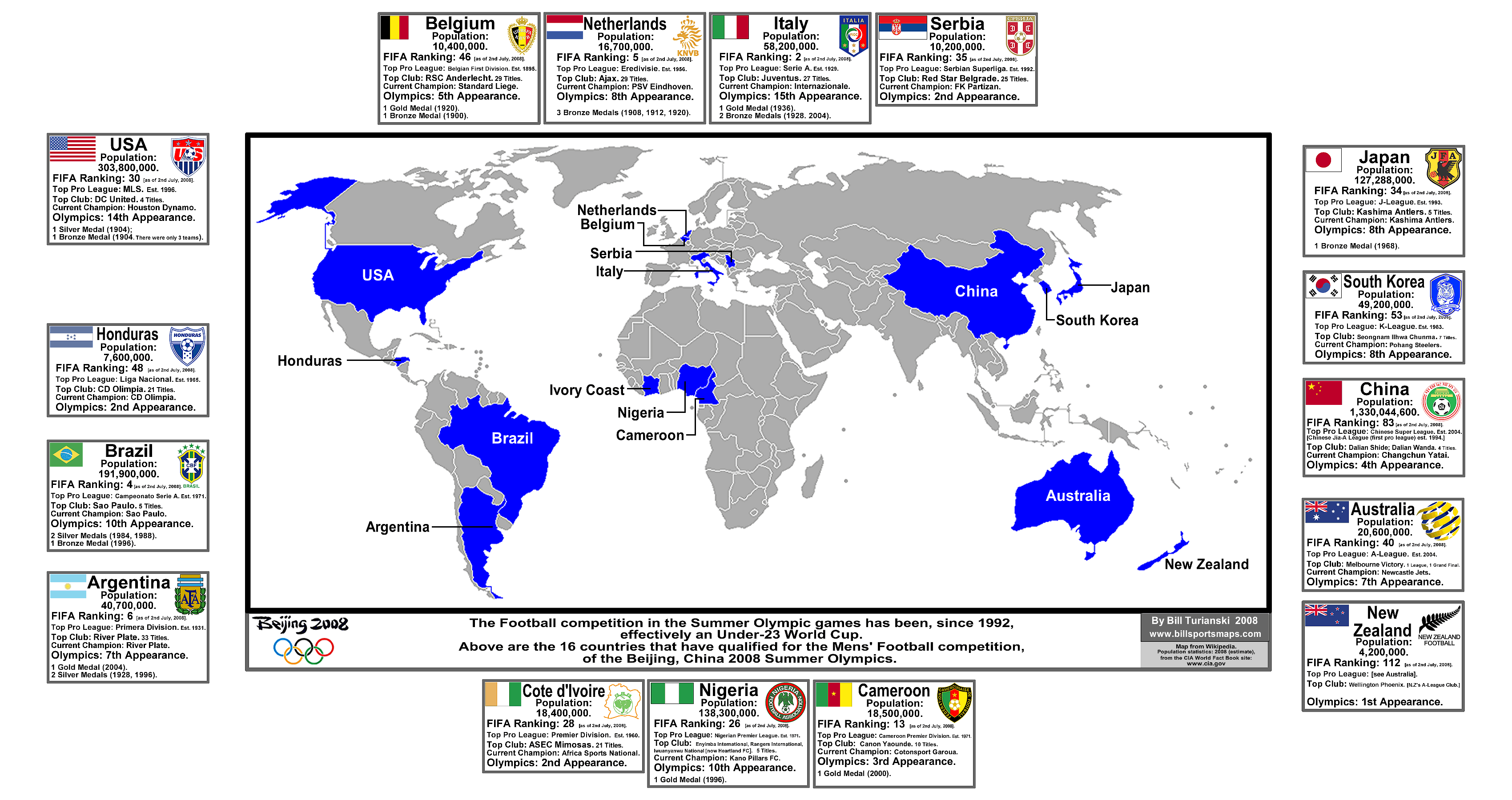
2008 Beijing Summer Olympics: Men’s Football- National Teams Map.

Filed under: Olympics: Football — admin @ 11:14 am

olympics_mens_football2008_draft2_post.gif


[Note:  This map was done in collaboration with the Soccer Lens site: {click here for Soccer Lens' preview of the competition.]

Thanks to Wikipedia for the map and information; {click here, for their page on the competition}.  Thanks to the CIA World Fact Book site, for the population statistics {click here}.   Thanks to Ahmed, at Soccer Lens, for the idea, and input {click here}.

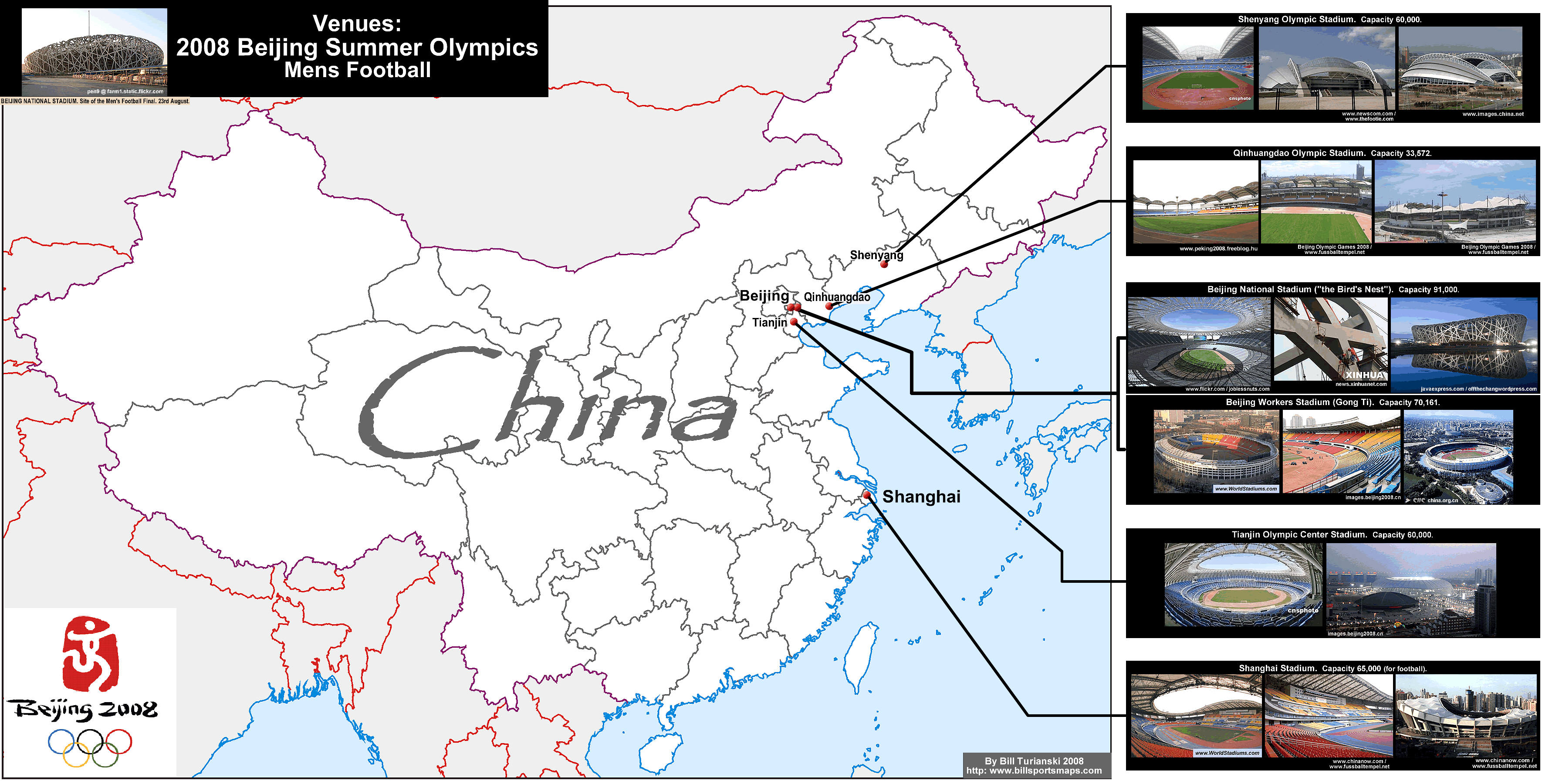
My next post will be a map, with photos of the 6 venues for the football competition, at the 2008 Beijing Summer Olympics.

July 16, 2008

Canadian Football League.

Filed under: Canada,Canadian Football League — admin @ 3:59 am

canadian-football-league_post.gif


[Note: the map shows each CFL team's present day helmet.  At the bottom of each team box is: 1. the team's earliest logo I could find;  2. a helmet design from the 1960s-1980s;  3. a recent variation of their logo/ or their current logo.]

The Canadian Football League was formed in 1958, though some of the teams had already been playing for many decades.  The Canadian championship of gridiron football, the Grey Cup {see this}, was last won by a non-CFL team in 1944, when a battalion from Montreal called Her Majesty’s Canadian Ship Donnacona {see this} were the champions.  (Just because I love historical trivia like this, the last two non-CFL winners before this were the Toronto RCAF Hurricanes, in 1942,  and The Sarnia (Ontario) Imperials {see this} in 1934 and 1936.)

The CFL is widely (and almost completely) ignored by the American media, and is overshadowed, even in Canada, by the National Football League.  But it has been getting solid attendance figures for years, and averaged 29,438 per game in 2007.  In fact the CFL is the 7th highest drawing league in the world {see this}.

The CFL season runs from July 1st to early November, with the Grey Cup played (in alternating cities) in late November.  The CFL has some crucial rule differences from the NFL.  First of all, there are only 3, not 4, downs (or plays), for the offensive team to gain the 10 yards necessary to start a new set of downs.  Secondly, the offensive backfield (ie, the players who get the ball the most often) can be in forward motion prior to the ball being put in play.  This gives the offense a much better chance of gaining yards than in the NFL.  Thirdly, the game is a far more wide-open affair, as the CFL field is wider, longer, and has deeper end-zones.  Again, more chance for the offense to score.  Finally, there is the opportunity for a 1-point score (called a “rouge”), via the kicking game. 

Here is Wikipedia’s page on the CFL {click here}.

Last season, the Saskatchewan Roughriders won only their 3rd Grey Cup, beating Winnipeg in the “Prairie Cup.” 

{Click here, for the 2008 CFL standings.}

{Click here, for the CFL site.}

Thanks to http://www.sportscolours.org, which includes Chris Creamer’s Sports Logos PageHelmets, Helmets, Helmets;  and Logo Shak.

July 11, 2008

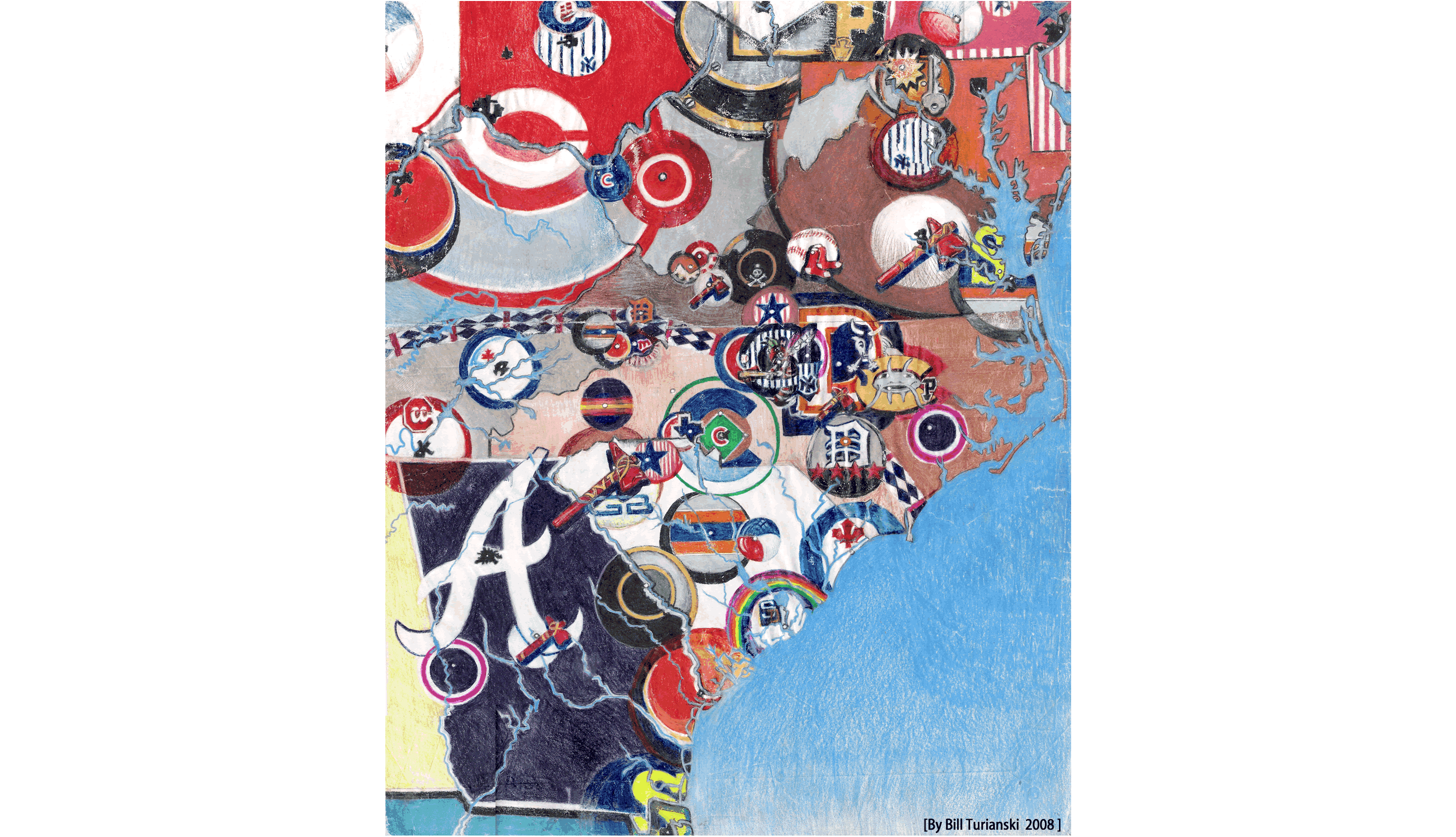
Baseball of the Southeast, circa 1992.

Filed under: Baseball,Hand Drawn Maps — admin @ 10:43 pm

baseball_southeast_post.gif


Major League Baseball clubs in this map are the Atlanta Braves, the Baltimore Orioles, the Cincinnati Reds, and the Pittsburgh Pirates.  The Phillies logo isn’t included, but you can see Philadelphia in the far upper right of the main map.

All the other teams on the map are minor league ball clubs.  Their parent MLB clubs are indicated by icons depicting the MLB clubs’ colors and logos.  For example,  the blue, orange, and gray circles are New York Mets minor league clubs (or farm clubs);  the blue and sky-blue circles with the maple leaf are Toronto Blue Jays farm clubs; the teams with the red tomahawks are Atlanta Braves farm clubs, and so on.

July 3, 2008

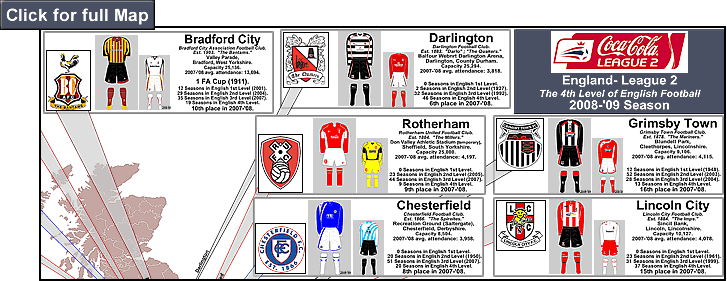
Major League Baseball: the American League Central- Map and Chart.

Filed under: Baseball: 2008 MLB div's — admin @ 6:02 pm

mlb_al_central_post_b.gif


Major League Baseball’s AL Central Division is made up of 4 charter members of the American League, three of which have remained in the same city since 1901; plus an expansion team from the late 1960′s. 

The Chicago White Stockings, the Cleveland Blues, the Detroit Tigers and the Washington Senators were all founding members of the American League.   Chicago changed their name to the White Sox in 1904;  Cleveland became the Indians in 1915.  The first Washington Senators became the Minnesota Twins, when the Senators moved to Minneapolis, Minnesota, in 1961 (although the city of Washington D.C. was concurrently granted an expansion team, the second Washington Senators, that began play also in 1961 [and later moved to Arlington, Texas, in 1972, as the Rangers].   The Kansas City Royals were an expansion team from 1969 (one of four that year;  the other three were the Seattle Pilots, the San Diego Padres, and the Montreal Expos).

{Click here, for team histories and photos (Sports E-cyclopedia site).}

AL Central Auxillary Chart, with each ball club’s uniforms evolution: Click on the image below, to see the full chart…

mlb_al_central_auxillary_segment.gif

 Thanks to the National Baseball Hall of Fame’s “Dressed to the Nines” site, which features uniform templates drawn by Marc Okkonen.

Thanks to http://www.sportscolours.org , which features Chris Creamer’s Logo Page.

June 29, 2008

Japan: The J-League, 2008- Zoom Map.

Filed under: Japan,Zoom Maps — admin @ 5:34 pm

japan_zoom_post_b.gif


The J-League is back from it’s summer break, so it’s a good time to feature a zoom map of the J-1 level of the league.  [J-2, which has 15 teams, is the other level of the J-League structure.]

The J-League was formed in 1992, and began play in 1993.  There are 18 clubs in today’s J-1, with 2 or 3 clubs relegated each season, and 2 or 3 clubs promoted from J-2.  The two league strucure, with a promotion/relegation system, was established in 1999.  It features a playoff between the 16th place J-1 team v. the 3rd place J-2 team.  The season runs from early March to early December, with a 6 week break in the early summer.

The current champion is the Kashima Antlers, a club from the Ibaraki prefecture, which is part of the greater Tokyo area (east of the city).  They were able to wrest the Title away from the Urawa Reds on the last day of the season. Urawa Red Diamonds, who were founded by Mitsubishi Motors (and are still bank-rolled by the corporation), are the biggest club in Japan.  They are also from greater Tokyo, north of the city, in the Saitama prefecture  They drew around 46,000 per game in 2007, the highest average gate in all of Asia.  Their true goal in 2007 was to win the Asian Football Confederation Champions League Title, which had eluded all Japanese teams since Jubilo Iwata won the Asian Cup (the ACF C.L. predecessor) in 1999.  Urawa Reds achieved this goal, beating Sepahan FC, of Iran, in mid-November.  But this probably contibuted to them losing their focus on the J-League Title.  The Reds only earned 2 points off their last 4 league games, and Kashima Antlers leapfogged them on the last day of the ’07 season (3rd December).  {See this article, from FIFA.com.}

To see the current J-League table, {click here}.   Urawa Reds, who definitely aim to take care of unfinshed business, sit at the top, but only on goal difference, as they are tied for points with Nagoya Grampus Eight.  Both these teams lost Saturday, though.  The Reds went down 1-2 to Kashiwa Reysol, and now Reysol are just three points off the pace.  Grampus lost big, 0-4, to reigning champs Kashima Antlers, so now the Antlers are just 1 point off the pace, with the best goal difference in the league. 

On Sunday, Gamba Osaka beat newly promoted strugglers Consadole Sapporo 4-2 , so now Osaka is also one point below the lead.  FC Tokyo, a relatively new team, with no major trophies but a large fan base, drew versus relegation-threatened JEF United, and now are 2 points behind the lead. 

Throw Omiya Ardija into the mix (at 4 points off the pace),  and you have the recipe for an interesting close of the J-League season, with very likely a half dozen teams (or more) with a shot at the crown.   {J-League site, click here.}

There is a really good independent site for the J-League.  It’s called The Rising Sun News {click here}.  It’s full of lots of info, and graphics.

On the map, I have included a segment of my 2006 J-League Attendance Map, so the viewer can get a better picture of the Greater Tokyo teams’ locations, and their fan-base sizes.  **{Click here, for my 2006 J-League Attendance Map.}

On the map, for each team, I have listed J-League Titles, and Titles for the Emperor’s Cup (the oldest Cup competition in Japan).   {Click here, for Wikipedia’s page on the Emperor’s Cup.}   I have tried to list the original names of all the teams, most of which started as company-teams.  The corporate connections have played a big part in Japanese football, and as far as I can tell, only 3 teams currently in J-1 were not formed by any sort of corporation:  Kyoto SangaAlbirex Niigata,  and Shimizu S-Pulse. 

I began rooting for the Shimizu S-Pulse because I thought their stadium looked the most fan-friendly, the team played an up-tempo style, and I have always had a soft spot for orange kits.  But now that I know they were formed at the grassroots level (from a big footballing region: {see this}), and initially with no big corporate money behind them, I like them even more.  

Thanks to Demis, of the Netherlands {click here},  for the blank map of Japan.   Thanks to http://www.colours-of-football.com,  for the kits.   Thanks to the Albion Road site {click here}, for background on the teams. 

Thanks to Mike, from the Go! Go! Omiya Ardija site {Click here}, for responding to my e-mail, and pointing out misspellings.   Check out this site:  Ardija is shaping up to be the surprise team of ’08…which is nice to see, as the club labors under the shadow of fellow Saitama-dwelling J-League giants Urawa Reds, and last year were only 3 points away from the relegation playoff.

June 28, 2008

UEFA Euro 2008: Finals Match- Germany v. Spain.

Filed under: UEFA Euro 2008 — admin @ 10:00 am

Sunday, 29th June, it’s the Germany National Team versus the Spain National Team, for the Championship of European football.  Euro 2008 has been an absolutely fantastic competition.  It’s amazing to think how big the Euros have become, and deservedly so, because there have been some incredible games.  I think, as opposed to the World Cup, the teams are willing to play less conservatively, and with a more go-for-broke attitude.  Whatever the reason, the Euro 2008 games have been, by and large, a thrilling affair.   [Note: this is old content, posted again here for viewer convenience.  Late Sunday, I will post a map of Japan's 2008 J-League.]


euro_2008_germany_post.gif

euro_2008_spain_post.gif

June 22, 2008

Major League Baseball: the National League Central- Map and Chart.

Filed under: Baseball: 2008 MLB div's — admin @ 9:07 am

mlb_nl_central_post_c.gif
The National League Central Division is made up of four long-time NL franchises (the Chicago Cubs, the Cincinnati Reds, the Pittsburgh Pirates, and the St. Louis Cardinals), plus two franchises that were formed in the 1960′s (the Houston Astros, and the Milwaukee Brewers (who were originally the Seattle Pilots)).

The Chicago, Cincinnati, Pittsburgh, and St. Louis ball clubs all date back to the nineteenth century.  The Chicago Cubs are the only charter member of the National League (established 1876) that has remained in the same city, continuously.

**Click on the image below, for the NL Central Auxillary Chart, which shows selected uniforms and logos from each ball club’s past. Click below…

mlb_nl_central_auxillary.gif

**{For team histories, and photos, click here (Sports E-cyclopedia  site.}

Thanks to the SSUR site (http://www.sportscolours.org/).  Thanks to the National Baseball Hall of Fame’s “Dressed to the Nines” site (click here}, which features team uniform templates by Marc Okkonen.

June 18, 2008

UEFA Euro 2008: Turkey- Squad Map.

Filed under: Turkey,UEFA Euro 2008 — admin @ 6:10 pm

euro_2008_turkey_post_b.gif


Kudos to the Turkey National Team, for their two consecutive come-from-behind victories in Euro 2008.  They beat Switzerland 2-1 on 11th June , and stunned the Czechs last Sunday, 15th June, by coming back from a 0-2 deficit, to win 3-2.  Nihat Kahveci pounced on a rare Peter Cech miscue, in the 87th minute.  Nihat then curled a fantastic shot from the top of the penalty area, in the 89th minute.  {See this article (uefa Euro 2008 site)}.

Turkey will now face Croatia, in a Quarter-Final match, on Friday 20th June, in Vienna, Austria.

The map includes the 12 largest cities in Turkey (500,000 population, or more).  {Click here, for the full list of Turkish cities (Mongabay site.

{Click here, for modern history/ demographics/info on the country of Turkey {CIA World Fact Book site}.}

Thanks to the UEFA site, for the Turkish Team kits.

June 15, 2008

UEFA Euro 2008: Croatia-Squad Map.

Filed under: Croatia,UEFA Euro 2008 — admin @ 10:37 am

euro_2008_croatia_post.gif


Croatia beat Germany 2-1, last Thursday, to clinch a spot in the Euro 2008 Quarter-Finals.  {To see an article on this, click here (SI/CNN site).}

The map includes the only 4 cities in Croatia with a population of 100,000 or more  {see this}.  Croatia has an approximate population of just 4.5 million, which underscores how impressive their Narional Team’s win over Germany was…Germany’s population is around 82.4 million.  {See this page on Croatia, from the CIA World Factbook site.}

[Note: all players' caps and goals are correct as of 12 June, 2008.]

Thanks to the UEFA site {click here}, for the Euro 2008 Croatia National Team kits.

June 11, 2008

UEFA Euro 2008: Germany- Squad Map.

Filed under: Germany,UEFA Euro 2008 — admin @ 5:30 pm

euro_2008_germany_post.gif
Though they were outshot by Poland 12-14, Germany won their first game last Sunday by a score of 2-0, with both goals scored by Polish-born Lukas Podolski  {click here, for a report from the UEFA site}.  Thursday, Germany plays Croatia.

There are three Polish-born players on the German team: Miroslav Klose, Lukas Podolski, and Piotr Trochowski.  Both Klose and Podolski were born in Silesia  {see this}, which was formerly part of Germany.  Most of Silesia is now in (south-west) Poland, with sections in the Czech Republic, and Germany.  {Click here, for background on Miroslav Klose’s family, and how they were able to get out of Communist-era Poland, with the help of German-ancestry laws.}

The map shows the 27 cities in Germany with a population over 250,000.  Here is a list of the largest cities in Germany  {mongabay site; click here}.   Below is a population density map of Germany (from Wikipedia).

german-pop.png

Thanks to the UEFA site {click here}  for the German kits.

[Note: Players caps and goals are listed up to before the start of Euro 2008.]

« Newer PostsOlder Posts »

Powered by WordPress