billsportsmaps.com

February 9, 2009

NCAA Basketball: AP Poll, Top 25, from February 9, 2009.

Filed under: NCAA Men's Basketball — admin @ 4:57 pm

ncaa_basketball_ap-poll_map-feb9-2009_post.gif


For the second straight week,  UConn is #1. – AP Poll, from February 9, 2009  {Click here}.

Thanks to Chris Creamer’s Sports Logos Page  {Click here}.

February 7, 2009

MLB Ball Clubs and their Minor League Affiliates: the Toronto Blue Jays.

Filed under: Baseball Clubs/Farm Teams — admin @ 8:20 am

toronto_blue-jays_mlb_al-east_with-minor-league-affiliates_post_2.gif


Below: Toronto Blue Jays Auxiliary Chart,  featuring selected Blue Jays’ logos and gear,  through the years of the franchise (1977-2009):

toronto_blue-jays_auxillary-chart2009_segment_b.gif

Toronto Blue Jays page at Sports E-cyclopedia {click here}. 

Thanks to Chris Creamer’s Sports Logos Page  {Click here}.   Thanks to MLB Shop  {Click here}.    Thanks to the contributors to the pages at Wikipedia  {Toronto Blue Jays page,  here).  Thanks to the National Baseball Hall Of Fame’s Dressed to the Nines site,  featuring team uniforms templates drawn by Marc Okkonen.  {Click here}.   Thanks to e-bay for image of the Ted Rogers memorial patch {click here}.

February 5, 2009

Mexico: Primera Division, 2009-Clausura-Map and Club Profiles.

Filed under: Mexico: Fútbol,Zoom Maps — admin @ 7:42 am

primera-division-de-mexico_zoom-map2009-clausura_post.gif


The Clausura 2009 of the Primera Division de Mexico began in mid-January, and will run to the final day of May.  {Wikipedia page, Click here}.   The map features an explanation of the complex league format.  The format was established to help the clubs create fixtures which draw larger crowds (ie, the playoff matches,  as well as the US-based InterLiga matches which decide 2 of the 3 Copa Libertadores qualifiers).  The byzantine format has helped get many of the clubs out of crippling financial situations,  but it is rather complicated. 

Here is a good write-up about the Mexican Primera Divsion from the US Soccer Players site:  {Click here}.

Mexican Primera División table  {Click here (ESPN)}.

Thanks to the Albion Road site  {Click here}.  Plus thanks to Jeremy for helping me get to the bottom of the sordid CD Irapuoto-to-ersatz Veracruz-to-Jaguares de Chiapas franchise movement.

In 2002, the people who ran the Veracruz club had the gall to buy another club and move the team to Veracruz and play as Veracruz in the first division, while the real Veracruz was in the 2nd division.  They bought and moved the 1st division club  CD Irapuato in early 2002, in between the Verano 2001 and Invierno 2002 half-seasons. For 19 games in 2002, there was a Veracruz in both the first and the second divisions (!?).  So of course, the 2nd-division-Veracruz won promotion after the Invierno 2002.  Management sold the formerly-Irapuato-now-Veracruz club to a group in the impoverished and fractious Chiapas state.  [Remember the masked revolutionary-leader Subcommandante Marcos  {see this}, from news reports around 8 or 9 years ago?  That place.].  The original-Veracruz ended up being relegated back to the Primera División A (the 2nd division) after the Clausura 2008.  A new club was created,  in the 2nd division,  for Irapuato for the 2002-’03 season.  The club won promotion that season,  and played in Primera Division in the 2003-’04 season,  but were relegated in 2004.  Irapuato were relegated again to the third division.  3 years later,  Pachuca-B gained promotion to the second division,  and the club was sold and moved to…Irapuato.  Talk about full circle.

Note: In the link I put up from the US Soccer Players site,  this affair is touched upon in the 11th paragraph,  the one that begins… “Much like American sports, owners can throw a wrench in relegation plans by moving teams all over the country and changing names…”  {Click here,  and go to the 11th paragraph}.

Thanks to the contributors to the relevant pages at Wikipedia  {Mexican Primera Division page,  Click here}.

February 2, 2009

Baseball Clubs and their Minor League Affiliates: the Washington Nationals.

Filed under: Baseball Clubs/Farm Teams — admin @ 7:23 pm

washington_nationals_mlb_nl-east_with-minor-league-affiliates_post_b.gif

Thanks to Joho Maps  {Click here}.

This starts a new series.   I want to post one Major League Baseball team each week,  or so.   There are 30 ball clubs in the majors,  so I started this series even before Spring Training has begun,  because I want to get in all the clubs before the summer is over.   I will do the teams alphabetically,  backwards,  so that the posts will show up in alphabetical sequence in the new Baseball Clubs/Farm Teams category I made. 

So that means up next will be the Toronto Blue Jays,  then the Texas Rangers.

-

On the main map is shown the location and logo of the featured MLB team,  and their 6 minor league affiliates.   These 6 levels are… Triple-A  [AAA].   The 2nd highest level,  Double-A  [AA].    Single-A ball,  with it’s three gradations  [Advanced-A A;  and A-Short Season].   The lowest rung,  the Rookie/ Instructional Leagues [R]. 

In the upper right hand corner is a block of text that includes the ball club’s 2008 divisional record,  and their 2008 average attendance figures.   Below that are the major league ball club’s 6 minor league affiliates.   The teams’ cap insignias are shown,  along with league,  level,  and length of time the minor league ball club has been part of the Major League team’s farm system.  

At the bottom is a map that shows the other MLB clubs in the the division,  in this case,  The National League East Division.  At the bottom of this section is shown the featured MLB team’s 2009 jerseys,  caps, and logos.

2008 Major League Baseball attendance figures, by team  {Click here (ESPN) }.

-

For the 5th straight season,  Minor League Baseball set an attendance record.   See this article,  from the Minor League Baseball site,  {Click here}.

Here is a list of minor leagues’ average attendance,  per game,  in 2008.  I used this article {Click here}, from Street & Smith’s Sports Business Daily.

2008minor-league-baseball-attendances-by-league_d.gif

Here is an article that lists the best minor league ballparks  {Click here (jaunted.com) }.   Here is an article from the Washington Post.com,  about visiting the Washington Nationals’ Double-A farm team in Harrisburg, PA  {Click here}.

-

Thanks to Chris Creamer’s Sports Logos Page  {Click here}.   Thanks to the contributors to the relevant pages at Wikipedia  {Minor League Baseball page, here}.   Thanks to the MLB.com shop  {Click here}.

January 31, 2009

NFL, 1997 Season: Map with Helmets.

Filed under: NFL>1997 helmet map,NFL/ Gridiron Football — admin @ 11:26 am

nfl_1997season_helmets_map_post_b.gif


Thanks to http://www.misterhabs.com/helmets.htm, for the helmets.

In the 1997 NFL Season, the Denver Broncos became the first AFC team to win the NFL Title in 14 seasons, when they defeated the Green Bay Packers in Super Bowl 32. The victory marked a turning of the tide: in the 10 Super Bowls since 1997, it has been AFC 7, NFC 3. The younger AFC, which comprises the 10 AFL (1960-1969) franchises among its 15 members, has begun a period of dominance over the older NFC, which has 8 franchises formed before 1960. True, the NFC’s New York Giants beat the AFC’s New England Patriots in last season’s Super Bowl, and they deseved the victory, with a stunning comeback drive. But the Patriots were heavily favored, as are the AFC’s Steelers, over the NFC’s Cardinals, in this season’s Super Bowl.

1997 was the first season the Denver Broncos first wore their flashy, futuristic navy blue and orange uniforms. The Tampa Bay Buccaneers also debuted their new pewter-colored/ skull and crossbones gear that year, ditching their rather festive pale orange uniforms with the winking pirate who sported a feathered hat (who on earth decided that look was a good idea ?). The full list of changes (uniforms and otherwise) for the 1997 NFL season can be seen {here}.
Here are the uniforms from 1997 {gridiron-uniforms.com/1997}.

January 27, 2009

2009 Copa Libertadores, Preliminary Round. Map (of all 38 clubs who qualified: 12 Preliminary clubs/ 24 Group Stage clubs).

Filed under: Copa Libertadores — admin @ 12:59 pm

copa-libertadores09_post.gif
The Copa Libertadores can be viewed as the Champions League of South America (plus Mexico).  However, it is a far more grueling ordeal for the clubs than the Champions League.  The competition is shoe-horned into a 4-month period (as opposed to the 9-month span of each Champions League season),  with travel far more problematic.  Modern airports and efficient travel routes are far less prevalent than in Europe.  The 2009 Copa Libertadores is the 50th edition of the tournament.    34 of the 49 Copa Libertadores Titles have been won by clubs from the 2 dominant nations of South America:  Argentina (21 Titles) and Brazil (13 Titles).  But not last year.

Defending Champions are Ecuador’s LDU Quito (Wikipedia page, {Click here} ).  They were a surprise finalist, and took Brazil’s Flumenese to penalties after the second leg’s regular time was finished, with the aggregate score at 5-5.   LDU Quito’s goalkeeper Jose Francisco Cevallos made three saves on Fluminese penalty kicks,  and the unheralded club from the small equatorial nation won the shootout 3-1.  It was the first Copa Title by a club from Ecuador.  Here is an article on the shock win, from the Guardian.co.uk site, from 4th July, 2008… {Click here}.

-

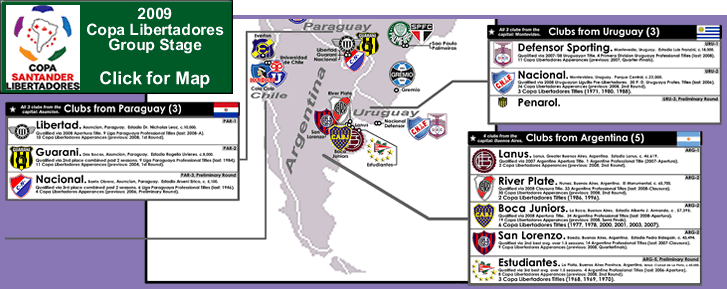
The Preliminary Round of the Copa Libertadores features 12 clubs.  They were drawn into two-legged match-ups.  The 6 winners are determined on aggregate goals, with European-style away goals rule in effect (since 2005).  If the aggregate is level, there is no extra time…it’s straight to a penalty shootout.  The 6 tie-winners advance to the first round,  which is the Group Stage {see the 8 groups,  here }.

[The Final has different rules for aggregate goals, though.  Away goals are not doubled, and there is a half-hour AET, before the penalty shootout, if necessary.]

Match-ups…{Click here (Foxsports) }.

El Nacional (Ecu.) v. Nacional (Par.) 1st leg, 27 Jan.

Universidad de Chile (Chi.) v. Pachuca (Mex.) 1st leg, 28, Jan.

Independiente Medellin (Col.) v. Peñarol (Uru.) 1st leg, 28 Jan.

Palmeiras (Bra.) v. Real Potosí (Bol.) 1st leg, 29 Jan.

Sporting Cristal (Per.) v. Estudiantes (Arg.) 1st leg, 29 Jan.

Deportivo Anzoátegui (Ven.) v. Deportivo Cuenca (Ecu.) 1st leg, 29 Jan.

The 12 clubs in the 2009 Copa Libertadores Preliminaries: [Note: unless otherwise noted, populations are from the Mongabay site {Click here},  and are 2002 estimates.]

Deportivo Anzoátegui (Venezuela).  A very new club, established in 2002.  The club has no titles,  and this is their Copa Libertadores debut.  From Puerto la Cruz, which is part of the metropolitan area of Barcelona, Venezuela (metro pop.: 607,000).  Kit: yellow, with red trim.

Deportivo Cuenca (Ecuador).  Relatively new club, established in 1971. Won their only National Title in 2004.  Cuenca is the third largest city in Ecuador (metro pop.: 417,000).  Third Copa Libertadores appearance in 5 years.  Kit: red, with black.

El Nacional (Ecuador).  The football club of the Equadorian military, they were founded in 1964.  Tied with Barcelona Sporting Cub for the most National Titles,  13 (their last in 2006).  From the capital, Quito (metro pop.: 2,686,000).  Kit: all red, with blue trim.

Estudiantes (Argentina).  From La Plata, the capital city of Buenos Aires Province (metro pop.: 833,000).  Glory days were four decades ago, when the club won 3 straight Copa Libertadores Titles (1968-’70).  Won their 4th Argentine Professional Title in 2006 (and their first in 23 years) under then-manager Diego Simeone, who built that team around Juan Sebastián Verón (who had returned after 11 years in Europe).  Verón is still on the squad, which finished in 7th in the 2008 Apertura.  [Note: qualification in Argentina for some of the spots in the Copa Libertadores is based on league form over one and a half seasons.]  Kit: red/ white vertical stripes on jersey; black pants.  Nickname: los Pincharratas (the Rat Stickers), for the plethora of rodents in their old ground.

Independiente Medellin (Colombia).  Dubbed “El Ponderosa de la Montaña” (the powerful of the mountain).  Had a great run in the early part of this decade, with Nationbal Titles in 2002-II and 2004-I, as well as a third-place finish in the 2003 Copa Libertadores.  First Copa appearance since ’05.  Medellin is the third largest city in Colombia (metro pop.: 2,994,000).  Kit: red jersey, blue pants. 

Nacional (Paraguay).  A club that has three spells in the second division in the last 30 years.  Their last of 6 National Titles was in 1946.  Nicknamd La Academia, for it’s good youth system.  Like most of the Paraguayan top tier, Nacional is from the capital, Asuncion (metro pop.: 1,600,000 [2005 estimate, from MSN Encarta]).  Kit: white jersey, blue pants.

Pachuca (Mexico).  The oldest pro club in Mexico, from Pachuca, Hidalgo state, which is 88 km east of Mexico City (55 miles).  Nicknamed Tuzos (Gophers), the club has had a remarkable last decade, with 5 National Titles (last, Clausura 2007), and 3 CONCACAF Champions League Titles (2002, ’07, and ’08).  This after years (prior to 1998) of yo-yoing between the 1st and 2nd divisions.  According to Wikipedia (page on Mexico, here),  Pachuca is the 31st largest city in Mexico (metro pop.: 439,000 [2005 census]).  Kit: blue and white vertcal striped jersey, white pants.

Palmeiras. (Brazil).  From Brazil’s largest city,  Sao Paulo (metro pop.: 18,505,000).  A 2004 survey found Palmeiras to be the 4th-most-supported club in the country,  with 11.8 million fans {you can see the whole list (plus a zoom map of 2008  Brazil Campeonato Serie A clubs), in this post,  from last May: Click here}.  Founded in 1914, as Palestra Italia, by members of the city’s Italian community (the club changed their name during WW II).  Palmeiras have won 4 Campeonato Serie A Titles (the last in 1994),  and 1 Copa Libertadores Title, in 1999.  They just missed out on the 2008 Brazillian Title (won by Sao Paulo for the third straight season),  and recently had their manager, Vanderlei Luxemburgo, attacked and injured by supporters {see this (from a blog on the FourFourTwo site) }.  Kit: all green.

Peñarol (Uruguay).  From the capital, Montevideo (metro pop.: 17,223,000), as are almost all top flight clubs in Uruguay (13 of the 16 clubs are from Montevideo, currently).  Peñarol vie with Nacional for the position as the biggest club in the country.  A 2006 survey showed that 45% of Uruguayan fans supported Penarol, while Nacional had 35%.  Peñarol has won 5 Copa Libertadores Titles.  Peñarol won the first 2 Copa Libertadores competitions, in 1960 and ’61.  Their fifth and last Copa Title was in 1987.  The club’s origins were as an off-shoot of the Central Uruguay Railway Cricket Club, in 1913.  Kit: black and yellow vertical stipes on jersey: taken from the colors used on railway signs and warning barriers. 

Real Potosí (Bolivia).  Bolivia is the ugly stepchild of South American football…no Bolivian club has advanced past the Group Stage (1st Round) of the Copa Libertadores in 8 years.  Real Potosí is a club that dates back to 1941, but was wound up in 1985, and re-launced in 1994.  Potosí (metro pop.: 136,000) is claimed to be the city with the highest elevation in the world (at 4,090 meters or 13, 420 feet…that’s 2 and a half miles).  The club has won 1 National Professional Title (2007 Apertura [Feb.-June]).  Kit: purple jersey, white pants (and their logo is so close to Real Madrid’s as to be a copyright infringement).

Sporting Cristal (Peru).  From the capital, Lima (metro pop.: 7,604,000),  the club’s original name was Sporting Tobacco (talk about an oxymoron).  Cristal is a brand of beer.  The club has won 15 National Titles, third most in Peru.  Kit: sky blue jerseys, white pants.

Universidad de Chile (Chile). From the capital, Santiago (metro pop.: 5,637,000).  The well-supported club has the second most National Titles, with 12 (last: 2004-Apertura),  but 16 less than Chilean giants Colo Colo.  Nickname is los Chunchos (the Owls).  Kit: all blue.  

-

Notes:   1.  In the category of Appearances, the ’09 competition is counted as an appearance.  Also, being eliminated in the Preliminary Round still counts as an appearance (the RSSSF site {see this page}uses this protocol, so I am following suit {RSSSF home page, here}).  

2. In the category of Titles Won, only professional titles are listed.  River Plate (of Argentina) have 1 amatuer title to add to their 33 pro tiles;  Boca Juniors have 7 amatuer titles to add to their 24 pro titles;   Estudiantes have 1 amatuer title to add to their 4 pro titles.    Penarol (of Uruguay) have 10 amatuer titles to add to their 31 pro titles;  Nacional (of Uruguay) have 11 amatuer titles to add to their 30 pro titles.  Libertad (of Paraguay) have 4 amatuer titles to add to their 9 pro titles.  Universiario Deportes (of Peru) have 7 amatuer titles to add to their 17 pro titles.  

3A.  Some countries have Apertura and Clausura titles that stand on their own as national titles.  Argentina is the best example of this;  Mexico, Colombia, Chile and Bolivia also use this system, and Paraguay has just adopted this system.   3B.  Uruguay, Ecuador, Peru, and Venezuela have a playoff format between the Apertura and Clausura winners to decide the season’s champion.   3C.  {Click here (Wikipedia)} and see the second paragraph to determine what part of the year the Apertura and Clausura are played.   Yes that’s right…in certain parts of South America,  “apertura” and “clausura” have the opposite meanings.  This is just the tip of the iceberg,  unfortunately,  of the dysfunction endemic to the game on this continent.  Thankfully,  the Copa Libertadores itself is only getting bigger and stronger  (and more important to clubs), as the years go by.

Thanks to the contributors to the pages on the Copa Libertadores at Wikipedia  {Click here}.

Thanks to Sam Kelly at the Hasta El Gol Siempre site  {Click here}  (and also at ESPN Soccernet [Sam Kelly at ESPN Soccernet archive here]),  for fact-checking and input.  Sam will be writng about the Copa on my next post on the competition, which will be just before the Group Stage begins on 11th February.

January 25, 2009

Turkey: 2008-2009 Turkiye Kupasi: Quarterfinals, with thumbnail profiles of the 8 clubs remaining.

Filed under: Turkey — admin @ 2:59 pm

turkiye_kupasi_2008-09_quarterfinals_post.gif


The  2008-2009 Turkish Cup is in it’s Quarterfinals Round (aka the 4th Round).   The competition switches back from the Group Stage (3rd Round) format to a knockout style format for the rest of the tournament.  Gone are all the lower division clubs;  the Big 3 (of Besiktas,  Fenerbahce,  and Galatasaray),  plus 5 other first division clubs,  remain.  Cup holders are the central Anatolian club Kayserispor;  they were knocked out last round.

Turkish Cup fixtures and results.  {Click here}.

2008-2009 Turkiye Kupasi page on Wikipedia  {Click here}.

Turkcell Super Lig table {Click here}. 

The 8 clubs still alive in the competition…

Ankaraspor. Relatively new club (est. 1978), with 5 seasons in the top flight.  No major titles,  but are currently 4th in the league.

Antalyaspor.  Classic yo-yo club, with 5 spells in top tier in last 36 years; 14 seasons in 1st division.  No major titles.

Besiktas.  One of the Big 3.  Founded in 1903,  Besiktas Jimnastik Kulübü are the oldest Turkish club (which was formed by Turks).  Their name is pronounced Be-shik-tash. Besiktas have been drawing very good crowds in the last few years (around 26,000 per game).  Nicknmed Kara Kartaller (the Black Eagles),  Besiktas have won 12 National Titles (their last in 2003),  and 7 Turkish Cups (last in 2007).

besilktas_bjk_inohu-stadium_f.gif

Bursaspor.  Bursa {see this} is the fourth largest city in Turkey,  known as Green Bursa for it’s many parks and gardens.  Bursaspor have the fourth biggest fan base in Turkey,  drawing around 16,000 per game.  40 seasons in the top flight.  Bursaspor won the 1986 Turkish Cup.

Denizlispor.  18 seasons in the first division.  No major titles.

Fenerbahce.  Founded in 1907,  Fenerbahce Spor Kulubu are located on the Asian side of the Bosporus Strait,  in the Kadikoy District of Istanbul  {see this}.  The name Fenerbahce means lighthouse garden,  and their crest features an oak acorn leaf.  Fenerbahce are tied with Galatasaray for the most championships.  The club has the highest average attendance in Turkey by far…around 39,000 last season,  making them the 34th highest-drawing club in Europe  {see this list from Wikipedia: Top average attendances of European Football Clubs}.   Fenerbahce have won 17 National Titles (their last in 2007),  and 4 Turkish Cups,  but none in half a century:  their last Cup win was in 1983.

fenerbahce_segment.gif

galatasaray-v-fenerbahce_1909.gif

Galatasaray.  Current league champions.  Formed in 1905,  by students at the elite Galatasaray Lycee,  in Istanbul.  This school was established,  as Galata Palace,  way back in the Middle Ages,  in 1481,  to train civil servants  (palace is Sarary in Turkish).  By the 1840′s,  the school bergan training Health Service personnel,  and by the 1870′s,  it expanded to include training for law,  literature,  and political science.  After the Turkish Republic was established,  under Kemal Ataturk,  circa 1923  {see Wikipedia’s page on Ataturk here},  the school changed it’s name to Galatasaray University,  and expanded it’s curriculum to encompass the ideals of the new Republic (ie,  goodbye Dark Ages,  hello democratic,  secular nation-state).  

Galatasaray SK are affectionately known as ’Cim-Bom’ (pronounced Jim-Bom;  the origins of the nickname are cloudy),  and are also nicknamed the Lions.   Galatasary will be moving into a giant new state-of-the-art stadium in late 2009  {see this (computer rendering of the new stadium);  see this (Wikipedia’s page on the under-construction Turk telecom Arena) }.   Galatasaray Spor Kulubu  have the most silverware of any Turkish club,  with 17 National Titles,  and  14 Turkish Cups (their last in 2005).   Official Galatasaray site,  {Click here}.  General Galatasaray information… http://www.cimbom.org/general/

galatasaray.gif

Sivasspor.  Sivas is in the eastern part of the central Anatolian region {Click here,  for a random, but beautiful photo from the region (from Beth at Picasa) }.  Known as Yigidolar (Bravemen),  Sivasspor are in just their 4th season in the first division.  This is a club that really looks like it is going places.  Sivasspor finished fourth last season,  and they currently lead the league,  at exactly the halfway mark of the season.   A telling statistic is that versus the Big 3 last season,  Sivasspor managed only 3 points out of a possible 18;  but this season,  they have taken 7 points out 9 so far,  including a 2-0 win over Galatasaray on Saturday.  If Sivasspor do manage to hold the lead,  it would be a huge accomplishment,  as no club outside the Big-3-plus-Trabzonspor has ever won the Turkish crown.  Here is a write-up from a Fenerbahce blog, posted on Monday, 26th Januar …{Click here (Fenerbahce Worldwide.org) }.  Sivasspor’s leading scorer is Mehmet Yildiz.  Leading scorers in Turkey can be seen  {here (SoccerBot) }.  Here’s what my favorite Turkish player,  Villarreal’s Nihat Kahveci,  has to say about Sivasspor  {Click here (SABAH newspaper, English edition, from New Year’s day) }.   

Thanks to Ugur,  for information,  graphics,  and links,  at PCLion FC Blog {Click here}.   Thanks to David Goldblatt,  for his book “The Ball Is Round,  A Global History of Football“,  originally published in 2006,  by Penguin Books, Ltd.,  London.   Thanks to the Albiuon Road site,  for info I couldn’t find in other places  {Albion Road/ Turkish Super LigClick here (the page features a nice Google Earth map of the clubs in the league}.   Thanks to the contibutor’s to the relevant pages at Wikipedia  {SuperLig page,  Click here}.

January 21, 2009

2008-2009 FA Cup Fourth Round: Map, with fixtures for 23rd to 25th January, 2009; and Gallery (featuring Torquay United).

Filed under: 2008-09 FA Cup — admin @ 10:39 am

2008-09_fa-cup_4th-round_post.gif


Fa Cup headlines: {Click here (FA site) }.

FA Cup fixtures and results  {Click here (BBC/ FA Cup) }.

The FA Cup is officially known as The Football Association Challenge Cup.  It is the oldest football competition in the world.  The 2008-2009 FA cup is the 128th edition.  Cup-holders are Portsmouth FC,  from the south coast of England,  in Hampshire. 

The competition begins it’s Fourth Round Proper on the weekend of 23rd through 25th January, 2009.   

Of the 32 clubs still alive in the 2008-2009 FA Cup,  there are 15 Premier League clubs,  13 League Championship clubs (the 2nd Level),  2 League One clubs (the 3rd Level), z ero League Two clubs (the 4th Level),  and 2 Conference clubs (Non-League, and the 5th Level).   The clubs involved have current average attendances (from league matches) ranging from 75,268 (Manchester United) to 1,814 (Kettering Town). 

Torquay United FC and Kettering Town FC are the two survivors from the record 8 Non-League clubs which made it to the FA Cup Third Round.  I decided to do a gallery of Torquay,  because their’s was the biggest “giant” killing of the 3rd round,  made a little less big because the club the Gulls beat,  Blackpool FC,  are sort punching above their weight.  Blackpool are holding steady in the 2nd Level, for the second straight season,  but can’t even draw over 10,000 if they wanted to…they basically are stuck (for the moment, they hope) playing in half a stadium at the partially refurbished Bloomfield Road.  Nevertheless,  the difference in league placing between Blackpool and Torquay is currently 60 places,  so I don’t care if the two clubs’ crowds are only about 5,700 per game apart…5th Level Torquay beating 2nd Level Blackpool is still a big upset.

To see Torquay United Gallery, including kit history (all kit illustrations copyright: Historical Football Kits site) click on the following title…torquay-united_plainmoor_gallery_with-kit-history.gif

Historical Football Kits site {Click here}.

Kettering Town had the fortune of drawing,  then beating,  the smallest minnows in the draw,  7th Level club Eastwood Town.  Both Kettering and Torquay are in the Conference,  having come to the fifth Level from opposite ends.  Torquay spent for talent last summer,  hoping to get back to League status  {see this (FA site: Lee’s delight at Cup win, 3rd Jan.) }.  So the club should feel very good about the financial gains of an extended Cup run,  they earned it. 

Northamptonshire’s Kettering Town won promotion from the Conference-North to the Conference for the first time in 5 years.  Kettering Town were the first club in England to have a sponsor’s ad on their jerseys,  in January 1976  (it was an ad for Kettering Tyres,  and it was banned,  so they made the writing say “Kettering T”,  but the FA weren’t having it.  3 years later,  Liverpool became the first top-flight club to succumb to advertising on their kit).  Now Kettering Town have taken their current 15 minutes of fame to do a sort of karmic payback on the whole Pandora’s Box of kit advertisements that they opened…{see this  (Guardian.co.uk site: Kettering chairman supports Palestinian plight, 2nd January.) }.

Torquay have a nice draw…they host Coventry City (in 13th place in the 2nd Level, aka the Championship),  which gives the Gulls the chance of facing a decent-sized club that is beatable.  Kettering Town have a tougher draw…hosting Ptremier League club Fulham.   I am sure Kettering Town wish they were facing Fulham a year ago,  because since then,  Fulham manager Roy Hodgson has turned the Cottagers into a more formidable side,  by far: they sit 10th in the Prem.

-

The FA Cup Fourth Round kicks off with one match Friday,  a classic Derby,  between out-of-form Derby County (who have sunk to 20th in the Championship),  and steadily-improving Nottingham Forest,  who have fought their way out of the relegation zone to 18th in the Championship,  and have won 4 straight, including all 3 games since Billy Davies (the former Derby County manager) took over as manager on 1st January.  The two clubs,  from the neighboring regions of Derbyshire and Nottinghamshire,  are separated by about 15 miles.  The fixture is made all the more intriguing because of Nigel Clough’s recent appointment as manager of Derby County.   This is the son of Brian Clough,  the man who managed both these clubs to their first National Titles.  Clough and his (then) trusted righthand-man Peter Taylor led Derby County out of the Division Two,  and to the Division One Title in a period of 4 seasons (1968-’69 to the title in 1971-’72). 

Clough’s acerbic nature rubbed many in high positions the wrong way,  and after falling out with the Rams’ board,  Clough and Taylor walked in 1973.  Virtually his entire staff,  including his network of scouts,  followed.  And 2 years and two false starts later (at Brighton & Hove,  then disastrously for 6 weeks at Leeds United),  Clough did the whole trick again with Derby County’s biggest and closest rival,  Nottingham Forest. 

Clough took over at Forest in January, 1975,  when the club was in 13th place in Division Two.  They gained promotion two seasons later.  And in the 1977-’78 season,  Clough’s Nottingham Forest became the last English club to win the Championship in their first season back in the top flight.  Nottingham Forest then went on to win the European Cup in back-to-back years,  1979 and 1980.   [ Nottingham Forest are the only club to have won the European Title more times than their National Title. ]  The Brian Clough page in Wikipedia, {Click here}.

Nigel Clough comes to Derby County from 5th Level-leaders Burton Albion.  He spent 10 years as manager there,  gaining Burton promotion to the Conference in 2002,  and leaving the club in a commanding first place position,  when he accepted Derby County’s offer in the first week of 2009.

-

There are two other marquee match-ups this weekend… Manchester United v. Tottenham,  one of 13 fixtures Saturday;  and Liverpool v. Everton (the Merseyside Derby),  one of two fixtures Sunday. 

For Fixtures, Results…Click on the following http://news.bbc.co.uk/sport2/hi/football/fa_cup/default.stm .

Thanks to Tony’s English Football Site (for attendance figures)  {Click here}.

Thanks to the Colours Of Football site,  for the kits on the map (well, most of them; a few weren’t up to date, or existant, so I had to use Wikipedia kits).  http://www.colours-of-football.com/ .

Thanks to Historical Football Kits site {Click here}.

Thanks to the FA site  {Click here} (I used their FA Cup banner).

Thanks to the contributors to relevant pages on Wikipedia {FA Cup 2008-’09 page, Click here}.

Thanks to EPL Talk,  for linking up to my last FA Cup post.  http://www.epltalk.com/ .

January 19, 2009

NCAA Basketball: AP Poll, Top 25, from January 19, 2009.

Filed under: NCAA Men's Basketball — admin @ 8:26 pm

ncaa_basketball_ap-poll_map-jan19-2009_post.gif


AP Poll  {Click here (SI.com) }.

Wake Forest Demon Deacons official site/ men’s basketball,  {Click here}.

Wake Forest University has an enrollment of just 6,444.   Nevertheless,  the Wake Forest Men’s Basketball team drew an average of 11,899 per game last season,  31st highest in the country.   But the school’s basketball program is perpetually overshadowed by two nearby giants…the North Carolina Tar Heels and the Duke Blue Devils.  And the Demon Deacons only Final Four appearance was in 1962. 

Wake Forest baslketball coach Dino Guadio stepped up from assistant coach when coach Skip Prosser died of a heart attack in the summer of 2007. 

On Monday,  January 19th,  Winston-Salem’s Demon Deacons became #1 in the nation for the first time since a two week run in November, 2004.   They are the only unbeaten team left in Division I,  with a 16-0 record.    Wake Forest beat #10 Clemson by 20 points last Saturday, but their big statement was their three-point victory over the Tar Heels on January 11th  {see this article, by Seth Davis at SI.com}. 

Thanks to Chris Creamer’s Sports Logos Page  {Click here}.

Hey, look what I just found…a map of all Divison I basketball teams, from (where else ?) Wikipedia  {Click here}.   PS, don’t hold your breath for my version of this map…doing the 2009 65-team March Madness map is as ambitious as I will get in this department.   

NCAA Division I standings {Click here (ESPN site) }. 

January 18, 2009

2008 NCAA Football Rankings- Final AP Poll, Top 10.

Filed under: NCAA Gridiron Football,NCAA/fb->AP top 10 — admin @ 2:02 pm

ncaa_ap-top-10-football-teams_final2008season-poll_jan2009_post_b1.gif
Final AP Poll,  {
Click here (ESPN site) }.  17 of the 65 voters refused to go with the program,  and voted for a team other than the Florida Gators.  The Utah Utes received 17 (!) first-place votes,  and the USC Trojans got 1 vote.  What does this tell you ?  That the BCS system has solved nothing,  and there will never be a time when there is a completely undisputed National Champion in college football,  until playoffs are established.  But that would eat into the lucrative Bowl system.  There must be some way to work it out so that the Bowls stay intact, but a playoff system,  like between the top 8 ranked teams,  is implemented.

Kudos to the Mountain West,  a conference that is for so-called mid-Major programs,  but has produced the 2008 AP College Football  # 2 (Utah) and  # 7 (TCU)  teams. 

« Newer PostsOlder Posts »

Powered by WordPress