billsportsmaps.com

May 7, 2009

England: League Two, 2008-’09 season. The 3 Promoted Clubs, and the 4 Playoff Clubs.

league-two_2009_3promoted-clubs_4playoff-clubs_post.gif


Football League play-off predictions, from the Guardian.co.uk {click here}.

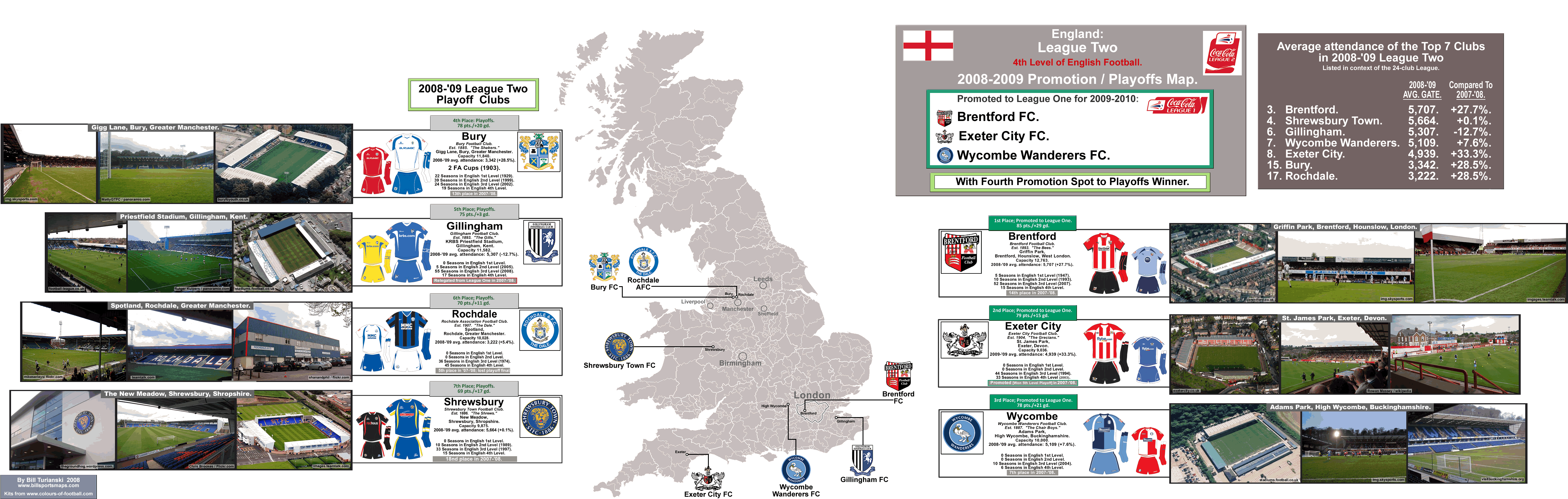
The top 7 clubs in the 2008-2009 English Football League Two season are shown on the map.  The three promoted clubs,  Brentford FCExeter City FC,  and Wycombe Wanderers FC,  are shown on the right.  The four playoff clubs competing for the fourth promotion spot are shown on the left.  

On the upper right,  there is a list of the 7 clubs’ average attendance this season.

League Two champions Brentford had the third highest average attendance in the league,  at 5,707 [for the full list of League Two attendances, {click here}].   This club,  from the London Borough of Hounslow,  had it’s heyday in the 1930′s,  when the Bees reached the First Division (in 1933) and two years later finished in 5th place (in 1935-’36).  Brentford ended up having a 5-season run in the English top flight,  and had a peak average attendance of 25,768 in 1946-’47  (this was the first English Football League season following World War II,  and there were dramatic attendance increases throughout the country).  But by 1962,  Brentford had dropped to the old Fourth Division.  Since then,  the club has largely stayed in the 3rd and 4th Levels.  In the last 20 seasons,  the Bees have spent 3 seasons in the 4th Level,  16 seasons in the 3rd Level,  and 1 season in the 2nd Level.  That was in 1992-’93,  when Brentford drew 8,456 per game.  Griffin Park is Brentford’s home.  It is a compact ground with a pub on each corner.

Exeter City has won promotion two straight seasons now.  The club,  from the League football-deficient West Country,  have never risen higher than the 3rd Level,  so the Grecians return to this level next season makes for some heady times in this corner of Devon.  I can’t be certain,  due to the lack of lower league attendance figures prior to 1990,  but the club seems to have had their best season ever at the turnstiles,  with a 4,939 average gate.  Exeter’s best gate figures from 1989-’90 to 2007-’08 was when they won the Fourth Division in 1989-’90,  drawing 4,859 per game. 

Wycombe‘s form dipped in the last third of the season,  and the Wanderers backed into their promotion,  but that didn’t stop 9,625 from attending their final home match last Saturday (a 1-2 loss to basement-dwelling Notts County).

Gillingham‘s drop in gate figures (to 5,307 per game) can be attributed to their relegation from League One in 07/08,  but it must be noted that the club drew 9,600 last Saturday.  Shrewsbury Town had only a small increase at the turnstiles (to 5,664 per game) despite their good season,  because their gate figures from 07/08 had shot up,  as the club had just moved in to New Meadow.

Bury and Rochdale are two clubs from neighboring towns in the northern part of Greater Manchester  {see this map of Greater Manchester, here}.  Rochdale has spent 35 straight seasons in the 4th Level.  The Dale made it to the League two playoff final last season,  losing to Stockport County.  Bury,  known as the Shakers,  were in the 2nd Level as recently as 1999 (when it was called the Nationwide League Division One).  The club drew 6,179 in 1997-’98.  But for years,  both these clubs’ fan bases have dwindled,  overshadowed as they are by the hugely successful and well-supported Manchester United,  and the hapless yet still decently supported Manchester City.  Two interesting things about Bury are that their Gigg Lane ground is also home to the 6th Level Non-League club FC United of Manchester;  and the fact that Phil and Gary Neville’s father Neville Neville was a fomer chairman of Bury FC,  and still works for the club as a non-paid jack-of-all trades,  at Gigg Lane.

Here are the match-ups for the playoff semi-finals…

Rochdale v. Gillingham, Thursday 7 May;  Gillingham v. Rochdale, Sunday 10th May.   Both these matches are on Setanta. (!).

Shrewsbury Town v. Bury, Thursday 7 May;  Bury v. Shrewsbury Town, Sunday 10 May.

Thanks to  Colours of Football site {click here}.

Thanks to Tony’s English Football Site for the gate figures{click here}.   Thanks to EFS site, for older gate figues {click here}.   Thanks to the Footy-Mad sites,  for their invaluable league history sections on each club {click here (set at Bury FC League history)}.

Thanks to the Colours of Football site,  for the kits {click here}.

Thanks to the Brentford FC site {click here}.   Thanks to Sky Sports {click here}.   Thanks to www.TeamTalk.com .   Thanks to www.Stadiums.Football.co.uk .   Thanks to www.VisitBuckinghamshire.org .   Thanks to www.ExeterCity.co.uk .   Thanks to MattyGTFC @ Panoramio.com {click here}. .   Thanks to www.BuryFCyouth.co.uk .  

Thanks to Mike Serieys @ Flickr.com {click here}. .   Thanks to shanandphil @ Flickr {click here}.   Thanks to http://www.football-league.co.uk/ .   Thanks to Rutger Kuipers @ Panoramio.com {click here}.   Thanks to http://www.thegroundhog.wordpress.com .    Thanks to Chris Brookes @ Flicker.com {click here}. 

Thanks to the contributors to the pages at Wikipedia {click here (set at Brentford FC page)}.

May 4, 2009

Brazil, 2009 Campeonato Serie A: the 20 Clubs.

Filed under: Brazil,Zoom Maps — admin @ 4:50 pm

brazil_zoom-map2009campeonato-serie-a_2post.gif


Defending champions are Sao Paulo,  who have won the last three Brazilian titles.   On the map,  on the far right,  I have listed the final table for 2008,  including the four relegated clubs,  the four clubs promoted from Série B,  and the 5 clubs which qualified for the 2009 Copa Libertadores.  All 5 of these clubs,  incidently,  have advanced to the Knockout Round (of 16) in the Copa… Sao Paulo FCGremioCruzeiroPalmeiras,  and 2008 Copa do Brazil winner (and 11th place league finisher) Sport Recife.

Of the 4 promoted clubs,  by far the most popular are SC Corinthians.  This massively supported Sao Paulo club will feature former Cruzeiro,  PSV Eindhoven,  FC Barcelona,  Internazionale,  Real Madrid and AC Milan striker Ronaldo.  And on a personal note,  one of my favorite players,  Andres D’Alessandro {Wikipedia profile, here},  returns for another spell at Internacional.  D’Alessandro,  a crafty midfielder,  was very instrumental in helping Portsmouth FC avoid relegation in the spring of 2005,  and I have kept an eye on him since.  And speaking of the oft-overlooked Porto Alegre club SC Internacional,  here is a nice blog on the club that I just discovered,  run by a Welsh futbol fan… http://Internacionaluk.blogspot.com/ .    

The 2009 Campeonato Brasileiro Serie A season begins on Saturday,  May 9th.  Here are the fixtures {click here (Data.7m.cn site);  (ESPN Soccernet, click here)}

Thanks to the contributors to the pages at Wikipedia. {Click here for the page on Campeonato Brasileiro Série A 2009}.

May 2, 2009

2009 Copa Libertadores, Knockout Stage, map of the 16 teams and their home stadiums; and the third installment of the tournament map.

Filed under: Copa Libertadores,Football Stadia — admin @ 6:59 am

cop-libertadores09_knockout-stage_post.gif


The Knockout Stage begins with the round of 16.  Teams are matched up according to results in the group stage.  The two-legged match-ups will be played on May 6 and May 13.  Here are the remaining 16 teams’ seeds, the match-ups,  and the bracket {click here}.   All 5 Brazilian teams have advanced.  There are no Colombian or Bolivian teams left in the competition.

Click on the title below for the other map…

copa-libertadores09_knockout-stage_16teams_continuation-of-initial-map_.gif

The two Mexican teams have a problem on their hands.  {See this, “Swine Flu Hits Copa Libertadores”, from The Offside.com}.

Thanks to Switch Image Project site for some of the jerseys (Boca Juniors, Palmeiras,  and Chivas Guadalajara jerseys)  {click here (set at Jan. 22, 2009 Club Deportivo Guadalajara Chivas 2008-09 kits}.   Thanks to the Sport Recife fans’ site called Meusport {click here (translated)}.   Thanks to the Cruzeiro fans’ site http://crufotos.wordpress.com/ .   Thanks to the Sao Paulo FC site Tricolormania {click here (translated)}.   Thanks to MuyBoca.com,  a Boca Juniors blog (translated) {click here}.   Thanks to Caracas FC site [I was unable to get a translation] {click here}.   Thanks to Sportfactory.Mediotempo.com,  and this thread {click here (Estadios Copa Libertadores 2009)}.   Thanks to GolazTropical.com.py , a Paraguayan sports site (translated) {click here}.   Thanks to http://deportivocuenca.blogspot.com/ .   Thanks to http://www.Cuencanos.com ,  for the elusive Deportivo Cuenca 2009 jersey photo {gallery at Flickr.com,  here}.

Thanks to the nice French site Chasseuer De Stades [which Babel Fish translated as 'hunter of stages',  but it's a site about football stadiums across the globe],  {click here}.

Thanks to GaloDigital {click here}.   Thanks to Flickr.com {click here .   Thanks to Panoramio.com {click here}.  

Thanks to World Stadiums.com {click here}.   Thanks to FussballTempel.net (German site on football stadiums) {click here}.   Thanks to the Onionbag.com {click here}.   Thanks to Futebol & Negócio {click here}.   Thanks to Minube.com (travel site) {click here}.   Thanks to Skyscrapercity site,  and this thread {click here (Estadios Peruanos III)}.

Finally,  thanks to the contributors to the pages at Wikipedia {click here (set at Copa Libertadores 2009 page)}.

April 29, 2009

England: 2008-09 Conference (aka Blue Square Premier League): the Promoted Club and the 4 Clubs in the Playoffs.

Filed under: 2008-09 English Football,Eng-5th level,Football Stadia — admin @ 12:53 pm

conference_aka-blue-square-premier-league_2009playoffs-and-promoted-club_post.gif


The 2008-’09 Conference season went down to the wire.  Burton Albion just held on to win the league and gain the sole automatic promotion.  Burton’s form had plummeted following ex-manager Nigel Clough’s January exit.  It will be the Staffordshire club’s first-ever appearance in the Football League.  The town of Burton upon Trent did once have League representation,  though,  from 1892 to 1910,  with Burton Swifts and Burton United.  BSFC merged with Burton Wanderers to form BUFC, in 1901,  but the club folded in 1910.  

Burton Albion were formed in 1950.  The club was promoted from the 6th Level Southern League,  to the Conference,  in 2002.  They moved into the all-mod-cons Pirelli Stadium in 2005.  This ground has a capacity of 6,500,  2,000 of which is seated.  Burton upon Trent is located in Staffordshire,  38 km. (23 miles) north of Birmingham.  It sort of sits on the divide between the East Midlands and the West Midlands.  The town’s population is 61,000 (2001 estimate),  and is best known for it’s brewing heritage.  It is currently home to 5 brewers {see this}.  So one can see why the club is called the Burton Albion Brewers.

Four clubs will battle for the second promotion spot.  The four playoff clubs are a good representation of the rather wide variation of clubs in the 5th Level these days.  Two clubs,  Torquay United and Cambridge United,  boast League history. 

Cambridge United have spent 35 seasons in the League,  including 9 seasons in the 2nd Level.  CUFC were relegated out of the League,  to the Conference,  in 2005.  The club boasts a decent sized fan base, and had the second highest average attendance in the Conference in 08/09,  drawing 3,410 per game.  The highest average attendance CUFC attained was in 1991-92,  when they began their last, 2-season spell in the old Division One (the 2nd Level),  and drew 7,084 per game to the Abbey Stadium.  This was the Cambridge United that featured in the influential book Fever Pitch,  by Nick Hornby. 

Torquay United spent 73 consecutive seasons in the League,  but were never able to get higher than the 3rd Level.  They were relegated in 2007,  and made the playoffs last season,  losing in the final to Exeter City.  The club had a good FA Cup run this season, making it to the Fourth Round.   {see this post I made in January,  which includes a Torquay United gallery}.

One club, in the ’09 Conference playoffs,  Histon,  is a little over 100 years old,  but has never been higher than this level,  and this is just their second season in the Conference.  The club is located just a couple miles outside of Cambridge.  Their Bridge Road ground is the second-smallest ground in the League (Lewes’ ground was smaller, but they are going back down to the 6th Level in 09/10).   

The fourth club in the Conference playoffs,  Stevenage Borough,  were formed relatively recently (in 1976),  but have been trying for 15 years to get into the promised land of the League.  [Note: Wikipedia has the wrong 08/09 home jersey design for SBFC; I would try to get it changed if I knew how, but it's pretty late in the season anyway.]  Stevenage Borough were denied entrance to the League in 1993-’94),  when they won the Conference,  because their ground was not up to standards.  Now Broadhall Way is one of the best grounds in Non-League football.  Stevenage is in Hertfordshire,  43 km. (27 miles) north of London.

As far as average attendance goes,  four of the top 8 drawing clubs in the Conference are on this map.  Histon is the exception,  and as they are near the bottom of the attendance list,  the small club from the village of Impington can be seen as a club punching above their weight.  But considering how Histon beat Leeds United in the FA Cup earlier this season,  no one should be surprised if Histon advance in the playoffs.

Blue Square Premier League average attendance,  2008-2009 season {click here  (ITV.stats.football) }.   [Note: the top list is by percent capacity; the second list is by average.]    For the second straight season,  the highest-drawing Conference club was Oxford United.  Had it not been for a five-point deduction for roster irregularities,  Oxford would be in the playoffs right now,  as the chairman groused about Monday {see this (BBC)}.  Then he apoligized for calling the Conference “poxy”  {see this}.  He should realize that no club is too big for any league,  something Leeds United fans,  and maybe,  Newcastle United fans,  will need to come to grips with.

-

The Conference playoffs begin Thursday, 30th April,  with Stevenage Borough v. Cambridge United.  The other match-up features Torquay United v. Histon,  on Friday, 1st May.  The second leg of both match-ups is on the following Monday, 4th May.  The final will be at Wembley, date TBD.

-

While on the subject of Non-League football,  there is one story that should not go unmentioned…the fourth promotion in seven years for AFC Wimbledon  {see this article,  by David Conn in the Guardian.co.uk site}. 

-

Thanks to Tony’s English Football site for gate figures and fixtures information {click here}.   Thanks to the contributors to the pages at Wikipedia {click here (set at Conference National page)}.   Thanks to BoroGuide.com {click here},  for the information on the 08/09 kit.   Thanks to Flick.com {click here}.   Thanks to Panoramio.com {click here}.   Thanks to the Geobytes site,  for their City Distance tool {click here}.   Thanks to the footy-mad site,  for League history of clubs {click here}.  Thanks to Jeremy at Albion Road site {click here},  for finding the first site last Sunday that had the Conference playoffs schedule  (at Tony’s English Football site,  of course). 

Thanks to VirtualGlobetrotting {click here}.  

April 26, 2009

MLB Ball Clubs and their Minor League Affiliates: the Philadelphia Phillies.

Filed under: Baseball Clubs/Farm Teams — admin @ 2:03 pm

philadelphia_phillies_mlb_nl-east_with-minor-league-affiliates_post_d.gif


Below:  Philadelphia Phillies Auxillary Chart,  featuring selected uniforms and logos from the history of the Philadelphia Phillies franchise…established in 1883 as the Philadelphia Quakers (1883-1888);  Philadelphia Phillies (1889-2009).
 philadelphia_phillies_auxillary-chart2009_segment_b.gif

-
Philadelphia Phillies page at Sports E-Cyclopedia {click here}.

Thanks to the National Baseball Hall of Fame’s “Dressed to the Nines” site,  featuring baseball uniforms templates drawn by Marc Okkonen {click here (set at Phillies 1945-1953)}.   Thanks to Chris Creamer’s Sports Logos Page {click here}.   Thanks to MLB shop {click here}.   Thanks to the Minor League Baseball site {click here}.   Thanks to Dugout Memories/ Cooperstown Gifts {click here}.   Thanks to Mitchell & Ness {click here}.   Thanks to the Phinally Philly site, for the image of the Harry Kalas memorial patch {click here}.   

Thanks to the contributors to the pages at Wikipedia {click here (Philadelphia Phillies page)}.

April 22, 2009

J. League, 2009: the 18 teams in J.1, with 2008 final table chart.

Filed under: Japan — admin @ 12:37 pm

j-league2009_post.gif 


J. League, J.1 Table {click here (ESPN Soccernet)}.   The Rising Sun News site (‘A Celebration of Football in Japan’)  {click here}.

Official J. League site (translated) {click here}.

Thanks to BigSoccer.com {this thread, here}.   Thanks to the contibutors to the pages at Wikipedia {click here (J. League page)}.   Thanks to Demis.nl {click here}.

April 19, 2009

MLB Ball Clubs and their Minor League Affiliates: the Pittsburgh Pirates.

Filed under: Baseball Clubs/Farm Teams — admin @ 6:54 pm

pittsburgh_pirates_mlb_nl-central_with-minor-league-affiliates_post2.gif


Below:  Pittsburgh Pirates Auxiliary Chart,  featuring selected logos and uniforms from the history of the Pittsburgh Pirates… Allegheny [no nickname],  established in the American Association (I) in 1882 (1882-1886 in the American Association);  Pittsburgh Allegheneys,  established in the National League in 1887 (1887-1890);  Pittsburgh Pirates (1891-2009).

pittsburgh_pirates_auxillary-chart2009_post.gif

Pittsburgh Pirates page at Sports E-Cyclopedia {click here}.

-

http://pittsburgh.pirates.mlb.com/pit/history/uniforms_logos.jsp

-

Thanks to Chris Creamer’s Sports Logos Page {click here}.   Thanks to the National Baseball Hall of Fame’s “Dressed to the Nines” site, featuring baseball uniforms templates drawn by Marc Okkonoen {click here (set at Pirates, 1971-1979)}.   Thanks to MLB shop {click here}.   Thanks to MiLB shop {click here}.   Thanks to Fans Edge site {click here}. 

Thanks to the contributors to the pages at Wikipedia {Pittsburgh Pirates page, click here}.

April 16, 2009

Major League Soccer, 2009.

major-league-soccer2009_post.gif


MLS Major Trophy Winners, {click here}.

MLS week 4 power rankings,  from The Offside.com {click here}. 

Thanks to ProSoccer.com Ultimate Soccer Store {click here}.   Thanks to MLS Gear.com {click here}.   Thanks to the contibutors to the pages at Wikipedia {MLS Page,  here}.

April 13, 2009

MLB Ball Clubs and their Minor League Affiliates: the St. Louis Cardinals.

Filed under: Baseball Clubs/Farm Teams — admin @ 4:04 pm

st-louis_cardinals_mlb_nl-central-with-minor-league-affiliates_post_2.gif

Below:  St. Louis Cardinals Auxiliary Chart, featuring selected uniforms and logos from the history of the St. Louis Cardinals franchise…established in the National League in 1892 as the St. Louis Brown Stockings (I) (1892-1898)/ St. Louis Perfectos (1899)/ St. Louis Cardinals (1900-2009).

st-louis_cardinals_auxillary-chart_segment_b.gif

St. Louis Cardinals page at Sports E-Cyclopedia {click here}.

Thanks to the National Baseball Hall Of Fame’s “Dressed to the Nines”site, featuring baseball uniforms templates drawn by Marc Okkonen {click here (set at St. Louis Cardinals, 1939-1947)}.   Thanks to the MLB shop {click here}.   Thanks to the MiLB shop {click here}.   Thanks to CBS Sports store {click here}.   Thanks to the contributors to the St. Louis Cardinals page at Wikipedia {click here}.

April 7, 2009

Major League Baseball, 2008 attendance map.

Filed under: Baseball,Baseball >paid-attendance — admin @ 5:23 pm

mlb_08attendance_map_post.gif


Please note: to see the most recent MLB paid-attendance map-and-post, click on the following: category: Baseball >paid-attendance.

On the map,  each MLB team’s 2008 average attendance is listed on the far right.  On the map itself, each ball club’s cap crest is sized to reflect their 2008 gate figures.   Last season’s overall attendance was the second highest ever,  at 32,516 per game, 1.4% behind the record-setting figures of 2007.

Here are the top 5 drawing ball clubs from 2008, and their gate figures from five seasons before, in 2003…

[One note...In 2008, the Boston Red Sox drew to 104.0% capacity, and the Chicago Cubs drew to 99.1% capacity  {capacity-based 2008 gate figures , here}.  Both these ball clubs have smaller sized parks than the top 5 teams listed below.  Of course,  much of the charm of Boston's Fenway Park and Chicago's Wrigley Field is just this intimate (and well-aged) atmosphere,  so it is sort of pointless to debate whether these two clubs would be pulling in top-5-drawing-ball-club numbers if their parks were bigger.  Because if their parks were bigger,  the two ball clubs wouldn't be playing in Fenway and Wrigley, but rather in new ball parks, because there is basically no room for significant expansion at both sites. And both the Red Sox and the Cubs would be crazy to move out of these priceless landmarks.]

1. New York Yankees. 2008: 53,069 per game / 2003: 42,785 [1st highest].  I remember going to Yankees games in the early 1990′s, when there would never be more than 25,000 on a weekday game. In 1990 , the Yankees averaged 24,771 per game. After the New York Yankees’ dominance of the 1996-2000 period (with 4 World Series Titles and 4 AL Pennants in 5 years), the crowds swelled.  By 2000,  the Yankees were averaging 38,193. There followed average gates of 40,811 (2001), 43,323 (2002), 42,263 (2003), 46,609 (2004), 50,502 (2005), 52,445 (2006), and 52,729 (2007).

The Yankees’ on-field failures in the latter part of the last five seasons have not in the least affected their gigantic crowds, but of course the gate figures will go down this season only because the new Yankee Stadium has a smaller capacity. Yankee Stadium (II) seats 52,325, around 4,100 less than the final capacity of  the old Yankee Stadium.  Compare this to the situation in the late 1980′s and early 1990′s.  After the Yankees great run in the late 1970′s and early 1980′s,  the organization started spending unwisely on a revolving door of over-the-hill players and/ or players unable to handle the full-glare media presence in New York City. The team underachieved for years, and fans just stopped showing up. People like to be associated with a winner. Of course, the Yankees did make the playoffs every season from 1995 to 2007,  and in comparison,  the Yankees did not make the playoffs from 1982 to 1994.  So even if the team plays in the most populous metropolitan area in the USA, the sparse crowds of the 1980′s and early 1990′s are understandable. 

The new stadium probably assures attendances won’t fall off, even if the Yankees continue to fall short of a successsful season…except for one crucial factor. That is the combination of increased ticket prices coming at a time of a severe economic downturn.  I guess we’ll see. One thing should be remembered: even in the Yankees’ greatest eras, their attendance was not as good as it has been in the last 12 years.

When Roger Maris hit his 61st home run on the last day of the 1961 season, there were just 23,154 in attendance (the Yankees averaged 21,577 that year, and that was a championship season). 

Many call the 1927 Yankees (featuring Babe Ruth, Lou Gehrig, Bob Muesel, and Tony Lazzeri, aka “Murderers’ Row” {see this}) one of the (if not the ) greatest-ever baseball lineups.  Average attendance in Yankee Stadium in 1927 ?  15,117 per game {see this, from Baseball-Reference.com}. OK, granted, the bulk of home games then were during working hours, and NYC was far less populous than today. But still.

In 1978, the World Champion Yankees drew merely 28,855 per game en route to their second straight title. The Yankees’ highest gate figures through the 1970′s and 1980′s was in 1980, when the AL Pennant winning Yankees drew 32,437 per game.  So when was the Golden Age of Baseball? If you measure that by gate figures, we’re living in it. 

Here is Wikipedia’s page on the new Yankee Stadium {click here}.

2. New York Mets. 2008: 51,165 / 2003: 28,406 [16th highest in MLB]. In 2001, the year after the Mets last won the NL Pennant, the ball club drew 32,818 per game. Their average gate then shrunk by over 4,000 to 28,406 by 2003. This was in the bottom half of the league, at 16th highest. But the franchise turned this around mainly by improving their squad… By 2007, with their new crop of players coming into their own and bringing excitement to the dreary, unfriendly and jet-flight-path-cacaphonous confines of Shea Stadium (the place sucked,  basically), the crowds for Mets games increased dramatically (41,723 per game in 2006; 47,580 per game in 2007). And two straight seasons of choking in September will not hurt the gate figures this season. Nevertheless, the figures will go down, because like their cross-town rivals, the Mets are moving into a shiny new ball park with a smaller capacity. But it seems to me the Mets made their new park a bit too small.  Citi Field will seat just 42,000, which is 15,000 less than Shea Stadium, and 9,165 less than what the Mets drew last season. Maybe it won’t matter, and gate figures will start falling anyways, if the divided-by-cultures (Anglo players vs. Latin players) Mets team continues to meltdown when it matters most.  Here is a nice article about how crucial the 2009 season is for the Mets, by ex-Deadspin.com editor Will Leitch, from the March 15, 2009 edition of New York Magazine  {click here}.

3. Los Angeles Dodgers. 2008: 46,056 / 2003: 38,748 [4th highest]. A couple years ago, there was talk about how the Angels were starting to challenge the Dodgers for fan-base supremacy in southern California. But the Angels, as improved an organization as they are in the last decade, will probably never outdraw the Dodgers. Dodger Stadium is simply an incredible place. The entire stadium is re-painted every off-season, it is perpetually spic-and-span, and it is home to a ball club with as much tradition, history, and (eventual) success as any in the baseball world. And the voice of the Dodgers is the venerable and mellifluous Vin Scully. My brother told me about a Dodgers blog he came across called Vin Scully Is My Homeboy {click here}, which pretty much answers the question of whether the LA Dodgers will be able to tap into the ever-growing Latino baseball fan market, now that the Angels are owned by a Latin American.

4. St. Louis Cardinals. 2008: 42,353 / 2003: 35,930 [7th highest]. Speaking about first class organizations and huge fan bases, the Cardinals have drawn over 30,000 per game in 21 of their last 24 seasons. In the late 1970′s they were stagnating, though, and drew only 17,101 per game in 1980. The Cardinals won their ninth World Series title two seasons later, in 1982, and drew 26,073 per game that year. By 1985, the NL Pennant winning Cardinals were drawing 32,563 per game. Since then, the only years the ball club has drawn below 30,000 per game were in 1991 and 1992, when they drew in the 29,000′s; and in the strike-shortened 1995 season, when manager Joe Torre was fired midway through the season and the team finished 62-81 (the Cardinals drew 24, 344 per game that year). The next season, 1996, current manager Tony LaRussa took over, and the team’s fortunes and gate figures began their ascent. It is ironic to consider that the Cardinals had their worst recent year at the gate when Joe Torre was in charge, since Torre was the man who managed the Yankees to their last 4 Titles and shepherded the Bronx ball club into their most lucrative period ever. 

But getting back to St. Louis…their huge fan base has only gotten bigger after the opening of Busch Stadium (III) in 2006 {see the stadium’s page on Wikipedia, here}, and their surprise World Series title later that year. It was a surprise because that Cardinals team had peaked 2 seasons earlier, and at just 83-78, the 2006 Cardinals squeaked into the playoffs, where they shocked the Mets (who have never recovered) thanks to a late 7th game home run by weak hitting catcher Yadier Molina {recap, here}. The Cardinals, now veterans of the post-season grind, then used that momentum to dismantle the upstart Detroit Tigers in the Fall Classic, 4 games to 1. The 2006 St. Louis Cardinals became the team with the least amount of victories to ever win the World Series; it is their 10th World Series title, second to only the New York Yankees 27 World Series Titles.

5. Philadelphia Phillies. 2008: 42,254 / 2003: 28,973 [14th highest in MLB].  The Phillies went through decades of futility sprinkled with periods of disappointment, with only one World Series title (in 1980) in over 120 years of existence.  But last October, they buried a good deal of that negativity by bestowing the city of Philadelphia with it’s first major league sports title in 30 years. There are three factors which contributed to the Philadelphia Phillies’ near-100% capacity gate figures last year. First off, the club has had 7 out of 8 winning seasons since 2001.  Secondly, the city has always boasted committed (if ill-mannered) fans. And third, the Phillies moved into a new ball park in 2004 {Citizens Bank Park page at Wikipedia, here}.

The Phillies were drawing in the 30,000′s in the years leading up to their first championship in 1980. But the large crowds fell away as the years went by after that, and the franchise reached a level of mediocrity in a god-awful ugly Veterans Stadium that moldered in it’s concrete-encased,  plastic-turf covered gloom.  Te hugely entertaining NL Pennant winning Phillies of 1993, led by such colorful characters as John Kruk,  Mitch Williams,  and Kurt Schilling, produced a two-year spike in gate figures, with the ball club pulling in 38,737 per game in 1993. The next season showed almost the same figures, but by 1997, the ball club was in the basement, and the average gate was only 18,403.  The Phillies’ record improved in the years from 1998 to 2003 on a generally uphill progression, and the gate figures improved too, but not drastically, with the high point here being the last year in Veterans Stadium, 2003, with an average crowd of 27,901. 

Still that’s not half-bad for a horrible stadium,  perhaps the worst of it’s ilk,  which was the now-dreaded multi-purpose,  circular concrete stadium  {see this} {see this, on Veterans Stadium,  from BallParksOfBaseball.com site}. City planners thought they were pretty smart,  building stadiums for both their MLB and NFL teams. What they didn’t really look into was the fact that these stadiums were doomed to be lousy venues for both sports. 

These monstrosities plagued Major League Baseball throughout the 1960′s, the 1970′s, the 1980′s,  and into the mid-1990′s. There is little doubt, in retrospect, that this type of stadium began depressing baseball attendance figures by the mid 1980′s, when these stadiums began to age in a rather ungraceful way, and baseball fans began wondering why they weren’t being allowed to see their city skylines hidden behind a wall of usually empty outfield seats.  So much of the whole attraction of going to a ball game is the unique aspect of each ballpark, a factor which was eliminated by these multi-purpose behemoths. Sight lines were bad, and the seats were invariably too far away from the action on the field. And they were freaking ugly. In the multi-purpose heyday, circa 1985 or so,  about 40% of MLB cities were afflicted by these concrete purgatories…San Francisco, Oakland,  San Diego, Seattle, Houston, St. Louis, Minneapolis, Cincinnati, Pittsburgh, Atlanta, Montreal, and New York (the Mets’ Shea Stadium). The only two that remain are the Minnesota Twins’ Metrodome, and the Oakland Athletics’ Oakland-Alameda County Stadium; and the Twins will be moving into a new, suitably retro-themed open-air ballpark called Target Field, next year {see this}. 

Oakland’s situation, though, is fraught with difficulties. When the NFL’s Raiders moved back to Oakland from Los Angeles (in 1995), the stadium got a Frankenstein makeover that left the Athletics fans behind home plate having to stare at a Death-Star-like structure looming behind center field, a sheer wall of nose-beed football seats that was soon dubbed “Mount Davis”, after the Raiders’ Mephistophelian owner, Al Davis {see this}. Something tells me this issue will never go away, and the A’s will have to move to Sacramento or Las Vegas, or learn to live with Mount Davis.

-   

All baseball fans owe a huge debt to the Baltimore Orioles organization of the early 1990′s, which oversaw the creation of the trailblazing Oriole Park at Camden Yards {see the ball park’s page at Wikipedia, here}. Since then 11 MLB franchises have followed suit by building similar asymetrical ballparks which a) maintain a traditional feel,  while b) being coupled with modern amenities {see this list}. And which have nothing to do with the damn NFL.

Thanks to ESPN for the attendance figures {click here}.  Thanks to Baseball-Reference.com for attendance figures from earlier seasons {click here (set at 1990)}.   Thanks to the contributors to the pages at Wikipedia {MLB page, here}

« Newer PostsOlder Posts »

Powered by WordPress