billsportsmaps.com

September 7, 2009

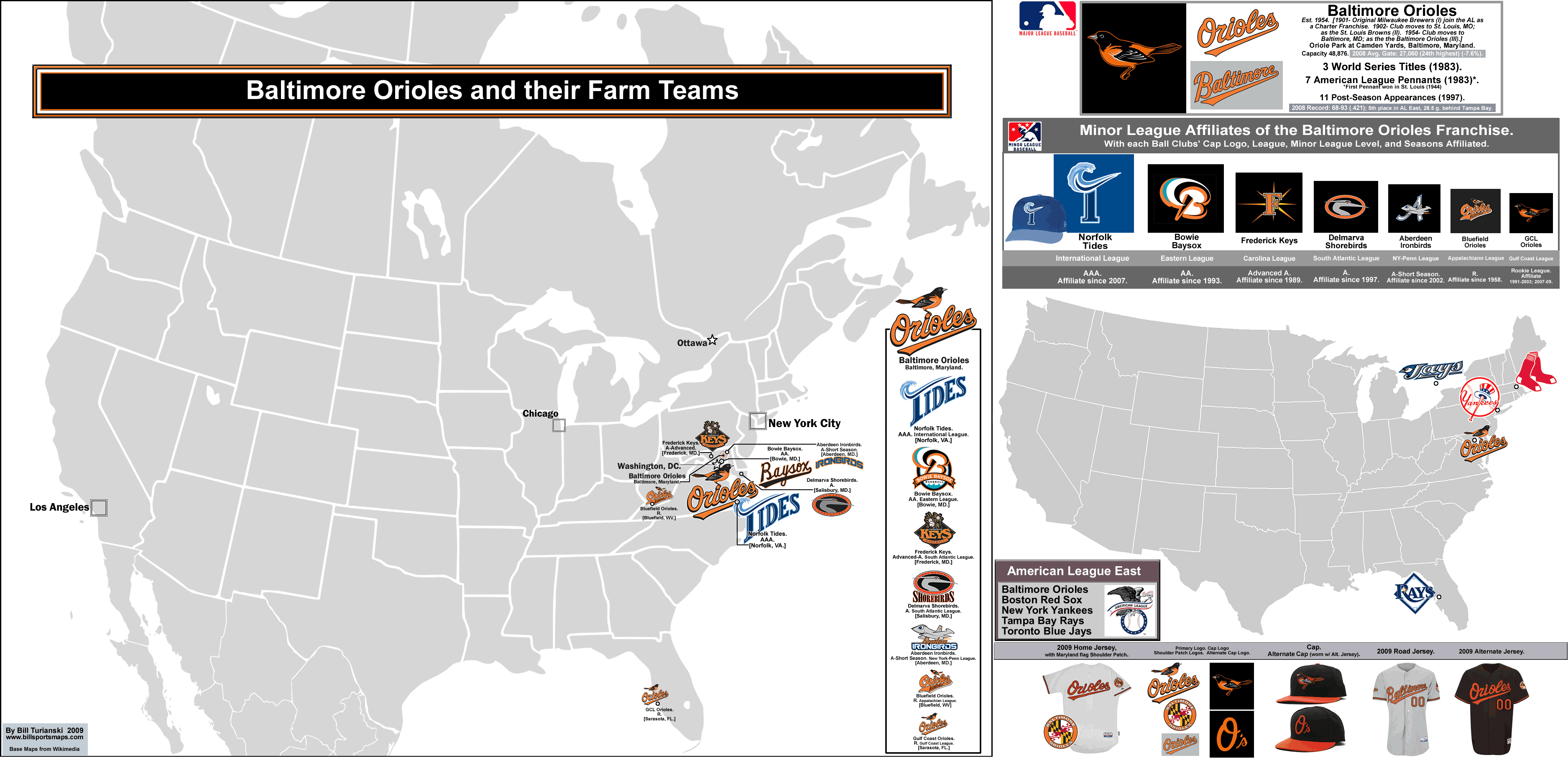
MLB Ball Clubs and their Minor League Affiliates: the Baltimore Orioles.

Filed under: Baseball Clubs/Farm Teams — admin @ 4:34 pm

baltimore_orioles_mlb_al-east_with-minor-league-affiliates_post_d.gif


Below : Baltimore Orioles Auxiliary Chart,  featuring selected uniforms and logos from the history of the Baltimore Orioles franchise,  established in 1894 in the minor league Western League (I),  as the Milwaukee Brewers (I) / in 1901 as a charter member of the major league American League,  as the Milwaukee Brewers (I) / St. Louis Browns (II) (1902-1953) / Baltimore Orioles (III) (1954-2009).

baltimore_orioles_auxillary-chart2009_segment.gif

Baltimore Orioles team history with photos,  at the Sports E-Cyclopedia site {click here}.

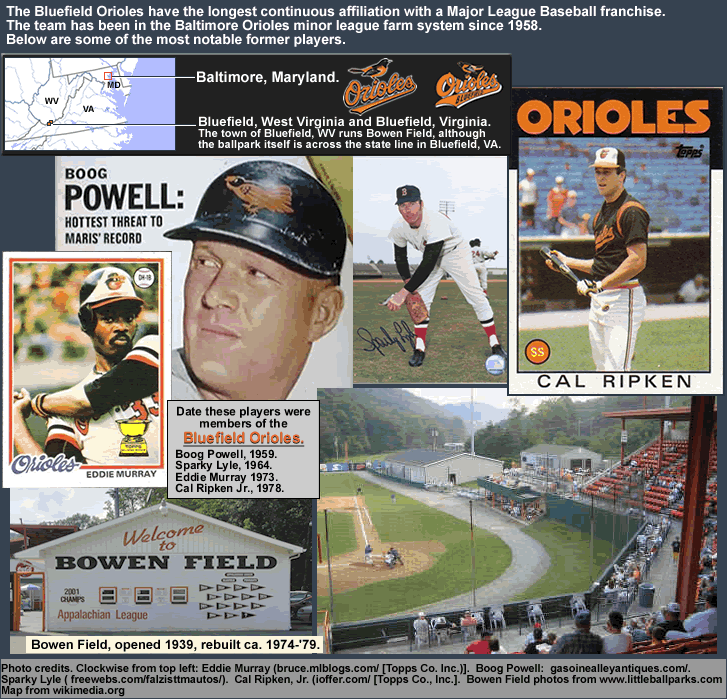
The Bluefield Orioles have the longest running affiliation with the same MLB franchise.  This is the 52nd year that Bluefield has been part of the Baltimote Orioles farm system.   Here is an article about the history of baseball in Bluefield,  from MinorLeagueBaseball.com {click here}.  Here is the Bluefield Orioles’ ballpark,  Bowen Field, capacity 3,000 {click here (Bluefield page)} {@ http://www.LittleBallParks.com.}. 

The Bluefield Blue-Grays were a team that played in the Coalfield League in 1924 and 1925;  in the Blue Ridge League for two seasons;  and then joined the Class D Mountain State League.  A decade later,  the Blue-Grays’ championship season of 1938 led to the construction of a new ballpark,  Bowen Field,  in 1939.  The National League’s Boston Braves were Bluefield’s first MLB parent club,  sponsoring them from 1939 to 1953.  The Appalachian League was formed in 1954,  and the Bluefield Blue-Grays were a charter member.  The team changed their major-league affiliation three times during this era,  with the Washington Senators in 1954,  the Boston Red Sox in 1955 and ’56,  and the Brooklyn Dodgers in 1957.  The following year, 1958,  the Baltimore Orioles took over,  and the team became the Bluefield Orioles.

bluefield-orioles_bowen-field_boog-powell_eddie-murray_sparky-lyle_cal-ripken-junior.gif

Since 1958,  around 100 former Bluefield Orioles players have played in the big leagues,  including Don Baylor,  Mark Belanger,  Eddie Murray,  Sparky Lyle,  Boog Powell,  and Cal Ripken, Jr.  

Bowen Field was almost completely destroyed by fire in 1974.  It was rebuilt without the funds for seating,  and fans brought lawn chairs and blankets the first few seasons.  The belatedly installed seats were castoffs from the California Angels (when the Angels expanded their ballpark into a dual sport stadium in the late 1970s).  The Bowen Field ballpark site straddles the West Virginia/Virginia border,  and the field itself is actually in Bluefield, Virginia.

Thanks to the National Baseball Hall of Fame’s ‘Dressed to the Nines’ site,  featuring baseball uniforms templates drawn by Marc Okkonen {click here (set at Baltimore Orioles 1954-1962)}.   Thanks to MLB shop {click here}.   Thanks to Chris Creamer’s Sports Logos Page {click here}.   Thanks to the contributors to the pages at wikipedia {click here (set at Baltimore Orioles page)}.   Thanks to http://www.thebaseballcube.com/ .   Thanks to the fantastic site Little Ball Parks.com, Baseball Parks of the Minor Leagues {click here}. 

September 3, 2009

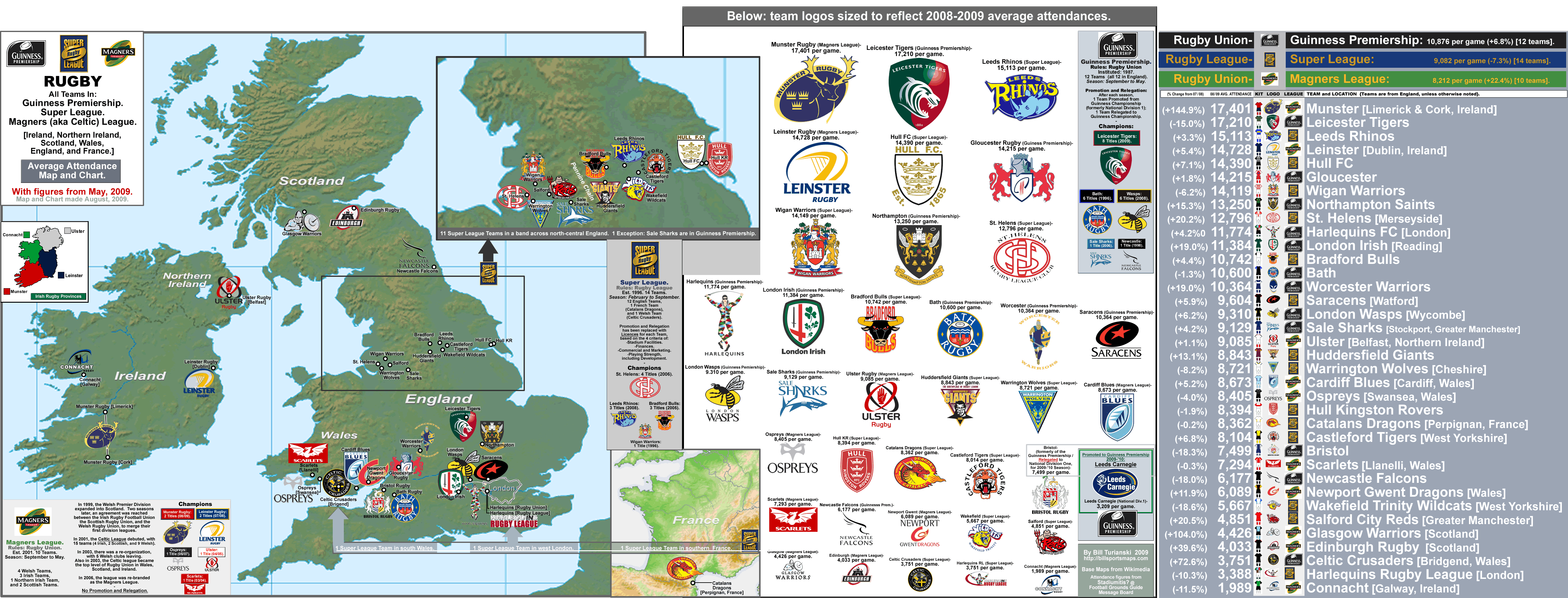
Super League XIV; Guinness Premiership 2009-10 and the Magners League 2009-10, with maps of each league, and attendance map of all 36 teams in top flight UK/Irish rugby.

Filed under: Ireland,Rugby,Rugby>England,Scotland,Wales — admin @ 6:25 am

rugby_post_b.gif


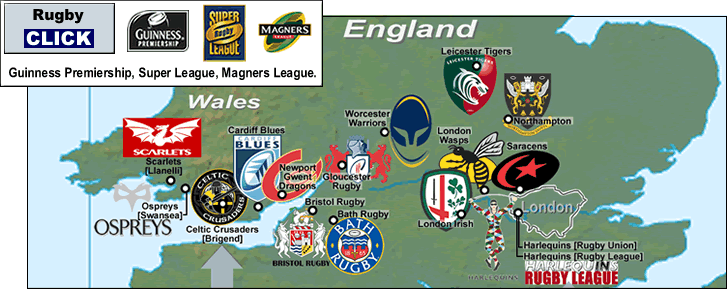
The first map shows all 36 teams in the three top rugby leagues of Great Britain and Ireland.  The maps for Super League XIV,  Guinness Premiership 2009-10,  and Magners League 2009-10 are further down in the post.  

Two of the three leagues shown on the map use the older Rugby Union code.  Super League uses the newer Rugby League rules

The Rugby Union code dates back to 1870 {see this}. The Rugby League code has its roots in the Great Schism, and the formation of the Northern Rugby Football Union in 1895 {see this: ‘The Great Schism’ (from RugbyFootballHistory.com)};  {see this: ‘History of rugby league’, from en.wikipedia.org}.}.   

In the late nineteenth century, the working class status of the majority of rugby players in the north of England necessitated an establishment of payment for the players (as well as compensation for injuries). The origins of many of the rugby players in the south of England were middle class and upper class, and many learned the game at the Public Schools (which were then and still are essentially private schools for the privileged). So there was less a need for player payment. The Rugby League / Rugby Union split can traced to this Victorian era class divide…in the north, poor working-class men playing the game, in the south, Public School graduates with little pressing need for salary augmentation, playing the game under the principles of amateurism. 

In 1892, charges of professionalism were made against rugby clubs in Yorkshire, specifically in Leeds and Bradford. By 1893, widespread suspensions of northern clubs and players began. In late August, 1895, in a meeting in Manchester, nine Lancashire clubs declared their support for their Yorkshire colleagues. Two days later, 29th August, 1895, representatives of 22 clubs met in Huddersfield, Yorkshire to form the Northern Rugby Football League. Included in these 22 clubs were 7 clubs that are currently in Super League XIV…Huddersfield, Hull FC, Leeds, St Helens, Wakefield Trinity, Warrington, and Wigan.

-

Rugby Union is more plodding, and utilizes scrums to restart the run of play {see this, ‘Playing rugby union’}.  Rugby League is faster and more wide-open {see this: ‘Rugby League’}. But Rugby League is the dominant game in just two areas of the world…in a swath of north-central England, and in Australia. 

Rugby League Code: Super League…

rugby-league_region-of-north-central-england.gif

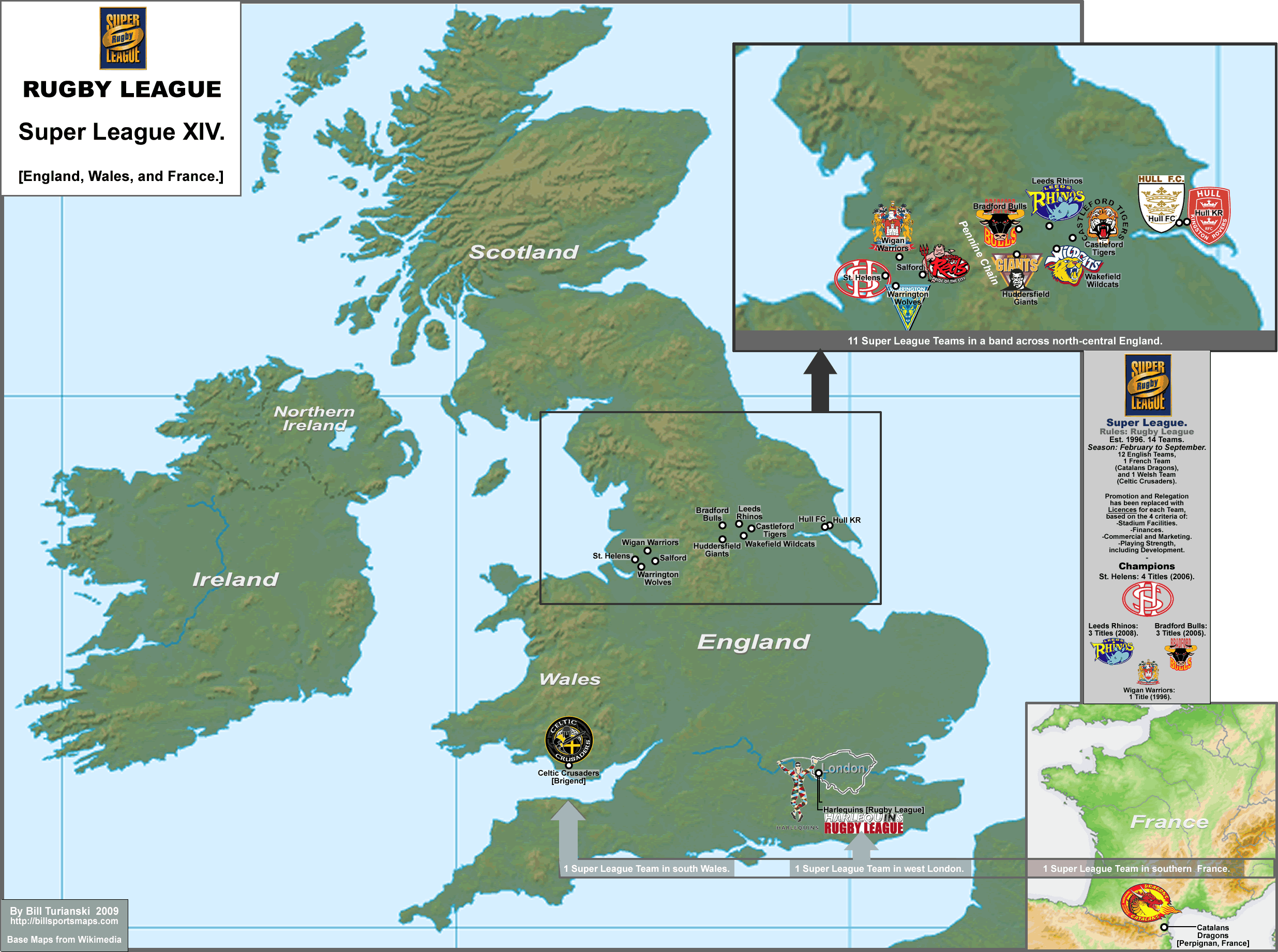
Click on the following title for Super League XIV map:  rugby_super-league-xiv___.gif

The parts of northern England where Rugby League is the dominant code are in a band which stretches from Merseyside, through Cheshire, Greater Manchester, and east across the Pennine Chain to West Yorkshire, and the East Riding of Yorkshire, centered on Hull. 11 of the 14 current teams in Super League are from this Rugby League-intensive swath of England. In this swath there is 1 team from Merseyside, just east of Liverpool (St Helens); [Editors note ca. 2014: now 2 teams currently from Cheshire incl. the re-instated Widnes Vikings] 1 team from Cheshire (Warrington Wolves); 2 teams from Greater Manchester (Wigan Warriors and Salford City); 5 teams from West Yorkshire (Huddersfield Giants, Bradford Bulls, Leeds Rhinos, Wakefield Trinity Wildcats, and Castleford Tigers); and 2 teams from Kingston upon Hull (Hull FC, and Hull Kingston Rovers).

There is one other team in Super League from England: Harlequins RL, who are based in west London. Although it had separate origins, since 2005 Harlequins RL has been a branch of the Rugby Union/ Guinness Premiership team Harlequins FC. Harlequins field a team in both rugby codes (as do Super League team Leeds Rhinos, with their Rugby Union team being Leeds Carnegie). 

The other two teams in Super League XIV are the Celtic Crusaders of Bridgend, south Wales, who joined Super League in 2008; and Catalans Dragons, of Perpignon, France (in the Catalonian area of southern France), who joined in 2006. [Note: Celtic Crusaders are now defunct, having been wound up in Sept. 2011.]. Super League was formed with the intention of being Europe’s top league in the Rugby League code, but having one team outside of Great Britain is as far as the league has got in that direction. The French team was originally Paris Saint-Germain RL , but thar poorly supported club went under in 1997.

In 2005, Super League replaced promotion/relegation with Licensing {see this}. There is a brief description of Super League Licenses on the map, in the sidebar.  Super League features a February to September playing season, unlike the traditional late summer/ fall/ winter/ early spring rugby season. 

The highest drawing teams in Super League are Leeds Rhinos, who averaged 15,113 per game in 2008;  Hull FC (14,390 per game);  Wigan Warriors (14,149 per game); and St Helens (12,796 per game). As a whole, Super League XIII averaged 9,082 per game. Here is the list of attendances that I used {click here (FootballGroundGuide.com Message Board thread, posted by frequent contributor Stadiumitis?)}

Super League has a large play-off format, with 8 teams qualifying each season . This system has been in place since 1998 {see this}, and culminates each season in the Grand Final.

Only four teams have won Grand Final Titles…St Helens 4 times; Leeds Rhinos and Bradford Bulls 3 times; and Wigan Warriors once, in the first final in 1998.   Leeds Rhinos were 2008 champions.

For the full list of Rugby League Champions (1895-’96 to 2008), {click here}.

http://www.superleague.co.uk/

For the 2009 Super League table {click here}.

For new expanded Super League play-off structure {click here (Sky Sports broadcast report from March, 2009}.

-

Rugby Union Code: Guinness Premiership…

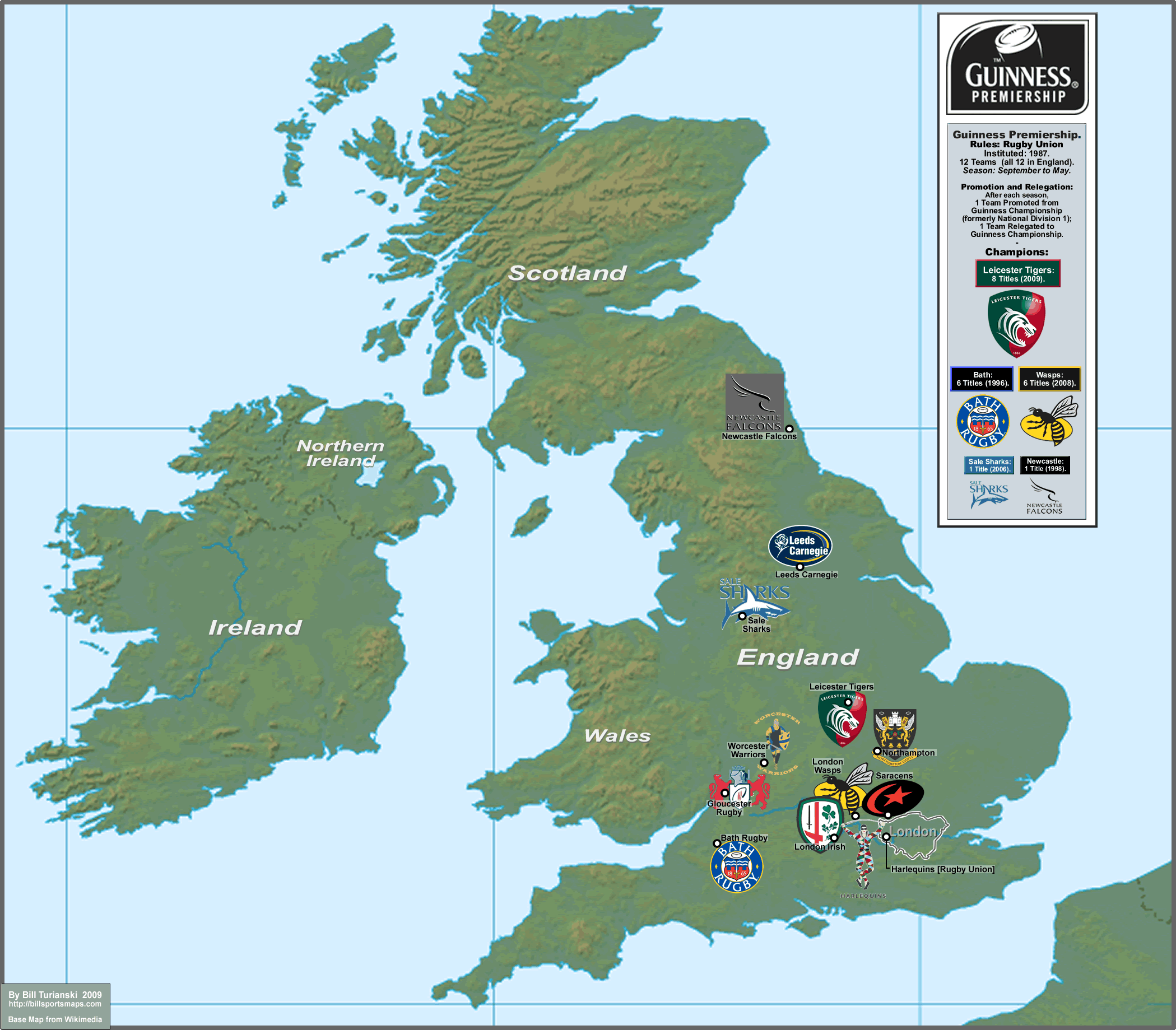
Click on the following title for Guinness Premierhip 2009-10 map: rugby_guinness-premiership2009-10_1.gif

 The Guinness Premiership is strictly an English affair.  Its roots are in the English Rugby Football Union’s decision in the early 1970′s to finally sanction a knock-out cup (which is now known as the Anglo-Welsh Cup {see this}. The pro game in England had been held back by the organizers fear that ‘dirty play’ would ensue if leagues were organized within English Rugby Union. By the mid-1980′s , national merit tables came into being (this being the first time Rugby Union teams’ success was quantifiably measured). In 1987, the Courage Leagues were formed. This was a pyramid system involving 108 leagues and over 1,000 teams. In 1994, Sky Sports started broadcasting games. In 1996, professional status began with the debut of the Rugby Union Premiership. In 2002-03, the champion was now determined by the Playoffs winner, instead of first place in the final league table. That season the title went to London Wasps, while Bath was winner of the now-secondary league table. Those two teams, London Wasps and Bath Rugby, both have won 6 Premiership Titles, they are second only to Leicester Tigers  who boast of 8 Premiership titles. Leicester also draws very well,  averaging around 17,000 per game. The only other teams with titles are Newcastle Falcons and Sale Sharks, both with 1 championship season. Incidentally, Sale Sharks are the lone Rugby Union team in the Rugby League region of north-central England. Gloucester has won the league table 3 times. Reigning champions are Leicester Tigers.

The Guinness Premiership has relegation and promotion, with last place being sent down to the Guinness Championship (formerly National Division One). It is the only one of these 3 leagues that has promotion/relegation in the strict sense. Leeds Carnegie have been promoted for the 2009-10 Guinness Premiership,  upplanting the relegated Bristol Rugby. 

The Guinness Premiership draws the highest crowds of the 3 leagues, averaging 10,876 per game in the 2008-’09 season. Highest drawing teams in 2008-09 were Leicester Tigers (17,210 per game); Gloucester (14,215 per game); Northampton Saints (13,250 per game); Harlequins RFC (11,774 per game); and London Irish, of Reading (11,384 per game). Five teams drew between 9,100 and 10,600 per game…Bath Rugby; Worcester Warriors;  Saracens,of Watford; London Wasps, of Wycombe;  and Sale Sharks, of Stockport, Greater Manchester. 

Guinness Premiership 2009-2010 season starts 4th September,  fixtures {click here (Official site)}

-

Rugby Union Code: Magners League…

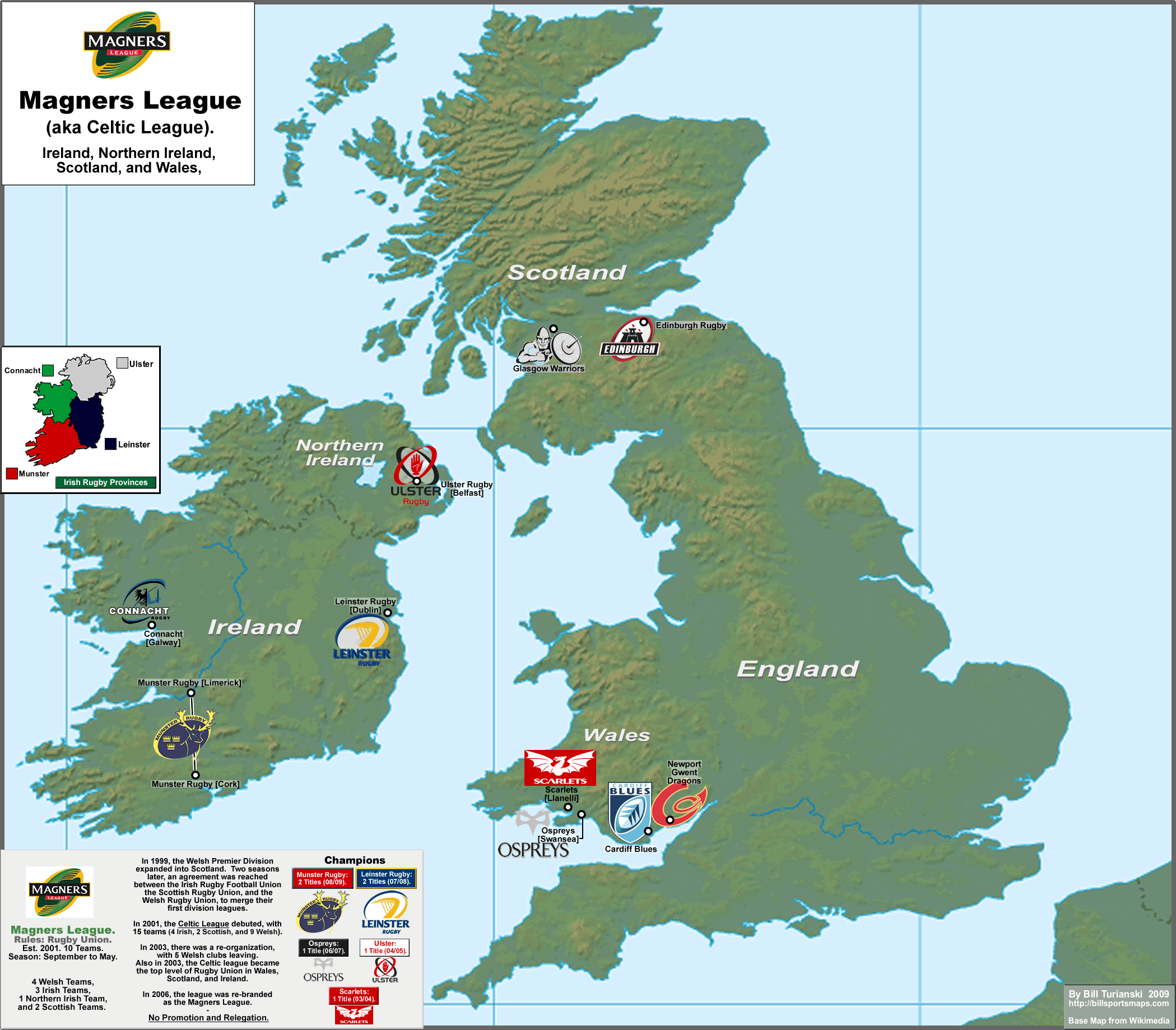
Click on the following title for Magners League map: rugby_magners-league09-10.gif

The Magners League is the top flight rugby league of Wales, Scotland, Ireland, and Northern Ireland. Its roots are in the old Welsh Premier Division. In 1999, Scottish teams joined, and in 2001, Irish and Northern Irish teams joined,  inaugurating the Celtic League. After a shake-up in early 2003, involving the demise of some of the Welsh teams, it was decided that the Celtic League would become the sole professional league in Wales, Scotland, Ireland, Northern Ireland. [The Welsh Premier Division is now a developmental league, see this.]. In 2006, for sponsorship reasons, the Celtic League became known officially as the Magners League. 

Munster and Leinster have won the title twice; Ospreys, Llanelli, and Ulster have one title each. Munster Rugby are reigning champions. Munster also drew highest of all teams, not just in the Magners League, but versus teams from the other two leagues as well. Munster plays in two locations: in Cork, and in Limerick. They averaged 17,401 per game in 08/09. Leinster also drew well, second highest in the Magners League and fifth best overall, at 14,728. The next highest drawing Magners League team last season was Ulster, of Belfast, Northern Ireland, who drew 9,085 per game. Next in order came the four Welsh teams… Cardiff Blues (8,673 per game); Ospreys, of Swansea (8,405 per game); Scarlets, of Llanelli (7,293); and Newport Gwent Dragons (6,089). The 2 Scottish teams only drew in the 4,000-range; and the lowest drawing club of all was Connacht, of Galway, Ireland,  ho drew only 1,989 per game, lower than 10 teams in lower-division leagues. There is a Magners League sidebar at the lower left of the map.

Magners League 2009-2010 season starts 4th September,  fixtures {click here}.

-

Lower Leagues

The highest drawing non-top-flight team in 08/9 was Exeter Chiefs, of National Division 1 (that league will be called the Guinness Championship in September 2009). Exeter drew 4,599 per game in 08/09, higher than 2 Super League and 2 Magners League teams. Next highest, at 4,006 per game, was Widnes Vikings, of Cheshire, a team in the second tier of Rugby League, which is called the Co-Operative Championship {see this map of the teams in the Co-operative Championship…again,  ote the concentration of teams in the Rugby League-oriented north of England} [note: Widnes Vikings joined Super League in 2012.].

-

Thanks to Football Grounds Guide Message Board, and contributor ‘Stadiumitis?’  {click here}.   Football Grounds Guide home {click here}.  

Thanks to James at The Rugby Blog {click here}, for input and information.

Thanks to Steven Bond at Plover.net {‘Rugby League vs. Rugby Union’, click here}.  

Thanks to Suite101 site, and this thread {click here: ‘Rugby Union versus Rugby League’,  by Stuart Duncan}.  
Thanks to the contributors to the pages at Wikimedia  {click here for Super League XIV page;  click here for Guinness Premiership pageclick here for Magners League page}.
August 31, 2009

MLB Ball Clubs and their Minor League Affiliates: the Boston Red Sox.

Filed under: Baseball Clubs/Farm Teams — admin @ 4:03 pm

boston_red-sox_mlb_al-east_with-minor-league-affiliates_post.gif


Below…Boston Red Sox Auxiliary Chart,  featuring selected uniforms and logos from the history of the Boston Red Sox franchise,  established in 1901,  as Boston (1901-1907),  a charter member of the American League / Boston Red Sox (1908-2009).

boston_red-sox_auxillary-chart2009_segment.gif

Thanks to the National Baseball Hall of Fame’s “Dressed to the Nines” site,  featuring baseball uniforms templates drawn by Marc Okkonen {click here (set at Boston Red Sox 1928-1936)}.   Thanks to MLB shop {click here}.   Thanks to http://national-pastime.stores.yahoo.net/index.html .   Thanks to Chris Creamer’s Sports Logos page {click here}.   Thanks to the contributors to the pages at Wikipedia {click here (set at Boston Red Sox page)}.

August 26, 2009

Spain, La Liga 2009-2010 season: Map and chart, with cities represented; and attendances from 08/09.

Filed under: Spain — admin @ 4:18 pm

spain_la-liga_2009-2010_cities_with-clubs08-09-attendance_post_b.gif


Note: to see my latest post on Spanish football, click on the following, category: Spain.

At the far right,  average attendances from last season are shown via proportionally sized club crests.  At the lower right-center is the list of the cities in Spain which have clubs in the 2009-2010 La Liga season.  Here is the list I used for city/metro area population and rank {click here (‘List of metropolitan areas in Spain by populatiion’,  from en.wikipedia.org)}. 

The 09/10 La Liga season starts on Saturday,  29th August,  with two matches;  and Sunday the 30th,  with 8 matches.  Here are fixtures {click here (BBC)}.

‘La Liga 2009-2010: A Season Preview (Part One)’, by Andy Pineda at La Liga Talk.com {click here}.  (Part Two), {click here}.

Thanks to the European Football Statistics site,  for the attendance figures {click here}.   Thanks to the contributors to the pages at Wikipedia {click here (set at La Liga 2009-10 page)}.   Thanks to European Spatial Planning Observation Network (ESOPN) {click here}. 

August 24, 2009

MLB Ball Clubs and their Minor League Affiliates: the Chicago Cubs.

Filed under: Baseball Clubs/Farm Teams — admin @ 1:23 pm

chicago_cubs_mlb_nl-central_with-minor-league-affiliates_post.gif


Below: Chicago Cubs Auxiliary Chart,  featuring uniforms and logos from the history of the Chicago Cubs franchise…established as the Chicago White Stockings (I),  in 1870,  in the National Association of Professional Base Ball Players / established as a charter member of the National League in 1876,  as the Chicago White Stockings (I) / Chicago Colts (unofficial name circa 1890-1897) / Chicago Orphans (unofficial name circa 1898-1901) / Chicago Cubs (unofficial name 1902-1905;  official name 1906-2009).

chicago_cubs_auxillary-chart2009_segment.gif

Chicago Cubs team history with photos, at the Sports E-Cyclopedia site {click here}.
___
Thanks to the National Baseball Hall of Fame’s ‘Dressed to the Nines’ site,  featuring baseball uniforms templates drawn by Marc Okkonen {click here (set at Chicago Cubs 1936-1944)}.   Thanks to MLB shop {click here}.   Thanks to Chris Creamer’s Sports Logos Page {click here (set at Chicago Cubs)}.   Thanks to the contributors to the pages at Wikipedia {click here (set at Chicago Cubs page)}.

August 22, 2009

MLB Ball Clubs and their Minor League Affiliates: the Chicago White Sox.

Filed under: Baseball Clubs/Farm Teams — admin @ 12:03 pm

chicago_white-sox_mlb_al_central_with-minor-league-affiliates_post.gif


Below: Chicago White Sox Auxiliary Chart,  featuring uniforms and logos from the history of the Chicago White Sox franchise…established as the White Stockings (II) in the minor-league American League in 1900 / established as a charter member of the major league American League in 1901 / Chicago White Sox (1904-2009).

chicago_white-sox_auxillary-chart2009_segment.gif

Chicago White Sox team history, with photos {click here (Sports E-Cyclopedia)}.

** ‘Mark Buerhrle’s Perfect Game’,  DeWayne Wise’s juggled catch off the wall (25th out), and final out {click here (Daily Motion.com)}. 

Thanks to the National Baseball Hall of Fame’s ‘Dressed to the Nines’ site,  featuring baseball uniforms templates drawn by Marc Okkonen {click here (set at Chicago White Sox 1969-1977)}.   Thanks to Chris Creamer’s Sports Logos Page {click here}.   Thanks to MLB shop {click here}.   Thanks to the contributors to the pages at Wikipedia {click here (set at Chicago White Sox page)}.

August 19, 2009

Argentina: Primera División, 2009-’10.

Filed under: Argentina — admin @ 9:23 pm

argentina_primera-dvision2009-10_with-titles_post_c2.gif


Reigning champions,  from the 2009 Clausura competition,  are Club Atlético Vélez Sársfield.  The club now has 7 national titles,  with their previous crown won in the 2005 Clausura.  Vélez Sársfield are from the western edge of the city limits of Buenos Aires,  in the Liniers Barrio  [neighborhood].   Here is an article on Vélez Sársfield’s title win {click here (Goal.com, 6th July 2009)}.  The club saw a 62.7% attendance increase,  from 17,000 to 27,666 per game.   To see Primera División Argentina attendance figures,  from Football-Lineups.com…{click here}.

Gallery: CA Vélez Sársfield 2009 Clausura Champions.  Click on the image below, then click on new image once more,  for a sharper view.

velez-sarsfield_segment_2.gif

-
There are two newly promoted clubs for the 2009 Apertura and the 2010 Clausura.  Chacarita Juniors are from just outside the northwestern city limits of Buenos Aires,  in Villa Maipú, Buenos Aires Province.  However,  their stadium is being rebuilt,  and they currently are playing back within the city limits,  here at Estadio Ricardo Etcheverry,  and at Vélez Sársfield’s Estadio José Amafitani {click here}. 

The club was formed in an anarchist library,  in the Chacarita Barrio,  in north-central Buenos Aires.  Chacarita Juniors won the 1969 Metropolitano,  but have spent the majority of their years in the lower divisions.  Chacarita’s last spell in the top flight lasted from 1999 to 2004.  Here is the architect’s rendering of Chacarita Juniors future home {click here (Google 3D warehouse, w/ translation available)}.  

The other promoted club is from the remote northwestern Province of Tucumán,  Atlético Tucumán.  The club replaces,  so to speak,   another Tucumán club who were just relegated…San Martin de Tucumán.  Apertura 2009/Clausura 2010 will be Atlético Tucumáns 10th season in the Primera División,  their previous spell being a single season in 1984-’85.  Here is the 3D image of Atlético Tucuman’s Estadio Monumental José Fierro  {click here (Google 3D warehouse)}.

-

The Primera División Argentina begins this weekend;  Sam Kelly,  at Hasta El Gol Siempre, has the details…{click here (’2009-2010: The season is upon us’)}.

Here is an article on why the Primera División Argentina’s 2009 Apertura season start was delayed…{click here (‘A question of rights and wrongs’,  by Sam Kelly at ESPN Soccernet)}.

-

Primera División Argentina kits {click here (Football11.net)}.

-

Thanks to the Kit Design, by eroj site {click here (Vélez Sársfield post)}.   Thanks to Football-Lineups.com site,  for attendance figures and player information {click here}.  

Thanks to the contributors to the pages at Wikipedia {click here (set at Primera División Argentina 2009-10)}.   Thanks to Sam, at http://hastaelgolsiempre.com/ ,  for input and fact-checking.   And a huge thank you to  billsportsmaps.com commenter Thomas,  for finding Argentine attendance figures and sending me the address.  I will be making an attendance map of Primera División Argentina after the 2009 Apertura is finished,  around January.

August 16, 2009

Germany: Clubs in the 2009-’10 Bundesliga season, with 08/09 attendance figures.

Filed under: Germany — admin @ 3:24 pm

germany_bundesliga_2009-2010_sized-for-attendance_post_f.gif


Bundesliga table {click here (SoccerStats)}.

Reigning champions are the tepidly supported dark horses VfL Wolfsburg,  powered by the record-setting goal-scoring tandem of Edin Dzeko and Grafite  {see this (VfLWolfsburg.de, 23 May, 2009, ‘Dzeko and Grafite- A record-breaking strike-force’)}.   Their 54 goals eclipsed the 53 goals scored in 1971-’72 by Gerd Müller and Uli Hoeness,  of Bayern Munich.  Speaking of the Bavarian giants,  their former manager,  Felix Magath,  led Wolfsburg to their unlikely first title.  Magath had been sacked by Bayern Munich in January, 2007,  when the club was in fourth place,  and below Champions League qualification.  That Magath had led Bayern Munich to two consecutive league and cup doubles (in 2004-’05 and 2005-’06) was not enough.  So it must be rather satisfying for Magath to win the title with a club like Wolfsburg…essentially Volkswagen’s pet club,  and a club that has never been on any list of big German clubs.  In terms of German standards,  Wolfsburg play in a small stadium (30,000 capacity) that has never been filled to capacity over a season.  And again,  speaking of the Bavarian giants,  it was only fitting that the Bundesliga goal of the season,  a Grafite back-heel after a mazy run,  was scored by one of Magath’s players against his former club {see this (‘Grafite’s signature goal takes Wolfsburg’s winning sequence to eight’, by Raphael Honigstein at Guardian.co.uk)}. Magath has left Wolfsburg, after signing a fat contract with FC Schalke 04. So he has got a reward for his acumen as a manager, but he has his work cut out for him, seeing as how Schalke are a notoriously underachieving club.

-

The map is accompanied by an all-time titles chart of the German Bundesliga.  The Fussball-Bundesliga began play for the 1963-’64 season.  Prior to that,  the national champion was determined by a play-off between clubs which had qualified through the many regional leagues.  Semi-professional status was introduced in 1949,  when five Obërligen   (Premier Leagues) were in existence.  The five leagues can be seen here.

For the list of  national champions in Germany, 1903-Present ,  {click here (Wikipedia, List of German football champions)}.  Here is the list by total titles {click here}.

-

I also have listed all the European qualifiers from Germany.  Wednesday, 19 August,  Stuttgart starts their two-legged draw versus FC Timisoara,  of Romania,  for qualification to the 2009-’10 Champions League Group Stage.  Wolfsburg and Bayern Munich are already in the 09/10 Champions League Group Stage.  Draws for Play-offs for CL Group Stage,  {here (UEFA.com/ucl)}.    

In the Europa League (the re-brandedf and re-formatted UEFA Cup),  Hertha Berlin,  Werder Bremen,  and Hamburg are in contention.  UEFA.com Europa League main page, here.  

Thanks to http://www.bundesliga.de/en/ .   Thanks to the contributors to the pages at Wikipedia {click here (set at Fussball-Bundesliga 2009-10 page)}.   Thanks to Sascha Drenth @ Panoramio.com {click here}.   Thanks to Christoph F. Siekermann at the German Wikipedia.   Thanks to RP Online.de {click here}.   Thanks to Soccerway {click here (set at ‘Edin Dzekov [sic] is going to stay at Wolfsburg’)}.   Thanks to Subsidesports.com {click here}.   Thanks to UKsoccerShop.com {click here}.

August 11, 2009

England: 2009-10 Premier League, with attendance figures from 08/09 season.

Note – to see my latest map-&-post of the Premier League, click on the following: category: Eng>Premier League
.
.
.
.
.
.
.
.
2009-2010_english-premier-league_sized-for-attendance_post_c.gif


On the map,  all club crests are the same size.  On the right,  the crests are sized to reflect the clubs’ 08/09 average attendance,  and are displayed in order of largest to smallest gate figures.  On the far right are thumbnail lists for each club,  with the club’s finish in the last 2 seasons;  the club’s highest finish;  total seasons the club has spent in the top flight;  and Major Titles (English Title,  FA Cup,  and League Cup).

Here are the 09/10 kits for Premier League clubs,  from the Historical football Kits site {click here}.

Thanks to Tony’s English Football site,  for attendance figures {click here}.   Thanks to the FootyMad sites,  for clubs’ League histories {click here (set at Premier League)}.   Thanks to the contributors to the pages at Wikipedia {click here (set at  2009-10 Premier League)}.

August 9, 2009

MLB Ball Clubs and their Minor League Affiliates: the Cincinnati Reds.

Filed under: Baseball Clubs/Farm Teams — admin @ 1:21 pm

cincinnati_reds_mlb_nl-central-with-minor-league-affiliates_post_.gif 


Below: Cincinnati Reds Auxiliary Chart,  featuring uniforms and logos from the history of the Cincinnati Reds franchise,  established in the American Association (I) in 1884,  as the Cincinnati Red Stockings (III) (1884-1889)/ established in the National League in 1890,  as the Cincinnati Reds (1980-2009).

cincinnati_reds_auxillary-charts2009_post_b.gif

Cincinnati Reds team history with photos,  from the Sports E-Cyclopedia site {click here}.

Thanks to MLB shop {click here}.   Thanks to the National Baseball Hall of Fame’s “Dressed to the Nines” site,  featuring baseball uniforms templates drawn by Marc Okkonen {click here (set at Cincinnati Reds 1900-1908)}.   Thanks to Chris Creamer’s Sports Logos page {click here}.   Thanks to the contributors to the pages at Wikipedia {click here (Cincinnati Reds page)}.

« Newer PostsOlder Posts »

Powered by WordPress