
2010 FIFA World Cup, schedule...2010 FIFA World Cup - Matches
-
This starts my series of 2010 FIFA World Cup maps.
The aim on this map is to show, on the map itself, the location of where each player grew up (as opposed to where the player was born...although I also list that on the chart section at the left of the main map).
To the left of the map is the final 23-man roster of the USA national soccer team. Each player's birth place and birth date are listed. If the player grew up, and/or attended high school in a different location, that information is listed next.
After that is a list of clubs that each player has played for, starting with the youth clubs (the larger ones, anyway) that each player was involved with. Then all pro clubs the player played for are listed chronologically left to right, with loan out periods noted by an asterisk (*). Then in larger type, the current pro club of each player is listed, along with the club logo. Finally, each player's international appearances (aka caps), and international goals are listed.
At the lower left are photos of projected starters and key subs, in the gear of their current professioinal club.
-
The IMG Soccer Academy in Bradenton, Florida is US Soccer's full-time residency program for the United State's U-16 and U-17 men's national teams, and has produced 7 players who are members of the 2010 USA World Cup squad. Those players are Oguchi Oneywu, Jonathan Spector, Landon Donovan, DaMarcus Beasley, Michael Bradley, Jonathan Bornstein and Jozy Altidore.
-
Thanks to the contributors to the pages at en.wikipedia.org, USA men's national soccer team
June 1, 2010
2010 FIFA World Cup: United States- 23-man roster.
May 27, 2010
2010 FIFA World Cup: map, with the 32 teams’ home jerseys, and the 32 teams’ World Cup titles and appearances list.

From World Cup Blog.org: ‘The Final Pre-World Cup Rankings’.
-
Thanks to the contributors to the pages at en.wikipedia.org, National team appearances in the FIFA World Cup.
-
Thanks to World Soccer Shop.com, for some of the jersey photos. Thanks to EuroSport at www.soccer.com, for some of the jersey photos. Thanks to World Cup Blog.org, for some of the jersey photos. Thanks to http://shop.bigsoccer.com, for some of the jersey photos. Thanks to My Football Kits.co.uk, for the photo of the Germany jersey. Thanks to Jersey99.com, for the photo of the Nigeria jersey. Thanks to UK Soccershop.com, for the photo of the Netherlands jersey.
May 22, 2010
England, Non-League Football: the 50 highest drawing clubs in the 2009-10 season (all clubs averaging over 500 per game).

…
…
On the map, club crests are sized to reflect each club’s average attendance from home league matches in the 2009-10 season. At the far left on the map page is the list of all the clubs in English Non-League football that drew over 500 per game. The club’s level is then listed, with any promotion or relegation this season noted; then the average attendance this season, then the percent increase or decrease versus the club’s 2008-09 average attendance.
-
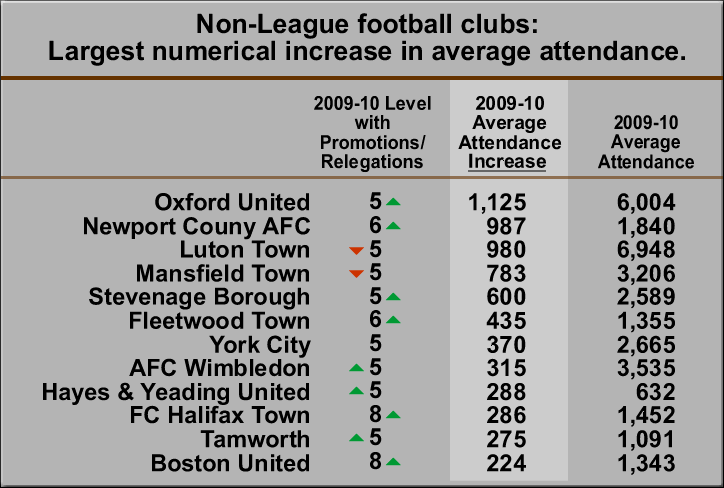
Below is a list I put together from data I found on Mike Avery’s Non-League Football Page. The list here shows the highest numerical increase in average attendance for Non-League clubs [the list on www.mikeavery.co.uk lists all clubs, League and Non-League, combined].
Note: in the column named ’2009-10 Level with Promotions/Relegations’, an up or down arrow preceding the Level number denotes league movement for that club after the 2008-09 season; and an up arrow after the Level number denotes a promotion for that club after the 2009-10 season.
It is worth noting that only one club on this list did not have any league movement in the past two seasons, York City. Also, unlike most situations where a club is relegated and then sees an attendance drop the following season, Luton Town and Mansfield Town saw attendance increases. Mansfield’s higher average attendance was pushed up by their pay-what-you-want promotion in February {see this}, which drew 7,261 to Field Mill in Mansfield, Nottinghamshire.
-
The cut-off on this map was 500 per game home attendance in league matches, and this meant there ended up being 50 clubs on this map. The map I made in October, 2009 had a cut-off at 600, but I lowered the bar by 100 because I couldn’t resist cramming a few more clubs into this end-of-season attendance map. The extra clubs happened to include 3 clubs from South London, so to the map page I added the Greater London map you see at the top of this post. Bromley and Welling United are both in the Conference South, which is a 6th Level league. Sutton United are a 7th Level club, and play in the Isthmian League Premier Division.
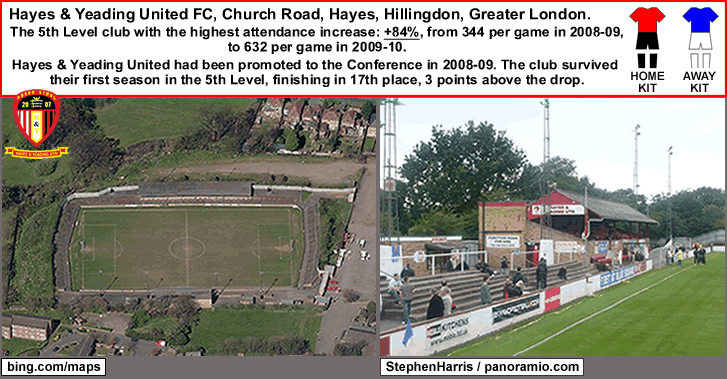
Other clubs which made it onto this map, and not onto my 3 other previous Non-League attendance maps are…Eastleigh (of the Conference-South), who are from Hampshire, just north of Southampton; Dorchester Town (also of the Conference South), who are from Dorset; and Hayes and Yeading United, who are from Hayes, Hillingdon, West London, about 3 km. (2 miles) north of Heathrow Airport. Hayes and Yeading won promotion to the Conference (aka Blue Square Premier League) in 2008-09, and drew 334 per game. This season in the Conference the club drew 664 per game, an 84% increase. Hayes and Yeading survived the drop by 3 points, finishing in 17th place.
-
Hayes & Yeading were the Conference club which had the highest percentage increase in average attendance (+84%)…
…
English Football Attendances, Average Attendances 2009-10 by % Change (www.mikeavery.co.uk)
…
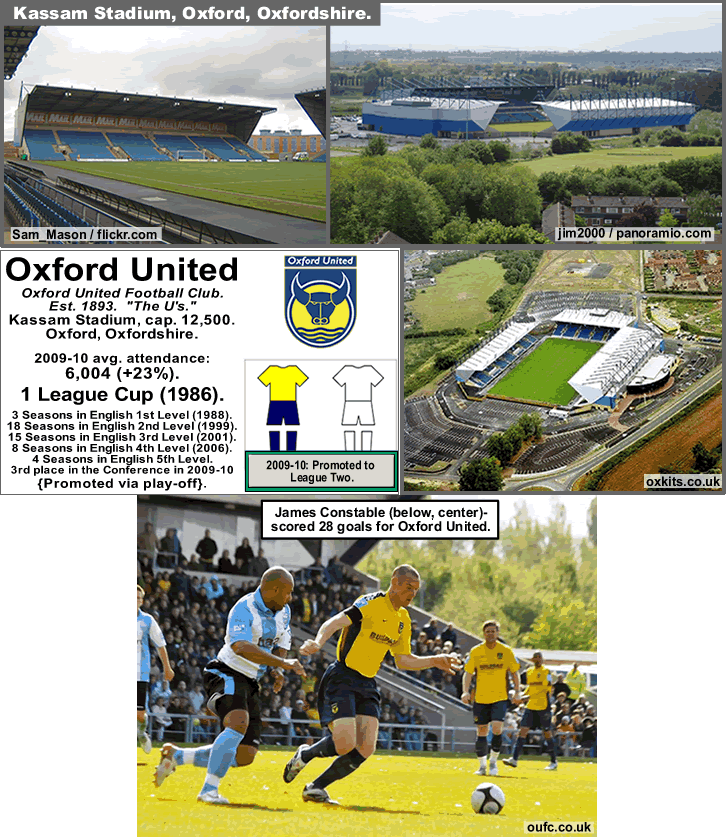
The Conference club with the highest numerical increase in average attendance was Oxford United, whose turnstile count went up 1,125 per game, to 6,004 per game. Oxford won the Conference play-off, and will play in League Two in 2010-11, thus returning to the League after a 4 season absence. Leading scorer for Oxford was James Constable, who scored 28 league goals (Conference top scorers, here {ESPN Soccernet}), and scored 3 times in 3 matches in the club’s successful playoff campaign.
-
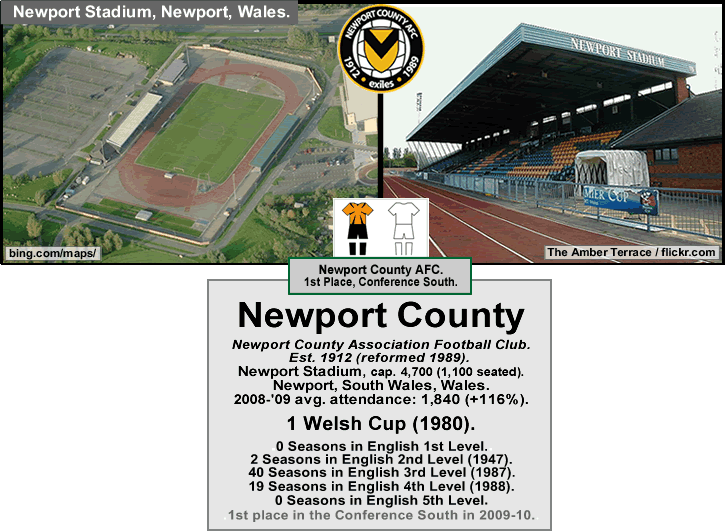
The 6th Level club with the highest average attendance percentage increase and the highest numerical increase was the Welsh club Newport County AFC, who won automatic promotion to the Conference by winning the Conference South, and drew over 900 more per game than in 2008-09. The Exiles drew 1,840 per game, a 116% increase from 08/09, to their not-exactly fan-friendly, running track-scarred municipal stadium, the Newport Stadium. Newport County is a club with a pretty long League history (61 seasons, including two seasons in the 2nd Level), and are finally having a resurgence. They will make their debut in the Conference, as they were relegated multiple levels when they were relegated out of the old Fourth Division in 1988.
-
The 7th Level club with the highest percent increase was Aveley FC, an Isthmian League Premier Division club located in Aveley, Essex, near the Dartford Crossing. Aveley did not make this map (and in fact, their ground only has a 1,100-capacity). The Millers drew 212 per game, a 47% increase from the 144 per game they drew in 08/09, when they won promotion the Isthmian League-D1 North. Aveley page at en.wikipedia.org .
…
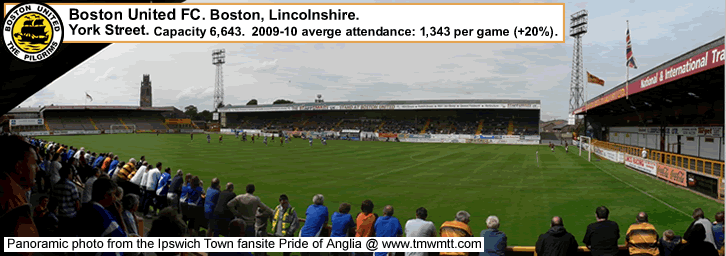
The 7th Level club with the highest numerical increase in average attendance was Boston United, of Lincolshire. Boston United won promotion this season to the Conference North, drawing 224 more per game than in 08/09. Boston United drew 1,343 per game this season, and it looks like the Pilgrims are finally starting to recover from the the financial mess/grounds problem that resulted in a protracted time in administration and which plunged them from League Two (the 4th Level) to the Unibond Premier League (in the 8th Level) in the space of 2 years. York Street, home of Boston United, below…
-
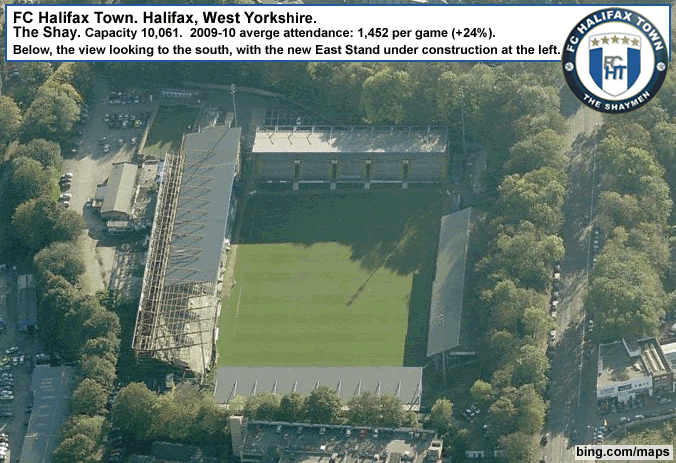
The 8th Level club with the highest numerical increase in average attendance was the phoenix-club FC Halifax Town, of Halifax, West Yorkshire. The Shaymen saw their gates go up 286 per game to 1,452 per game, which is a figure that dwarfs other clubs at this level. Sure enough Halifax won promotion and are on the path back to regaining the position of their predecessor club, Halifax Town AFC, who had League and Conference history, but were forced to dissolve due to tax debts in 2008. The photo below shows the Shay, FC Halifax’s home. The stadium is owned by the Calderdale Metopolitan Council. Calderdale is a metropolitan borough in West Yorkshire, and is made up of 6 former local government districts within the towns of (from east to west) Brighouse, Elland, Halifax, Sowerby Bridge, Hebden Bridge, and Todmorden. Todmorden is right up against the Pennine Chain, and this is pretty much where Yorkshire ends. At the other, western, side of the Pennine Chain (which is a low-rising mountain chain which is often called the backbone of England), is Lancashire.
Seen below is the new East Stand, from a satellite photo taken while that stand was still under construction [the view is towards the south]. The East Stand was opened in March, 2010. You can pretty much see how ambitious FC Halifax Town are, by the size of the stand. The stadium now has a capacity of just over 10,000, and that is a Football League-sized ground for sure.
…
The 8th Level club with the second-highest numerical increase at the turnstiles was Bury Town, of Bury St. Edmunds, in Suffolk. Bury Town saw their gates increase 172 per game, from 273 to 445 per game, as they won the Southern Football League Division One Midlands. Bury Town’s Ram Meadow @ Extreme Groundhopping site.
…
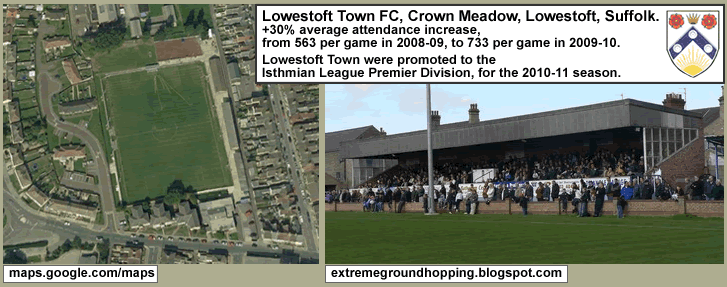
The 8th Level club with the third-highest numerical increase in average attendance was Lowestoft Town, of Lowestoft, Suffolk. The Trawler Boys won the Isthmian League Division One North by 15 points and drew 733 per game to their Crown Meadow ground, a 30% increase and 170 more per game higher than in 2008-09. And in 2007-08, Lowestoft Town were drawing just 310 per game, so the club’s fan base has more than doubled in two years.
-
Thanks to Bing.com/maps, Hayes & Yeading United FC, Church Road ground (Bird’s Eye view). Thanks to Stephen Harris at Panoramio.com, Stephen Harris @ panoramio.com.
Thanks to Sam Mason at Flickr.com,Oxford United FC – Kassam Stadium. Thanks to Jim 2000 at Panoramio.com, Photos by jim 2000 @ panoramio.com. Thanks to Oxford United FC- OxKits, www.oxkits.co.uk. Thanks to Oxford United official site/ Gallery, www.oufc.co.uk. Thanks to The Amber Terrace at Flickr.com, The Amber Terrace’s photostream @ flickr.com.
Thanks to the Pride of Anglia – Ipswich Town Football Club, Pride of Anglia (Ipswich Town).
Thanks to Extreme Groundhopping, Exreme Groundhopping – Crown Meadow, Lowestoft Town FC.
May 17, 2010
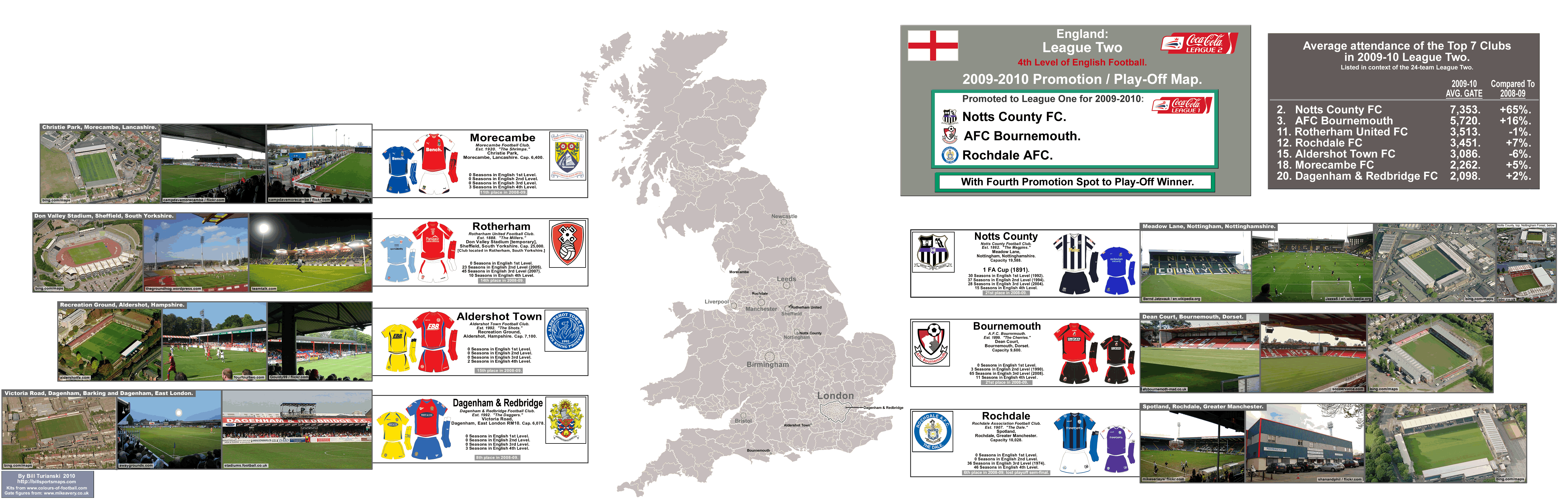
League Two, 2009-10 season. The 3 promoted clubs and the 4 play-off clubs.
League Two Play-Off fixtures and results, England – League Two (Soccerway.com).
Notts County FC, empowered by the support shown by their re-awakened fan base, took the title. Lee Hughes scored 33 goals for the Magpies, and the club overcame a mid-season lull to finish strong and on top. Notts County had their highest average attendance in 16 years. The club drew 7,353 per game this season, a 65 percent increase from 08/09, when they drew 4,446 per game and finished in 19th place. This is a club that had finished in 21st place twice, 19th place twice and in 13th place in the last 5 seasons. Their new, mysterious foreign ownership had promised to invest heavily at the start of this season, and several top calibre players (for the fouth division, anyway), including goalkeeper Kasper Schmeichel, joined the squad (with celebrity executive Sven-Göran Erikson on board as well). But the Qatar-based owners pulled out in February, and Notts County were almost wound up. Sven is gone now too, and the club’s financial worries are still not over, but the bottom line is this…all the early season hype and media glare got the fans back into Meadow Lane, and now that the club has won promotion, the crowds should continue to swell. But the thing is, Notts County has never come close to filling their 19,500-seat ground on a regular basis.
The last, single, season Notts County were in the the top flight was in the last season of the old First Division (in 1991-92, under manager Neil Warnock). That season the Magpies drew 11,133 per game and were relegated. It was during that season, in January 1992, that the club made plans to rebuild three sides of Meadow Lane to make it the near-20,000 seat stadium it is today. But relegation and poor play in the following seasons saw average gates diminish as re-building and expansion continued. The average gate had dwindled to the 8,000-range for the next two seasons in the second tier, and by 1994-95, in the same season that the final re-building phase was completed, Notts County were relegated to the third tier (into the old Division Two). With their big new ground the Magpies then went through a 14 season period where they drew above 6,000 just once, drawing 6,154 per game in 2002-03.
Notts County’s second-most-recent top flight spell had been three seasons in the First Division in the 1980s, with the club drawing 11,613; 10,265; and 9,463 per game from 1981 to 1984. So why did a club, which had never pulled in more than 11,000 per game in the modern era, build a stadium that has an almost 20,000 capacity? My guess is jealousy of their (very) nearby rivals, Nottingham Forest. The two clubs have grounds the closest together of any clubs in England, separated by only 275 meters (300 yards) [you can see that in the photo on the far right in the Notts County section on the map]. When Nottingham Forest were in their heyday, in the late 1970s and early 1980s, and winning trophies as recently as the 1989 and 1990 League Cup (and making a 1991 FA Cup finals appearance), it must have irritated the board at Notts County to see Nottingham Forest so big and (relatively) successful.
So when Notts County got that taste of the promised land (ie, first division football), in 1991-92, they re-built Meadow Lane too big for their fan base, believing they could increase their support as they consolidated their position in the top flight. The exact opposite happened. They were relegated that season and have never had an average attendance of higher than 10,000 per game since. I’m not saying Notts County are akin to a club like Darlington FC, in building an empty white elephant of a stadium that will never be filled on a regular basis, but over a decade of playing to 25% capacity or less cannot have been good for Notts County or their supporters.
-
Second place and automatic promotion goes to AFC Bournemouth. The Cherries also saw an increase at the turnstiles, though more modest…Bournemouth drew 5,720 per game (up 16% from 08.09). Brett Pitman scored 28 goals for Bournemouth this season. Two years on from their finanancial meltown and administration, Bournemouth are a club on the rise. It could be argued that this is a club that definitely belongs in the third tier and perhaps ever the second tier, if one were to go by city population, because Bournemouth is in the top 30 largest cities in England, List of towns and cities in England by population [en.wikipedia.org].
-
Third place and automatic promotion goes to the longest-running non-promoted club in the League, Rochdale AFC. 36 seasons in the fourth division, and finally a promotion. Well done to irrepressible manager Keith Hill, their goal-scoring tandem of Chris O’Grady (22 goals) and Chris Dagnall (20 goals), and the league’s stand-out defender, the young and promising Rochdale-born Craig Dawson, who has eschewed signing with a bigger club for next season, opting instead to continue contributing to the success of his hometown club.
-
The League Two 2009-120 Play-Off features one down-on-their-luck-but-finding-revitalization club, Rotherham United; and three small clubs that five years ago were not even in the League…Morecambe, Aldershot Town, and Dagenham & Redbridge.
In the first legs… Rotherham snatched a late goal at Aldershot, when former Rochdale striker Adam LeFondre stole a back pass and netted. Second leg is Wednesday, 19th May in at The don Valley Stadium in Sheffield, South Yorkshire.
Meanwhile, in East London, Dagenham demolished Morecambe 6-0, with a double-brace from Joshua Scott and a brace from Paul Benson (who had scored 18 goals this season). Second leg is up in Lancashire at Morecambe’s Christie Patk on Thursday, 20th May.
League Two fixtures, here, (news.bbc.co.uk).
-
Morecambe will say goodbye to Christie Road, as they are set to move into their new stadium in August. From FC Business.co.uk, “Morecambe’s new 12 million-pound stadium to be called ‘Globe Arena’ [16 Feb., 2010]. www.morecambestadium.co.uk, Globe Arena, Morecambe FC. There is a new Morecambe logo as well, New Morecambe crest- what do you think? (www.thevisitor.co.uk)
-
Thanks to BBC/Nottingham, Aerial photographs of Nottingham. Thanks to Bing.com/maps, Meadow Lane [Birds-Eye view]. Thanks to Jazza5 and Berndt Jatzwauk at en.wikipedia.org, Meadow Lane.
Thanks to SoccerVoice.com, Soccer Voice.com/Ground Guide, League 2. Thanks to AFC Bournemouth-Mad.co.uk, Dean Court.
Thanks to Shanandphil at Flickr.com, shanandphil’s photostream @ flickr.com; Rochdale FC [exterior]. Thanks to mikeserieys at Flickr.com, Rochdale Promotion 17/4/2010 (Set)/ My favorite picture of the day [part of mikeserieys' photostream @ flickr.com].
Thanks to campdavemorecambe at Flickr.com, Christie Park, Morecambe FC; campdavemorecambe’s photostream @ flickr.com. Thanks to The Groundhog.co.uk, Rotherham (DVS) [Don Valley Stadium]. Thanks to TeamTalk.com, Rotherham United.
Thanks to Aldershot FA.com, Alderhot Divisional Football Association. Thanks to FourFoutTwo.com/blogs, [scroll 2/3 down page] ‘The Recreation Ground: They don’t make ‘em like this anymore’ [part of 03/09/08 entry on Andy Mitten's blog].
Thanks to Gouldy99 at Flickr.com, Gouldy99′s photostream @ flickr.com. Thanks to Stadiums.Football.co.uk, League 2 Stadiums. Thanks to Away Grounds.com, Away ground- UK Football Ground Guide.
-
Thanks to E-F-S site, for attendance figures, Attendance Figures, European Football Statisrics.co.uk.
Thanks to Aerofilms Football Grounds- Then and Now, from Ian Allen Publishing, Aerofilms Football Grounds from the Air: Then and Now (Paperback) [BookDepository.com].
May 12, 2010
League One, 2009-10 season. The 2 promoted clubs and the 4 play-off clubs.

It was a nail biting final match day last Saturday in League One. Charlton, then Millwall had the edge up to finish in the crucial second spot, and automatic promotion. Then 10-man Leeds scored twice on Bristol Rovers in the space of 5 minutes, with goals from Jonathan Howson in the 59th minute, and from Jermaine Beckford in the 63rd minute. Leeds United returns to the League Championship along with table-topper Norwich City.
Both promoted clubs had pretty good results at the turnstiles (for big clubs being stuck in the third division, that is), with Leeds drawing 24,818 per game (up 3% from 08/09), and Norwich averaging 24,617 per game (up 1% from 08/09).
The four playoff clubs all were in the top 8 of average attendance in League One. The just-relegated Charlton Athletic saw a sharp drop in attendance, to 17,407 per game (-17% from 08/09). Huddersfield Town has continued with it’s cut-rate season tickets promotion, and drew 14,381 per game (+8% from 08/09). Millwall overcame the disappointment of losing in the Play-Off final to Scunthorpe United in 2008-09. This season Millwall had decent gates, as the Lions remained competitive and exciting all season, drawing 10,835 per game (+21% from 08/09). Swindon Town also saw an increase, though more modest, as the Robins went from being a relegation-threatened side (in 2008-09) to a promotion challenger. Swindon drew 8,389 per game (+12%).
Other high-drawing clubs in League One in 2009-10 that did not win promotion, or make the playoff, were Southampton, who drew 20,982 per game (an 18% increase from 08/09), and MK Dons, who drew 10,290 per game (a 2% decrease from 08/09).
-
The four clubs battling for the third promotion spot are Millwall, Charlton Athletic, Swindon Town, and Huddersfield Town. Play-Off fixtures here, League 1 Play-Offs Confirmed (Football League site).
Friday, 14 May, at The County Ground in Wiltshire, it’s Swindon Town v. Charlton Athletic; with the return leg on Monday, 17 May, at The Valley in Charlton, Greewnwich, South East London.
Saturday, 15 May, at the Galpharm Stadium in West Yorkshire, it’s Huddersfield Town v. Millwall; with the return leg on Tuesday, 18 May at the New Den in Bermondsey, Lewisham, South East London.
-
Thanks to Mike Avery’s Non-League Football site, Football League One Attendance Grids and Charts 2009-2010.
-
Thanks to The Pinkun’, a Norwich-based weekly newspaper and website, The Pink’un newspaper. Thanks to Mskau at Panoramio.com, Carrow Road “Come on you Yellows”. Thanks to Away Grounds.com, League One Grounds, at www.awaygrounds.com.
Thanks to Raddersndakman at en.wikipedia.org, Elland Road [2007]. Thanks to Gunnar Larsson at en.wikipedia.org, Elland Road, Leeds [exterior]. Thanks to Leeds United.com, leedsunited.com / Stadium tours. Thanks to susstudio_x at Flickr.com, Elland Road exterior, part 1.
Thanks to daejin at Flickr.com, The New Den [aerial shot]. Thanks to Les Bailey at Flickr.com, Millwall Stand.
Thanks to Bing.com/maps, The Valley, Charlton, London: Bird’s Eye view. Thanks to shields_t at Flickr.com, The Valley [exterior]. Thanks to John Mills at www.yourlocalweb.co.uk, Pictures of New Charlton and the surrounding area.
Thanks to Matthew Ashton at The Guardian, “Huddersfield’s community stadium dream sours in ownership wrangle [6 May, 2009]“. Thanks to Sky Sports.com, Huddersfield Town.
May 7, 2010
Brazil, Campeonato Série A: 2010 season, with average attendances from 2009.

At the upper right on the map page is a list of 2009 atendances of all the clubs in Brazil’s 2010 Campeonato Série A season.
Reigning champions are Flamengo, the giant club from Rio de Janeiro, who had last won the title in 1992. The final match of the season at the Maracana drew 80,000, to see a 2-1 win over Gremio. São Paulo had an uncharacteristic stumble in the run-up, losing away to both Goiás and Botofogo in the weeks leading up to the finish. That massive gate pushed Flamengo to the top of the average attendance list once more.
-
Of the four promoted clubs from Série B, only one has both a large following and significant titles, and that is Rio’s Vasco da Gama, who have regularly drawn in the mid to high 20,000s. Vasco have won 4 Campeonato Série A titles (last in 2000), and the club won the 1998 Copa Libertadores title. Vasco da Gama bounce straight back to the Brazilian top flight after one season in the second tier.
The other promoted club with silverware is Guarani, from Campinas, São Paulo state, which is 83 kilometers (49 miles) north of the city of São Paulo. Guarani are named after the indigenous tribes that came from what is now Paraguay and southern Brazil. Guarani won the Brazilian title in 1978. They averaged around 6,800 last year in the second tier, and historically have averaged around 8,500 per game when in the first division [for attendance figures, see this... {historical attendances in Brazil}.]
The other two promoted clubs have won no national titles, and in fact have both never qualified for the Copa Libertadores…Atlético Goianiense, from Goiânia; and Ceará, from the impoverished north, in the city of Fortaleza, which is the fifth-largest city in Brazil, with a population of around 2.5 million {2009 figure}. Ceará drew very well in their promotion campaign, averaging around 21,000 per game. Atlético Goianiense drew just 4,700 per game last year, and are the second-biggest club in a city that does not tend to show support for it’s football clubs, with the relatively in-form Goiás (8th place in 2008, 9th place in 2009) only drawing about 10,200 per game over the last two seasons. Goiânia is the 13-largest city in Brazil, with a population of around 2.2 million {2008}, so the combined average gate of the two biggest clubs, about 16,000, is pretty low.
-
All 5 Brazilian clubs who qualified for the 2010 Copa Libertadores remained alive in the competition through to the Round of 16.
In the Round of 16, Cruzeiro, Flamengo, Internacional, and São Paulo have advanced to the Quarterfinals.
Fixtures and results, here… Copa Libertadores fixtures and results (ESPN Soccernet).
-
Thanks to Albion Road (Football Clubs guide), for info help Football Club guide, Brazil.
Thanks to Babylon- translation @ a click, translation.babylon.com.
Thanks to Bolana Area.com, for attendance figures 2009 Campeonato Série A attendance figures [under 'Média De Público'], and 2009 Campeonato Série B attendance figures [under 'Média De Público Por Clube'].
Thanks to the contributors to the pages at en.wikipedia.org Campeonato Brasileiro Série A.
Thanks to Jon Cotteril, at TV Globo and at his blog, for pointing me in the direction of Brazilian Serie A and B attendance figures. Also thanks to Jon for linking up to this map on his recent post, Pitaco Gringo’s guide to the 2010 Campeonato Brasileiro.
“Pitaco do Gringo” (Gringo’s Opinion).
TV Globo, TV Globe Esportes.
May 2, 2010
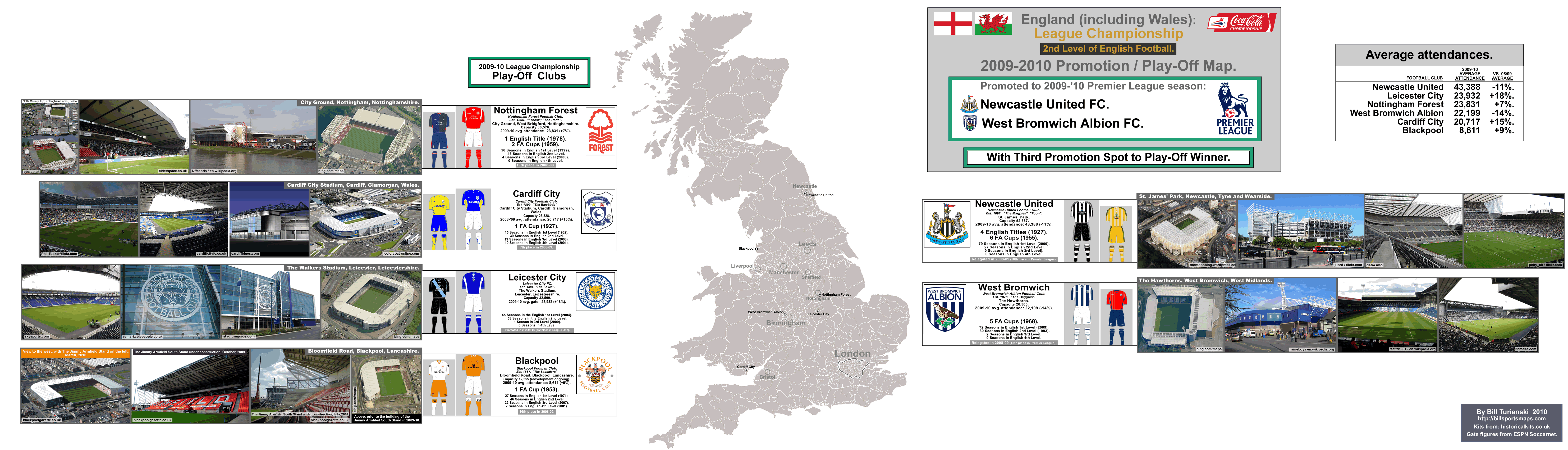
League Championship, 2009-10 season. The 2 promoted clubs and the 4 play-off clubs.
Play-Off dates… Play-Off dates announced (The Football League site).
League Championship Play-Off fixtures, Championship Play-Offs Confirmed.
-
On the right of the map are the 2 clubs automatically promoted to the Premier League for the 2010-11 season…Newcastle United, and West Bromwich Albion, both of whom bounce straight back to the top flight. Shown in each club’s profile box are major domestic titles and League history; 2009-10 average attendance; 2009-10 kits; and 4 photos of the club’s ground. Ditto for the 4 Play-Off clubs (on the left of the map). The four play-off clubs will vie for the third promotion spot…with two legged match-ups of Nottingham Forest versus Blackpool; and Cardiff City versus Leicester City. The first legs are Saturday 8th May (Blackpool hosting Forest) and Sunday, 9th May 9 (Leicester hosting Cardiff). Second legs are Tuesday the 11th (at City Ground) and Wednesday the 12th (at the brand new Cardiff City Stadium). The winners will advance to the Play-off final at Wembley Stadium on Saturday, 22nd May.
-
Attendance figures of the 6 clubs are shown at the upper right on the map page. Here are attendance figures for the whole League Championship this season, Attendance table, League Championship (ITV.com).
-
Thanks to Toon Toon Blog, Toon Toon Blog. Thanks to j lord at Flickr.com, j loord’s photosream @ flickr.com. Thanks to Down at thr Mac- the Huddersfield Town fansite, DATM. Thanks to poity_uk at Flickr.com, poiy_uk’s photostream @flickr.com.
Thanks to Bing.com/maps, The Hawthorns (Bird’s Eye view. Thanks to Jameboy at en.wikipedia.org, The West Stand and Smethwick End (exterior) by Jameboy. Thanks to Mattd1991 at en.wikipedia.org, The Hawthorns, by Mattd1991. Thanks to LFC Malta.com, Liverpool Supporters Club Malta.
Thanks to NffcChris at en.wikipedia.org, City Ground by NffcChris. Thanks to Ciderspace.co.uk, Ciderspace-the independant Yeovil Town FC website. Thanks to BBC/Nottingham, Aerial photographs of Nottingham.
Thanks to Colorcoat-online, Cardiff City Stadium, project summary/gallery. Thanks to Cardiff Blues.com, Cardiff Blues and Cardiff City FC sign stadium contract. Thanks to Cardiff City FC.co.uk, Cardiff City Stadium. Thanks to Phil Tucker at Flickr.com, Phil Tucker’s photostream @ flickr.com.
Thanks to The Stadium Guide.com, Walkers Stadium. Thanks to Remarkable People.co.uk, [Football] Grounds [visited]. Thanks to SkySports.com, The Walkers Stadium.
Thanks to leftarmoccasional via Zim Flyer at SkyScraperCity.com, Bloomfield Road Redevelopment/14.000+/Phase Two thread [featuring photos by leftarmoccasional]. Thanks to Blackpool Today, Blackpool Today, South Stand progress/Gallery.
Thanks to Historical Football Kits, for the kit illustrations, Historical football Kits.
April 27, 2010
Football Conference (aka Blue Square Premier League)-Top of the table, 2009-10 season.
Stevenage Borough will play in the Football League next season for the first time in their 35 year history. Stevenage Borough were famously denied entrance into the Football League in 1996, when, after winning the Conference, their automatic promotion was denied due to their ground being below standards. So 14 years later, it’s payback time for Stevenage and their fans. In the interim, the club had improved their ground, Broadhall Way, to the point where it was considered one of the top facilities in the Conference. This season, Stevenage saw a 30% increase in average attendance, to a very respectable 2,589 per game.
That still was far below the two turnstile giants of Non-League football these days…Luton Town and Oxford United, who both have averaged in the 6,000s this season. Average attendances of the top 5 clubs in the Conference are listed on the left on the map page. The following link shows average attendances in the Conference this season…Conference Premier Attendance Grids and Charts 2009-2010 (www.mikeavery.co.uk).

Stevenage Borough FC page at en.wikipedia.org
The four clubs competing for the other promotion spot to League Two are: Luton Town, Oxford United, Rushden & Diamonds, and York City. All four of the playoff clubs have League history, and their relegations from the League are noted in their club profile box. Also listed are the number of seasons spent in each of the top 5 levels of English football, and the club’s 09/10 kits. Also included in the profile boxes are three photos of each club’s home ground.
On the map I have listed the 23 clubs that competed in the 2009-10 Conference. The odd-number of clubs is due to the mid-season expulsion of Chester City.
That made relegation a matter of three other clubs, and those relegated this season were: Grays Athletic, Ebbsfleet United, and Forest Green Rovers. However, Salisbury City were penalized for failing to pay creditors, and were relegated two levels to the Southern Premier League, in the 7th Level. This was made official on 12th June. Forest Green Rovers, as the highest-placed relegated club, were thus re-instated into the Blue Square Premier League for the 2010-11 season.
-
Play Off dates…The Play-Off begins Thursday, 29th April, with Rushden & Diamonds v. Oxford United; and York City v. Luton Town. ; 2nd Legs Monday, 3rd May. Play-Off final Sunday, 16th May, at Wembley Stadium. 2010 Conference Play Off fixtures, at Football Conference site .
-
Thanks to Football Supporter’s Federation Ground Guide,FSF Ground Guide. Thanks to Soccerway, England- Conference National/Venues (www.soccerway.com). Thanks Google Maps, Google Earth view.
Thanks to World Stadia.com, www.worldstadiums.com. Thanks to RDFC Fans Blog, Rushden & Diamonds fansite. Thanks tor RDFC official site, www.thediamondsfc.com.
Thanks to Sam Mason at Flickr.com, Sam Mason @ Flickr.com. Thanks to jim2000 at Panoramio.com, jim2000 @ panoramio.com. Thanks to OxKits.co.uk, OxKits.com, A visual history of the kits of Oxford United.
Thanks to SoccerWorld.com, soccerword.com. Thanks to UK European Football Stadiums, stadiums.football.co.uk/Non League Stadiums. Thanks to Bing.com, Luton Town FC, Kenilworth Road (Birds Eye view).
Thanks to Campdavemorecambe at Flickr.com,‘[Photo of]Broadhall Way, Stevenage Borough. Thanks to Ray Stanton at Panoramio.com, [Photo of] Stevenage Borough FC. Thanks to Virtual Globetrotting, Broadhall Way (satellite view).
Thanks to Mike Avery Non-League Football Stats site, http://www.mikeavery.co.uk.
Thanks to Jeremy, at Albion Road site, for tech support help, Albion Road, Fan’s guide to Football Clubs around the world .
April 23, 2010
2010 Copa Libertadores, Second Stage, Round of 16, with top 5 leading scorers.

The map shows the 14 clubs through to the Round of 16, plus the two Mexican clubs who were allowed to pick up where they were a year ago prior to the H1N1 scare in Mexico that forced the two clubs, San Luis and Chivas Guadalajara, to pull out of the 2009 Copa Libertadores.
-
Click on the gif below to see photos, with flag of the country of birth listed, for the top 5 scorers in the competition so far. [Note, I couldn't get an image inserted here...I am having a few problems with the newly installed WordPress 2.9.2 .]

The Brazilian forward Kleber leads with 7 goals for his club Cruzeiro, who lost the 2009 Copa Libertadores final to Estudiantes. From 2003 to 08, Kleber played 65 times for Dynamo Kyiv, scoring 25 goals. He was then loaned out to Palmeiras in 2008, then signed with Belo Horizonte’s Cruzeiro in 2009, where he scored 7 league goals in 15 games and 3 in the ’09 Copa Libertadores.
Two of the players on the list below have been instrumental in propelling their under-dog status clubs into the Round of 16…Jose Carlos Fernandez of Peru’s Allianza Lima, and Rodolfo Gamarra, of Paraguay’s Libertad. One player, the Panamanian forward Luis Tejada, of Peru’s Juan Aurich, netted 6 times but his production was not enough to see his club go through. Two Peruvian clubs have made it through, though, the aforementioned Allianza Lima, and another club from the capital, Universitario. That’s an impressive showing for a country that been out of the limelight for a time, now. Sao Paulos’ Washington, born in the city of Brasilia, is a 35-year old journeyman who has played in Turkey (with Fenerbahce, scoring 10 goals in 12 games) and Japan, where he helped Urawa Reds win their first J-League title in 2006, and an Asian Champions League title in 2007. He netted 42 times in 52 games with Urawa. His prolific output has continued. He returned home in 2007, and scored 21 times in 28 games with Fluminense, before being signed by Sao Paulo, where he has scored 35 goals in 59 games, and counting.
-
Credit must be given to the Brazilian contingent, all five of which advanced to the Round of 16…Corinthians, Cruzeiro, Flamengo, Internacional, and Sao Paulo.
-
Thanks to the contributors to the pages at en.wikipedia.org, 2010 Copa Libertadores.
Thanks to Jeremy, at Albion Road site, for tech support… Football Clubs Guide, Albion Road.com, a fan’s guide to Football Clubs around the world.
April 19, 2010
Minor League Baseball: the International League, the 14 ball clubs and their ballparks.
Please note: A more recent map of the International League (2016) is available, here:
Affiliated Triple-A minor league baseball (MiLB): location-map of 2 leagues, the Pacific Coast League (PCL) & the International League (IL) – with 2015 attendances and MLB-team-affiliations noted./ + illustrations for: the highest-drawing MiLB team in 2015, the Charlotte Knights & the 3rd-highest drawing team in MiLB in 2015, the Sacramento River Cats.
…

…
…
The International League is a Triple-A league, one of the three top-ranked minor leagues in the Major League Baseball farm system. [The other Triple-A leagues are the Pacific Coast League, and the Mexican League.]
Reigning champions are the Durham Bulls, the top minor league affiliate of the Tampa Bay Rays. The Bulls swept the Scranton/Wilkes-Barre Yankees in 3 games last September, to claim the Governor’s Cup.
Here is the official site of the minor leagues, Minor League Baseball.com… MiLB.
-
On the map, I have ball club profile boxes which contain the franchise history of each team (note- this is not the same as the minor league baseball history of each city, because just as major league teams (ie, franchises) can move from city to city, so too can minor league teams). I also have the full lists of MLB affiliations of each team, including the logo of each minor league team’s present-day parent-club. Then there are a couple photos of each team’s ballpark, with capacity and opening date listed.
At the lower left on the map page, there is an article on the roots of the International League, and then brief histories of the three oldest teams in the league…the Rochester Red Wings, the Indianapolis Indians, and the Toledo Mud Hens.
-
Below- 2009 average attendances of International League teams, with the ball clubs’ current logos and home caps.

Thanks to Little Ballparks.com {click here}. Thanks to Ballpark Reviews.com {click here}.
Thanks to the contributors to the pages at en.wikipedia.org {click here (set at International League page)}.
Thanks to http://international.league.milb.com/ , for information on the early history of the league.


![Elland Road [2007]](https://en.wikipedia.org/wiki/File:Img_0712.jpg)
![Elland Road, Leeds [exterior]](https://en.wikipedia.org/wiki/File:Elland_Road,_Leeds.JPG)
