NFC West
…
…
…
Arizona Cardinals
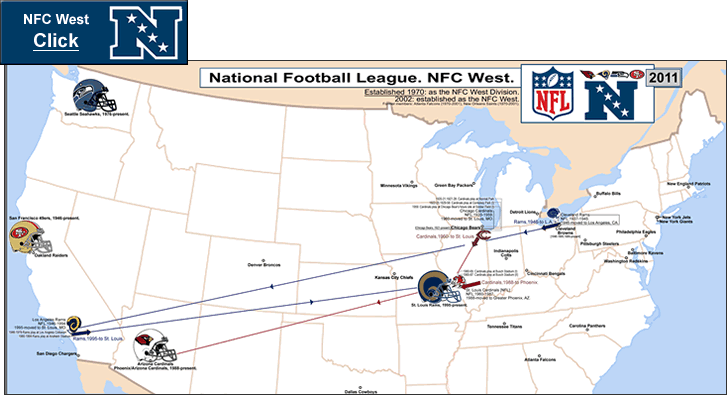
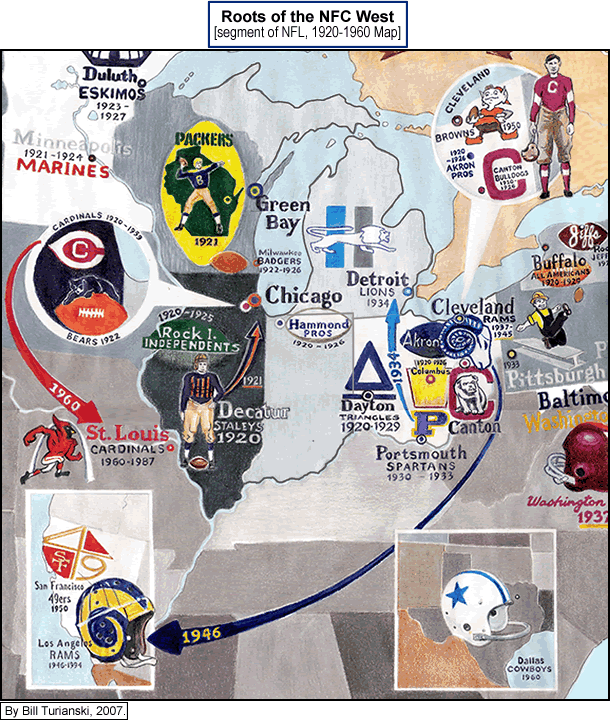
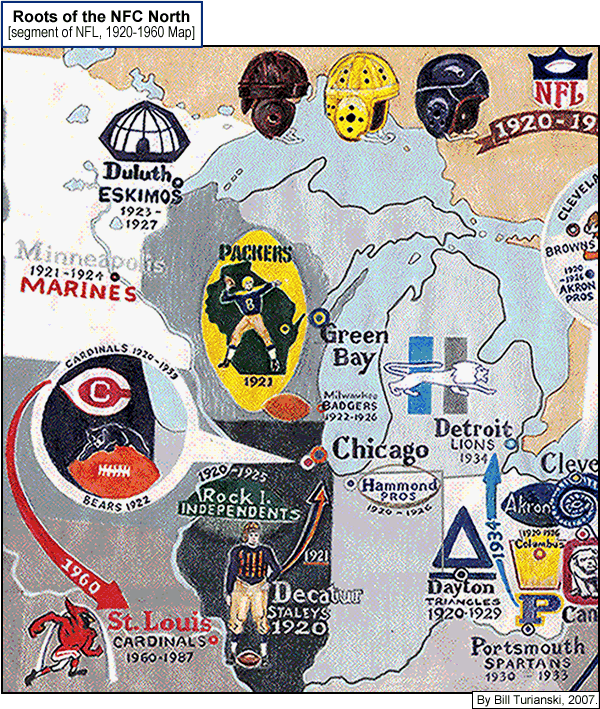
Est. 1898 as the Independent semi-pro team the Morgan Athletic Club of Chicago, IL (Morgan Athletic Club {Independent}, 1898). / Name changed to Racine Normals (Racine Normals {Independent}, 1899-1901) [Racine being the football field (Normal Park) in the South Side of Chicago where the team was located at]. / In 1901 name changed to Racine Cardinals (Racine Cardinals {Independent}, 1901-06;1913-18; 1918-19). / Joined NFL [APFA] in 1920 as the Racine Cardinals (NFL, 1920-21). / In 1922 name changed to Chicago Cardinals (NFL, 1922-1959). / In 1960 moved to St. Louis, MO: St. Louis Cardinals (NFL, 1960-1987). / In 1988 moved to Greater Phoenix, AZ: Phoenix Cardinals (NFL, 1988-93). / In 1994 name changed to Arizona Cardinals (NFL, 1994-2013).
Arizona Cardinals Helmet History -

Arizona Cardinals Helmet History
Image credits above – gridiron-uniforms.com/cardinals.
The Arizona Cardinals’ franchise history is the oldest and arguably the most complicated in the NFL. The Cardinals were founded in 1898, as the gridiron football team [an amateur team] of the Morgan Athletic Club, of Morgan St. in the Irish neighborhood of the South Side of Chicago, Illinois. The team’s founder was Chris O’Brien, a local painting and decorating contractor. Later in the first year, the team’s name was changed to the Racine Normals (Racine Normals, 1898-1901). This was after the team began playing at Normal Park at Racine Ave. and 61st St. in Chicago. In 1901, the team got their present nickname from the faded maroon jerseys they bought from the University of Chicago’s football team – O’Brien quipped, “That’s not maroon, that’s cardinal red.” (Racine Cardinals, 1901-06; 1913-18; 1918-21). The team disbanded in 1906 due to lack of local competition. The Racine Cardinals (still under O’Brien), re-formed in 1913, this time as a professional team. In 1917, the Racine Cardinals won the championship of the long-since-defunct Chicago Football League. In 1918, the team suspended operations due to WW I and the Spanish Flu epidemic. They resumed playing later in 1918. So the Arizona Cardinals’ franchise history goes back, in a continuous sense, to late 1918, and makes the Cardinals the oldest team in the National Football League.
The Racine Cardinals would be a charter member of the NFL [APFA] in 1920. The 1920 Cardinals finished 6-2-2 and ended up tied for 4th place with the Rock Island Independents (NFL, 1920-25). [The Akron Pros (NFL, 1920-1926) won the first NFL [APFA] title, in 1920.]
In 1921, the Cardinals would be forced to cede sole territorial ownership of the Chicago area, with the Decatur Staleys (the present-day Chicago Bears) moving into Chicago and Wrigley Field, and promptly winning the 1921 APFA [NFL] title. The Cardinals never really got over this, and for almost four decades (39 years), the Cardinals played second fiddle to the Chicago Staleys (in 1921) and the Chicago Bears (from 1922 on).
Below, the Chicago Cardinals first home, Normal Park, located in the South Side of Chicago…
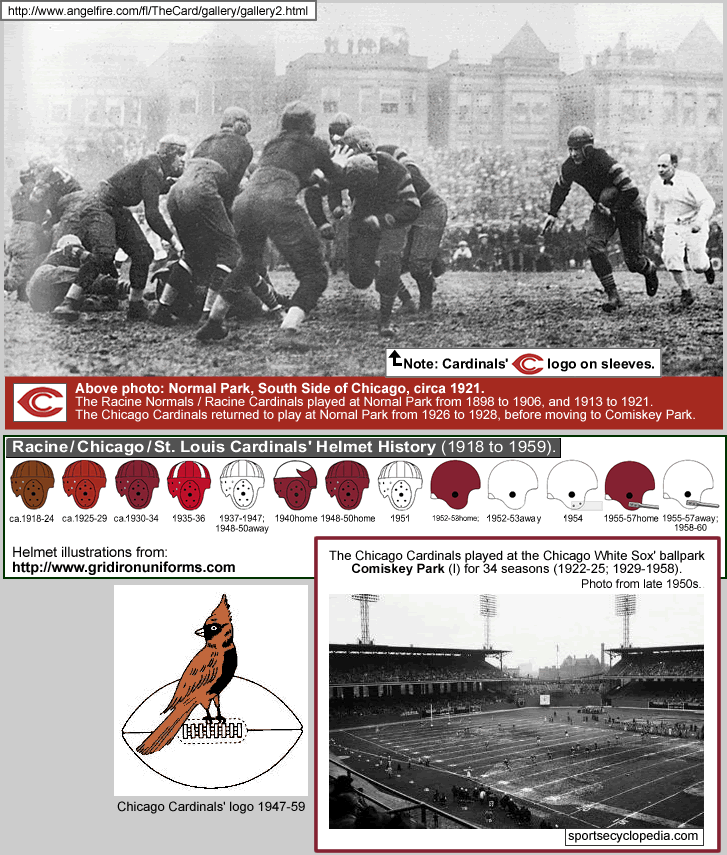
Image credits – Normal Field, http://www.angelfire.com/fl/TheCard/gallery/gallery2.html . Comiskey Park w/ gridiron markings, http://www.sportsecyclopedia.com/nfl/azchi/cardschi.html . Cardinals’ Helmet History (1920-1959), images courtesy of The Gridiron Uniform Database, at gridiron-uniforms.com/cardinals.
In 1922, the Racine Cardinals changed their name to the Chicago Cardinals, so as to not be confused with the briefly-lived Racine, Wisconsin NFL team called the Racine Legion (NFL, 1922-24). Also in 1922, the team moved from Normal Park to a few miles east, to the Chicago White Sox’ ballpark, Comiskey Park (which was also in the South Side of Chicago). The Cardinals would play at Comiskey Park from 1922 to 1925, returning to Normal Park from 1926-28, and would again play at Comiskey Park for 30 straight seasons (from 1929 all the way to 1958).
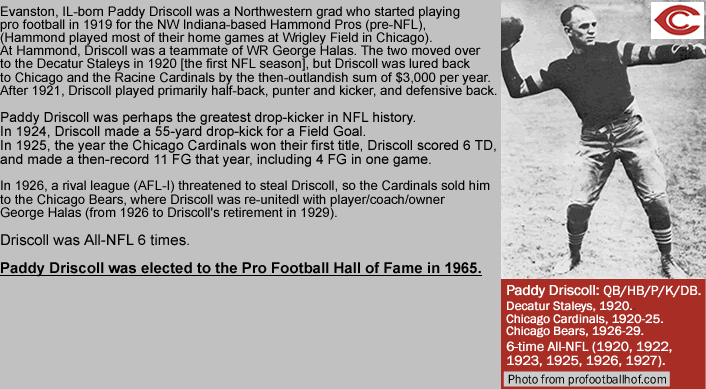
Photo credit: Paddy Driscoll: ‘The Last Drop Kick‘ (ProFootballHoF.com).
Powered by the offense that halfback/drop-kicker John “Paddy” Driscoll provided the team, the Chicago Cardinals won the 1925 NFL title. But the Cardinals really only won the championship by hastily organizing and winning 2 late-season games against extremely weak opposition, winning those, and then having the league give a favorable ruling to them with respect to the team that rightfully deserves the 1925 NFL title, the Pottsville Maroons. This was the era of unbalanced schedules in the APFA/NFL (1920-1932). [The Pottsville Maroons, formed in 1920 as a semi-pro team from the coal-town of Pottsvile, Pennsylvania, were an NFL member from 1925 to 1928.] The Pottsville Maroons looked set to have the best record in the league in late 1925, after they had defeated the Chicago Cardinals in Chicago by a score of 21-7, on December, 6th. 1925. But then the Cardinals quickly arranged two more games in a 3-day span in mid-December that year, against very weak opponents, to fatten their winning percentage and be able to claim the title. Amazingly, this was not a violation of league rules at the time. The Cardinals played those two games – both of which were versus teams that had already disbanded for the season [the Milwaukee Badgers (NFL, 1920-1926) and the Hammond (Indiana) Pros (NFL, 1920-1926).] One of these teams (Milwaukee) illegally fielded four [ineligible] high school players. The Cardinals won both games. Meanwhile, the Pottsville Maroons had scheduled a non-league, exhibition game against former Notre Dame players (“the Notre Dame All-Stars”). The problem was that, to make a bigger profit, Pottsvile played that game versus the Notre Dame All-Stars not at their tiny, 5,000-capacity high school stadium called Minersville Park in Pottsville, but down the road in Philadelphia, at the 32,000-capacity ballpark Shibe Park. That turned out to be a mistake that Pottsville would eternally regret. Because the NFL team that owned the Philadelphia franchise back then, the Frankford Yellow Jackets (NFL, 1924 to 1931/1926 NFL champions), of the Frankford neighborhood of Philadelphia, complained to the league about Pottsville engaging in territorial infringement by playing that lucrative game in Philadelphia, while Frankford was playing a home game that same day. The league suspended Pottsville (who claimed a verbal agreement had been made with the league office to be allowed to play that game in Philadelphia), and voided their chance at the title. Pottsville had one more league game scheduled, a winnable one, in Rhode Island versus the Providence Steam Roller (NFL, 1925-31/1928 NFL champions), and Pottsville was not allowed to play that game. So the top of the final standings for the 1925 NFL season read thus:
1st place: Chicago Cardinals, 11-2-1 (.846 Pct). 2nd place : Pottsville Maroons, 10-2-0 (.833 Pct).
In early 1926, at the annual league meeting, and to his credit, Cardinals owner Chris O’Brien refused to accept the title, saying his team did not deserve to take the title from a team that had beaten them fairly. It also must be pointed out that while Pottsville did certainly violate rules (as weak as Frankford’s case of “infringement” was), so too did the Chicago Cardinals. Because not only did the Cardinals players knowingly play against those 4 ineligible high schoolers (on the Milwaukee Badgers), but one of the Cardinal players, Art Folz, admitted to being the person who had recruited those four teenagers. Art Folz was banned for life for playing in the NFL as a result of this. The owners, however, absolved O’Brien of any wrongdoing at that February, 1926 meeting – the other owners agreed that O’Brien knew nothing about the ineligible players. [We'll never know if O'Brien did, but if he did know, logic would dictate that he most likely would have claimed the title.] {see this – ‘The Discarded Championship (PFRA [former site] via WaybackMachine)‘.
The Chicago Cardinals under Chris O’Brien might have refused to accept the 1925 NFL title, but when Charles Bidwill took over ownership of the Cardinals in 1932, he claimed the title, and the Bidwill family, who still own the Cardinals franchise to this day, have been the strongest opponents of Pottsville’s 1925 NFL title-claim (which was last rebuffed by the NFL in 2003…
From ESPN site, from January 28, 2008, by David Fleming, ‘Pottsville, Pa. and Cardinals each claim rights to 1925 NFL title‘.
{See this, from en.wikipedia.org, ‘1925 NFL Championship controversy‘.}
In 1947, the Cardinals won an actual, uncontested league title. The Cardinals had amassed a set of offensive talent called the “Million Dollar Backfield”, which included quarterback Paul Christman, fullback and place-kicker Pat Harder, halfback Elmer Angsman, and the final piece of the puzzle, Georgia Bulldogs’ [college] standout halfback Charley Trippi, who was signed for the then-record $100,000 by the Bidwills, who out-bid rival-league AAFC teams for Trippi’s signature. Trippi was born and raised in the eastern Pennsylvania coal-town of Pittston.
Below: the 1947 Chicago Cardinals’ Million Dollar Backfield
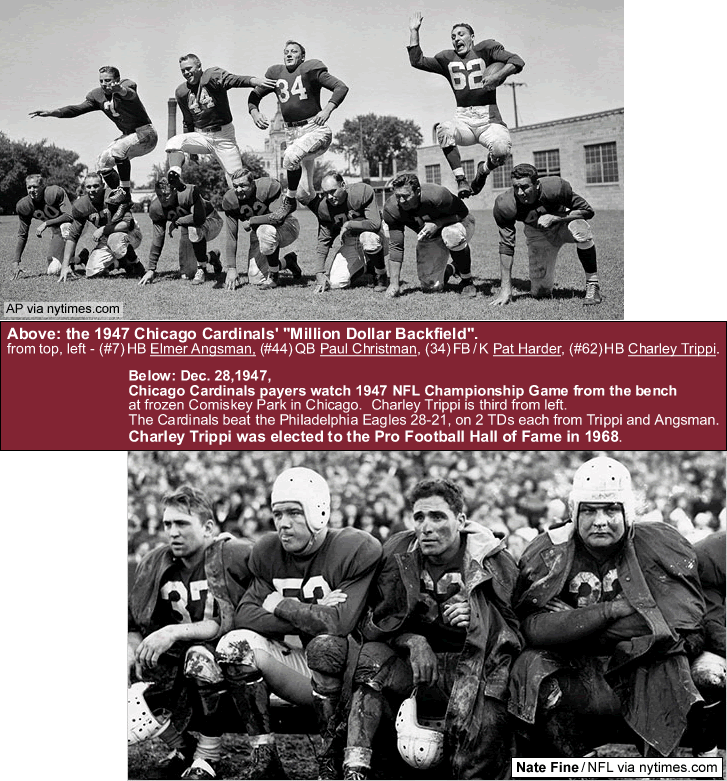
Photo credits – http://investorshub.advfn.com/boards/read_msg.aspx?message_id=35774910 (Associated Press). ‘Memories of the Cardinals’ Last N.F.L. Championship‘ (nytimes.com, Jan.15,2009).
In 1947, the Cardinals went 9-3, and were set to face either the Pittsburgh Steelers or the Philadelphia Eagles for the title – both went 8-4 and an extra quasi-playoff game was scheduled at Forbes Field in Pittsburgh – which the Eagles won 21-0. So on December 28, 1947, on an icy field at Comiskey Park in Chicago, the Cardinals faced the Eagles. It was both teams’ first appearance in a NFL title game. Because of the frozen and slippery field conditions, many players on the Cardinals, including Trippi, wore tennis sneakers instead of cleats. Both Charley Trippi and Elmer Angsman scored 2 touchdowns each – Trippi on a 44-yard run in the 1st quarter and a 75-yard punt return in the 3rd quarter; while the speedy Angsman scored on two different 70-yard runs, one in the 2nd and one in the 4th quarter. Besides the tainted 1925 title, it is the Cardinals’ only title. The Cardinals franchise has the longest running title-drought in the NFL [63 years as of 2010].
In 1959, the Cardinals played their first 4 games [at the future Bears' stadium] Soldier Field, then in a failed attempt to find a new locale, played their final 2 home games in suburban Minneapolis/St. Paul at Metropolitan Stadium in Bloomington, Minnesota. As mentioned, the Cardinals had always had second-team status in Chicago to the Chicago Bears, and by the late 1950s, it was obvious that the only way the Cardinals were to survive was by relocating.
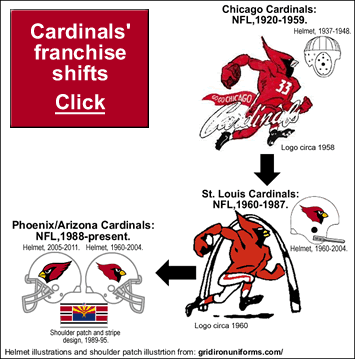
Above: Helmet illustrations and shoulder patch illustration from: gridironuniforms.com/cardinals.
After the NFL surveyed the viability of a team in St. Louis, Missouri, and found the conditions favorable, the Chicago Cardinals moved to St. Louis in 1960, becoming the St. Louis (football) Cardinals (St. Louis Cardinals [NFL], 1960 to 1987). From 1960-65, the team played at Sportsman’s Park [officially by then known as Busch Stadium (I)], which was the home of the St. Louis (baseball) Cardinals. Then the football Cardinals played at Busch Stadium (II), also along with the baseball Cardinals, from 1966 to 1987. By the late 1980s, the no-longer-adequate Busch Stadium, plus fan-indifference due to the team’s longstanding mediocrity led the Bidwill family to decide to relocate again, and the Greater Phoenix, Arizona metro-area became their new home.
The Phoenix Cardinals debuted in 1988 (Phoenix Cardinals, NFL 1988 to 1993). The Cardinals played their first 18 seasons in Arizona at Arizona State’s Sun Devil Stadium, in Tempe, AZ. The Cardinals changed their name to the Arizona Cardinals in 1994 (Arizona Cardinals, NFL 1994-present). In 2005, the Cardinals moved into the state-of-the-art University of Phoenix Stadium, in Glendale, AZ. The Cardinals have sported their trademark frowning-cardinal-head-logo on white-helmet-with-grey-facemask since 1960 (ie, since their first season in St. Louis). The helmet logo was re-designed in 2005, to make it look “meaner”, although it could be argued that they only made the bird look more like a cartoon (at least they kept the classy grey facemask).
The St. Louis Cardinals won 2 NFL Championship titles (1925, 1947).
The Cardinals are 0-1 in Super Bowl appearances [lost to the Pittsburgh Steelers in the 2009 season].
…
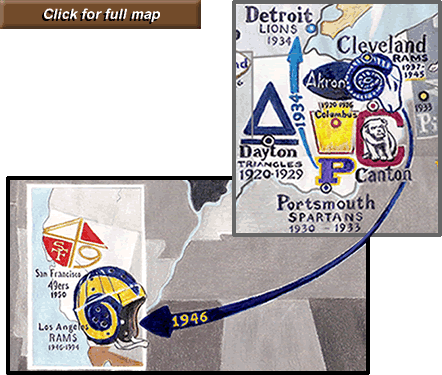
St. Louis Rams
Est. 1936 as the Cleveland Rams of Cleveland, OH, a team in the second [of 4] AFL leagues that existed in the 20th century, the AFL (II) of 1936. / Joined NFL in 1937 as the expansion team the Cleveland Rams (NFL, 1937-45)/ in 1946 moved to Los Angeles, CA as the Los Angeles Rams (NFL, 1946-1994)/ in 1995 moved to St. Louis, MO as the St. Louis Rams (NFL, 1995-2012):
St. Louis Rams Helmet History -

St. Louis Rams Helmet History
Image credits above – gridiron-uniforms.com/rams.
The St. Louis Rams also have a convoluted history. The NFL Rams’ franchise played 8 seasons in Cleveland, OH; 49 seasons in Los Angeles/Orange County, CA, and are currently [2011] playing their 17th season in St. Louis, MO.
The Rams’ NFL franchise traces its roots to the Cleveland Rams of the short-lived AFL (II) of 1936. This 6-team league lasted just 1 year. Attorney Homer Marshman founded the Cleveland Rams in 1936. His general manager Damon “Buzz” Wetzel suggested their nickname, after the Fordham (NY) Rams college football team (his favorite team). Like the Fordham Rams, the Cleveland Rams originally wore red and black (in the AFL in 1936, and in their first season in the NFL in 1937). After the Rams’ 1936 season in the AFL (II), where they finished in second place to the Boston Shamrocks, Marshman learned of the NFL’s intention of expanding for the 1937 season, and his bid was selected over bids from groups in Los Angeles and Houston (the NFL wished to keep its teams, at that point in time, in a concentrated area of the Northeast and the Upper Midwest). No front office or coaching staff, and just four 1936 Rams’ players made the jump over from the AFL of 1936 to the Cleveland Rams of the 1937 NFL – {See this photo of Mike Sebastian, William “Bud” Cooper, Harry “The Horse” Mattos, and Stan Pincura (the four members of Cleveland Rams who joined the NFL in 1937}. So the NFL considers the 1936/AFL (II) version of the Rams to be a separate entity.
The Cleveland Rams joined the NFL’s Western Division in 1937, making the league a balanced 10-team league again, and filling the gap left by the Cincinnati (football) Reds, who were an expansion team in 1933 (along with Pittsburgh and Philadelphia), but folded midway through the following season (1934). The Cleveland Rams played their first 2 NFL seasons in the cavernous Cleveland Municipal Stadium, but were barely able fill even a fraction of it. The club had a very poor first season, going 1-10. The next season they changed their uniforms to navy blue and yellow-orange; they finished 4-7. In 1939, the Cleveland Rams began playing in dark royal blue and yellow-orange, which would become the colors of the Rams’ franchise from 1939 to 1948, from 1950 to 1963, and from 1973 to 1999 (51 seasons). [The St. Louis Rams have been wearing navy blue and metallic gold since 2000.] The Cleveland Rams organization had a shaky start in the NFL, even playing in a high school football stadium for a while (in 1938, at Shaw Stadium in east Cleveland). They played at Municipal Stadium in 1936 and ’37, from 1939 to ’41, and in December 1945 in the NFL Championship Game. For some games in 1937, and for the 1942, 1944 and ’45 seasons, the Rams played mostly at League Park (which was home of the MLB team the Cleveland Indians from 1901 to 1946). The Cleveland Rams were forced to remain dormant for the 1943 season due to lack of players, because of World War II. The team never had a winning season until UCLA phenom Bob Waterfield was drafted by the team in early 1945. For the 1945 season, Waterfield immediately started as quarterback. He also handled kicking and punting duties, as well as playing defensive back (with 20 interceptions in 4 years). Waterfield led the team to a 9-1 record, and they faced the Washington Redskins in the 1945 NFL Championship Game. The Rams beat the Redskins 15-14, on a frozen field, at the Cleveland Municipal Stadium, with Waterfield throwing touchdown passes of 37 and 44 yards. But the margin of victory was the 2 point safety that was awarded to the Rams, after a Redskin pass attempt in their end-zone struck the field goal crossbar, and fell to the ground. **{See this article, on the 1945 NFL Title Game, from the NFL website.} Bob Waterfield was voted the league’s Most Valuable Player for 1945. That was the first time in the NFL that a rookie won the honor.
The 1945 title game was the last game the Rams played in Cleveland. Their owner at the time, Daniel Reeves, claimed the team had lost $40,000 that year, despite winning the title. He was also threatened by the presence of a Cleveland team in the nascent All-America Football Conference (1946-1949). This league was formed in late 1944, but put off playing the 1945 season because of World War II. By late 1945, it was becoming apparent to the Rams management that this new AAFC team, to be called the Cleveland Browns, would put a dent in the already thin Rams’ fan support. Reeves began talking to the city of Los Angeles about playing at the 90,000 seat Memorial Coliseum. In January 1946, the Cleveland Rams moved west to California. When the Los Angeles Rams began play in the fall of 1946, they became the first major-league team in America to set up shop west of St. Louis, Missouri. Which is ironic, because 48 years later, the franchise would move to St.Louis.
The Los Angeles Rams ended up as trailblazers on another front, as well. Because the Memorial Coliseum commissioners stipulated that as part of the lease agreement, the Los Angeles Rams must be integrated. So the Rams signed two black UCLA players, Kenny Washington {see this}, and Woody Strode {see this}. The Los Angeles Rams played at the 90-to-100,000-capacity Memorial Coliseum from 1946 to 1979 (34 years).
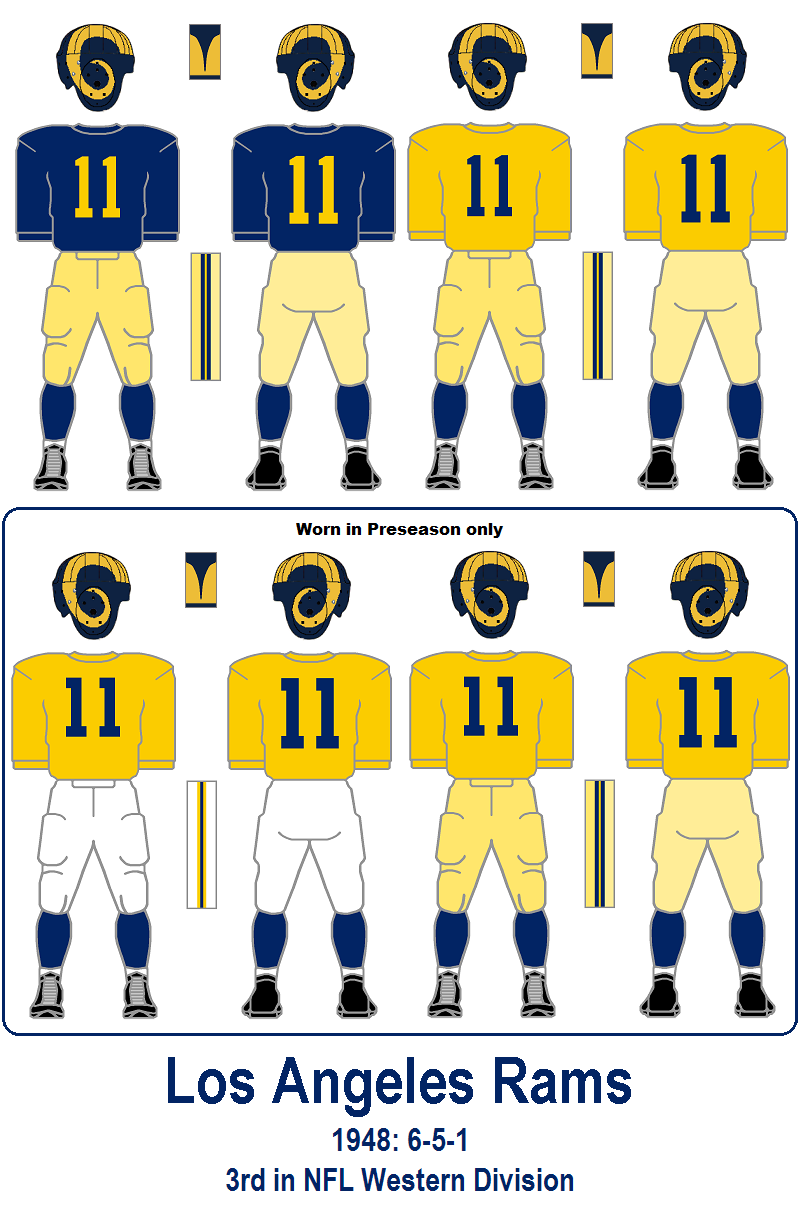
In 1948, Rams’ halfback and off-season commercial artist Fred Gehrke painted the team’s helmets with a set of ram’s horns. This became the first example of an insignia on the helmet of a pro football team. Here is a good article on Gehrke and his designing of the Rams helmet logo, from Sports Illustrated, from Sept. 5 1994, by Mark Mandemach, ‘Rembrandt Of The Rams
Fred Gehrke got out his brushes and changed helmets forever‘ (sportsillustrated.cnn.com/vault).
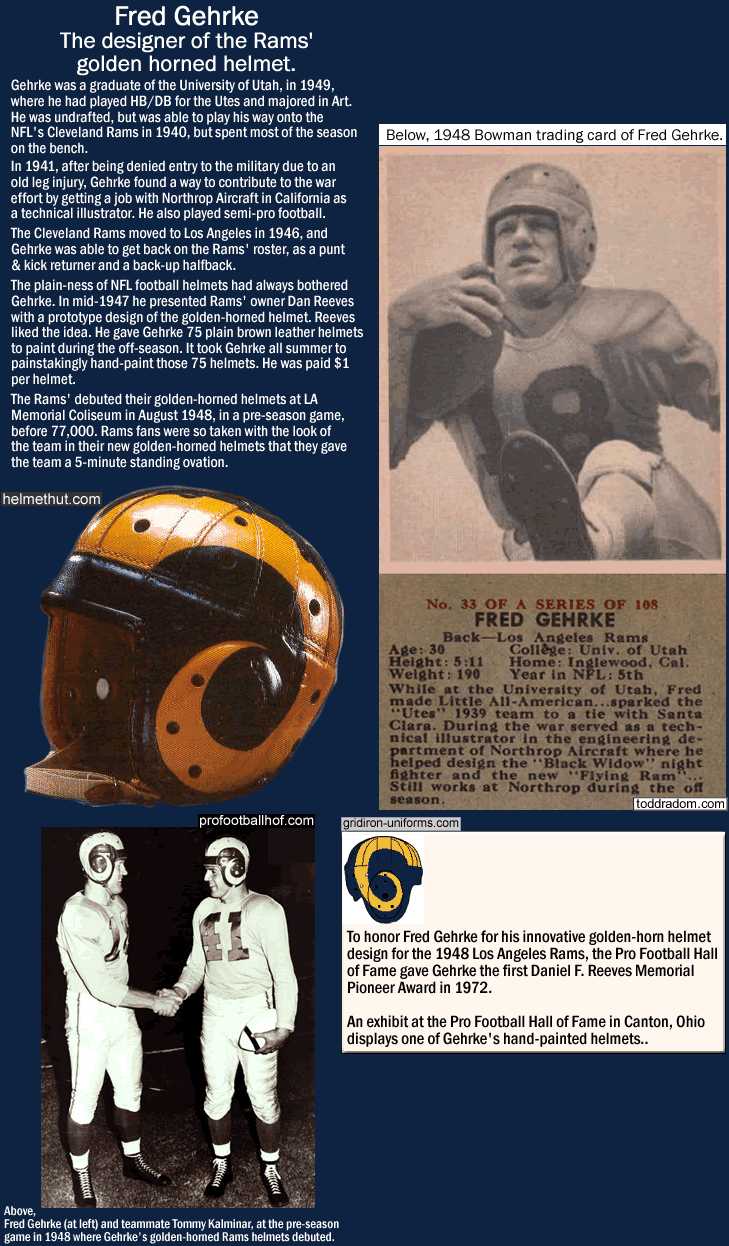
Photo and Image credits above -
helmethut.com/leatherram.
toddradom.com/athletes-as-artists-andrew-mccutchen-and-the-1948-la-rams.
gridiron-uniforms.com/Rams 1948.
profootballhof.com/history/infographic-wednesday.
The Los Angeles Rams were about to enter their glory days. They ended up playing in four NFL Championship Games between 1949 and 1955. And though they only won one NFL title in this period, in 1951, the greatness of this team cannot be diminished. Wide receivers Elroy “Crazy Legs” Hirsch and Tom Fears were the Rams’ two big offensive weapons. Bob Waterfield, and from 1950 on, Norm Van Brocklin, both helmed the squad at quarterback. For a while the two worked in tandem, which is unheard of in pro football. To say the team emphasized the passing game would be an understatement. In 1950, the NFL began allowing unlimited substitutions, and the Rams exploited the rule change. They ended up averaging 38.4 points per game that season (1950), a record to this day. Their wide-open offense proved so popular that the Rams became the first pro football team to have all its games televised. Despite their local television deal, the LA Rams of the mid-to late 1950s still drew extremely well. In 1958, for example, when the Rams went 8-4, they averaged 83,680 per game (6 games), including 100,470 for the Chicago Bears and 100,202 for the Baltimore Colts.
Below, the Rams’ first star, QB/K/P/DB Bob Waterfield – Photo on left: seen with his high school sweetheart and wife of 20 years, the film star Jane Russell. Photo in middle: Waterfield seen charging down the sideline for a 13-yard touchdown run versus the [now-defunct] Baltimore Colts of 1951 (gridironuniforms.com) at the Los Angeles Memorial Coliseum on Sunday, October 22, 1950 – final score Los Angeles Rams 70, Baltimore Colts 22 {boxscore from pro-football-reference.com, here}. At right is an [unattributed] illustration of Bob Waterfield in his 1948 LA Rams uniform….
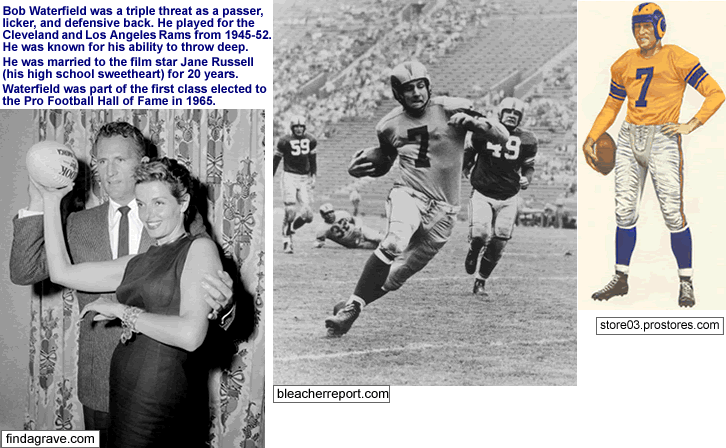
Photo credits – Findagrave.com/Bob Watefield. Action photo from 1950 from Los Angeles’ Memorial Coliseum, from ‘100 Greatest Quarterbacks in NFL History Part II: 50-21 ‘. Color illustration: from a 1994 Los Angeles Rams’ game program [artist was unattributed] via http://store03.prostores.com/servlet/dcbcollectibles/the-Football-Collectibles/s/496/Categories .
There were two other successful periods for the Rams in Los Angeles. In the mid-to-late 1960s, the Rams featured the Fearsome Foursome, the great defensive line of Rosey Grier, Merlin Olsen, Deacon Jones, and Lamar Lundy. The 1967 Rams, who were led by head coach George Allen, went 11-2-1, and became the first NFL team to draw over a million spectators in a season (14 games [ie, home and away gate figures combined]). In 1969, Allen hired a 33-year old Dick Vermeil to be the NFL’s first-ever special teams’ coach; the Rams went 11-3 that year. But these Rams were never able to win in the playoffs. And the next good Rams teams, of the mid-to-late 1970s (who were coached by Chuck Knox) had the same problem, losing in the NFC Championship Game 4 times in 5 seasons (1974-76; 1978). The Los Angeles Rams did make it to the Super Bowl – once – in the 1979 season, but lost to Pittsburgh 31-19 in Super Bowl XIV.
In 1980 the Rams moved south of downtown Los Angeles to Anaheim, Orange County, CA and Anahiem Stadium (home of the MLB team the California Angels). The Rams needed a smaller stadium, because the dreaded blackout rule was killing them – they couldn’t come close to selling out the then-93,000-capacity Coliseum, so their product was being diminished in their home town because games were being blacked out. The solution was a smaller venue. The Rams played at the 69,000-capacity Anaheim Stadium for 15 seasons (1980-94), but that situation never really worked out for the Rams (or, actually, for the Angels as well, because the renovations made at the stadium to accommodate the Rams ruined the atmosphere for baseball games there, and after the Rams left, the Angels pretty much gutted the stadium and returned it to the respectable, mid-40,000-capacity ballpark it originally was). By the early 1990s, the Rams were foundering, both on-field and with respect to waning fan interest and another inadequate stadium situation. They found that neither Orange County nor the city of Los Angeles was willing to build a new stadium, and, true to the tenor of the times, the Los Angeles Rams became yet another NFL team in the first half of the 1990s that openly courted other cities (to get a free stadium). Baltimore, MD was first sought after (Baltimore would steal the Browns from Cleveland soon after, in 1995/96), but that deal fell through.
The city of St. Louis, now 7 years without an NFL team, stepped up with a sweetheart deal, and the Rams moved back east, to St. Louis, Missouri. The St. Louis Rams did not change their uniforms at all when they first moved to Missouri (they did do an overhaul of their gear in 2000 [right after they had won the Super Bowl], switching to navy blue and turning their rams’ horns and trim color from yellow-orange to metallic gold). For the first half of the 1995 season, the Rams played at Busch Stadium (II), then moved into the publicly-financed Trans World Dome in November 1995 [the stadium is now called the Edward Jones Dome].
The Rams continued their lackluster form until ex-Eagles coach Dick Vermeil came out of retirement, returning to the Rams’ organization and taking the Rams’ head coach job in 1997. The Rams of this era became a very high-powered offensive force that featured WR Isaac Bruce and RB Marshall Faulk (Hall of Fame, 2011) and were led by a QB, Kurt Warner, who came out of nowhere – from the Iowa Barnstormers of the now-defunct Arena Football League. Warner went from stocking supermarket shelves to hoisting the Super Bowl trophy in 5 years flat. In the 1999 season, in Super Bowl XXXIV [39], the Rams beat the Tennessee Titans by a score of 23-16, with the final touchdown a 73-yard completion from Warner to Bruce, and with the win clinched by a last-second, one-yard-line tackle by Rams’ linebacker Mike Jones on Titans’ WR Kevin Dyson {see this ‘Final play of Super Bowl XXXIV‘}.
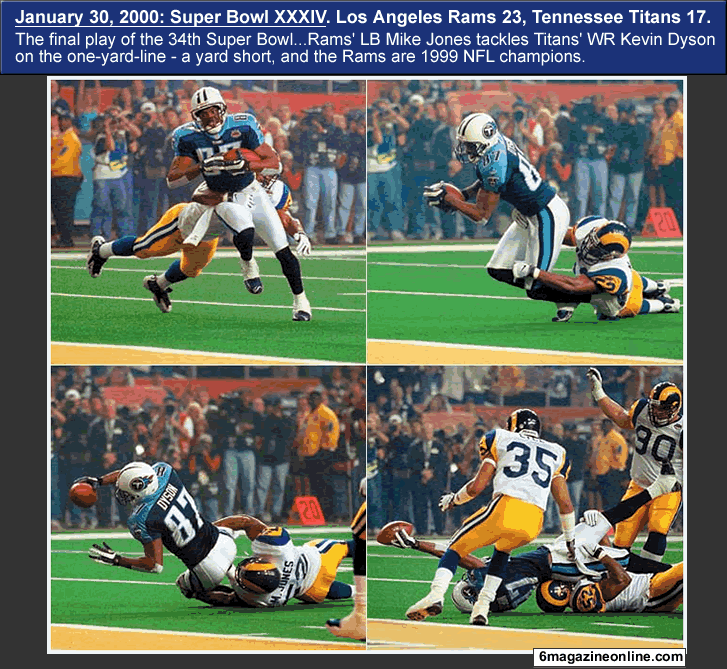
Photo credits – unattributed at 6magazineonline.com, ‘Top 10 NFL games of the 2000s‘.
The Rams won 2 NFL Championship titles (1946 [as the Cleveland Rams], 1951 [as the Los Angeles Rams]).
St. Louis Rams: 1 Super Bowl title (1999).
The Rams are 1-2 in Super Bowl appearances [losing to the Steelers in the 1979 season, and losing to the Patriots in the 2000 season].
…
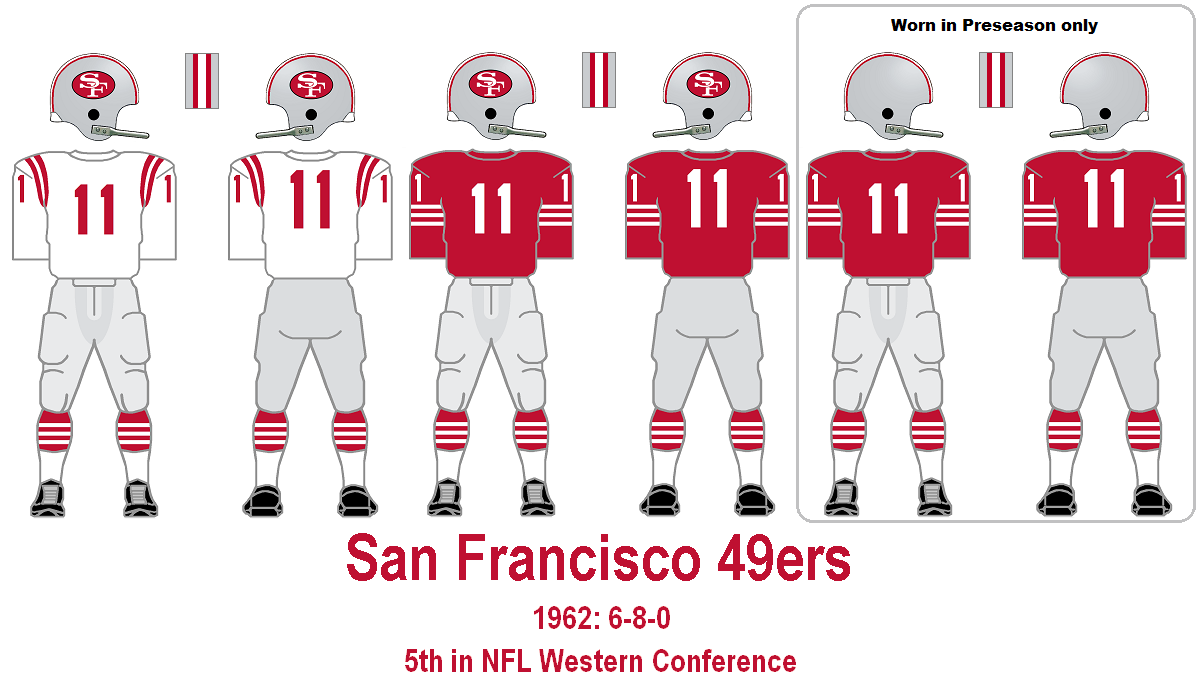
The San Francisco 49ers were established in 1946 in the 8-team All-America Football Conference (1946-1949), and played the 4 seasons of that league’s existence. The AAFC merged with the NFL in 1950. Coming into the NFL from the AAFC along with the 49ers were the Cleveland Browns and the first Baltimore Colts (I) [who have no affiliation with the present-day Baltimore/Indianapolis Colts' franchise and who wore green and silver and who lasted only one season before folding after the 1950 season]. In the 1949 off-season, players from the other 4 surviving AAFC teams were distributed to other NFL teams. The 49ers were named after the California Gold Rush of 1849. The 49ers have most often played in scarlet [bright red] and white jerseys (sometimes with black trim), and their classic look (now restored since 2009) features an understated three-stripe sleeve motif in white or scarlet on the jersey, with gold pants and a gold helmet with a grey facemask. Illogically (since the team is named after a gold rush) from circa 1946 to 1963, the 49ers usually wore silver, and not gold, helmets and pants. {See this, 1962 San Francisco 49ers uniforms, and 1964 San Francisco 49ers Uniforms (from gridiron-uniforms.com}. It wasn’t until 1964 that the 49ers began wearing gold helmets and gold pants for good (the oval “49ers” logo debuted in 1962 on a silver helmet).
The San Francisco 49ers began play in the 13-team NFL in 1950 in the 7-team National Conference (the old Western Division). From 1946 to 1970, the 49ers played at Kezar Stadium, which was located adjacent to Golden Gate Park in San Francisco. Though utilitarian in design (with a single tier of bleachers ringing the entire 54,000-capacity stadium), Kezar had a great atmosphere. {here is a youtube.com video, ‘San Francisco 49ers Tribute to Kezar Stadium‘} {here is the Kezar Stadium page at the StadiumsofProFootball.com site}. Because Kezar was built close to several San Francisco residential neighborhoods including the Flower Power nexus of the Haight-Ashbury neighborhood, considerable amounts of Niners fans walked to games [San Franciscans - reducing their carbon footprint before the phrase even existed]. The 49ers final game at Kezar Stadium was on January 3, 1971 – the 1970 NFC Championship Game, which the 49ers lost to the Dallas Cowboys. That was only the 49ers’ second playoff appearance at that point in their history (their first was in 1957, when the Niners went 8-4, then lost in the first round of the playoffs to the eventual ’57 champions the Detroit Lions). Along with the MLB team the San Francisco Giants, the 49ers moved into the poorly-sited, cold and windy Candlestick Park in 1971, and have played there ever since (the Giants have their own ballpark now, on another part of San Francisco Bay, where weather conditions are much more favorable). [Candlestick Park is frankly inadequate now, and is pretty much an albatross for the football team.] Through the early 1970s, the 49ers continued their new-found competitiveness, appearing in 3 straight NFC Championship Games (1970-72), but they lost all three to the Cowboys (the Forty Niners would get their revenge in the 1981 season).
In 1977, the San Francisco 49ers were acquired by real estate developer Edward J. DeBartolo, Jr. After the 1978 season, DeBartolo hired former Stanford coach Bill Walsh as the 49ers’ new head coach. From the en.wikipedia page on the 49ers…{excerpt}…”Walsh is given credit for popularizing the ‘West Coast offense‘. The Bill Walsh offense was actually created and refined while he was an assistant coach with [the] Bengals. The offense utilizes a short, precise, timed passing game as a replacement/augmentation of the running game. The offense is extremely difficult to defend against as it is content to consistently make 6-8 yard gains all the way down the field.”…{end of excerpt}. Notre Dame grad Joe Montana became the 49ers starting QB in late 1980, after he led the 49ers to what was then the greatest comeback in NFL history, beating the New Orleans Saints 38-35 in OT, after trailing the Saints 35-7 at halftime. In 1981 Walsh overhauled the defense – new arrivals included CB/S Ronnie Lott, LB Jack “Hacksaw” Reynolds, and DE Fred Dean. The much-improved defense led to a more balanced team, and the 1981 49ers had the best record in the league (13-3), making the playoffs for the first time since 1972. And once again, the 49ers and the Cowboys faced off in the NFC Championship Game. This time, San Francisco won 28-27, on a 6-yard TD completion from Montana to WR Dwight Clark, with 58 seconds left. Montana never saw the receiver or the reception, and had thrown the pass off-balance after being chased towards the sidelines by 3 Dallas defenders, and it first looked like he was just throwing the ball away to avoid the sack or the loss of yards. But Dwight Clark was able to leap high enough to snare the ball with his fingertips.
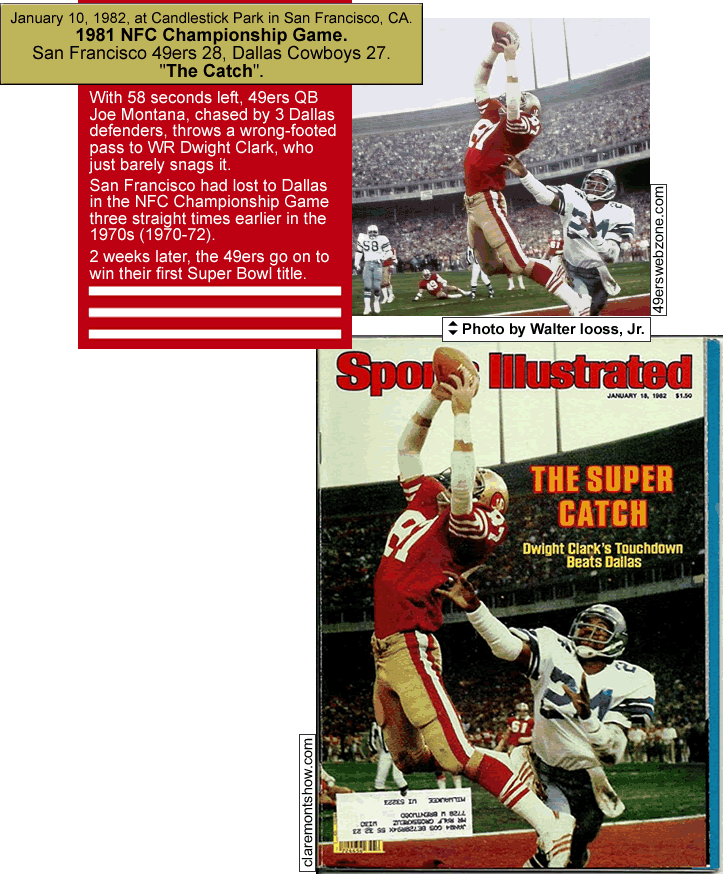
Image credits – photo [in 2 different cropped versions] by Walter Iooss, Jr/Sports Illustrated magazine {SI.com/vaults}. 49erswebzone.com, ‘What is your favorite 49ers memory/moment?‘. SI cover from http://www.claremontshows.com/catalog/publications/sportsillustrated/simags.htm
The play is known as “The Catch”, and is one of the most legendary and important plays in NFL history. It marked a turning point in the league’s balance of power, as it signaled the start of the ascension of the San Francisco 49ers as one of the greatest teams of the NFL. The 49ers went on to win the Super Bowl (XVI) that year over Bill Walsh’s old team, the Cincinnati Bengals, by a score of 26-21. The 49ers went on to win 5 Super Bowl titles in a 14-year span. The San Francisco 49ers are the only NFL team to have won more than 1 Super Bowl title and still be undefeated in Super Bowl appearances. The 49ers’ 5 Super Bowl titles are tied with the Dallas Cowboys for the second-most Super Bowl titles [the Pittsburgh Steelers have the most, with 6 Super Bowl titles].
The San Francisco 49ers won no NFL Championship titles [between 1950-1965].
San Francisco 49ers: 5 Super Bowl titles (1981, 1984, 1988, 1989, 1994).
The 49ers are 5-0 in Super Bowl appearances.
…
The Seattle Seahawks joined the NFL in 1976, along with the Tampa Bay Buccaneers. They were the 29th and 30th NFL franchises. Both played their first season in the opposite conference, then switched the next season (1977), with Seattle ending up in the AFC West, from 1977-2001. In 2002, with the restructuring of the league following it’s 32-team set-up, Seattle moved back to the NFC, joining the NFC West (2002-on). The Seahawks have played in 3 stadiums. First was the Kingdome, which was opened in 1976 and demolished in 2000. The Seahawks played in the Kingdome from 1976 to 1993. The Seahawks played the first half of the 1994 season at the University of Washington’s Husky Stadium, when the concrete ceiling of the Kingdome partially collapsed {see this ‘Kingdom/Ceing Collapse‘, from en.wikipedia.org}. The MLB team the Seattle Mariners left the inadequate and unsafe Kingdome in 1999, and the Seahawks followed suit in 2000, returning to Husky Stadium for a two-year spell (2000-01). Then in 2002, the Seahawks moved into the state-wide-voter-approved publicly funded Seahawks Stadium [now called CenturyLink Field].
Below is a link to a pretty nice page on the history of the Seahawks’ uniforms…
Seatle Seahawk Uniform History (http://mickelyantz.com/HawksUnis.html) 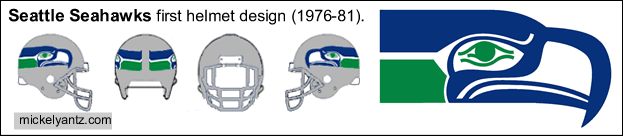
The Seahawks’ helmet logo is based on Native Northwestern Haida tribal art. From Thegreenglare.com/’Seahawks Logo Design – Case Study‘, …”Although, stated as indigenous to NW coastal indian art, some elements of the design seem to be borrowed from other artistic forms. One notable area seems to be in the eye/brow region. Although, you could make a case that certain lines resemble the Kwakiutl/Haida in expression; i.e. round pupil, curved brow and socket region. It does seem, however, that these lines more closely resemble elements of the ‘Sky God’ Eye of Horus. Not surprising since this is a powerful and popular symbol derived from the Egyptian hieroglyphs to represent their Falcon. Most other areas of the logo resemble more closely to the Haida form, however, loose in it’s interpretation. The Osprey is linked firmly to the design due to the indigenous moniker ‘Seahawk’, as well as, in image via the auricular feathers (covering the ear) with it’s bold horizontal lines. The aquiline beak portion of the design is clearly Haida Eagle in form…” {end of excerpt}.
The Seahawks originally wore silver helmets and pants, royal blue or white jerseys, and royal blue and forest green trim. In 2002, using fan-voting to arrive at a color-scheme-change, they re-tooled the Seahawk logo and changed their primary color, including their helmet-color, to a greyish-dark-blue-green color called “Seahawk blue”. Navy and lime green (actually a very distracting neon green) were trim colors. (Hey Seahawks front-office, what exactly was wrong with royal-blue/silver/forest-green?). They also turned the shape of the Seahawk logo into the shape of a squeeze of toothpaste {see this}, and they got rid of the subtle second-eyelid on the bird. In other words, they dumbed it down. This color scheme lasted from 2002 to 2011. Then it got worse. In 2012, the Seahawks again messed with their once great color scheme – changing their colors to a god-awful dark-blue-grey/neon-green/light grey. Question: Why? Answer: Because Nike. The Seahawks look horrible in their new colors, especially when you notice the strange U-shaped pattern that is on the top of their helmet and in their jersey and pants stripe-detail {see this (mickelyantz.com)}. That strange U-shaped pattern that the Seahawks have plastered all over their gear now is supposed to be feathers (explanation for that is in the excerpt two paragraphs below). Feathers?
Here are the 2012 Seattle Seahawks uniforms (gridiron-uniforms.com). Here is an article on the 2012 Seahawks uniforms, ‘Pics: Seattle Seahawks New Uniform Makes Debut‘ (news.sportslogos.net). As a commenter at that last link says of the Seahawks’ new uniforms, ‘Sweet mother of Jesus, its the Arena League’ [comment made by FormerDirtDart at the previous link]. As another commenter at that article says, ‘Is it the Seattle Seahawks or the Seattle Nikes? This is about as trashy as it gets when it comes to the new uniforms. Shame on Nike! Least subtle sports branding I’ve ever seen.’ [comment made by Matt at the previous link].
Here is an excerpt from the Seahawks Wikipedia page…’On April 3, 2012, Nike, which took over as the official uniform supplier for the league from Reebok, unveiled new uniform and logo designs for the Seahawks for the 2012 season. The new designs incorporate a new accent color, “Wolf Grey”, and the main colors are “College Navy” and “Action Green”. The uniforms incorporate “feather trims”, multiple feathers on the crown of the helmet, twelve feathers printed on the neckline and down each pant leg to represent the “12th Man”, referring to the team’s fans.’…{end of excerpt}). Yeah, because whenever I think of loud fans, or the concept of the 12th man, I always think of a strange U-shaped pattern plastered on players’ domes and running down their pants legs.
The Seattle Seahawks are 0-1 in Super Bowl appearances [losing to the Steelers in the 2005 season].
___
Thanks to the contributors to the pages at en.wikipedia.org, ‘NFC West‘.
Thanks to misterhabs.com/Helmets , aka Helmets, Helmets, Helmets site. At that site I got most of the helmet illustrations for the 8 maps in this series. There are two problems with this set of helmet illustrations at the HelmetsX3 site – the metallic helmets are shown too dark, and the site hasn’t been updated since 2009 or so. So all the helmet illustrations in this series are from the HelmetsX3 site except for the helmet illustrations of all the silver or gold (or pewter) helmeted teams – Carolina, Dallas, Detroit, Oakland, New England, New Orleans, San Francisco, and Tampa Bay; as well as new Buffalo, recently new Arizona, recently new Indy, and also Tennessee helmet illustrations, all of which I found at each team’s page at en.wikipedia.org… ‘National Football League‘.
Thanks to mlive.com, for the photo of the Vince Lombardi Trophy.
Thanks to Cardinals’ Photo Album site, for many of the old Chicago Cardinals photos.
Thanks to Maple Leaf Productions for information on designs of old, circa 1920s and early 1930s NFL helmets [on pdfs, like this one for Arizona Cardinals Uniform and Team History.
Thanks to Tim Brulia, Bill Schaefer and Rob Holecko of The Gridiron Uniforms Database (gridironuniforms.com), for giving billsportsmaps.com permission to use images from their gridiron uniform database.












![[now-defunct] Baltimore Colts of 1951 (gridironuniforms.com)](http://img23.imageshack.us/img23/4125/1950baltimorecoltsic.png)

![‘NCAA Hockey Division I [map]](https://upload.wikimedia.org/wikipedia/en/3/37/Hockey_d1.png)




![New York Giants, 1949 [uniforms]](http://www.gridiron-uniforms.com/GUD/images/1949_NYGiants.png)