billsportsmaps.com

December 14, 2016

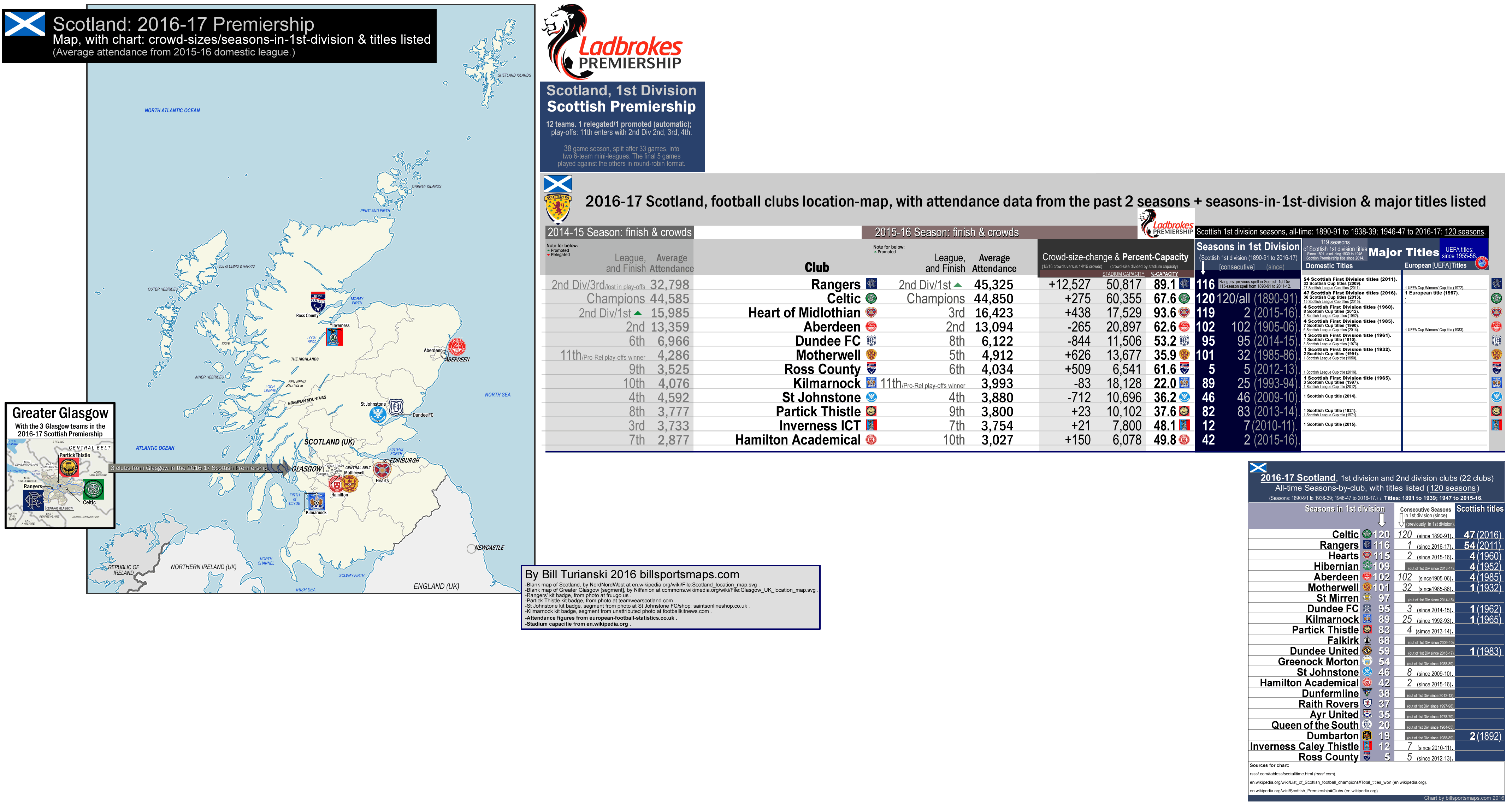
2016–17 Scottish Premiership (Scotland/1st division) location-map, with: 15/16 attendance data, seasons-in-1st-division-by-club & major titles listed.

Filed under: Scotland — admin @ 8:45 am

scotland_premiership_2016-17_map_w-crowds_seasons-in-1st-div_titles_post_f_.gif
2016–17 Scottish Premiership (Scotland/1st division) location-map, with: 15/16 attendance data, seasons-in-1st-division-by-club & major titles listed


By Bill Turianski on 14 December 2016; twitter.com/billsportsmaps.

Links…
-Teams, etc…2016–17 Scottish Premiership (en.wikipedia.org).
-Fixtures, results, table, stats…Premiership [Summary] (soccerway.com/national/scotland/premier-league).
-Kits…Ladbrokes Scottish Premiership 2016 – 2017 [Scottish 1st division kits] (historicalkits.co.uk).


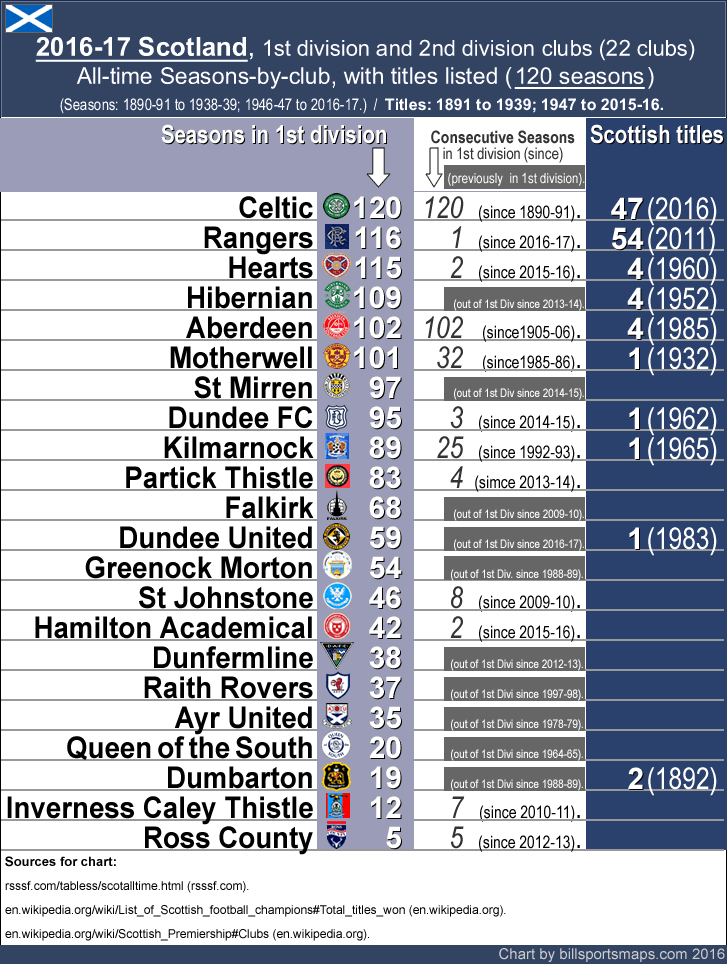
List of all-time seasons in the Scottish 1st division by club (1890-91 to 2016-17)…
I could not find any media outlet that had a list for Scotland – All-time 1st division seasons by club. That is including RSSSF and Wikipedia (well, I couldn’t find one, anyway). Although RSSSF does have a very confusing season-by-season list that only goes up to 2011-12, and regardless, that page at RSSSF does not tally the Scottish clubs’ seasons-in-the-1st-division into any form of readable list {see it here, Scotland – All-Time Table (since 1890/91) [and ending at 2011-12]}. So I made a list myself.

First off, counting 2016-17, there have been 120 seasons of top-flight (aka 1st division) football in Scotland.
The first season of Scottish top-flight football was in 1890-91, and the first Scottish national title was won jointly by Rangers FC and Dumbarton FC. Rangers and Dumbarton were declared joint champions after both teams finished even on points and then a play-off between the two – for the title – finished in a 2–2 draw. (Note: Dumbarton is 13 miles west of central Glasgow; Dumbarton FC are currently a 2nd division side, after having won promotion last season.) Dumbarton were champions outright in the second season of organized Scottish top-flight football (in 1891-92), and Celtic FC won their first Scottish title in the third season (in 1892-93). Then came re-organization into the Scottish League First Division (1893–1975). [Note: there were 6 seasons stricken due to World War II (1939-40 through 1945-46).]

By the 1950s, the Old Firm (Celtic and Rangers) had become the entrenched mega-clubs they are today, but even so, in the early post-War period there were several instances of clubs challenging the Old Firm’s dominance. First it was Hibernian, who won 3 titles in a 5-season-stretch (in 1948, in 1951, and in 1952). Then Aberdeen won the first of their 4 titles, when they were champions in 1955. Then Hearts were champions twice in 3 years (in 1958 and in 1960). And then, two much-smaller clubs were unlikely champions in the 1960s…with Dundee FC winning their only national title in 1962, then Kilmarnock winning their only national title in 1965.

Then came another re-organization with the Scottish Football League Premier Division (1975–98). The next 17 seasons – from 1966 to 1982 – saw the Old Firm more dominant than ever, and claim every title. But then in the 1980s, for a brief time, it looked like clubs were going to finally challenge the nigh-insurmountable Old Firm duopoly. That occurred in a 6-season spell in the first half of the 1980s, with Aberdeen winning their second title in 1980, then 3 years later Dundee United won their only national title in 1983. And then that was followed by the Alex Ferguson-led Aberdeen winning the next two national titles (in 1984 and ’85). But that was the last time neither Rangers or Celtic were champions.

The next re-organization saw the creation of the Scottish Premier League (1998–2013). And then the most recent re-organization brings us to the present-day, with the institution of the Scottish Premiership in 2013-14. Rangers were relegated down 4 divisions due to financial improprieties in May 2012. Rangers regained top-flight status in 2016-17, after one season in the 4th division, one season in the 3rd division, and two seasons in the 2nd division. So the Old Firm is back, and the last time another club has been the champions of Scotland has been 31 years ago…and counting.

The chart below shows the clubs in the Scottish Premiership and the Scottish Championship (2016-17 season)…
scotland_all-time-1st-division_seasons-by-club_titles_1890-91-to-2016-17_i_.gif
Sources for chart:
-Scotland – All-Time Table (since 1890/91) [and ending at 2011-12] (rssst.com).
-List of Scottish football champions (en.wikipedia.org).
-Scottish Premiership/Clubs (en.wikipedia.org).

___
Thanks to all at…
-Blank map of Scotland, by NordNordWest at File:Scotland location map.svg (en.wikipedia.org).
-Blank map of Greater Glasgow [segment], by Nilfanion at File:Glasgow UK location map.svg (commons.wikimedia.org).
-Rangers’ kit badge, from photo at fruugo.us.
-Partick Thistle kit badge, from photo at teamwearscotland.com.
-St Johnstone kit badge, segment from photo at St Johnstone FC shop.
-Kilmarnock kit badge, segment from unattributed photo at footballkitnews.com/jpg

December 11, 2016

NCAA Division I Hockey: the Atlantic Hockey Conference (AHC): attendance map (2015-16 regular season), with arena capacities, percent-capacities.

Filed under: Hockey,NCAA, ice hockey,NCAA, ice- Atlantic Conf — admin @ 7:00 pm

ncaa_ice-hockey_atlantic-hockey-conference_attendance-map_2015-16_11-teams_post_d_.gif
NCAA Division I Hockey: the Atlantic Hockey Conference (AHC): attendance map (2015-16 regular season), with arena capacities, percent-capacities


By Bill Turianski on 11 December 2016; twitter.com/billsportsmaps.

Links…
Conferences…Division I in ice hockey.
Teams in Atlantic Hockey, etc…Atlantic Hockey (en.wikipedia.org).
-USCHO.com Atlantic Hockey blog (uscho.com).

Conference-maps for NCAA Division I (aka D1) men’s ice hockey
(Note: already-posted D1-hockey conference maps are linked-to, below.)
I am making a location-map for each of the 6 D1-hockey conferences, which are…
Atlantic Hockey Association (11 teams/est. 1998-99/ zero titles).
Big Ten Conference hockey (6 teams [7-teams in 2017-18]/est. 2013-14/ 23 titles won amongst its six teams).
∙ECAC Hockey (12 teams/est. 1961-62/ 7 titles won amongst its twelve teams).
∙Hockey East Association (12 teams [11 teams in 2017-18]/est. 1984-85/ 13 titles won amongst its twelve teams).
National Collegiate Hockey Conference (aka NCHC) (8 teams/est. 2013-14/ 18 titles won amongst its eight teams).
Western Collegiate Hockey Association (aka WCHA) (10 teams/est. 1951-52/ 8 titles won amongst its ten teams).

The location-map here shows the eleven-team Atlantic Hockey Conference (AHC).
The AHC has teams spread through four Northeastern states, plus Colorado. There are 4 teams from New York (Canisius College, Niagara, Rochester Institute of Technology [RIT], US Military Academy [Army]), 3 teams from Massachusetts (American International University [AIC], Bentley, Holy Cross), 2 teams from Pennsylvania (Mercyhurst and Robert Morris), 1 team from Connecticut (Sacred Heart), and 1 team from Colorado (US Air Force Academy).

The map
The map is based on my recently-posted 60-team NCAA D1-hockey location-map {see it here}. The Atlantic Hockey teams’ crests, colors and arena-locations are shown on the map. Each team’s color-circle, which radiates out from their location-dot, is sized to represent average attendance…the larger the circle, the higher the team’s average attendance. Crowd-size-rank within the 60-team-D1 is also noted – by the number next to the team-name on the map and on the attendance-list. (North Dakota is the highest-drawing D1-hockey team, currently.)

The chart at the right side of the map page shows attendance data. Along with average attendances of the 11 Atlantic hockey teams (2015-16 home regular season figures), arena sizes and percent-capacities are listed. At the lower-right of the map-page is a chart showing all D1-hockey teams’ titles and Frozen Four appearances (39 of the 60 D1-hockey teams).

Of the eleven Atlantic Hockey teams, eight of them are in the bottom ten of D1-hockey attendance…
Not only is Atlantic Hockey full of teams that are decidedly small-program, there are no D1-hockey titles won among its eleven teams. But there are four teams in Atlantic Hockey which are filling their small arenas pretty well. The Mercyhurst Lakers (of Erie, PA) are playing to sell-out crowds most games (they drew 1.2 K in their 1.3-K-capacity arena last season). And the Air Force Falcons, the RIT Tigers, and the Holy Cross Crusaders are all drawing above 75 percent-capacity.

I suspect most teams in Atlantic Hockey do not benefit from much local newspaper coverage or from local television-sports-news coverage, and this contributes to low attendance. Here is an article from the Buffalo News from March 2015, which discusses this, BNRinkside: College hockey attendance analytics (by Amy Moritz at buffalonews.com). In that article it is said that “Atlantic Hockey could do better to promote itself, not just nationally but in its own markets.” But how? If the local media aren’t covering Atlantic Hockey teams because they draw so low, how do you get people to know you even exist? It is a Catch-22-situation that ends up dooming low-drawing Atlantic Hockey teams to small crowds, thanks to a non-existent media footprint. In other words, they don’t get any local news coverage because they draw so poorly, and they draw so poorly because they don’t get any local news coverage.

That being said, there are a few teams in Atlantic Hockey that enjoy decent coverage in their local newspaper, like my hometown’s team, the RIT Tigers (see 2 paragraphs below). And like the Holy Cross Crusaders (of Worcester, MA), as this write-up of a recent game shows. And like Air Force (of Colorado Springs, CO)/see this. And like the two Greater Buffalo-based teams (Canisius College and Niagara)/see this.

But many teams in Atlantic Hockey, like the Robert Morris Patriots (of Moon Township, Greater Pittsburgh, PA), get very spotty coverage (like a report on a game a week ago, but no report on the Robert Morris game versus Bentley on Dec. 10th). Or gets none at all (note how at that link there is a section for the minor-league soccer team [Pittsburgh Riverhounds], but no section at all for any Robert Morris sports teams). And the same can be said – for a complete lack of media coverage – of the two Atlantic Hockey teams within the Greater New York City area: the Sacred Heart Pioneers (of Fairfield, CT) and the Army Black Knights (of West Point, NY). Ditto for the Bentley Falcons (of Waltham, MA), in Boston. I could not find any coverage of the AIC Yellow Jackets in the Springfield, Massachusetts television and print media. And it looks like the Mercyhurst Lakers get less coverage than local high school hockey and the Erie Otters (who play in the Ontario Hockey League and draw 4 times what Mercyhurts draws/see this recent OHL map I made).

In my hometown – Rochester, NY – that is actually not the case, and the RIT Tigers hockey team gets pretty solid coverage in the local newspaper, and from the local cable 24-hour news channel, as well as the local network-television stations (like this: RIT hockey toger toss and this: RIT Hockey Loses Series Against Providence). But that is because my hometown is a real anomaly. Rochester has a population of around 1.1 million in its metro-area (making it the 54th largest city in the USA/see this). Despite that, Rochester is one of the two largest city/metro-areas in the USA without even a D1-college basketball team, let alone any major league teams, or a D1-football team. (The only other city of equal-or-greater-size with that same situation is Grand Rapids, MI [52nd-largest-city in the USA], which also has no major league teams, or D1-football teams, or D1-basketball teams.)

So when the RIT Tigers hockey team made the leap up, from Division III to Division I in 2005, it was relatively big news in my sleepy town, because Rochester finally had a D1 team, albeit only in hockey. But Rochester is a hockey town (the Rochester Amerks are the second-oldest team in the AHL and are the nearby Buffalo Sabres’ top farm team). Now in a new, on-campus 4.3-K-capacity arena, the RIT Tigers lead Atlantic Hockey in attendance, drawing 3.3 K. And the RIT Tigers made it to a Frozen Four (in 2010), which is the only time any Atlantic Hockey team has ever done so.
___
Thanks to all at the following links…
-Thanks to AMK1211 for blank map of USA, ‘File:Blank US Map with borders.svg”>File:Blank US Map with borders.svg‘ (commons.wikimedia.org).
-Thanks to Two Hearted River at en.wikipedia.org/[each teams' page at Wikipedia], for small segments of jersey illustrations of several teams (Wisconsin, Minnesota-Duluth, Cornell, Maine, Minnesota State, Vermont, Yale, UMass, Western Michigan, Canisius College, American International), such as at File:ECAC-Uniform-Cornell.png.
-Thanks to USCHO site for attendance data, Men’s Division I Hockey Attendance: 2015-2016 (uscho.com).

December 7, 2016

NCAA Division I Hockey: Big Ten Conference hockey: attendance map (2015-16 regular season), with arena capacities, percent-capacities & D1-hockey titles listed.

Filed under: Hockey,NCAA, ice hockey,NCAA, ice- Big Ten hockey — admin @ 4:15 pm

ncaa_ice-hockey_big-ten-conference_attendance-map_2015-16_7-teams_post_b_.gif
NCAA Division I Hockey: Big Ten Conference hockey: attendance map (2015-16 regular season), with arena capacities, percent-capacities & D1-hockey titles listed


By Bill Turianski on 7 December 2016; twitter.com/billsportsmaps.

Links…
Conferences…Division I in ice hockey.
Teams, etc…Big Ten Conference hockey (en.wikipedia.org).

Conference-maps for NCAA Division I (aka D1) men’s ice hockey
(Note: already-posted D1-hockey conference maps are linked-to, below.)
I am making a location-map for each of the 6 D1-hockey conferences, which are…
Atlantic Hockey Association (11 teams/est. 1998-99/ zero titles).
Big Ten Conference hockey (6 teams [7-teams in 2017-18]/est. 2013-14/ 23 titles won amongst its six teams).
∙ECAC Hockey (12 teams/est. 1961-62/ 7 titles won amongst its twelve teams).
∙Hockey East Association (12 teams [11 teams in 2017-18]/est. 1984-85/ 13 titles won amongst its twelve teams).
National Collegiate Hockey Conference (aka NCHC) (8 teams/est. 2013-14/ 18 titles won amongst its eight teams).
Western Collegiate Hockey Association (aka WCHA) (10 teams/est. 1951-52/ 8 titles won amongst its ten teams).

The location-map here shows the 6-team (and soon-to-be-7-team) Big Ten Conference hockey.
Big Ten hockey has teams spread through 5 states in the Northeast/Upper Midwest: 2 teams from Michigan (Michigan and Michigan State), 1 team from Minnesota (Minnesota), 1 team from Wisconsin (Wisconsin), 1 team from Ohio (Ohio State), and 1 team from Pennsylvania (Penn State). Next season – 2017-18 – Notre Dame (of Notre Dame, Indiana) will join Big Ten Conference hockey to make it a 7-team conference. So I have included Notre Dame on the map, with a captions describing their future inclusion into Big Ten hockey. I also added Notre Dame’s attendance data. {Also see this, Notre Dame Fighting Irish men’s ice hockey.}

The map
The map is based on my recently-posted 60-team NCAA D1-hockey location-map {see it here}. The Big Ten hockey teams’ crests, colors and arena-locations are shown on the map. Each team’s color-circle, which radiates out from their location-dot, is sized to represent average attendance…the larger the circle, the higher the team’s average attendance. Crowd-size-rank within the 60-team-D1 is also noted – by the number next to the team-name on the map and on the attendance-list. (North Dakota is the highest-drawing D1-hockey team, currently.)

The chart at the right side of the map page shows attendance data. Along with average attendances of the Big Ten hockey teams (2015-16 home regular season figures), arena sizes and percent-capacities are listed. Also shown, below the attendance data, is a list showing all D1-hockey titles which have been won by teams that currently play in the conference (in this case, all titles won by teams in Big Ten Conference hockey). Finally, at the lower-right of the map-page is a chart showing all D1-hockey teams’ titles and Frozen Four appearances (39 of the 60 D1-hockey teams). (Michigan has the most D1-hockey titles, but the Wolverines have not won a hockey title in eighteen years (last in 1998); meanwhile, with North Dakota winning the title last season (2015-16), they have moved past Denver up to second-most D1-hockey titles, with 8. The D1-hockey team with the most Frozen Four appearances is the Boston College Eagles, with 25.)

Division I NCAA hockey was instituted in 1948.
(Division I NCAA hockey titles, 1948 to 2015-16/ 69 titles.)
The inclusion of Penn State as a D1-hockey team (who debuted in 2012-13), led to the 2011-2013-era realignment in D1-hockey. The shakeup in D1-hockey conferences occurred in much the same way (and in nearly the same time-period) as the recent realignments in NCAA D1-football and in NCAA D1-basketball. After the dust had settled in D1-hockey, there was 6 conferences instead of 5, and one conference was dissolved – the Central Collegiate Hockey Associaition (CCHA). (The CCHA existed as a D1-hockey conference from 1973-2013.) (Note: there is one D1-hockey team that is currently an Independent, newcomers Arizona State.)

Since 2013-14, there are two new conferences in D1-hockey:
Big Ten Conference hockey,
National Collegiate Hockey Conference (NCHC).

In D1-hockey these days, the Big Ten is the 800-pound gorilla in the room…
The creation of Big Ten Conference hockey has upset some within the D1-college-hockey community. They fear that the days of small schools being able to compete in D1-hockey may be soon over. And it is not just that small schools have been able to be in, and compete well, in D1-hockey. It is the fact that, going back many decades, small schools within D1-hockey have actually been able to win D1 titles. Like how all three D1-hockey schools from the Upper Peninsula in Michigan (Michigan Tech, Northern Michigan, and Lake Superior State) were able to win D1-hockey titles in the time period from the 1960s up until the mid-1990s. And more recently, like how tiny Union College (of Schenectedy, NY) won the 2014 D1-hockey title. Despite Union College being a school with an enrollment of only around 2,240 undergraduates, and despite the Union College Dutchmen having a D1-hockey team without a single scholarship-player.

Here an excerpt from an article from 2014 from the College Hockey News site, ‘From the get go, there’s been a worry that the formation of the Big Ten would allow the rich to get richer, allow recruiting budgets to go even higher, increase the distance between the big guy and little guy.’ (quote from Stop Complaining – Conference Tournaments’ Attendance, Setup Not Worthy of Scorn by Adam Woden at collegehockeynews.com).

Big Ten hockey did something recently that was by most accounts pretty tone-deaf. They made, unilaterally, a proposal to the NCAA, to toughen the D1-hockey rules for older-aged players’ eligibility, which would end up hurting the smaller schools. (You can read about that in the article at the link below.) That action by Big Ten hockey is being perceived by some as perhaps being a foreshadowing of the big schools throwing their weight around in D1-hockey, to the detriment of the smaller D1-hockey schools. Here is an article from July 2016, from SB Nation, on the Big Ten’s entrance into D1-hockey and how it has some worried (note: the comments section at the link below is also worth reading, as several commenters there raise some interesting points)…The Fabled Big Ten Hockey Conference Is Ruffling Feathers Did you know that many hockey fans outside of the Big Ten are not happy about the conference’s existence? – (by Chris Taylor at blackshoediaries.com).
___
Thanks to all at the following links…
-Thanks to AMK1211 for blank map of USA, ‘File:Blank US Map with borders.svg”>File:Blank US Map with borders.svg‘ (commons.wikimedia.org).
-Thanks to Two Hearted River at en.wikipedia.org/[each teams' page at Wikipedia], for small segments of jersey illustrations of several teams (Wisconsin, Minnesota-Duluth, Cornell, Maine, Minnesota State, Vermont, Yale, UMass, Western Michigan, Canisius College, American International), such as at File:ECAC-Uniform-Cornell.png.
-Thanks to USCHO site for attendance data, Men’s Division I Hockey Attendance: 2015-2016 (uscho.com).

November 29, 2016

2016-17 FA Cup 2nd Round – map and attendance list./+ Stourbridge FC, the lowest-placed club still alive in the tournament.

Filed under: 2016-17 FA Cup — admin @ 1:55 pm

2016-17_fa-cup_2nd-round_location-map_40-clubs_w-current-attendances-in-leagues_w-fixtures_post_b_.gif
2016-17 FA Cup 2nd Round map and attendance list


Links…
-The competition…FA Cup (en.wikipedia.org).
-2nd Round: fixtures/teams… (us.soccerway.com/national/england/fa-cup).
-BBC’s page on the FA Cup…FA Cup (bbc.com/sport/football/fa-cup).
-2016-17 FA Cup 2nd Round Tie-by-Tie Preview (facupfactfile.wordpress.com).
-FA Cup second round: Early reunions and second chances among stories to watch (compiled by Tom Garry on 2 December 2016 at bbc.com/football).

By Bill Turianski on 29 November 2016; twitter.com/billsportsmaps.com.

Schedule for 2016-17 FA Cup…
2016-17_fa-cup_schedule_d_.gif

The map…
The map shows the 40 clubs who have qualified for the 2016-17 FA Cup Second Round Proper. There are 12 Non-League teams still alive, as well as 28 teams from the lower two divisions of the Football League (Leagues One and Two). Also on the map page is the 2nd Round fixture list, and there is a list of the 40 clubs’ current home league average attendances.

The lowest-placed club to qualify for the 2016-17 FA Cup 2nd Round is Stourbridge FC
Stourbridge are in the Northern Premier League (which is a 7th-level league); they currently are in 10th place. Stourbridge FC are drawing 778 per game, which is the highest crowd-size in the league. Stourbridge is in the Black Country region of the West Midlands, just southwest of Dudley, and 18 km (11 mi) W of central Birmingham (as the crow flies). As it says at Stourbridge’s Wikipedia page,…”Historically a part of Worcestershire, Stourbridge was a centre of glass making, and today includes the suburbs of Amblecote, Lye, Norton, Oldswinford, Pedmore, Wollaston, Wollescote and Wordsley.” Stourbridge has a population of around 63,000 {2011 figure}.

Owing to the town’s traditional association with the glass-making and cut-glass industries, the football team is known as the Glassboys. They wear red-and-white vertically-striped jerseys. Stourbridge have played at the War Memorial Athletic Ground for over 120 years (since 1890). (The War Memorial Athletic Ground is sometimes referred to as Amblecoat, for the region in Stourbridge that the ground is located in.) It is a dual-sport facility: Stourbridge FC ground-share with the Stourbridge Cricket Club. So the pitch features just three sides of small-stands-or-terracing, with the one long side open to accommodate the cricket playing-field. The main stand is very small and features a small central section that is a barn-style roof. Here is a nice groundhoppers-type article, from 2013, which features Stourbridge’s ground [scroll all the way to the end of the post to see the Stourbridge section], 20 Glorious Non-League Grounds (peterrmiles.wordpress.com).

The manager of Stourbridge FC is Gary Hackett, who is Stourbridge-born and has been on the coaching staff at Stourbridge since 2003. Gary Hackett is a former Winger who had a long career at Bomsgrove Rovers, Shrewsbury Town, Aberdeen (in Scotland), West Bromwich Albion, Peterborough United, Chester City, and Halesowen Town, retiring from the playing field in 1997. Gary Hacket has been at the helm at Stourbridge for 11 years now. In the early 2000s, Jon Ford and Gary Hackett had been the co-managers at nearby Bomsgrove Rovers. The two moved over to Stourbridge FC in 2003. Hackett took over as full-time manager of Stoursbridge in 2005, with Ford taking the assistant manager job (Ford decided to step down owing to work and family commitments). The two have remained in those capacities ever since, ushering in Stourbridge’s best decade ever. In that time, the Glassboys have won two promotions (up to the 7th level) and have qualified for the FA Cup 5 times in 8 years, including 4 FA Cup 2nd Round appearances, two of which as the lowest-placed team still alive in the competition.

Stourbridge have had a recent history of FA Cup success…
Stourbridge FC have been around since 1876, but had never made it to the FA Cup 1st Round in over a century of trying, until the 2009-10 season. And then making it to the 2nd Round four times in less than a decade…well that is a pretty impressive accomplishment for a club that has never been above the 7th division. Stourbridge’s second FA Cup 1st Round appearance, in 2011-12, saw them beat Football League mainstays Plymouth Argyle (in the re-play) to make it to the 2nd Round. The re-play at home v Plymouth, and the 2nd Round match at home v Stevenage were both televised. Then Stourbridge also made it to the 2nd Round in 2013-14, when they beat 7th-level-side Biggleswade Town. Then in 2015-16, Stourbridge beat then-5th-division-side and local rivals Kidderminster Harriers in the 4th Qualifying Round, and then beat 5th-division-side Dover Athletic, away, in the 1st Round, to again advance to the 2nd Round. And then this season [2016-17], Stourbridge once again advanced to the 2nd Round when they beat 9th-level-side Westfields (in the re-play).

Now, in the 2016-17 FA Cup 2nd Round, Stourbridge have gotten a decent match-up – at home versus 3rd-division-side Northampton Town (who are in 17th place in League One currently). As the FA Cup Factfile site says…”Stourbridge fans and players can take heart in the knowledge that The Cobblers hold the record of most FA Cup 2nd Round exits with 30.”…{excerpt from 2016-17 FA Cup 2nd Round Tie-by-Tie Preview (facupfactfile.wordpress.com)}. I think a draw or even a giant-killing upset is definitely feasible at Stourbridges’ War Memorial Athletic Ground [on Sunday the 4th of December 2016]. Especially because Northampton Town’s top priority is to avoid being relegated right back to the 4th division, yet have lost the 4 straight League One games leading up to this Cup-match on Sunday. The match is sold out {see this, from the official Stourbridge FC site.}

Televised matches for 2016-17 FA Cup 2nd Round…
In my opinion, the Stourbridge-v-Northampton match should have been chosen as one of the live televised games, but it wasn’t. That being said, there is a very enticing match being televised live…Curzon Ashton v AFC Wimbledon. 6th-level/National League North side Curzon Ashton are from the eastern part of Greater Manchester, in the foothills of the Pennines just south of Oldham (and 10 km E of Manchester). At their relatively-new Tameside Stadium in Ashton-under-Lyme (which opened in 2005), Curzon Ashton will host AFC Wimbledon, the world-renowned supporter-owned club from South London (who are now in the 3rd division, and have been playing well, and sit 7th, just below the play-off places). {To whet your appetite for the match, here is a Curzon Ashton/Tameside Stadium groundhopping-post, from 2012, from the excellent Gibbos92 site, here.} That Curzon Ashton/AFC Wimbledon match is on the Sunday the 4th. Also being televised live for the 2nd Round is the Friday the 2nd game: Macclesfield Town v Oxford United, as well as the Monday the 5th game: Lincoln City v Oldham Athletic. {Here is a nice Macclesfield Town/Moss Rose groundhopping-post, from 2013 from the great Groundhopping.se site, here; here is a nice Lincoln City/Sincil Bank groundhopping-post from, from 2016, from the Groundhopping with Ryan blog, here.}

Below: the War Memorial Athletic Ground, home of Stourbridge FC…
stourbridge-fc_war-memorial-athletic-ground_gary-hackett_c_.gif
Photo and Image credits above – Stourbridge home kit, illustration from en.wikipedia.org. Stourbridge town centre, photo by Stephen McKay at commons.wikimedia.org. Photo of entrance to ground, photo unattributed at warmemorials.myfastforum.org. Photo of main stand, photo by europlan-online.de. Game-action shot of main stand, photo by richardl1967 at stadiumsandcities.wordpress.com. Shot of manager Gary Hackett, photo by Kevin Quigley via dailymail.co.uk/football.

____
Thanks to all at the links below…
-Blank map of UK historic counties, by Nilfanion (using UK Ordnance Survey data), at File:United Kingdom police areas map.svg (commons.wikimedia.org).
-Blank relief map of Greater London, by Nilfanion (using UK Ordnance Survey data), at File:Greater London UK relief location map.jpg.
-Blank relief map of Greater Manchester, by Nilfanion (using Ordnance Survey data), at File:Greater Manchester UK relief location map.jpg.
-Photo of Curzon Ashton badge, photo from ebay.com.
-Current average attendance figures from Soccerway.com.
-Current average attendance for lower Non-League club (7th Level), at non-league-matters.co.uk.

November 23, 2016

NCAA Division I Hockey: the National Collegiate Hockey Conference (NCHC): attendance map (2015-16 regular season), with arena capacities, percent-capacities & NCAA D1-hockey titles listed./+Chart of all-time D1-hockey titles-&-Frozen-Four-appearances.

Filed under: Hockey,NCAA, ice hockey,NCAA, ice- NCHC — admin @ 10:42 pm

ncaa_ice-hockey_nchc-conference_attendance-map_2015-16_8-teams_post_d_.gif
NCAA Division I Hockey: the National Collegiate Hockey Conference (NCHC): attendance map (2015-16 regular season), with arena capacities & percent-capacities


By Bill Turianski on 23 November 2016; twitter.com/billsportsmaps.

Links…
-Teams in NCHC, etc…National Collegiate Hockey Conference (en.wikipedia.org).
-NCHC page at USCHO.com.
-My recent post of D1-hockey (map with all 60 teams & 2015-16 attendance.

Conference-maps for NCAA Division I (aka D1) men’s ice hockey
(Note: already-posted D1-hockey conference maps are linked-to, below.)
I am making a location-map for each of the 6 D1-hockey conferences, which are…
Atlantic Hockey Association (11 teams/est. 1998-99/ zero titles).
Big Ten Conference hockey (6 teams [7-teams in 2017-18]/est. 2013-14/ 23 titles won amongst its six teams).
∙ECAC Hockey (12 teams/est. 1961-62/ 7 titles won amongst its twelve teams).
∙Hockey East Association (12 teams [11 teams in 2017-18]/est. 1984-85/ 13 titles won amongst its twelve teams).
National Collegiate Hockey Conference (aka NCHC) (8 teams/est. 2013-14/ 18 titles won amongst its eight teams).
Western Collegiate Hockey Association (aka WCHA) (10 teams/est. 1951-52/ 8 titles won amongst its ten teams).

The map-page here shows the eight-team National Collegiate Hockey Conference (NCHC) + a chart of all-time D1-hockey titles-&-Frozen-Four-appearances…
The NCHC has teams spread through 6 states: 2 teams from Colorado (Denver and Colorado College [of Colorado Springs, CO), 2 teams from Minnesota (Minnesota-Duluth and St. Cloud), 1 team from North Dakota (North Dakota [of Grand Forks, ND]), 1 team from Michigan (Western Michigan [of Kalamazoo, MI]), 1 team from Ohio (Miami of Ohio [of Oxford, OH]), and 1 team from Nebraska (Omaha). In 2013, Miami of Ohio and Western Michigan left the now-defunct CCHA to join the newly-formed NCHC. Also in 2013, 6 others joined the newly-formed NCHC – Denver, Colorado College, Minnesota-Duluth, North Dakota, Omaha, and St. Cloud. Those 6 teams came from the Western Collegiate Hockey Association (WCHA). The WCHA still exists, but is vastly different from what it was before 2013 – the WCHA now has a vast spread of teams in Alaska, Alabama, Michigan, Minnesota, and Ohio {see WCHA former-members and WCHA timeline}.

The NCHC team the North Dakota Fighting Hawks were champions in D1-hockey in 2016…
{See this recent illustration I made for 2015-16 North Dakota: D1-hockey champions.} As to the all-time records, Michigan (now of Big Ten hockey) has the most D1-hockey titles, but the Wolverines have not won a hockey title in eighteen years (last in 1998). Meanwhile, with North Dakota winning the title last season, North Dakota has moved past Denver up to second-most D1-hockey titles, with 8. The NCHC team the Denver Pioneers won the last of their 7 D-1 hockey titles in 2004 and 2005. There are 2 other NCHC teams which have won D1-hockey titles…the Colorado College Tigers, and the Minnesota-Duluth Bulldogs. Colorado College has won 2 D1-hockey titles (albeit both were won over a half century ago, in 1950 and 1957). Minnesota-Duluth won their sole D1-hockey title 6 seasons ago, in 2011.

North Dakota has 22 Frozen Four appearances, which is tied for 4th-best (with Boston University). (The D1-hockey team with the most Frozen Four appearances is the Hockey East team the Boston College Eagles, with 25 Frozen Four appearances.) Another NCHC team is high on the list of Frozen Four appearances – the Denver Pioneers, with 15 (6th-best). To round out the Frozen Four appearances of NCHC teams, the Colorado College Tigers have 10 (last in 2005), and 3 others have one each: the Miami RedHawks (in 2005), the St. Cloud State Huskies (in 2013), and the Omaha Mavericks (in 2015). An indication of the power of the NCHC is that in the 3 seasons it has existed, it has produced 5 of the last 12 Frozen Four qualifiers, with North Dakota qualifying for 3 straight Frozen Fours (2014-16), and with Denver (last season) and Omaha (two seasons ago) also making it to the Frozen Four since the NCHC began operating in 2013-14. So the NCHC is brand new, and it already is basically one of the elite D1-hockey conferences.

NCHC teams draw pretty well too…
Every NCHC team draws above 75 percent-capacity. And 4 of the 8 NCHC teams draw crowds that place them in the top 6 of D1-hockey…#1-best-drawing-team North Dakota Fighting Hawks (drawing 11.6-K, at an impressive 100.5 percent-capacity), #4-best-drawing-team Omaha Mavericks (6.9-K, at 87.6 percent-capacity), #5-best-drawing-team Minnesota-Duluth Bulldogs (6.1-K, at a solid 92.6 percent-capacity), and #6-best-drawing-team Colorado College Tigers (6.1-K, at 83.2 percent-capacity). Colorado College’s attendance numbers are even more respectable than it first appears, once you realize that there actually is another D1-hockey team in their home-city of Colorado Springs – Air Force Academy (of the Atlantic Conference).
___
Thanks to all at the following links…
-Thanks to AMK1211 for blank map of USA, ‘File:Blank US Map with borders.svg”>File:Blank US Map with borders.svg‘ (commons.wikimedia.org).
-Thanks to Two Hearted River at en.wikipedia.org/[each teams' page at Wikipedia], for small segments of jersey illustrations of several teams (Wisconsin, Minnesota-Duluth, Cornell, Maine, Minnesota State, Vermont, Yale, UMass, Western Michigan, Canisius College, American International), such as at File:ECAC-Uniform-Cornell.png.
-Thanks to USCHO site for attendance data, Men’s Division I Hockey Attendance: 2015-2016 (uscho.com).

November 15, 2016

NCAA Division I Men’s Ice Hockey – 2015-16 average attendance map of all 60 teams in D1-hockey (with arena capacities & percent capacities).

Filed under: Hockey,NCAA ice hockey map 2011,2016,NCAA, ice hockey — admin @ 6:09 pm

ncaa_ice-hockey_attendance-map_2015-16_60-teams_post_b_.gif
NCAA Division I Men’s Ice Hockey – 2015-16 average attendance map of all 60 teams in Division I (with arena capacities & percent capacities)


By Bill Turianski on 15 November 2016; twitter.com/billsportsmaps.

Links…
-D1 Men’s Hockey coverage…uscho.com.
-Teams, etc…College ice hockey/Division I (en.wikipedia.org).

-Conference-maps for NCAA Division I (aka D1) men’s ice hockey
(Note: already-posted D1-hockey conference maps are linked-to, below.)
I am making a location-map for each of the 6 D1-hockey conferences, which are…
Atlantic Hockey Association (11 teams/est. 1998-99/ zero titles).
Big Ten Conference hockey (6 teams [7-teams in 2017-18]/est. 2013-14/ 23 titles won amongst its six teams).
ECAC Hockey (12 teams/est. 1961-62/ 7 titles won amongst its twelve teams).
∙Hockey East Association (12 teams [11 teams in 2017-18]/est. 1984-85/ 13 titles won amongst its twelve teams).
National Collegiate Hockey Conference (aka NCHC) (8 teams/est. 2013-14/ 18 titles won amongst its eight teams).
Western Collegiate Hockey Association (aka WCHA) (10 teams/est. 1951-52/ 8 titles won amongst its ten teams).

Here is a list of all D1-hockey teams (14 teams) which drew above 90 percent-capacity in 2015-16…
Team [location], percent-capacity, average attendance, (D-1 attendance-rank).
Penn State Nittany Lions [of University Park, PA], 105.4% at 6,093 per game (#7 in attendance).
Quinnipiac Bobcats [of Hamden, Greater New Haven, CT], 105.2% at 3,247 per game (#27 in attendance).
North Dakota Fighting Hawks [of Grand Forks, ND], 100.5%, at 11,675 per game (#1-best attendance).
Mercyhurst Lakers [of Erie, PA], 98.7%, at 1,283 per game (#54 in attendance).
Minnesota Golden Gophers [of Minneapolis/St. Paul, MN], 98.5% (#2 in attendance.
Providence Friars [of Providence, RI], 98.3%, at 2,980 per game (#29 in attendance).
Yale Bulldogs [of New Haven, CT], 97.1%, at 3,385 per game (#23 in attendance).
Vermont Catamounts [of Burlington, VT], 95.7%, at 3,860 per game (#21 in attendance).
Notre Dame Fighting Irish [of Notre Dame, IN], 94.6%, at 4,749 per game (#16 in attendance).
Cornell Big Red [of Ithaca, NY], 94.3%, at 4,022 per game (#19 in attendance).
Michigan Wolverines [of Ann Arbor, MI], 94.1%, at 5,457 per game (#10 in attendance).
UMass-Lowell River Hawks [of Lowell, Greater Boston, MA], 93.2%, at 5,592 per game, at 6,111 per game (#5 in attendance).
Minnesota-Duluth Bulldogs [of Duluth, MN], 92.6%, at 6,111 per game (#5 in attendance).
Merrimack College Warriors [of North Andover, Greater Boston, MA], 92.5, at 2,359 per game (#39 in attendance).

Division I NCAA hockey was instituted in 1948.
(Division I NCAA hockey titles, 1948 to 2015-16/ 69 titles.)
The inclusion of Penn State as a D1-hockey team (who debuted in 2012-13), led to the 2011-2013-era realignment in D1-hockey. The shakeup in D1-hockey conferences occurred in much the same way (and in nearly the same time-period) as the recent realignments in NCAA D1-football and in NCAA D1-basketball. After the dust had settled in D1-hockey, there was 6 conferences instead of 5, and one conference was dissolved – the Central Collegiate Hockey Associaition (CCHA). (The CCHA existed as a D1-hockey conference from 1973-2013.) (Note: there is one D1-hockey team that is currently an Independent, newcomers Arizona State.)

Since 2013-14, there are two new conferences in D1-hockey:
Big Ten Conference hockey,
National Collegiate Hockey Conference (NCHC).

    The highest-drawing NCAA college hockey team & the 2016 NCAA Division I champions:
    The University of North Dakota (of Grand Forks, ND
    ).

-From USA Today.com from April 10, 2016, North Dakota beats Quinnipiac 5-1 to capture NCAA hockey title (usatoday.com).
-From the official UND site, Ralph Englestad Arena (article, with photos, at undsports.com).
University of North Dakota hockey team – 2016 Division I champions…
north-dakota_fighting-hawks_hockey_2016-div1-champs_2016-best-attendance_ralph-engelstad-arena_grand-forks-nd_d_.gif

Photo and Image credits above -
Aerial view of Grand Forks [video image] from Smithsonian via gettyimages.com/video/view-of-grand-forks-town-square-and-red-river-grand-stock-footage. Shot of exterior of Ralph Englestad Arena at twilight, photo by undsports.com. Aerial shot, photo by Northern Technologies, LLC at ntigeo.com/projects/project-example-two-2 [Ralph Englestad Arena]. Interior shot of full crowd at the Ralph, photo by undsports.com. Game-action shot of 2016 Final, photo unattributed at fox61.com [New Haven, CT]. 4 game-action shots of 2016 Final, photos by UNDsports.com at undsports.com/PhotoAlbum [2016 Final]. Drake Caggiula slapping teammates gloves, photo by Tampa Bay Times at live.tampabay.com/Event/Live_blog_2016_Frozen_Four_in_Tampa. North Dakota players getting the trophy, photo by Elsa/Getty Images via chicagotribune.com/sports/college.

__
Thanks to all at the following links…
-Thanks to AMK1211 for blank map of USA, ‘File:Blank US Map with borders.svg”>File:Blank US Map with borders.svg‘ (commons.wikimedia.org).
-Thanks to Two Hearted River at en.wikipedia.org/[each teams' page at Wikipedia], for small segments of jersey illustrations of several teams (Wisconsin, Minnesota-Duluth, Cornell, Maine, Minnesota State, Vermont, Yale, UMass, Western Michigan, Canisius College, American International), such as at File:ECAC-Uniform-Cornell.png.
-Thanks to USCHO site for attendance data, Men’s Division I Hockey Attendance: 2015-2016 (uscho.com).

November 1, 2016

2016-17 FA Cup 1st Round – map and attendance list./+ the 3 FA Cup 1st Round first-timers (Merstham FC, Stamford AFC, Westfields FC).

Filed under: 2016-17 FA Cup — admin @ 3:07 pm

2016-17_fa-cup_1st-round_location-map_80-clubs_w-current-attendances-in-leagues_w-fixtures_post_e_.gif
2016-17 FA Cup, First Round Proper: location-map with current average attendances


Links…
-The competition…FA Cup (en.wikipedia.org).
-First Round: fixtures/teams…2016-17 FA Cup/First Round Proper (soccerway.com/national/england/fa-cup).
-Preview, from FA Cup Factfile…FA Cup 2016-17 1st Round ‘Proper’ tie-by-tie preview (facupfactfile.wordpress.com).
-BBC’s page on the FA Cup…FA Cup (bbc.com/sport/football/fa-cup).

-From the Guardian/football…FA Cup first round: the minnows’ stories, from Westfields to Merstham (Interviews by Alan Smith and Paul MacInnes at theguardian.com/football/blog).

By Bill Turianski on 1 November 2016; twitter.com/billsportsmaps.com.
The map (click on image at the top of this post) shows all 80 clubs who have qualified for the 2016-17 FA Cup First Round Proper. Also on the map page is the 1st Round fixture list, and there is a list of the 80 clubs’ current home league average attendances.

There were 736 clubs accepted into this season’s tournament. The 44 clubs from the Premier League (the 1st division) and the Football League Championship (the 2nd division) will join the competition in the 3rd Round (played in early January). The 1st Round and the 2nd Round are contested between all the clubs from the two lower leagues of the Football League (48 teams) – League One (3rd division) and League Two (4th division) – plus the 32 Non-League clubs who qualified through the preliminary and qualifying rounds (6 rounds). After those 6 qualifying rounds were played this season, the lowest placed club still alive, and into the 2016-17 1st Round, is the 9th-level-side Westfields FC of Hereford (see Westfields section further below). As well as the Westfields section, further below there are also sections on the other two clubs making their FA Cup 1st Round debuts: the 8th-level side Stamford AFC of south Lincolnshire, and the 7th-level side Merstham FC of Surrey. (Note: two other clubs which were the result of club-mergers – Solihull Moors and Spennymoor Town – are making their 1st Round debuts, but in both cases one of the pre-merger-clubs had qualified for the 1st Round in the past [Spennymoor Town (est. 2005), as Evenwood United in 1956-57; Solihull Moors (est. 2007), as both Solihull Borough in 1992-93 and in 1997-98, and as Moor Green in 2002-03].)

This is the 136th FA Cup competition. The FA Cup is the oldest association football competition in the world. The FA Cup was first played in the 1871-72 season. This year’s competition [2016-17] will be the 136th edition of the tournament. Current Cup Holders are Manchester United, who beat Crystal Palace 2-1 (aet), at Wembley Stadium on 21 May 2016. That put Manchester United back with Arsenal at the top of the all-time FA Cup title-winners’ list – both have won 12 FA Cup titles {List of FA Cupfinals/Results by team (en.wikipedia.org)}.

Schedule for 2016-17 FA Cup…
2016-17_fa-cup_schedule_d_.gif

    The 3 clubs which are making their FA Cup 1st Round debuts in 2016-17:
    Merstham FC (of Surrey), Stamford AFC (of south Lincolnshire) and Westfields FC (of Hereford)…
    Merstham FC.

Est. 1892.
Ground: Moatside, Merstham, Surrey. Capacity: 2,000. Opened 1921.
Manager: Hayden Bird.

Merstham is a small village in Surrey of around 8,000, near Redhill, and located 28 km (17 mi) S of central London. Merstahm FC are a 7th-division club that wear old-gold (aka pale orange) and black colours. Their nickname is the Moatsiders, after their ground, Moatside.

Five years after their founding in 1892, Merstham FC were a founder-member of the Redhill and District League in 1897. In the early 1920s, Mertham FC moved into their present-day location just south-east of the village centre. It took a couple decades to finally win their first league-title, and Merstham ended up winning 5 titles in the Redhill and District League (1927, 1935, 1936, 1950, 1951). By the spring of 1951, the the club felt they could take a step up, and they applied to the Surrey Intermediate League, and in 1952-53 Merstham were admitted into the Eastern Section of the Surrey Intermediate League. Merstham promptly won the title at the first try (1953), but were unable to win the league for the next eleven seasons. Nevertheless, after 12 seasons in the Surrey Intermediate East, Merstham was admitted into the Surrey Senior League in 1964. They won one title in their 14 years there, in 1972-73. In 1978 they joined the London Spartan League, but only finished as good as in third place (in the first two of their six seasons there). Also at that point in time, Merstham made their debut in the FA Cup in 1978-79, losing to Hendon in the First Qualifying round.

Then, as it says at the official Merstham FC site’s history page …”By the 1984/85 season Merstham had decided that the travelling involved in the Spartan League was proving too much on the club’s resources and they applied to join the Combined Counties League, partly reformed from the Surrey Senior League. This new league encompassed teams from Surrey, Berkshire, Hampshire and Middlesex. 1984 also saw the completion of the new clubhouse replacing the portable shelter that had been in use since 1975.”…{excerpt from mersthamfc.co.uk/mfchistory}.

Merstham remained in the Combined Counties League for over two decades, up to 2007-08, when they finally won promotion to the Isthmian League South (an 8th level league). Seven seasons later, Merstham won promotion to the Isthmian Premier Division (in the 7th level), by winning the 2014-15 Isthmian South play-offs. Merstham had finished fourth that season, then beat Faversham Town 5-4 aggregate in the semifinals, and then the Moatsiders beat Folkestone Invicta 0-3 in the final at Folkestone, Kent. Then last season [2015-16], Merstham had a decent showing in their first-ever season in the 7th level, finishing in 10th place and drawing 201 per game {median-crowd size in the Isthmian Premier last season was 261 per game; see this}. This season, their second in the 7th tier, sees Merstham currently in 17th place, with an average gate of 195 {see Isthmian table and attendances here (nonleaguematters.co.uk)}.

To qualify for the 2016-17 FA Cup 1st Round, Merstahm beat 6th-division side Ebbsfleet United (of Kent) 2-1, in front of 664 at Moatside, on Saturday 15 October 2016 [in a 4th Qualifying round match] (see photos from that game below). Triple their average crowd showed up at the Moatside for the match. Merstham fell behind in the 10th minute, then equalized in the 26th on a nice curling 25-yard strike by the Merstham squad captain, MF Tom Kavanagh. The winner came just before the half on a goal by Merstham FW Charlie Penny, who scored at close range after an Xavier Vidal free kick found its way into the box.

Then, in the FA Cup 1st Round draw, Merstham drew a very plum tie – at home, versus 3rd-division side Oxford United. Then it was announced that the Mertham/Oxford match at Moatside would be televised live {see this, FA Cup live TV date on BT Sport for Merstham FC vs Oxford United (getsurrey.co.uk)}. So the Moatsiders of Merstham will play at their humble home-ground, versus a former First-Division team – a team 4 divisions above them, on national television, on Saturday 5 October 2016. That means a £67,500 windfall for Merstham {see this from the Mirror.co.uk/football, which also mentions the other televised matches}. The Merstham v Oxford United match is sold out.

merstham-fc_moatside_2016-17_fa-cup_1st-round_cup-debut_b_.gif
Photo and Image credits above –
Street-view of Mertham village centre, photo by Peter Trimming at geograph.org.uk. Interior shot of ground, photo by Merstham FC at facebook.com/MersthamFC. 7 photos of 4th Qualifying round match [Merstham 2-1 Ebbsfleet Utd on 15 Oct 2016], photos by Donna Prior at surreymirror.co.uk/photos-fa-cup-fourth-qualifying-round-merstham-2-v-1-ebbsfleet-united.

    Stamford AFC.

Est. 1896.
Ground: Zeeco Stadium, Stamford, Lincolnshire. Capacity: 2,000 (250 seated). Opened December 2014.
Manager: Graham Drury.

Stamford AFC are an 8th-level club, currently [2016-17] playing in the Northern Premier League Division One South. As of 1 November 2016, Stamford are in 19th place in the 22-team Northern League D1-South. But, due to their FA Cup-run this season, Stamford have played about 4 or 5 less games than most other teams in their league, and that has contributed to their lower-table position {here is the 2016-17 Northern Premier League Division One South table (with attendances)}. Stamford are currently drawing 284 per game, which is second-best in the league (AFC Rushden & Diamonds draw best in the league at 454; median average attendance in the league is 169 per game).

Stamford AFC drew over 4 times more than their league-average for their 4th Qualifying Round match, on 15 October versus 5th-division-side Wrexham (of North Wales). Stamford drew 1,264 and played a strong second half to come back from a 0-1 deficit and equalize the game (on a penalty converted by Lee Beeson), and send it to a re-play. This in what, before the game, the PA announcer called Stamford’s biggest game in its history. From the official Stamford AFC site, {here is a gallery from that match, 2016/17 : Stamford AFC v Wrexham AFC (15.10.16)}.

Then, three days later, in the re-play, played at the Racecourse Ground in Wrexham, North Wales on Tuesday 18 October, Stamford beat Wrexham 2-3 in aet, with Jake Duffy’s extra-time free kick the winner {you can see that nicely curled shot at the following link [scroll down there half-way], Stamford AFC reach FA Cup 1st round for first time in 120-year history (by Stefan Pidluznyj at lincolnshirereporter.co.uk)}. Stamford had bested a team 3 levels and 73 league-places higher than them. And so Stamford AFC qualified for the FA Cup 1st Round for the first time in the club’s 120-year history. {See this article, FA Cup: Wrexham 2-3 Stamford (bbc.com/football).}

Stamford AFC are from the small market town of Stamford, Lincolnshire, which has a population of around 19,000. Stamford is 167 km (104 mi) N of London by road, and Stamford is 50 km (31 mi) E of the city of Leicester by road. Stamford is situated on the River Welland (which flows eastward, into the Wash). Stamford is located in the far south-western edge of Lincolnshire, right next to the very small county (smallest in England) of Rutland, which is just north and west of Stamford. (Stamford is so close to and so linked to the two-town county of Rutland that a prominent local paper there is called the Rutland and Stamford Mercury.) To the south-west of Stamford is Northamptonshire, and to the south-east of Stamford is Cambridgeshire and the city of Peterborough.

Stamford is a picturesque little town. Owing to its many well-preserved 17th and 18th century honey-stone houses and stone streets, its beautiful streets and vistas, its good schools, its nice shops and its fast-and-extensive rail service (55 minutes to London), Stamford was in fact rated by the Sunday Times as the best town to live in, in all of England {see this from 2013; also see this 2013 article on how nice Stamford is, from the Guardian, here}.

Stamford AFC wear red, and are nicknamed the Daniels, after the heaviest man in England, Daniel Lambert (1770-1809), who was the gaol-keeper in Stamford, and who weighed over 50 stone (700 lb; 320 kg), and, after becoming the heaviest authenticated person up to that point in recorded history, became something of a celebrity in London and in nearby Leicester, in the early 1800s.

Stamford AFC had played for 100 years at the Kettering Road ground near the town centre. They now play at the relatively brand-new Zeeco Stadium at the Stamford Sports Centre, which is just beyond the last houses on the south side of town. The stadium, which opened in December 2014, has a 2,000 capacity (250 seated). (Zeeco is a company involved in refining, petrochemical production, power/steam, and bio-gas industries.) As it says in this article from the Rutland and Stamford Mercury.co.uk, “the ground is part of a £5.5m development at the Borderville site which also includes a sports centre, classrooms and artificial pitches. The Daniels have teamed up with New College Stamford and Burghley Estates on the development.”

For the 1st Round, Stamford have been given a draw away to 4th-division-side Hartlepool United, at their Victoria Road ground up in County Durham. Here is an article from the Hartlepool Mail.co.uk, Who are Hartlepool United’s FA Cup opponents Stamford AFC?.


stamford-afc_zecco-stadium_stamford-lincolnshire_i_.gif

Photo and Image credits above –
Photo of Stamford viewed over the Meadows, photo by Old Phthg at picturescolourlibrary.co.uk. Photo of cobblestone street in Stamford, photo by Travelpix via thesundaytimes.co.uk. Photo of a street in Stamford town centre, photo by lincolnshire.org. Aerial shot of Zeeco Stadium, photo by lk2.co.uk/projects. Screenshot of Zeeco Stadium, partially completed and 4 months prior to opening (August 2014), image from 0:16 video uploaded by Stampy72 at Zeeco Stadium – 15th August (youtube.com). Shot of 2016-17 FA Cup 4th Qualifying Round match (Stamford 2-2 Wrexham, on 15 October 2015), photo by Chris P at groundhoppersdiary.blogspot.com/2016/10/stamford-afc-zeeco-stadium. Shot of goal scored by Stamford, photo by Jake Whiteley at Stamford AFC official site pitchero.com/clubs/stamfordafc/news/photos-daniels-v-wrexham-afc.

    Westfields FC.

Est. 1966.
Ground: allpay.park (at Widemarsh Common), Hereford, Herefordshire. Capacity: 2,000 (216 seated). Opened December 2003.
Manager: Sean Edwards.

Westfields FC are a 9th-level club in the Midland Football Alliance. Westfields are the lowest-placed team in the 2016-17 FA Cup 1st Round. Westfields currently [1 Nov 2016] are in 3rd place in the Midland Premier, despite playing much less games than most other teams in the league (owing to their 6-game-long FA Cup-run this season); {here is the 2016-17 Alliance Premier Division table (with attendances)}. Their current average home attendance is 194, which is the largest crowd-size in the Midland Football Alliance Premier Division (the median-crowd-size in the 22-team league, currently, is 81 per game). Westfields drew almost four times their home-crowd-average for their 4th Qualifying Round match, when 741 were on hand to see Westfields beat 7th-division-side Leiston (of Suffolk), 2-1 (see two paragraphs below, and see photos in the illustration further below).

Westfields wear claret and sky blue. Inspired by England’s triumph in the 1966 World Cup, Westfields FC were formed in November 1966, by some local teenagers who played friendlies on Widemarsh Common nearby the city centre of Hereford. One of the youths who founded the club was Andy Morris; he is still involved with the club and is now its chief executive. Westfields first played in the Hereford Sunday League. In 1975, the club moved from Widemarsh Common to the sports ground of Thorn Lighting on the Rotherwas Industrial Estate, in south-east Hereford. In their 12th year, in 1978, Westfields joined the West Midlands Regional League [present-day 12th level]. In 1983, they were promoted to the 1st Division of the West Midlands Regional League. And four years later in 1987, they were promoted to the Premier Division of the West Midlands Regional League. Sixteen years later, in 2003, Westfields won promotion to the Midland Football Alliance [which is in the present-day 9th level]. That same year, in December 2003, Westfields moved back to Widemarsh Common in the heart of Hereford, in a purpose-built ground (cost: £250,000). For sponsorship purposes, the name of the ground is allpay.park, after allpay.net, a Hereford-based cashless-payment firm.

On 15 October 2016, after defeating 7th-division side Leiston in the 2016-17 FA Cup 4th Qualifying Round, Westfields FC qualified for the FA Cup 1st Round for the first time in the 60-year-old club’s history. Of course, Westfields had the good fortune of drawing 5 consecutive home matches in the preliminary rounds (Westfields 16/17 FA Cup-run listed below, along with their steadily-increasing home attendances). And that luck has carried on to the First Round Proper, as Westfields got a rather winnable home match versus 6th-division side Curzon Ashton (of Greater Manchester). {2016-17 FA Cup 1st Round draw, here: FA Cup first-round draw: Westfields ‘quietly confident’.}

As a 9th-division side, Westfields had to enter the FA Cup right at the start of the competition, on 6 August 2016.
In other words, to qualify for the 2016-17 FA Cup 1st Round, Westfields went the maximum 6 preliminary/qualifying rounds…
-In the Extra Preliminary Round, Westfields beat Stourport Swifts away, 3-4.
-In the Preliminary Round, Westfields beat Tivdale 5-1 at Widemarsh Common (attendance, 96).
-In the 1st Qualifying Round, Westfields beat St Ives Town 4-0 at Widemarsh Common (attendance, 190).
-In the 2nd Qualifying Round, Westfields beat Highgate United 4-2 at Widemarsh Common (attendance, 239).
-In the 3rd Qualifying Round, Westfields beat Walton Casuals 4-0 at Widemarsh Common (attendance, 349).
-And then in the 4th Qualifying Round, Westfields beat Leiston 2-1 at Widemarsh Common (attendance, 741) {see photos and captions further below}.
westfields-fc_allpay-park_widemarsh-common-hereford_2016-17_fa-cup_1st-round_cup-debut_h_.gif
Photo and Image credits above – Street-level exterior shot of allpay.park, photo by moravianfootball.blogspot.com via soccerway.com. 3 interior shots of ground, photos by Antti’s Football Scarves at saturday3.com/showmg.php?id=allpay.park_westfields_fc_12.03.2011. Photo of 4th Qualifying Round match at allpay.stadium by Jan Kruger/The FA via Getty Images via theguardian.com/football. 5 photos from 4th Qualifying Round match, photos by James Maggs at Westfields beat Leiston 2-1 in the FA Cup Fourth Qualifying Round (herefordtimes.com).
____
Thanks to all at the links below…
-Blank map of UK historic counties, by Nilfanion (using UK Ordnance Survey data), at File:United Kingdom police areas map.svg (commons.wikimedia.org).
-Blank relief map of Greater London, by Nilfanion (using UK Ordnance Survey data), at File:Greater London UK relief location map.jpg.
-Blank relief map of Greater Manchester, by Nilfanion (using Ordnance Survey data), at File:Greater Manchester UK relief location map.jpg.
-Photo of Curzon Ashton badge, photo from ebay.com.
-Current average attendance figures from Soccerway.com.
-Current average attendance for lower Non-League clubs (7th and 8th and 9th Levels), at non-league-matters.co.uk.
-Thanks to the official site of Merstham FC, for club history info, at mersthamfc.co.uk/mfchistory.
-Thanks to the official site of Westfields FC, for FA Cup qualifying rounds info, westfieldsfc.com.
-Thanks to the official site of Stamford AFC, for the match-photo and for general information.
-Thanks to Donnaa Prior at the Surrey Mirror, for match-photos of Merstham’s Cup-qualifying win, PHOTOS: Merstham beat Ebbsfleet United to qualify for the FA Cup first round proper.
-Thanks to James Maggs at the Hereford Times, for match-photos of Westfield’s Cup-qualifying win, Westfields beat Leiston 2-1 in the FA Cup Fourth Qualifying Round [with pictures].

October 22, 2016

2016-17 Ligue 1 (France/1st division) location-map, with: 15/16 attendance data, seasons-in-1st-division-by-club & major titles listed./ Plus the 3 promoted clubs (Nancy, Dijon, Metz).

Filed under: France — admin @ 8:07 pm

france_2016-17_ligue-1_map_w-15-16-attendance_seasons-in-1st-div_titles-listed_post_d.gif
2016-17 Ligue Un [1] (France/1st division) location-map, with: 15/16 attendance data, seasons-in-1st-division-by-club & major titles listed


By Bill Turianski on 22 October 2016; twitter.com/billsportsmaps.

Links…
-Teams, etc…2016-17 Ligue 1 (en.wikipedia.org).
-Fixtures, results, table, stats…Ligue 1 [summary] (soccerway.com).
-Ligue 1 official site (in English)…ligue1.com.

New Regions of France (effective 1 Jan 2016/final decree of names on 1 Oct 2016).
…Regions in France have been reduced from 27 regions to 18 regions…Regions of France [1982-2016] (en.wikipedia.org).

    The 3 promoted clubs in the 2016-17 Ligue Un (Nancy, Dijon, Metz)

Nancy won the 2015-16 Ligue 2. Dijon finished in 2nd place in the 15/16 Ligue 2. Metz finished in 3rd place in the 15/16 Ligue 2, bouncing straight back up to Ligue 1.

    • AS Nancy

(Est. 1967). City-population of Nancy: around 104,000/ 38th-largest city in France {see this}; metro-area population: around 434,000/ 20th-largest urban area in France {see this} {2012 estimates}. Nancy is, by road, 59 km (37 mi) S of Metz. Nancy is, by road, 160 km (99 mi) W of Strasbourg. Nancy is, by road, 385 km (239 mi) E of Paris.

Colours: Red-and White. Nicknames: ASNL, Les Chardons (The Thistles).

Manager: Pablo Correa (age 49), born in Montevideo, Uruguay. (See photo of Pablo Correa, and caption, further below.)

Major titles: 1 Coupe de France title (1978) (with Nancy winning 1-0 over Nice, the goal scored by Michel Platini in the 57th minute).
Seasons in the 1st division: counting 2016-17, Nancy have spent 30 seasons in the French 1st division. Their first season in the top flight was in 1970-71 (which was just 4 years after the club was formed, in 1967). The previous spell AS Nancy had in Ligue 1 was an eight-season spell from 2005-06 to 2012-13.

Thus far, up to 10 games (on 22 October), Nancy have had a horrible time of it back in Ligue 1, and have only won once, and sit in the relegation zone. Nancy are drawing pretty well, though, at 17.7 K per game. That is an increase of 2.6 K from last year. They are filling their stadium well, playing to 88.2 percent-capacity.

nancy_stade-marcel-picot_promoted2016_m-dalé_a-robic_y-hadji_p-correa_i.gif
Photo and Image credits above -
Photo of 16/17 Nancy jersey unattributed at footballkitnews.com/jpg. Aerial photo of Foire de Nancy 2010 (2010 Fair of Nancy) -Cours Léopold, photo by François Bernardin at File:Foire-de-Nancy Cours-Léopold.JPG (commons.wikimedia.org). Skyline view of central Nancy, photo by Toltek at File:NancycentreEst.jpg (commons.wikimedia.org). Aerial shot of Stade Marcel Picot, photo by AS Nancy at asnl.net/stade_presentation. Shot of AS Nancy supporters with scarves held up, photo by Lolotho at File:Supporter asnl.jpg (commons.wikimedia.org). Photo of MauriFred Marvaux at gettyimages.in. Photo of Antony Robic celebrating with fans, photo unattributed at football365.fr.
Photo of coach Pablo Correa celebrating promotion (April 25 2016), photo by Jean-Christophe Verhaegen/AFP at zimbio.com. Photo of AS Nancy players and staff singing as they celebrate promotion (April 2016), photo by Jean-Christophe Verhaegen/AFP at zimbio.com. Promotion celebration in Nancy city centre, photo by Fans Of Nancy (@asnlfans) | Twitter.

    • Dijon

(Est. 1998). City-population of Dijon: around 152,000/ 17th-largest city in France {see this}; metro-area population: around 239,000 {2012 estimates}. Dijon is, by road, 263 km (163 mi) SE of Paris.

Colours: Red-and White-with-Black-trim. Nicknames: DFCO, Les Rouges.

Manager: Olivier Dall’Oglio (age 52), born in Alès, southern France.

Major titles: (none).
Seasons in the 1st division: counting 2016-17, Dijon have spent 2 seasons in the French 1st division. Their first season in the top flight was in 2012-13.

Dijon have been renovating their stadium, and due to the demolition and rebuilding of one of the stands at the Stade Gaston Gérard, capacity for 2016-17 has been reduced by about 5.3 K, to 10,578. Dijon began the 16/17 campaign poorly, but have recently improved their form and are unbeaten in 4 – with a win and then 2 draws, then a 1-0 win (v Lorient on 22 October), and Dijon have moved above the relegation zone. Dijon currently (Oct. 22 2016) are playing to a decent 82.9 percent-capacity after 5 home matches, at 8,846 per game at their (temporarily-reduced-capacity) stadium.

Here is a map-and-post that I made, from 2011, which features Dijon, when they had gained promotion to Ligue 1 for the first time; it has more information on Dijon’s ongoing stadium re-build…France: the 3 promoted clubs from Ligue 2 to Ligue 1, for the 2011-12 season (Évian TG, Ajaccio, Dijon).

dijon-fco_promoted2016_stade-gaston-gerard_o-dall-aglio_j-tavares_l-diony_e_.gif
Photo and Image credits above –
16/17 Dijon jersey, photo by Dijon FCO at dfco.fr/shop. Aerial photo of Dijon city centre, photo unattributed at kukly-bratc.ru/[Djon France] k.e. Interior-photo of stadium, photo unattributed at essma.eu e. Shot of recently-built stand, photo unattributed at stadedijonfootball.t.s.f.unblog.fr. Olivier Dall’Oglio, photo unattributed at sofoot.com. Júlio Tavares, photo by dijon-sportnews.fr. Loïs Diony, photo by Emmanuel Lelaidier at francetvsport.fr/football/ligue-2. Tavares jumping in celebration, photo by Ligue 1 at ligue1.com/ligue1/article/dijon-secure-promotion.

    • Metz

(Est. 1967). City-population of Metz: around 119,000/ 30th-largest city in France {see this}; metro-area population: around 389,000 {2012 estimates}. Metz is, by road, 59 km (37 mi) N of Nancy. Metz is, by road, 167 km (104 mi) NW of Strasbourg. Metz is, by road, 331 km (206 mi) E of Paris.

Colours: Garnet-Red-and-White. Nicknames: Les Grenats (the Maroons), les Messins, les Graoullys (the Dragons).

Manager: Philippe Hinschberger (age 56), born in Algrange, Lorraine (which located is 18 miles south of Metz). (For more on Philipe Hinschberger, who played his entire 15-year career with FC Metz, see photos and captions further below.) Hinschberger got Metz promoted back to Ligue 1 by the narrowest of margins, finishing in 3rd, even on points AND even on goal difference with Le Havre, but with 2 more goals scored than Le Havre.

Major titles: 2 Coupe de France titles (1984 & 1988). In the 1984 Coupe de France Final, Metz beat Monaco 2-0 (aet), with goals by (current-Metz-coach) Philippe Hinschberger in the 104th minute, and by Slovenian-German FW Tony Kurbos in the 108th minute. Four years later, Metz won the Coupe de France title again, this time in a 5-4 penalty shootout following a 1-1 score with FC Sochaux-Montbéliard. Scottish FW Eric Black had scored the Metz goal in the 45th minute, nine minutes after a Sochaux goal in the 36th minute. After the scoreless added extra time, all 5 Metz players scored their penalties (Bernard Zénier, Philippe Hinschberger, Jean-Louis Zanon, Christian Bracconi, Sylvain Kastendeuch). Metz have never won the French title, but came agonizingly close in 1997-98, when they finished even on points with RC Lens, but lost out on winning the league on a goal difference of 5 (Lens had 68 points and a goal difference of +35; while Metz had 68 points and a goal difference of +30).

Seasons in the 1st division: counting 2016-17, Metz have spent 59 seasons in the French 1st division. Their first season in the top flight was in 1935-36 (which was the fourth season of the professional French first division [ie, Ligue 1).

Metz might have barely squeaked into the 1st division last season, but seem to be holding their own in Ligue 1 in 2016-17. They started out strong, although they have lost two in a row as of 22 October, and Metz sit right at mid-table on 4 wins, one draw, and 4 losses. As of that date, Metz are drawing OK, as they have seen a 3.4 K-increase from last season (to 16.7 K)...but they are playing to just a 65.1 percent-capacity. So perhaps Metz' stadium is a bit too big (their Stade Saint-Symphorien has a 26.6-K-capacity, and was at a 2-K-reduced 24.5-K-capacity last season in Ligue 2, and is currently at a slightly-reduced 25.6-K-capacity for their Ligue 1 games this season). {From the excellent Ligue 1 official site, here are current attendances and capacities.}

Metz is the 30th-largest city in France. Metz is capital of the department of Moselle, and capital and largest city in the historical province of Lorraine. Metz is located at the confluence of the Moselle and Seille Rivers. Metz is very nearby another promoted club from Lorraine - Nancy.

Timeline of Metz, from the 12th century to the present-day...
In 1189, the city of Metz rose to the status of a Free Imperial City in the Holy Roman Empire (from 1189-1552).
In 1552, following the Siege of Metz, Metz was ceded by the Holy Roman Empire, and became part of the Kingdom of France (from 1552-1871).
In 1871, after the Franco-Prussian War, Metz was re-gained by Germanic-speaking people: Metz became part of the German Empire (from 1871-1918).
In 1919: after the First World War, and following the Treaty of Versailles, Metz became part of France again (from 1919-1940).
In 1940: during WW II, (with the Annexation of the Moselle), Metz was again re-gained by Germany [well, maybe not Germany per se, but by the Nazis] [and Metz briefly became part of the Third Reich].
On 13 Dec. 1944: the Battle of Metz ended; the Germans [Nazis] were ousted. Metz was re-gained by France for the third time.

metz_promoted2016_h-diallo_c-bekamenga_y-nbokato_p-hinschberger_h_.gif"
Photo and Image credits above –
16/17 Metz jersey, photo unattributed at 4.bp.blogspot.com/[jpg]. Photo at twilight of confluence of the Moselle and the Seille rivers in Metz, photo unattributed at militaryingermany.com/discover-metz-france. Aerial shot of Stade Saint-Symphorien, photo by FC Metz at thinkfoot.fr/stade-football [metz]. Panoramic interior shot of Stade Saint-Symphorien, photo by Yann Dupré at elsass-groundhopping.over-blog.com/2016/05/stade-saint-symphorien-metz. Photo of Habib Diallo, photo by Michel Dell’Aiera via wort.lu/fr/sport. Photo of Christian Bekamenga, photo by Fred Marvaux at gettyimages.com. Photo of Yeni N’Bakoto by Fred Marvaux/Icon Sport via footballclubdemarseille.fr. Photo of 1982 Panini trading card of Philipe Hinschberger, photo from oldschoolpanini.com. Photo of Philipe Hinscberger at FC Metz promotion celebration (30 April 2016), photo by Le Républicain Lorrain via forum-fcmetz.com/[promotion-celebration FC Metz April 2016].

___
Thanks to all at the links below…
-Blank map of France, by Eric Gaba (aka Sting)/Otourly/NordNordWest, at File:France adm-2 location map.svg (en.wikipedia.org).
-Attendances, from E-F-S site, european-football-statistics.co.uk/attn.htm.
-2015-16 stadium capacities (for league matches), from en.wikipedia.org/wiki/2015%E2%80%9316_Ligue_1#Stadia_and_locations.
-Coupe de France titles, from en.wikipedia.org/wiki/Coupe_de_France#Performance_by_club.
-French 1st division titles, from en.wikipedia.org/wiki/Ligue_1#Performance_by_club.

October 11, 2016

2016-17 Primera División (aka La Liga) (Spain/1st division) location-map, with: 15/16 attendance data, seasons-in-1st-division-by-club & major titles listed./ Plus the 3 promoted clubs (Alavés, Leganés, Osasuna).

Filed under: Spain — admin @ 4:06 pm

spain_2016-17_la-liga_map_w-15-16-attendance_seasons-in-1st-div_titles-listed_post_c_.gif
2016-17 La Liga (Spain/1st division) location-map, with: 15/16 attendance data, seasons-in-1st-division-by-club & major titles listed


By Bill Turianski on 11 October 2016; twitter.com/billsportsmaps.

Links…
-Teams, etc…2016-17 La Liga (en.wikipedia.org).
-Fixtures, results, table, stats…Primera División [summary] (soccerway.com/national/spain/primera-division).
-Here is a great blog which I have had on my blogroll here since 2007…Spanish Football & Sports blog (spanishfootballsports.blogspot.com).
-Football Espana site…football-espana.net.

    The 3 promoted clubs for the 2016-17 Spanish 1st division
    (Alavés, Leganés, Osasuna)

Alavés won the 2015-16 Segunda División title and return to La Liga for the first time in 10 seasons. Leganés, who are from a southern suburb of Madrid, finished in 2nd place in the Segunda División last year, and will make their 1st division debut in 2016-17. Osasuna won the 15/16 Segunda División play-offs, and return to La Liga after two seasons in the 2nd division.

2015-16 Segunda División champions…

    • Deportivo Alavés.

Deportivo Alavés S.A.D., est. 1921.
Vitoria-Gasteiz, Basque Country, Spain. The city of Vitoria-Gastiez, founded in the 12th century, has a population of around 243,000 {2015 figure}, and is the capital of the Basque Country (autonomous community).
Ground: Mendizorrotza. Capacity 19,840 seated. Opened 1924; last renovated and expanded in 1999.
Colours: Blue-and-white vertically-striped jerseys. Nickname: Babazorros (Basque for ‘bean sacks’) / El Glorioso (The glorious one).
Seasons that Alavés have spent in La Liga [the Spanish 1st division]: 12 seasons [counting 2016-17]. Previous spell in Spanish 1st division: a one-season spell in 2005-06.
Major titles: (none), but Alavés were UEFA Cup runner-up in 2000-01 (losing to Liverpool 5-4 aet).

Coach: Mauricio Pellegrino (age 43), born in Córdoba, Argentina.

2016-17 Season Preview: Alaves (from 15 August 2016 by Euan McTear at football-espana.net).

Alavés return to La Liga after 10 seasons in the second division – then 3 games in, they beat Barcelona…
Alavés made an emphatic start to their first division return, drawing away to Atlético Madrid 1-1 in their first match (with a last-gasp goal by Manu Garcia in the 95th minute), then drawing 0-0 at home versus Sporting Gijón, and then shocking Barcelona away 1-2 (with goals by Deyverson in the 39th minute, and the winning goal by Ibai Gómez in the 69th minute). Alavés have cooled off a bit since then, but still sit 12th after 7 games, with 2 wins, 3 draws and 2 losses. After 3 home games, Alavés are playing to a decent 79.3 percent-capacity at their 19.8-K-capacity Estadio Mendizorrotza, drawing 15,751 per game.

Alavés made their top-flight debut in the early 1930s, back when La Liga had a very strong Basque presence (40%+ of the 1st division teams were Basque).
Deportivo Alavés first played in La Liga for a 3-season-spell in the early 1930s (1930-31 to 1932-33), back in the very early days of La Liga, when 40-to-50 percent of the Spanish first division was comprised of clubs from the Basque region. (La Liga – the professional Spanish first division – was established in the truncated season of 1929, as a 10-team league {see this}.) First-division Spanish football in its infancy was very Basque-centric. While the first Spanish football club was founded in the south of Spain (Recreativo Huleva, in 1896), one of the oldest clubs from Spain is Athletic Club [Bilbao] (est 1898). And Athletic Club were the first champions of organized Spanish football, when the club from Bilbao won the first Copa del Rey title in 1903 (beating Madrid FC [Real Madrid] 3-2). Basque football had such a strong presence in the early days of Spanish football that 40% of the charter-members of the Spanish first division in the inaugural season of La Liga in 1929 were Basque.

Those 4 Basque clubs that were founding members of the Spanish 1st division are…
-Athletic Club [Bilbao],
-Real Sociedad de Fútbol [of San Sebastian, the 2nd-largest Basque city],
-Arenas Club de Getxo [of Gexto, which is a suburb of Bilbao], and
-Real Unión Club de Irún [of Irún, a suburb of San Sebastian on the border with France].

Arenas de Gexto and Real Unión de Irún have never been in the 1st division since the 1930s, and are both currently in the 80-team/4 sub-division regionalized Spanish 3rd division, in Segunda B Group 2. It might surprise you (well, it surprised me) that all four of these clubs – and not just Athletic Club and Sociedad – have won major titles. Real Unión de Irún have won four Copa del Rey titles (in 1913 over fellow Basque-side Athletic, in 1922 over Barcelona, in 1924 over Real Madrid, and in 1927 over fellow Basque side Arenas de Gexto). And Arenas de Gexto have won one Copa del Rey title (in 1919 over Barcelona). There are only 14 clubs in Spain which have ever won a Copa del Rey title {see list here}, and two of them are present-day 3rd-division-clubs from the Basque Country.

The peak of percentage of Basque teams in La Liga came about with the promotion of Deportivo Alavés for the 1930-31 season…
{See this page, with map, at the Spanish Wikipedia, Primera División de España 1930-31}. In 1930-31, not only were half the teams in the Spanish top flight from the Basque lands, but that season a Basque side – Athletic Club [Bilbao] – was the first club in Spain to win the Double (the Primera División title and the Copa del Rey title). This 50%-Basque-first-division in La Liga lasted two seasons, as Real Unión Club de Irún were relegated the following season of 1931-32. And the next season of 1932-33, Alavés were relegated (and Alavés would not return to the top flight until a two-season spell in the mid-1950s). Then two years after that, in 1934-35 (when La Liga expanded by 2, to 12 teams), two more Basque sides also suffered relegation (Real Sociedad and Arenas de Gexto). The next season, a club within the greater Basque region, Osasuna, was promoted for the first time. At that point, right on the eve of the onset of the Spanish Civil War (which was fought from July 1936 to April 1939), the geographic distribution of Spanish 1st-division clubs began to more resemble the modern-day make-up of La Liga. You can see that by looking at the map of the 1935-36 season {here/1935-36 La Liga},

2016-17: there are 5 clubs from the Basque Country (Greater Region) in La Liga, once again…
Fast forward to 7 decades later, and now in 2016-17, the Basque football presence in La Liga is at its highest level since the mid-1930s. Because with the promotion of Alavés back to the Spanish 1st division, and the continued top-flight-survival of the smallest-ever La Liga club – SD Eibar – as well as the continued 1st division presence of Real Sociedad and, of course, the continued presence of the never-relegated Athletic Club [Bilbao], there are now once again four Basque clubs in La Liga. And if you count the region of Navarra as part of the Basque region – and most people do – then that number of Basque teams currently in La Liga is 5…because CA Osasuna, of Pamplona, Navarre, have also just gained promotion back to the first division (see Osasuna section further below).

Below,
Basque clubs in the 2016-17 Spanish top flight: 4 clubs from the Basque Country proper, plus Osasuna from the Basque Country (greater region)…

basque-clubs-in-la-liga_map-of-4-clubs_2016-17_alaves_athletic-club-bilbao_eibar_real-sociedad_plus-osasuna_c_.gif
Image credits above -
Road map of Basque Country from Google.com [image search].
Blank map of Spain [segment] by NordNordWest, at File:Spain location map.svg (en.wikipedia.org).
Original map by billsportsmaps.com, spain_2016-17_la-liga_map_w-15-16-attendance_seasons-in-1st-div_titles-listed_m_.gif.

alaves_promoted2016_estadio-mendizorrotza_vitoria-gasteiz-basque-country_v_.gif
Photo and Image credits -
Alaves badge, photo unattributed at 3.bp.blogspot.com. 16/17 Alaves jersey, photo unattributed at en.as.com/en/imagenes. Twilght in Gasteiz, photo by spain.info. Central city square, with Napoleanic War Memorial in Gasteiz at dusk, photo by Mikelcg at File:Plaza Virgen Blanca VITORIA-GASTEIZ tras reforma.JPG. Wide-view aerial photo, photo unattributed at elcorreo.com/alava/multimedia/fotos/alaves/20140423/mendizorroza-anos-historia. 2nd aerial photo by lfp.es at marca.com/futbol/segunda-division/album. 3rd aerial photo by @JCDrone at twitter.com/jcdrone.

2015-16 Segunda División runner-up…

    • Leganés.

Club Deportivo Leganés, S.A.D, est. 1928.
Leganés, Greater Madrid, Spain. Leganés is a suburb of Madrid located 11 km (7 mi) S of the city centre of Madrid.
Ground: Estadio Municipal de Butarque. Capacity 10,958 seated. Opened 1998, renovated and slightly expanded in 2016.
Colours: Blue-and-White vertically-striped jerseys. Nickname: los Pepineros (the Cucumber Growers).
Seasons that Leganés have spent in La Liga [the Spanish 1st division]: 1 season [counting 2016-17]. Top-flight debut for Leganés in 2016-17.
Major titles: (none).
Coach: Asier Garitano (age 46), born in Bergara, Basque Country. Asier Garitano has been the coach of Leganés since June 2013, when the club was in the Spanish 3rd division. He got Leganés promoted in his first season (2013-14). Then after 2 seasons in the Spanish second tier, Garitano got Leganés promoted again, as they finished in 2nd place in the 15/16 Segunda División, 3 points above Gimnàstic Tarragona.

Leganés make their La Liga debut in 2016-17…
So Leganés play in the first-division for the first time in their 88-year history, just as two of the four 1st division clubs in Greater Madrid have been relegated (Rayo Vallecano and Getafe). CD Leganés play at the small but rather decent Estadio Municipal de Butarque, which was opened in 1998, and which in early 2016 was renovated (with new seats installed), and was slightly expanded. Butarque now has a capacity of 10.9 K, which is about 2.8-K-more seated-capacity than the original stadium was. {See this article on Estadio Municipal de Butarque, from 2011, which has been updated to 2016; and see 6th paragraph at there, Leganés – Estadio Municipal de Butarque (by Chris Clements at estadiosdeespana.com).}

As of early October 2016, and after 7 games, Leganés have made a pretty decent start of it in La Liga, as they sit right at mid-table on 10 points, with 3 wins, 1 draw and 3 losses (all those 3 wins were away). And the turn-out by the home fans has been fantastic – Leganés are playing to solid 89.9 percent-capacity at Butarque (see last 2 photos below, which were taken in 2016 after the stadium renovation, the last photo of the full-capacity crowd there for their match versus Barcelona).

The municipalty of Leganés is a satellite-city just south-west of central Madrid, with a population of around 186,000. The suburb of Leganés is home to many high-yielding vegetable farms, and is particularly noted for its cucumbers, hence CD Leganes’ nickname of los Pepineros (the Cucumber Growers) (see photo of a Leganes fans’ banner-and-tifo-display, which references the Cucumber nickname). Visiting teams even have nice gift-baskets of cucumbers waiting for them in the Leganés club-house dressing room (also see photo below).

-Here is a great article on the first-division home debut of CD Leganés…
(Leganés 0-0 Atlético Madrid on 27 August 2016), from Sid Lowe at the Guardian/football, Noisy neighbours Leganés give Atlético blues to take back corner of Madrid (by Sid Lowe on 29 Aug. 2016 at theguardian.com/football/blog).

-2016-17 Season Preview: Leganes (from 21 August 2016 by Dave Redshaw at football-espana.net).

leganes_promoted2016_estadio-municipal-de-butarque_los-pepineros_the-cucumber-growers_i_.gif
Photos of 16/17 Leganes jersey and badge by satglobe.net. Aerial photo of Butarque by lfp.es at La LFP te descubre los 22 estadios de Segunda desde el aire(marca.com/futbol/segunda-division [Gallery]. Shot of promotion-celebration at Leganes, photo by EPA via dailymail.co.uk/football. Shot of Leganes fans tifo, photo unattributed at krge.tumblr.com. Shot of gift-basket of Leganes cucumbers, photo unattributed at soccerinfomania.com. Photo of interior of Butarque during a match (2014), photo by Miguelazo84 at File:Leganés-Bilbao Athletic 2014.jpg (commons.wikimedia.org). Photo of interior of Butarque following 2016 renovation (incl new seats), photo by Miguelazo84 at File:FondoNorteButarque.jpg (commons.wikimedia.org). Shot of crowd at a match in Sept. 2016 (v. Barcelona), photo by Miguelazo84 at File:LegaBarcelona2016gol.jpg (commons.wikimedia.org).

2015-16 Segunda División play-offs winner…

    • Osasuna.

Club Atlético Osasuna, est. 1920.
Pamplona, Navarre, Spain.
Ground: El Sadar. Capacity 18,761 seated. Opened 1967, last renovated and expanded in 2003.
Colours: Deep Red jerseys, Blue (or Dark Blue) trim and pants. Nickname: Los Rojillos / Gorritxoak (The Reds).
Seasons that Osasuna have spent in La Liga [the Spanish 1st division]: 37 seasons [counting 2016-17]. Previous spell in Spanish 1st division: a 14-season spell, from 2000-01 to 2013-14.
Major titles: (none), but Osasuna were runner-up in the 2004-05 Copa del Rey Final, losing to Betis 2-1 aet.
Coach: Enrique Martín (age 60), born in Pamplona.

2016-17 Season Preview: Osasuna (from 21 August 2016 by Euan McTear at football-espana.net).

Osasuna return to La Liga after 2 seasons in the second tier…
Osauna won promotion to La Liga for 2016-17 via the play-offs. Osasuna did this by finishing in 6th place in the 15/16 Segunda División, just squeaking in to the play-offs thanks to the the head-to-head tiebreaker rule that Spain uses (Osasuna ahead of Alcorcón and Zaragoza on head-to-head record: with on Osasuna 7 points, Alcorcón on 6 points, Zaragoza on 4 points). Then Osauna won the 15/16 play-offs by beating Gimnàstic Tarragona in the semifinals by 6-3 aggregate, and then they beat Girona in the finals by 3-1 aggregate.

CA Osauna are from Pamplona, which is most famous for its annual Running of the Bulls event (see photo below). While not part of the official region of the Basque Country, Pamplona is part of the Basque Country (greater region). Counting 2016-17, Osasuna have played 37 seasons in the Spanish top flight (their previous stint in La Liga was a 14-season spell, from 2000-01 to 2013-14). Osasuna’s best season was in 2005-06, when they actually finished in 4th place, and just missed out on qualifying for the 2006-07 Champions League Group Stage, losing to Hamburger SV 1-1 aggregate (away goals rule). But their great run didn’t end there, because Osauna were placed in the 2006-07 UEFA Cup Group Stage, where they advanced to the knockout stages and then beat Glasgow Rangers and then Bayer Leverkusen, before bowing out to eventual champions Sevilla. (Man are Spanish teams good in Europe.)

Osauna has a really nice little stadium, the 18.7-K-capacity Estadio El Sadar
El Sadar (formerly called Reyno de Navarra) opened in 1967 and was last renovated in 2003. It is sort of like a small Spanish version of Newcastle’s St James Park. El Sadar is all-roofed and with the seats very close to the pitch (as they do in Spain), with one much-larger stand dominating the rest of the structure (like at Newcastle), and with the other 3 stands being double-tiered, despite not being very large. It looks like there really is not a bad seat in the house. El Sadar might need a bit of a spruce-up, but it is nevertheless an underrated gem of a stadium.

Unfortunately for Osasuna, they are one of those clubs in Spain (like, currently, for example, Valencia) that have went through severe financial trouble. In 2014, Osauna were so far in debt (over €100 million in debt) that they had to sell their stadium – to the regional government of Navarre, in November 2014. That same season they were relegated. But less than two years later Osasuna have not only survived, but have bounced back. They settled their debt earlier this year {see this, from March 2016, Spanish Second Division Side Osasuna Presents Financial Viability Plan (sportsbusinessdaily.com)}.

But Osasuna have had a bad start back in the first division. Currently (second week of October 2016) they sit near the basement of La Liga, in 19th place after 7 games, with 0 wins, 3 draws and 4 losses. After 4 home games, Osasuna have been drawing OK, playing to 81.8 percent-capacity at 15,310 per game.

osasuna_pamplona-navarre_estadio-el-sadar_reyno-de-navarra_promoted2016_f_.gif
Photo and Image credits above -
Photo of 16/17 Osasuna jersey unattributed at 2.bp.blogspot.com. Photo of Pamplona, photo unattributed at archaeoccidens.com. Photo of running of the bulls in Pamplona, photo by AFP/Getty Images via dailymail.co.uk. Interior photo of stadium, photo by Stuart MacDonald at File:Inside Estadio Reyno de Navarra.JPG (commons.wikimedia.org). Strret-level photo of main tribune of stadium, photo by frank-jasperneite.de via stadiumdb.com. Aerial photo of El Sadar, photo by CA Osasuna at navarrainformacion.es.

___
Thanks to all at the links below…
-Blank map of Spain, by NordNordWest, at File:Spain location map.svg (en.wikipedia.org).
-Blank map of Spain incl. Canary Islands [segment], Miguillen, at File:EspañaLoc.svg
-Blank map of Spain incl. Canary Islands, by Miguillen, at File:España-Canarias-loc.svg.
-Attendances from E-F-S site, european-football-statistics.co.uk/attn.htm.
-2015-16 stadium capacities (for league matches) from Primera División de España 2015-16/Ascensos_y_descensos (es.wikipedia.org).
-Titles from La Liga (en.wikipedia.org).
-Seasons in Spanish 1st Division, Spanish Premier Division All-Time Table 1928-2016 (85 Leagues [85 seasons])
-Thanks to the contributors at 2015–16 La Liga (en.wikipedia.org).
-Thanks to Football-Espana.net, for the nice team previews; Football-Espana.net can be found at the blogroll here.

September 30, 2016

2016-17 Bundesliga (Germany/1st division) location-map, with: 15/16 attendance data, seasons-in-1st-division-by-club & major titles listed./+ promoted clubs from 2.Bundesliga (SC Freiburg, RasenBallsport Leipzig).

Filed under: Germany — admin @ 3:56 pm

germany_2016-17_bundesliga_map_w-15-16-attendance_seasons-in-1st-div_titles-listed_post_d_.gif
Germany: 2016-17 Bundesliga location-map, with: 15/16 attendance data, seasons-in-1st-division-by-club & major titles listed


By Bill Turianski on 30 September 2016; twitter.com/billsportsmaps.
Links…
-Teams, etc…2016-17 Bundesliga (en.wikipedia.org).
-English-speaking Bundesliga coverage…bundesligafanatic.com.
-Official site of the Bundesliga in English (offizielle webseite der Bundesliga)…bundesliga.com/en/.
-Table, fixtures, results, stats, etc…Bundesliga – Summary (soccerway.com/national/germany/bundesliga).

    Below: the 2 promoted clubs from 2.Bundesliga to the Bundesliga for 2016-17
    (SC Freiburg, RB Leipzig)
    • SC Freiberg

(Est. 1904). City-population of Freiburg im Breisgau: around 220,000 {2014 figure}. Freiburg is, by road, 205 km (127 mi) SW of Stuttgart. Freiburg is, by road, 70 km (44 mi) N of Basel, Switzerland.

Colours: Red-with-Black. Nickname: (none). Coach: Christian Streich (age 51), born in Weil am Rhein, SW Baden-Württemberg.

-From Bundesliga official site, from May 2016, Youth-oriented Freiburg are back. After relegation to 2.Bundesliga in May 2015, SC Freiburg retained their coach, Christian Streich, and much of their young squad. In 2015-16, they bounced straight back up to the Bundesliga with relative ease, clinching automatic promotion with 2 games to spare. Seen below are the top two scoring threats for Freiburg last season: Nils Petersen and Vincenzo Grifo. Both return for 2016-17.

Counting 2016-17, Freiburg have spent 12 seasons in the Bundresliga…
Freiburg’s previous stint in the top flight was a 6-season spell from 2009-10 to 2015-16. Freiburg’s fanbase is pretty faithful, seeing as how the club these days pretty much always plays to near-capacity (above 97 percent-capacity since 2012-13 [4 seasons]). The club saw barely any drop-off in attendance at all when they were down in the second division last season (in 2015-16). Last season Freiburg drew 23.3 K in a 24.0-capacity stadium, and they only drew 473 less than they were drawing in the 1st division in 14/15. That less-than-one-percent drop-off in crowd-size reminds me of Norwich City. Norwich City also loses less than one-percent of their crowd-size when they (invariably) get relegated. So SC Freiburg are kind of like Norwich City in that way. Plus both clubs are from relatively small cities to be having a 1st division team (some seasons), and both clubs are from cities which are tucked in somewhat outlying corners of their respective countries.

Freiburg im Breisgau is located in far south-western Germany, about 18 km (11 mi) E of the French border, and about 67 km (42 mi) N of the Swiss border. Freiburg is situated on the western edge of the Black Forest, and the city is located within the Baden wine-growing region. Freiburg has one of the highest standards of living in Germany, and is renowned for its advanced environmental practices. An example of how green and eco-conscious Freiburg is can be seen in the fact that in 1996, SC Freiburg were the first football club in Germany to install solar panels on their stadium (on three-quarters of the roof-space [see photo below]). Freiburg is so green that the coach, Christian Streich (a Freiburg-area native), rides his bicycle to the team’s home games at the Schwarzwald-Stadion.

-From the Transition site [an academic site],
The Future for SC Freiburg’s stadium is still bright (by Jessica Porter on 24 June 2015 at transition.web.unc.edu).

freiburg_schwarzwald-stadion_2016-promoted_nils-petersen_vicenzo-grifo_christian-streich_i_.gif
Photo and Image credits -
16/17 Freiburg jersey, photo unattributed at 3.bp.blogspot.com. Freiburg, aerial photo by Thomas Maier at File:Freiburg-im-Breisgau-Luftaufnahme-16072004.jpg. Schwarzwald-Stadion, aerial shot, photo by badenova.de. Schwarzwald-Stadion, interior shot, photo by Picture Alliance via kicker.de. Photo of Vincenzo Grifo, photo by Joachim Hahne at suedkurier.de/sport/sport/Spielernoten-So-stuermte-der-SC-Freiburg-an-die-Spitze. Nils Petersen, photo by Alexander Scheuber/Bongarts via zimbio.com. Photo of Freiburg players still celebrating during post-game press conference of coach Christian Srteich, image from screenshot of animated gif at kretschmannland.files.wordpress.com/2016/04/sc_freiburg_celebrate_promotion_29_04_2016.gif; kretschmannland.wordpress.com/category/the-daily-prompt/page/2/.

    • RasenBallsport Leipzig

(Est. 2009). City-population of Leipzig: around 560,000; metro-area population: around 1.0 million/ 10th-largest city in Germany {2015 figures}. Leipzig is, by road, 149 km (93 mi) SSW of Berlin. Leipzig is, by road, about 152 km (95 mi) ENE of the Czech Republic border at the Ore Mountains (Erzgebirge).

Colours: White-with-Taurine-Red-and-Dark-Blue-and-Gummy-Bear-Yellow. Nickname: die Roten Bullen (the Red Bulls). Manager: Ralph Hasenhüttl (age 49), born in Graz, Austria.

Only 5 teams from the former-East-Germany have ever played in the Bundesliga (1991-92 to 2016-17)…
RB Leipzig are the first team from the former-East-Germany to play in the Bundesliga in almost a decade, since Energie Cottbus (who were last in the German top flight in 2008-09). Now, counting RB Leipzig, since German reunification/football-leagues consolidation in 1991-92 (when the top 2 teams in the last season of DDR-Oberliga were promoted over into the Bundesliga), only 5 teams from the former-East-Germany have ever played in the Bundesliga…
Hansa Rostok (12 seasons in Bundesliga, last in 2007-08),
Dynamo Dresden (4 seasons in Bundesliga, from 1991-95),
VfB Leipzig (one season in Bundesliga in 1993-4),
Energie Cottbus (6 seasons in Bundesliga, last in 2008-09),
•and now, RB Leipzig.
RB Leipzig make their first-division debut in 2016-17. Seen further below are the top four scoring threats for RB Leipzig last season, when they finished in second place in 2.Bundesliga, clinching automatic promotion with one game to spare (by beating Karslruhrer 2-0 on 8 May 2016).

And for the first time in 22 years, there finally is a team in the Bundesliga from the 6th-largest metro-region in Germany – the Central German Metropolitan Region (Leipzig/Chemnitz/Halle/Dresden: population of around 4.6 million {2009 figure}, see this, Metropolitan regions in Germany). (The previous team in the Bundesliga from this metro-region was Dynamo Dresden, who last played in the Bundesliga from 1991-95.)

That is the good news. The rest is good news only if you like the concept of corporations taking over the sports world…
That is because the seven-year-old “club” RB Leipzig is part of the Red Bull pro sports empire, which is growing like a cancer. From Guardian/football, from 8 September 2016, by Phillp Oltermann, How RB Leipzig became the most hated club in German football (theguardian.com/football). From the Supporters Not Customers site, Against Red Bull Football (by Ben Dudley on 11 June 2013 at supportersnotcustomers.com).

In most of the following cases below, the energy-drink purveyors Red Bull took over a football club, changed its colours, crest, and name, thereby stripping the club of its history and re-branding it in the name of further corporate conquest. Three other teams were founded by Red Bull GmbH (a minor-league soccer team in NYC, a 5th-division Brazilian side, and a now-defunct Ghanain team)…

red-bull-teams_bull-scheiss_c_.gif
Image above originally appears as result of search query “red bull football teams” at google.com.

Football “clubs” and soccer franchises that Red Bull GmbH owns…
-RB Leipzig (Leipzig, Saxony, Germany/1st div/est 2009, re-branded from a club which dated back to 1990 [SSV Markranstädt].
-Red Bull Salzburg (Salzburg, Austria/1st div/est 2005, re-branded from a club which dated back to 1933 [SV Austria Salzburg]) (now is merely a feeder-”club” for RB Leipzig).
-New York Red Bulls (Harrison, New Jersey, USA/1st div [Major League Soccer]/est 2006, re-branded from a franchise which dated back to 1995 [the NY/NJ MetroStars]).
-FC Liefering (Grödig, Greater Salzburg, Austria/2nd div/est 2012, re-branded from a club which dated back to 1947 [FC Anif]) (feeder-”club” for other Red Bull teams).
The following are teams which Red Bull started from scratch…
-Red Bull Brasil (Campinas, São Paulo, Brazil/4th div/est 2007).
-Red Bull Ghana (2008-14/defunct).
-New York Red Bulls II (Harrison, New Jersey, USA/quasi-3rd div/est 2015) (feeder-minor-league-team in USL-1, for the New York Red Bulls of MLS).

-(Red Bull GmbH also owns 1st-division ice hockey teams in Munich and Salzburg; and Red Bull GmbH owns motor racing teams in Austria [F1], Italy [F1], and next year [2017] in Brisbane, Australia [Super-8].)

In the case of RB Leipzig, Red Bull GmbH took over the 5th division side SSV Markranstädt (1990-2009)…
The Red Bull corporation bought the 5th-division club SSV Markranstädt (of Markranstädt, Saxony near Leipzig), in 2009, with the announced intention of turning it into a Bundesliga team within 8 years. (They made it into the Bundesliga in 7 years.) The club was re-named RB Leipzig (RB is the shortened term for RasenBallsport, which translates as “LawnBallsport” [seriously]). Red Bull GmbH got around the 50+1 rule in Germany…and frankly have made a mockery of that rule…by making RB Leipzig a “club” that is so prohibitively expensive to join that there are only 17 members – virtually all of whom have financial-and/or-job-related ties to Red Bull GmbH (the club reserve the right to reject any application without a reason). It costs €1,000 a year to simply be a non-voting member of RB Leipzig. By comparison, it only costs around €70 per season to join Bayern Munich (and have full-voting-privileges). Bayern Munich is a club which has over 225,000 members. FC Schalke has over 140,000 members (also with voting privileges; as with the next few examples). Borussia Dortmund has around 139,000 members. Borussia Mönchengladbach has over 75,000 members. Hamburger SV has over 70,000 members. Even small-and-relative-newcomers-to-the-Bundesliga, clubs like FC Augsburg (12,200 members) and Darmstadt (5,500 members), have considerably more members than the less-than-two-dozen members which comprise the “club” known as RB Leipzig.

In the case of Red Bull Salzburg, in 2005 Red Bull GmbH took over a club – SV Austria Salzburg – with a long history in the Austrian 1st division including 4 Austrian titles…
SV Austria Salzburg wore purple and white colours; they averaged around 7-to-8 K per game (circa the mid-2000s); the supplanted team Red Bull Salzburg has ended up with about the same crowd-size, drawing 8.4 K in 2015-16. Back in 2005, when the fans of SV Austria Salzburg realized Red Bull GmbH’s identity-stripping intentions with the club they supported, and protested, Red Bull said something very condescending, to the effect that, If they liked purple so much then maybe the complaining fans would be happy if the Red Bull Salzburg goalkeeper wore purple socks. Here is an excerpt from the article linked to further above (and, again, here), entitled Against Red Bull Football…
“The Austrian Bundesliga side were purchased by Red Bull in the same way as their franchise in Leipzig, with the only part of the club the new owners truly cared about being the license to play. The violet and white colours of Austria Salzburg were replaced with a kit more suitable for the marketing of ‘the brand’, with supporters’ protests completely ignored by the clubs hierarchy. Also gone was the clubs traditional badge, once again replaced by a tawdry Red Bull infected logo without a shred of pride or passion. As supporters protested furiously for the return of Austria Salzburg’s soul, Red Bull’s offered a so-called compromise. “If colours are so important to the supporters, the goalkeeper can wear violet socks” said Red Bull.”…(excerpt by Ben Dudley at the Supporters Not Customers site).

So fans in Austria, upset with Red Bull, formed their own club in 2006, SV Austria Salzburg
Fan-owned protest club SV Austria Salzburg were placed in the 7th tier of Austrian football and initially had a good start, with 4 consecutive promotions and then five years later, a fifth promotion in to the Austrian 2nd division in 2015. But that promotion into the Austrian second-tier was so costly (debt of €900,000 by November 2015) that SV Austria Salzburg were relegated right back last season (2015-16), and are now again a 3rd-division-side, this time with severe financial problems. And meanwhile, the “club” that supplanted SV Austria Salzburg, Red Bull Salzburg, who after failing in 9 attempts to qualify for the UEFA Champions League Group Stage, have – as per orders from Red Bull corporate HQ – become merely a feeder club for Red Bull’s new flagship sports “brand”, the newly-promoted-to-the Bundesliga team RB Leipzig. So Red Bull took the identity of Salzburg’s biggest club from their supporters, then eleven years later, when that “product” failed to launch properly, turned that club into a mere feeder-team for their flagship brand (RB Leipzig).

Criticisms of RB Leipzig…
{The following excerpts are from https://en.wikipedia.org/wiki/RB_Leipzig#Criticism.}…”The establishment of RB Leipzig has caused much controversy in Germany. The controversy has revolved around the apparent involvement of Red Bull GmbH and the restrictive membership policy. This has been seen as contrary to common practice in Germany, where football clubs have traditionally relied on voluntary registered associations, with sometimes very large number of members, and where the 50 + 1 rule has ensured that club members have a formal controlling stake.RB Leipzig has been criticized for allegedly being founded as a marketing tool and for allegedly taking commercialization of football in Germany to a new level. The club has been rejected as a “marketing club”, a “commercial club” or a “plastic club”. The criticism has been widespread. Critics have been found both in the management and among coaches and supporters of other clubs.
The introduction of RB Leipzig was met with protests from supporters of other Leipzig football clubs, notably 1. FC Lokomotive Leipzig and FC Sachsen Leipzig. They feared a decline of traditional fan culture in Leipzig, and a commercialization of football in the region. After the partnership with SSV Markranstädt had become known, protests immediately appeared in Leipzig suburbs. Red Bull advertising boards at the Stadion am Bad in Markranstädt was smeared with graphitti and the pitch was purposely destroyed by a weed killer. Apart from these actions, protests in Leipzig were generally non-violent.”…/
…”The German economist Dr. Tobias Kollman said in 2009 that he saw Red Bull GmbH as a company with clear economic goals for its projects. Consequently, he described RB Leipzig as a “marketing club” and said that it was the first of this kind in Germany. He further described the activities of Red Bull GmbH in Leipzig a “sports political earthquake” in Germany. Borussia Dortmund chairman Hans-Joachim Watzke and Eintracht Frankfurt chairman Heribet Bruchhagen warned in 2013 that clubs backed by major companies or financially strong patrons could pose a threat to the entire Bundesliga, talking of a “clash of culture”.

rb-leipzig_lawnballsport-leipzig_red-bull-arena_emil-forsberg_marcel-sabitzer_davie-selke_dominik-kaiser_h_.gif
Photo and Image credits -
16/17 RB Leipzig jersey, photo by RB Leipzig at redbullshop.com r. Aerial shot of Red Bull Arena, photo by Philip at flickr.com. Photo of central Leipzig, photo unattributed at independent.co.uk/travel. Shot of 2015-16 RB Leipzig players celebrating a goal at the Red Bull Arena, photo by Getty Images via dailymail.co.uk/football/Borussia-Dortmund-supporters-groups-boycott-Red-Bull-Leipzig-visit. Emil Forsberg, photo by Boris Streubel/Bongarts via zimbio.com. Marcel Sabitzer, photo by Katrina Hessland/Getty Images via zimbio.com. Davie Selke, photo by Boris Streubel via gettyimages.com. Dominik Kaiser, photo by Ullstein Bold via gettyimages.com.
___
Thanks to all at the links below…
-Blank map of Germany by NordNordWest, File:Germany location map.svg (en.wikipedia.org).
-Attendances from E-F-S site, european-football-statistics.co.uk/attn.htm.
-2015-16 stadium capacities (for league matches) from Fußball-Bundesliga 2015/16 (de.wikipedia.org).
-List of German football champions (en.wikipedia.org).
-Seasons-in-1st-division data from Bundesliga (en.wikipedia.org).

« Newer PostsOlder Posts »

Powered by WordPress