billsportsmaps.com

June 19, 2017

Canadian Football League: CFL location-map for 2017, with 2016 attendance & titles-listed-by-team + photo of each of the 9 CFL venues.

Filed under: Canada,Canadian Football League — admin @ 12:28 pm

canadian-football-league_2017-map_attendance_titles-by-team_stadiums_post_d_.gif
Canadian Football League: CFL location-map for 2017, with 2016 attendance & titles-listed-by-team + photo of each of the 9 venues


By Bill Turianski on 19 June 2017; twitter.com/billsportsmaps.
Links…
-Teams…Canadian Football League/Teams;
-2017 CFL season (en.wikipedia.org).
-Official site…cfl.ca.
-Schedule, scores, standings, etc…flashscores.co.uk/american-football/canada/cfl/.
-Here is a great blog, Collecting Canadian Football (collectingcanadianfootball.blogspot.com).

The 2017 CFL season will be the 60th season since the CFL was founded, but the competition predates that by many decades, and teams in Canada have been competing for the Grey Cup title since 1909. As it says in Wikipedia, “The CFL was officially founded on January 19, 1958. The league was formed from a merger between the Interprovincial Rugby Football Union [Eastern Canada] founded in 1907 and the Western Interprovincial Football Union [Western Canada] founded in 1936.” {Excerpt from Canadian Football League (en.wikipedia.org).}

For most of its existence, and still today, the CFL has been comprised of 9 teams…
West Division: the BC Lions, the Calgary Stampeders, the Edmonton Eskimos, the Winnipeg Blue Bombers.
East Division: the Hamilton Tiger-Cats, the Toronto Argonauts, the Ottawa RedBlacks, the Montreal Alouettes.
The teams play a 20-game regular season, which spans from late June to mid-November; and the playoffs sees 6 of the teams compete for the Grey Cup title, which is held in a different venue each year. Last season saw the relatively new team the Ottawa RedBlacks (est. 2014) win their first Grey Cup title, defeating Calgary 39-33 at BMO Field in Toronto, on Sunday November 27, 2016. Ottawa will host the 2017 Grey Cup, to be played on Sunday the 26th of November.

In 2016, the CFL, overall, averaged 24,691 per game…
That 24,691 per game figure was almost exactly the same as in 2015 (just 46 per game lower than the 2015 overall average attendance of 24,737). The highest-drawing team in the CFL is usually the Edmonton Eskimos, with average crowds in the 30-32-K-range most seasons, but they never have a decent percent-capacity figure because the Eskimos play in the much too large Commonwealth Stadium (which was built for the Commonwealth Games in 1978, and was expanded in 1982, and currently has a capacity of 56.2 K, meaning the Eskimos play to over 24 thousand empty seats most games). But last year, the Saskatchewan Roughriders had the highest attendance, at 31.1 K. And because the Roughriders are about to move into their brand-new purpose-built stadium (Mosaic Stadium, capacity 33,000), Saskatchewan will probably have the highest attendance in 2017 as well. {See this, en.wikipedia.org/wiki/2017_CFL_season#Saskatchewan_Roughriders_new_stadium.}

Toronto: the largest city in Canada, yet the home of the worst-drawing CFL team…
The CFL draws pretty well. Most teams draw easily above 20 K, the glaring exception being Toronto. And last season [2016], two teams – Ottawa and Hamilton – played to above 100-percent-capacity, while two other teams played to near-full-house-capacities (Saskatchewan at 93%, and Montreal at 87%). If you are new to the CFL, and are wondering why Toronto, the largest city by far in Canada, is home to the worst-drawing CFL team, well that is because a vast amount of sports fans in Toronto consider the CFL to be a bush-league organization that is beneath them. And a significant amount of people in Toronto think that a major World-Class city, such as Toronto, deserves major-league things…things like NFL franchises. They don’t know what they are missing, because, having attended CFL games myself, I am here to tell you that the CFL is a great league, with exciting games, offense-friendly rules, passionate fans, cool logos and uniforms, and, by-and-large, excellent venues that host affordable outings. But that is ignored by the majority of Toronto sports fans, and to many in Canada’s largest city, the priority is in attaining an NFL franchise, whether by hook or crook…Toronto has been trying to steal the NFL’s Buffalo Bills for years now. Hey Toronto: you are in Canada, not the United States. And your country already HAS a major-league pro football league. So get over yourselves and live with it. ‘Cuz the Buffalo Bills ain’t moving to Toronto. Maybe you should be more concerned with the major-league teams you already have, Toronto…because that hockey team you got, the one with the idiotic misspelling in their name – the ‘Leafs’ [sic] – they haven’t won a Stanley Cup title in over half a century. That doesn’t sound very major league to me.


Note on CFL titles… The CFL pretends that the Montreal Alouettes (II), who folded on June 24 1987, actually went into dormancy. They say this today, after the fact, even though the CFL front office back then didn’t say so at the time, when it was announced that the Montreal Alouettes franchise had folded, at a press conference, organized by the CFL itself. But now the CFL pretends that the CFL team the Baltimore Stallions, who, nine-and-a-half years later, moved to Montreal in 1996 and adopted the Alouettes name (right after the Stallions had became the first team ever from the USA to win a Grey Cup title, in 1995). What really happened was that the Baltimore Stallions ownership and front office and coaching staff and many Stallions players moved to Montreal as the organization which adopted the Alouettes name. And magically this franchise morphs into the original Montreal Alouettes. You know, like how the NFL’s Cleveland Browns of today, who were formed and stocked by an expansion draft in 1999, pretend they are the same franchise as the Cleveland Browns of 1995 who moved the whole squad to Baltimore and became the Baltimore Ravens of 1996. Historical revisionism, arbitrarily changing things after the fact to serve selfish and sentimental reasons, must be opposed. How come there are 3 seperate Ottawa CFL franchises, but Montreal gets to revive a dead franchise? Montreal gets to revive a dead franchise and that organization gets to pretend they never won a Grey Cup title in the US. This, after that franchise was pronounced dead, by the CFL itself, two days before the start of the 1987 CFL season. You can read more on this subject in my previous post on the CFL, which includes an editorial on the present-day Montreal Alouettes’ bogus claim to the 4 CFL titles won by the original Montreal Alouettes (I) (1961-81)…
(click on the following link)…
Canadian Football League: CFL location-map for 2015, with 2014 attendances, percent-capacities, and titles-listed-by-team./ Plus illustrations for the 3 new stadiums in the CFL (Ottawa, Hamilton, Winnipeg)./ Plus an editorial on the present-day Montreal Alouettes’ bogus claim to the 4 CFL titles won by the original Montreal Alouettes (I) (1961-81).
___
Photo and Image credits on map page -
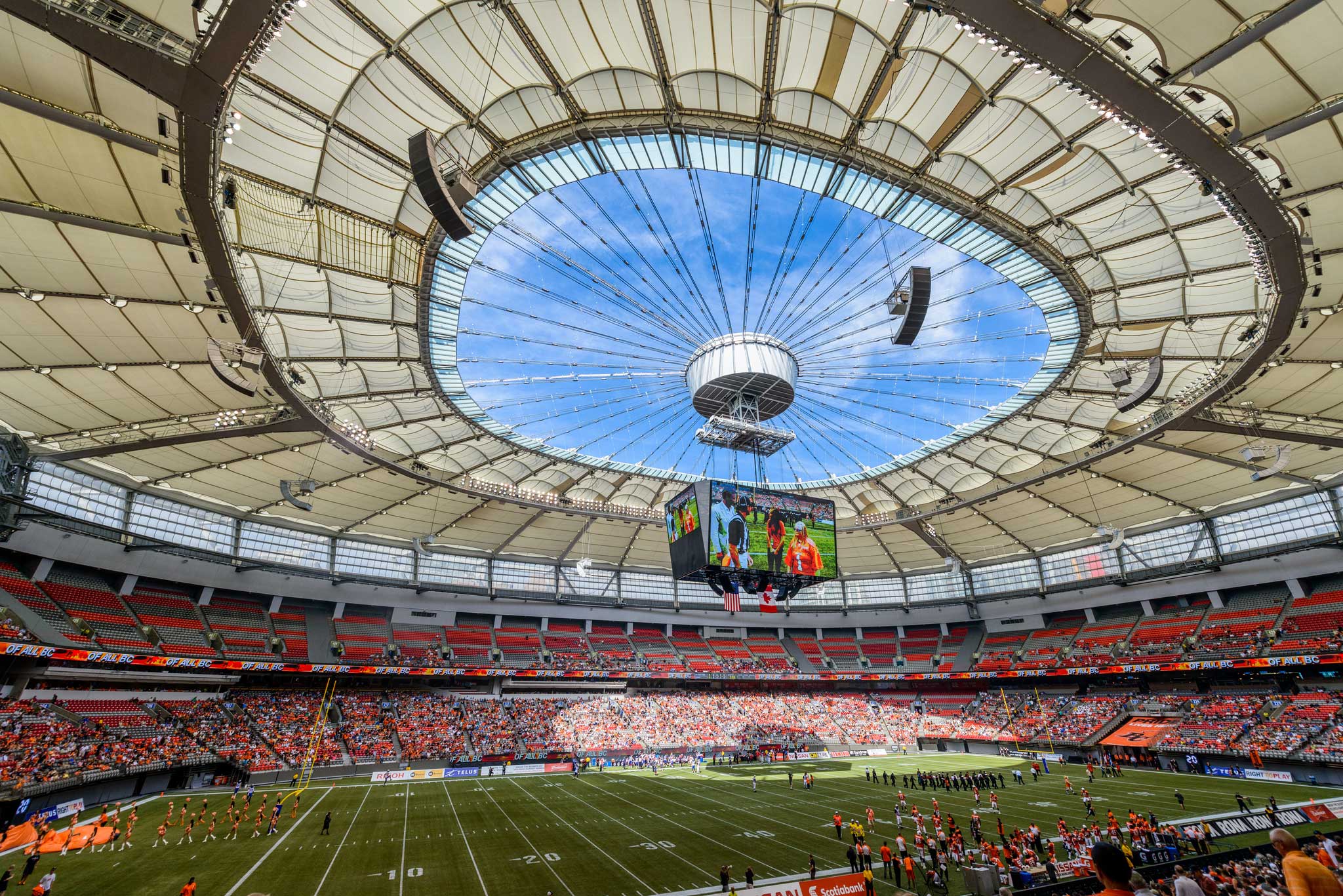
-BC Lions/BC Place, photo from infrasave.com/case-studies/case-study-bc-place. jpg.
-Calgary Stampeders/McMahon Stadium, photo from stampeders.com/mcmahon. jpg.
-Edmonton Eskimos/The Brick Field at Commonwealth Stadium, photo unattributed from stockaerialphotos.com.
-Saskatchewan Roughriders/Mosaic Stadium, photo from leaderpost.com.
-Winnipeg Blue Bombers/Investors Group Field, image from screenshot of video at Ranking CFL Stadiums (video uploaded by WorldWideSportsStadiums at youtube.com).
-Hamilton Tiger-Cats/Tim Horton’s Field, photo by Moe Masoudi/Moetion Picture for The Globe and Mail at theglobeandmail.com/news/toronto/the-high-cost-of-pan-am-what-legacy-will-hamiltons-new-stadium-leave-behind.
-Toronto Argonauts/BMO Field, photo by Thomas Makacek Photography via gensler.com/projects/bmo-field.
-Ottawa RedBlacks/TD Place Stadium, photo from Front Page Media Group via skyscrapercity.com/[thread: Ottawa - TD Place Stadium].
-Montreal Alouettes/Percival Molson Memorial Stadium, photo from en.montrealalouettes.com.

Thanks to all at the following links…
-Globe-map of Canada by: Aquarius.geomar.de at File:Canada (orthographic projection).svg (commons.wikimedia.org).
-Blank map of Canada by: S Tyx and Sémhur and Riba, at File:Blank map of Canada.svg (commons.wikimedia.org).
-Provinces-map of Canada by E Pluribus Anthony at File:Political map of Canada.png.

-CLF teams’ helmet-illustrations from MG’s Helmets.com (8 ofthe 9 teams); new BC Lions helmet-illustrations from MG Helmets’ template, with new logo drawn in by NY_CFL_fan at boards.sportslogos.net/topic/108075-my-personal-continental-football-league-more-recent-champs. Thank you NY_CFL_fan, you saved me a big headache with that illustration!
-Helmet-and-dark-uniforms illustrations on lower-centre-of-map-page by: Cmm3 at each CFL team’s page at en.wikipedia, such as File:CFL MTL Jersey with alternate.png.
-Several CFL team logos were found at sportslogos.net/Canadian_Football_League.
-Updated Montreal helmet, texashelmets.com. jpg
-2015 & 2016 CFL teams’ attendance figures from stats.cfldb.ca/league/cfl/attendance/2016.

June 3, 2017

Independent leagues (unaffiliated minor league baseball): map and chart of the 38 Independent leagues teams in USA & Canada from the top 4 Independent leagues which reported attendance figures (American Association, Atlantic League, Frontier League, Can-Am League)./ +CHS Field, the home of the St. Paul Saints, the best-drawing Independent baseball club in North America.

Filed under: Baseball,Baseball: Indep. Leagues — admin @ 2:00 pm

/baseball_independent-leagues_2016-attendance-map_american-association_atlantic-league_can-am-league_frontier-league_post_f_.gif
Independent leagues: 2016 attendance-map, 38 Independent leagues teams in USA & Canada (American Association, Atlantic League, Can-Am League, Frontier League)


By Bill Turianski on 23 April 2017; twitter.com/billsportsmaps.

Links…
-2016 Independent Attendance by Average (by Kevin Reichard on September 19, 2016 at ballparkdigest.com).
-Independent baseball league/Current_leagues (en.wikipedia.org).
-independentbaseball.net.
-twitter.com/independentball.

    Major League Baseball, and by extension, Organized Baseball, has an antitrust exemption…

Organized Baseball is: the 30 Major League Baseball teams {2016 MLB paid-atttendance map}, plus all the 234 affiliated minor league baseball teams [aka MiLB teams], which the MLB teams co-fund and use as developmental teams for their rosters; plus the 16 unaffiliated Mexican League teams / {my latest map of the Mexican League}.

Independent leagues are, by definition, completely comprised of pro baseball teams which operate outside of Organized Baseball.
The Independent leagues are technically not even really minor leagues…but everybody considers them as such, and most observers within the world of pro baseball consider them to be equivalent to a caliber of play between Double-A and Advanced-A level minor league ball [ie, a caliber of skill between two and three levels below the Major Leagues]).

Major League Baseball (MLB) has antitrust exemption, dating back to a 1922 ruling that centered on the suit brought about by the owners of the defunct 1914 Federal League team the Baltimore Terrapins {see this article, Baseball’s Con Game – How did America’s pastime get an antitrust exemption?, from 2002 by David Greenberg at slate.com}. Basically, in 1922, the Supreme Court justices maintained – naively – that Major League Baseball is a game, not a business. Justice Oliver Wendell Holmes wrote that “personal effort, not related to production, is not a subject of commerce”. What? Personal effort (ie, major league baseball players competing against each other) sure is related to production…just look at all that ticket revenue that MLB produces. Just look at those lucrative television contracts that MLB gets. Where did all that revenue come from? It came from personal effort (major league baseball players competing against each other). As Kavitha Dividson remarked at Bloomberg.com, “Nine decades later, the notion that professional baseball wouldn’t be considered commerce seems rather quaint. Not only is the “personal effort” of Major Leaguers an $8 billion product in and of itself, the lucrative national broadcast deals and growing audience for online streaming clearly place a significant chunk of business operations across state lines. Professional baseball can no longer be considered a local business, if it really ever could have been.” {Quote from, Antitrust Exemption Holds Baseball Back a Century (by Kavitha Davidson on April 8 2014 at bloomberg.com).}

There are many ways that this antitrust exemption affects things in the world of pro baseball. One is how the Oakland A’s franchise continues to get screwed by MLB and the San Francisco Giants…because the SF franchise owns the territory of San Jose, and MLB and the Giants have succeeded – in courts – from preventing the A’s from moving to San Jose. {See this: U.S. Supreme Court rejects San Jose’s bid to lure Oakland A’s (by Bob Egelko from Oct. 2015 at sfgate.com).} One of the latest ways the MLB antitrust exemption affects people within Organized Baseball is this: MLB scouts maintaining that they are being exploited {see this, Scouts Tell 2nd Circ. MLB Antitrust Exemption Doesn’t Apply (by Zachary Zagger on Jan. 23 2017 at law360.com)}. But here, I am only going to talk about how MLB’s antitrust exemption has inadvertently led to the success of most of the highest-drawing Independent leagues teams.

    Independent leagues (unaffiliated minor league baseball)…

Independent leagues have no affiliation with Major League Baseball – no player development contracts means the Independent leagues teams must pay for personnel and equipment. On the other hand, affiliated minor league teams have their WHOLE PAYROLL paid for them, by the Major League team…as it says in Wikipedia’s page on affiliated minor league baseball…“Generally, the parent major league club pays the salaries and benefits of uniformed personnel (players and coaches) and bats and balls, while the minor league club pays for in-season travel and other operational expenses…” (en.wikipedia.org/wiki/Minor League Baseball/Current system).

Independent leagues exist because MLB/Organized Baseball can actually ignore market forces…
There is essentially one reason why an Independent leagues team springs up in any given place. That is because the the ownership group in the municipality in question was unable to to secure an affiliated minor league team within Organized Baseball. With a few exceptions (the most prominent exception being the Sugar Land Skeeters of Greater Houston, TX), the highest-drawing of these Independent teams are located in the Upper Midwest and in the Northeast (and to a lesser extent, in Canada). Generally, here and there, in Organized Baseball, there are poorly-drawing teams within the affiliated leagues above the Short-Season-A and the Rookie levels (like two A-level teams in the Midwest League, in Burlington, Iowa and in Beloit, Wisconsin, both of whom draw below 1.2 K in a league which drew 3.8 overall in 2016). But the real dead weight with respect to bad drawing mid-and-upper-level-MiLB teams can be found in two warm-weather locales. You see, MLB/MiLB/Organized Baseball has two leagues that are, attendance-wise, real under-performers. Two leagues that are, to put it bluntly, a waste of space. I am speaking of two of the three Advanced-A-level leagues: the California League and the Florida State League. Year in, year out, these two leagues are chock full of teams that draw abysmally, especially since both regions have considerable populations. Last season [2016], 7 of the 10 California League teams drew below 2.5 K. And last season, 11 of the 12 Florida State League teams drew below the even lower bar of just 2.0 K. That is really bad attendance for a product that is just 3 levels below the Major Leagues. And this is happening in regions where hundreds and hundreds of thousands of people live nearby. Actually, most of those bad drawing teams in the California and Florida Advance-A-level leagues have over a million people within an hours’ drive. And they still draw poorly.

How pathetic is the attendance in the California League and Florida State League?
Look at it this way…
-California League overall average attendance in 2016 was 2.1 K…worse than 23 Independent leagues teams.
-Florida State League overall average attendance in 2016 was 1.3 K…worse than 34 Independent leagues teams.
{Source of figures in last two paragraphs: 2016 Affiliated Attendance by League (ballparkdigest.com).}

Meanwhile, there are municipalities all over the Upper Midwest and the Northeast that could EASILY maintain successful affiliated minor league teams. But for one legitimate reason (Spring training ballparks/facilities in Florida that are already there anyways), and one bogus reason (the hidebound notion that California deserves an affiliated minor league of its own), MLB/Organized Baseball – thanks to its antitrust exemption – can afford to ignore market forces. And ignore the fact that there are scores of minor league franchises which would have far better support…if they relocated out of Florida and California. And into Midwestern and Northeastern towns which are dying for affiliated minor league ball.

So, though ignored by Organized Baseball, Independent leagues teams, located in places off-the-beaten-track, thrive. Like in Winnipeg, Manitoba; and in Fargo, North Dakota; and in Lincoln, Nebraska; and in Marion, southern Illinois. And Independent leagues teams located very near to MLB franchises? They really thrive (see next 3 paragraphs). If the vast majority of the fine folks of Florida and California could not give a rat’s ass about a great and affordable product (affiliated minor league baseball), then why the heck don’t these dead-weight teams move to where people would appreciate such a great product? Successful Independent leagues teams prove that there are an abundance of locales which Organized Baseball has ignored, thanks to its de-facto-monopoly status. And don’t forget, these are Independent teams with basically no brand-name drawing-power. Yet they are outdrawing teams – affiliated minor league ball clubs – that are part of world-renowned brand-names (the Major League teams).

The positive side of no MLB affiliation…
The positive side of no MLB affiliation means Independent leagues franchises are not bound to abide by MLB’s onerous territorial mandates. Mandates which MLB/Organized Baseball can only enforce because of their antitrust exemption. For example, MLB allows no affiliated minor league baseball teams to be located in Nassau and Suffolk Counties, NY (ie, Long Island) [to protect the NY Mets]; as well as no other affiliated teams in southeast-central-Pennsylvania [to protect the Philadelphia Phillies as well as the affiliated minor league baseball teams the Reading Fightin Phils and the Harrisburg Senators]. So Independent leagues teams have sprung up in those 2 areas and have done very well drawing customers [the Long Island Ducks in Nassau County, New York; the York Revolution and the Lancaster Barnstormers in south-eastern Pennsylvania].

Basically, Organized Baseball usually does not put its affiliated minor league teams within the 75-mile-radius territory of the 30 MLB teams – with a few exceptions such as in: Tacoma, WA; Reading, PA; Toledo, OH; San Jose, CA; Tampa and Clearwater, FL; and, recently (in the last 20 years), in Dayton, OH; and in Bridgewater Township, NJ; and in Brooklyn, NY and in Staten Island, NY. But Independent leagues teams, again, can ignore MLB’s territorial edicts. Hence the (successful) Independent leagues teams such as…the St. Paul Saints of St. Paul, MN (right next to MLB’s Minnesota Twins); and the Kansas City T-Bones of Kansas City, KS (right next to MLB’s Kansas City Royals); and the Sugar Land Skeeters of Greater Houston, TX (right next to MLB’s Houston Astros); and the Somerset Patriots of Somerset County, NJ (relatively close by to MLB’s New York Yankees and New York Mets).

It is no coincidence that 5 of the 6 the top-drawing Independent teams would not be allowed to exist within Organized Baseball…
Five of the six highest-drawing Independent leagues teams (which all draw above 4-K-per-game) are located in places very near to MLB teams (ie, well within the 75-mile-radius protected areas [thanks to their antitrust exemption], which MLB/Organized Baseball can only enforce with respect to affiliated minor league teams):
1). St. Paul Saints: drawing 8.4 K/ St. Paul, MN [Minnesota Twins' territory].
2). Long Island Ducks: 5.2 K/ Nassau County, Long Island, NY [NY Mets' territory].
3). Somerset Patriots: 5.2 K/ Somerset County, NJ. [NY Yankees'/NY Mets' territory].
4). Winnipeg Goldeyes: 4.8 K/ Winnipeg, MB, Canada [no MLB team nearby].
5). Sugar Land Skeeters: 4.4 K/ Sugar Land, TX [Houston Astros' territory].
6). Kansas City T-Bones: 4.2 K/ Kansas City, KS [Kansas City Royals' territory].

The biggest problem Independent leagues teams face is overhead…
Again, Independent leagues teams get zero support from MLB/Organized Baseball, whereas affiliated minor league teams (being part of MLB/Organized Baseball) basically get their whole teams’ salaries (and some of their gear) paid for. So Independent leagues teams live a precarious financial existence, and are very prone to becoming defunct, and are almost completely reliant on ticket revenue and concessions to remain in business. In fact, last season [2016], the two lowest-drawing teams, of the four Independent leagues featured on the map here, both went out of business (Joplin and Laredo/see next section below). The following article from the Wall Street Journal explores just how precarious Independent baseball teams’ finances are…
-{How Independent Baseball Teams Make Money. Or Don’t. For unaffiliated teams, it takes gimmicks, cost cutting and a lot of luck (by Andrew Beaton on Aug. 24 2105 from wsj.com)}.

    What the map-and-chart of Independent ball clubs shows…

The main map is of USA and Canada; the inset-map is of the Northeast of the US. The two maps show the 38 Independent leagues teams in the USA & Canada which reported attendances figures (from home regular season games) in 2016, and which drew over 500-per-game…plus 2 new teams (see next paragraph). The 500-per-game cut-off is why I did not include the 4 teams from the Pacific Association, whose 4 teams only drew between 437 and 69 per game. The fact that some Independent league do not report attendance figures is why the map-and-chart does not feature teams from 3 other Independent leagues…the Empire League, the Pecos League, and the United Shore League {for info on those leagues, see this, en.wikipedia.org/wiki/Independent_baseball_league#Current_leagues}. If you are wondering why those three Independent leagues don’t report attendance figures, well, it is almost certainly because those teams in those leagues do not draw very well.

On the map, two of the teams [from the American Association] are now defunct: the Joplin Blasters, and the Laredo Lemurs. It is no coincidence that those two teams happened to be the two worst-drawing teams in the 4 leagues that the map depicts. Because, as mentioned earlier, Independent leagues teams basically live or die by their attendance figures, that being their only real source of revenue. Those two teams have been replaced in the American Association by one expansion team and one team that has moved over from the aforementioned Pecos League. The brand-new franchise for 2017 is the Cleburne Railroaders of Greater Dallas/Ft. Worth, TX. The franchise that has jumped over from the Pecos League to the American Association is the Salina Stockade (of Salina, Kansas). And finally, there is one franchise, in the Atlantic League, that has been recently relocated – the New Britain Bees (est. 2016) [of Greater Hartford, CT], who were the Camden Riversharks previously, but moved from Camden, NJ [Greater Philadelphia, PA] to Connecticut after the 2015 season. Here is an example of an Independent team filling the gap left by the lack of an affiliated MiLB team, because New Britain, CT had a Double-A MiLB team (the New Britain Rock Cats), until that franchise moved 12 miles up the road to Hartford, as the Hartford YardGoats, in 2016 {here’s a Double-A [affiliated MiLB] map I made in 2016, which mentions the new Hartford ball club}. That Camden-NJ-to-New-Britain-CT-franchise-move is shown on the map-page in the inset-map of the Northeast US.

The teams on the map have their primary cap-logo shown, as well as a circle in their team-colors.
The team-color-circles are sized to depict each team’s drawing-power (the higher their average attendance is, the larger their team-colors-circle is).

At the right-hand side of the map page is a chart that lists 5 things:
A). Teams’ attendance-rank within Independent leagues baseball.
B). The Independent league which each team is in.
C). The teams’ 2016 average attendance…regular season home games/ source: 2016 Independent Attendance by Average (ballparkdigest.com).
D). Teams’ year-of-establishment [first season they played].
E). Teams’ City-and-State-location (plus County-location, if that is part of any given team’s name).

The teams on the map are from the following 4 Independent leagues…
-American Association [American Association of Independent Professional Baseball], all 12 teams, including 2 defunct teams (see 3 paragraphs above), and including 2 new teams: the Cleburne Railroaders (est. 2017) [of Greater Dallas/Ft. Worth, TX], and the Salina Stockade (est. 2016/former Pecos League team) [of Salina, KS]). (American Association est. 2006/ 12 teams in 2017/ range: Plains States (Dakotas to Texas); one team from Indiana; one team from Manitoba, Canada.) 2016 overall average attendance: 3,156.
-Atlantic League [Atlantic League Professional Baseball], all 8 teams (including the 2016-relocated-team the New Britain Bees [of Greater Hartford, CT]). (Atlantic League est. 1998/ 8 teams in 2017/ range: Northeast; and Greater Houston, Texas.) 2016 overall average attendance: 3,939 [best-drawing Independent league].
-Frontier League, all 12 teams. (Frontier League est. 1993/ 12 teams in 2017/ range: half the teams [6 teams] from Illinois; one team each from: Missouri, Indiana, Michigan, Ohio, Kentucky, western Pennsylvania.) 2016 overall average attendance: 2,390.
-Can-Am League [Canadian American Association of Professional Baseball], all 6 teams. (Can-Am League est. 2005, but from 2012-15 it played an interlocking schedule with the American Association/ 6 teams in 2017/ range: 2 teams in New Jersey, one team in New York; 2 teams in Quebec, Canada, one team in Ontario, Canada. 2016 overall average attendance: 2,241.

[Note: to see other high-drawing Independent leagues teams (illustrations for 5 other teams), see my earlier post on Independent leagues baseball (from 2014).]

    The St. Paul Saints – the highest-drawing Independent baseball team (in 2015 and in 2016)…

In 2015, after 22 years at the inadequate Midway Stadium, the St. Paul Saints moved into CHS Field in the Lowerton district of downtown St. Paul, Minnesota, in area once full of industrial warehouses. The ballpark was opened on May 21, 2015. It was built with state funding of $25 million, combined with a $47.5 million outlay shared by the city of Saint Paul and the Saint Paul Saints. The venue is owned by the city of Saint Paul, and is operated by the St. Paul Saints. It has a fixed-seating-capacity of 7,210. Plus, there is around another 1,000-or-so extra-capacity seating: on both a grass berm behind the left-field fence (see second-to-last photo below), and in bar-style seats all along the sprawling street-level concourse which makes up the main part of the stadium-structure (see 4th, 5th, and 6th photos, below). The stadium is breathtaking in a very understated way, with its light-steel-frame pavilion, its open-air layout, and its stunning full-length red-cedar-ceiling-canopy. The architect, Julie Snow, intended for the ballpark’s design to take a warehouse and “turn it inside-out” (see article linked to at the end of this paragraph, for more on that). The new venue is a remarkable step up from the ramshackle Midway Stadium, which co-owner Mike Veeck used to “boast” was “the ugliest ballpark in America!” {quote from the Wikipedia page, here}. Mike Veeck, son of legendary baseball-owner-and-maverick Bill Veeck, Jr., is co-owner of the St. Paul Saints, along with actor/comedian Bill Murray, and others who make up the The Goldklang Group, a consortium who have a controlling interest in 4 minor league teams. Mike Veeck’s motto is “Fun is Good”, which is a sentiment I think very few could argue with. Here is an article from the Minneapolis Star-Tribune, on the opening day in May 2015 at the CHS Field in St. Paul, If ‘Fun is good,’ opening a new ballpark’s way better (by Jim Souhan at startribune.com).

The St. Paul Saints had long been a top-draw in Independent leagues baseball, and in their last season at Midway Stadium (in 2014), the Saints had the third-best average attendance in the Independent leagues, at 5.2 K, behind fellow-American-Association team the Winnipeg Goldeyes (at 5.6 K), and the Atlantic League team the Sugar Land Skeeters (at 5.5 K). {2014 Independent attendances, baseballpilgrimages.com/ [2014 Independent leagues].} But since their new ballpark opened, the St. Paul Saints have now become the best-drawing Independent ball club, by a considerable margin, of over 3 thousand per game. The Saints drew 8.0 K in the ballpark’s first year (in 2015). That meant they played to over eight-hundred-standing-room-only each game (8.0 K in a 7.2-K-seated-capacity stadium). {2015 Independent leagues attendance, ballparkdigest.com [2015 Independent leagues].} Then last year, word-of-mouth must have spread through the Twin Cities of Minneapolis/St. Paul, about the sweet new venue in town…because the Saints drew even better in 2016, at 8.4 K (which is an astounding 1.2-K-above-seated-capacity).

The second-best and third-best-drawing Independent leagues teams in 2016 were two Atlantic League teams from Greater New York City…the Long Island Ducks (est. 2000), of Central Islip, NY, at 5.2 K, and the Somerset Patriots (est. 1998), of Bridgewater Township, Somerset County, NJ, who also drew 5.2 K. {2016 Independent leagues attendance, ballparkdigest.com/ [2015 Independent leagues].} {Again, if you would like to see illustrations for the Long Island Ducks and the Somerset Patriots (and 3 of the other best-drawing Independent leagues teams, click here.}

Below: CHS Field, home of the St. Paul Saints, the best-drawing Independent baseball club in North America…
independent-leagues_highest-drawing-team-2016_st-paul-saints_chs-field_st-paul_mn_r_.gif"
Photo and Image credits above –
Saints ball cap, photo from St. Paul Saints team store, saints-crossing.com. Aerial shot of ballpark, photo by John Autey/Pioneer Prees via twincities.com/2016/05/07/photos-the-twin-cities-from-the-air. Exterior shot of main entrance, photo by snowkreilich.com/work/chs-field. Photo of main entrance on opening day, photo by St Paul Saints at saintsbaseball.com/the-saints-experience/2017-schedule. Interior shot of concourse (empty), photo by Paul Crosby via aia-mn.org/chs-field. Interior shots of concourse during a game-day, photos by hsnowkreilich.com/work/chs-field. Shot of Saints players warming up with main stand in background, photo by snowkreilich.com/work/chs-field. Photo of outfield lawn seating, photo by CHS Field via postbulletin.com/chs-field-combines-art-baseball-in-st-paul. Shot of full-capacity-crowd at sunset, photo by Paul Crosby at archdaily.com/chs-field-snow-kreilich-architects.
___
Thanks to all at the following links…
Some logos on the map page are from photos…
-Schaumburg Boomers cap logo, from photo at: boomersbaseball.com/fanzone/news/2013/288/boomers-end-of-season-clearance-sale/.
-Sugar Land Skeeters cap logo, from photo at: cdn3.volusion.com/zvscs.sfcdt/v/vspfiles/photos/OC100-1.jpg.
-Winnipeg Goldeyes cap logo, from photo at: pinterest.com/pin/384987468116306796/.

-Thanks to NuclearVacuum, at Wikimedia Commons, for the base map (blank map) of North America, at ‘File:BlankMap-North America-Subdivisions.svg‘ (commons.wikimedia.org).
-Thanks to the contributors at Independent baseball/Current leagues (en.wikipedia.org).

May 27, 2017

Canadian Hockey League: 2017-18 CHL location-map, including 2016-17 attendance chart with titles listed.

Filed under: Canada,Canada>OHL,Canada>QMJHL,Canada>WHL,Hockey — admin @ 5:45 pm

chl_2017-18_location-map_2016-17_attendance-chart_for_whl_ohl_qmjhl_60-teams_w-titles_post_e_.gif
CHL location-map with 2016-17 attendance chart


By Bill Turianski on 27 May 2017; twitter.com/billsportsmaps.
Links…
-CHL official site, chl.ca [live scores at top banner]
-Canadian Hockey League (en.wikipedia.org),

Links for 2016-17 attendances (home regular season) (from HockeyDatabase.com)…
-Ontario Hockey League 2016-17 Attendance Graph.
-Quebec Major Junior Hockey League 2016-17 Attendance Graph.
-Western Hockey League 2016-17 Attendance Graph.


Best percent-capacity figures in the CHL in 2016-17…
Below are the 12 teams in the CHL that were best at filling their arena, in 2016-17. (Best Percent-Capacity, or: Average Attendance divided-by Seated Capacity.) 7 of these teams are in the OHL. 3 of these teams are in the WHL. 2 of these teams are in the QMJHL. The top 2 played to SRO (standing-room-only)…the Rouyn-Noranda Huskies of the QMJHL, and the Oshawa Generals of the OHL.
#1). Rouyn-Noranda Huskies (QMJHL): 103.6 percent-capacity (2,228 per game in their 2,150-capacity arena [ie, 78-standing-room-only-customers-per-game]).
#2). Oshawa Generals (OHL): 100.5 percent-capacity (5,209 per game in their 5,180-capacity arena [ie, 29-standing-room-only-customers-per-game]).
#3). London Knights (OHL): 99.5 percent-capacity (9,003 per game in their 9,046-capacity arena).
#4). Kitchener Rangers (OHL): 98.3 percent-capacity (7,015 per game in their 7,131-capacity arena).
#5). Kelowna Rockets (WHL): 93.7 percent-capacity (5,162 per game in their 5,507-capacity arena).
#6). Niagara IceDogs (OHL): 90.6 percent-capacity (4,804 per game in their 5,300-capacity arena).
#7). Barrie Colts (OHL): 88.4 percent-capacity (3,709 per game in their 4,195-capacity arena).
#8). Guelph Storm (OHL): 86.1 percent-capacity (4,063 per game in their 4,715-capacity arena).
#9). Shawingan Cataractes (QMJHL): 85.9 percent-capacity (3,545 per game in their 4,125-capacity arena).
#10). Regina Pats (WHL): 84.1 percent-capacity (5,456 per game in their 6,484-capacity arena).
#11). Owen Sound Attack (OHL): 82.8 percent-capacity (2,898 per game in their 3,500-capacity arena).
#12). Prince Albert Raiders (WHL): 82.6 percent-capacity (2,133 per game in their 2,580-capacity arena).
___
Thanks to all at the following links…
-List of Memorial Cup champions/Tournament appearances by current CHL teams.
-WHL/ Ed Chynoweth Cup.
-OHL/ J. Ross Robertson Cup.
-QMJHL/ President’s Cup (en.wikipedia.org).
-Hockey Data Base.com.

May 17, 2017

2017 CHL Memorial Cup tournament (in Windsor, Ontario/ May 19 to May 28) – the 4 teams: Windsor Spitfires (host team), Erie Otters (OHL), Saint John Sea Dogs (QMJHL), Seattle Thunderbirds (WHL): photo-illustrations with standout players in 2016-17.

Filed under: Canada,Hockey — admin @ 7:39 pm

By Bill Turianski on 17 May 2017; twitter.com/billsportsmaps.
Links…
-2017 CHL Memorial Cup (en.wikipedia.org).
-CHL official site, chl.ca.

Windsor, Ontario will host the 2017 Memorial Cup…
The 2017 Memorial Cup tournament will be held at the 6,450-capacity WFCU Centre in Windsor, Ontario, with the OHL’s Windsor Spitfires the host-team. Windsor is just across the border from Detroit, Michigan {see illustration below}. The tournament will run from May 19th to May 28th, 2017. Here is a preview, from the Hockey Writers.com,
2017 Memorial Cup Teams Preview (by David Jewell on Wednesday May 17 2017 at thehockeywriters.com).

    the 4 teams that have qualified for the 2017 CHL Memorial Cup tournament…
    Windsor Spitfires (host team) , Erie Otters (OHL), Saint John Sea Dogs (QMJHL), Seattle Thunderbirds (WHL)…

Host team: Windsor Spitfires…
Windsor Spitfires, host of 2017 CHL Memorial Cup tournament…
windsor-spitfires_2017-memorial-cup_wfcu-centre_r_.gif
Photo and Image credits above -
Windsor Spitfires logos/info via sportslogos.net/Windsor_Spitfires.
Windsor home jersey, illustration from sportslogos.net/Windsor_Spitfires. Night-time shot of downtown Windsor with Detroit skyline in background, photo by Owen Wolter at flickr.com via windsorite.ca. View of Windsor skyline, photo by Tim Fraser/Windsor Star via windsorstar.com. Exterior-shot of WFCU Centre, photo from citywindsor.ca. Interior-shot of WFCU Centre [ca. 2009], photo by Kevin Jordan at ohlarenaguide.com/spitfires.
Players…Jeremy Bracco, photo by Tim Jarrold at inplaymagazine.com/windsor-spitfires-vs-saginaw-spirit-february-23 [2017]. Mikhail Sergachev, photo by Claus Andersen/Getty Images via gettyimages.com. Michael DiPietro, photo by Jason Kryk/Windsor Star at windsorstar.com/hockey.

Erie Otters (OHL champions in 2017).
From The Hockey Writers.com, Celebrating the Erie Otters’ OHL Championship (by Mark Scheg on May 13 2017, at thehockeywriters.com).
erie-otters_2017-ohl-champions__2017-memorial-cup_i_.gif
Otters’ jersey illustration, from sportslogos.net/Erie_Otters. Erie (aerial shot), unattributed at pinterest.com. Erie Insurance Arena, photo from goerie.com jpg. Game-action photo, by MountaindewPSU at aviewfrommyseat.com/Erie+Insurance+Arena/section-119/row-E/seat-2.
Players: Dylan Strome-3AZ, photo by Terry Wilson/OHL via sportsnet.ca. Alex DeBrincat-39Chi, photo by Keith Dotson/OHL at ontariohockeyleague.com jpg. Taylor Raddysh-58Tam, photo by Vaughn Ridley/Getty Images North America via zimbio.com. Anthony Cirelli-72TB, photo by Claus Anderson at gettyimages.com. Darren Raddysh-un, photo by Aaron Bell/OHL Images via ohlwriters.me jpg. Warren Foegele, photo by Dave Mead Photography via ontariohockeyleague.com. On-ice post-game celebration, photo by Dan Hickling/OHL Images via ohlwriters.me. Anthony Cirelli holds Robertson Trophy aloft, photo by Greg Wohlford/ETN at goerie.com/sports/champions-otters-win-ohl-title-on-cirellis-ot-goal. Erie players celebratory pose, photo by Dan Hickling/OHL Images via chl.ca/erie-otters-are-2017-ohl-champions jpg.


Saint John Sea Dogs (QMJHL champions in 2017).
From CHL.ca, Saint John Sea Dogs are 2017 QMJHL Champions (chl.ca on May 11 2017).
saint-john-seadogs_2017-memorial-cup_n_.gif
Photo and Image credits above -
Sea Dogs jersey, photo from saintjohnseadogs.com/adult-replica-jersey-blue; illustration from sportslogos.net/Saint_John_Sea_Dogs. Saint John near arena, photo by Jaroslaw Binczarowski File:Stjohnpanoramo.jpg (commons.wikimedia.org). Harbour Station, photo by Andrew Touchakis Photography from facebook.com/Harbour-Station. Saint John skyline at twilight, photo by DDD DDD~commonswiki at File:Saint_John,_NB,_skyline_at_dusk5.jpg (commons.wikimedia.org).
Players: Mathieu Joseph, photo from sjseadogs.com. Matthew Highmore, photo by François Laplante/FreestylePhoto/Getty Images North America via zimbio.com.
Thomas Chabot , photo unattributed at stationnation.blogspot.com. Callum Booth, photo from twitter.com/SJSeaDogs. Team photo after title-win, photo by Vincent Ethier/LHJMQ Média at theqmjhl.ca/sea-dogs-crowned-presidents-cup-champs-again.

Seattle Thunderbirds (WHL champions in 2017).
From the Seattle Times, Seattle Thunderbirds beat Regina in OT to take WHL title (seattletimes.com/sports on May 14 2017).
seattle-thunderbirds_showare-center_2017-whl-champions__2017-memorial-cup_m_.gif
Photo and Image credits above -
Thunderbirds’ jersey illustration, from sportslogos.net/Seattle_Thunderbirds.
Aerial shot of Kent, WA with Mt. Rainier in background, photo from City of Kent, Washington at Linkedin.com. ShoWare Center, two exterior-shots, photos by Lara Swimmer at djc.com.
Players: Keegan Kolesar, photo by Doug Westcott via eliteprospects.com. Mathew Barzal, photo unattributed at alchetron.com/Mathew-Barzal. Ethan Bear, photo from seattlethunderbirds.com/ethan-bear-named-chl-player-of-the-week.Carl Stankowski, photo from seattlethunderbirds.com. Alexander True scoring winner in OT, photo by Keith Hershmiller at kentreporter.com/thunderbirds-rally-capture-first-whl-crown-with-dramatic-ot-win-at-regina. On-ice celebration, photo by Troy Fleece/Regina Leader-Post via seattletimes.com/sports/seattle-thunderbirds-beat-regina-in-ot-to-take-whl-title.

___
Thanks to the contributors at the following limks…
- Western Hockey League;
-Ontario Hockey League;
-Quebec Major Junior Hockey League.
-Canadian metro-areas.
-USA metro-areas (en.wikipedia.org).
-Thanks to The Hockey Writers.com site, now on my blogroll, at thehockeywriters.com.
-Thanks to the fine site known as Elite Prospects.com (Hockey Prospects), for player info…eliteprospects.com.

May 5, 2017

Australian rules football – the Australian Football League (AFL), 2017 location-map, with map showing all venues (17 venues) for 2017 AFL season; plus 2016 attendance figures & titles list./+ Illustration for the 2016 Grand Final champions – Western Bulldogs.

Filed under: Australia,Australian Rules Football — admin @ 12:20 pm

australian-rules-football_2017-afl_location-map_stadiums_2016-attendance_titles_post_c_.gif
Australian rules football: Australian Football League (AFL), 2017 location-map, with with map showing all venues for 2017 AFL season; plus 2016 attendance figures & titles list


By Bill Turianski on 5 May 2017; twitter.com/billsportsmaps.

Links…
-AFL official site
-2017 AFL season (en.wikipedia.org).
-theroar.com.au/aussie-rules.
-Aussie rules scores/fixtures/ladder, etc..scorespro.com/aussie-rules.
-If you are new to Aussie rules football and would like to see an explanation of the rules, and/or a brief thumbnail-history of the AFL, you can see all that on my first map-and-post on the subject, here:
[from April 2015] Australian rules football – the Australian Football League (AFL), 2015 location-map with: rules (in general), clubs-history-chart, and chart of 2014 attendances with titles listed./ Plus: 2014 champions the Hawthorn Hawks.

    2016 Grand Final champions – Western Bulldogs: their second Premiership (title) and first title in 62 years…

australia_afl_2016-grand-final_western-bulldogs_89-67_sydney-swans_jason_johannisen_tom-boyd_liam-picken_tory-dickson_b_.gif
Photo and Image credits above – Jason Johannisen, photo by Tim Carrafa at heraldsun.com.au/sport. Tom Boyd, photo by Getty Images via pinterest.com. Liam Picken, photo by Graham Denholm/Fairfax Media via standard.net.au. Tory Dickson, photo by Alex Coppel at theaustralian.com.au/sport. Shot of clinching goal celebration, photo by Phil Hillyard at heraldsun.com.au/sport.

    Australian rules football – the Australian Football League (AFL), 2017 location-map, with map showing all venues for 2017 AFL season; plus 2016 attendance figures & titles list.

2017 AFL, location-map with titles chart & attendances…
The main map shows all the venues for the 2017 season (17 venues), plus of course the 18 AFL teams’ crests and their primary-locations. At the far-upper left of the map-page is a small map showing the venue-location in Shanghai, China (see 3 paragraphs below). [Note: if you are confused why the Wikipedia page for the AFL currently shows there being 16 venues (and not 17 venues) for the 2017 AFL season, that is because the (recently-renovated) venue in Ballarat, Victoria is not included there...and the Western Bulldogs will be in fact playing one of their home games there (at the 11-K-capacity Eureka Statium), this season (on 19 August, 2017).]

On the upper-right-hand-side is a chart of all the AFL teams, arranged by titles. The chart lists the 6 following items for each team…

A). Club colours, crest & jersey-pattern.
B). Premiers (titles), with year of last premiership. The most-titled clubs in the AFL are the Essendon Bombers and the Carlton Blues, both of whom have won 16 Premiers (but neither has been AFL champion since 2000).
C). Australian state that the team is located in (10 teams from Victoria; and 2 teams each from: New South Wales, Queensland, South Australia, Western Australia).
D). Year-of-establishment as an AFL team (with Melbourne-to-Sydney franchise-move [of 1981-82] noted).
E). Seasons in the VFL/AFL [2017 will be the 121st season of the VFL/AFL).
F). Premiers-per-season percentage [Premiers (Titles) divided by seasons]. The best percentage is owned by the Brisbane Lions (who have won a Premier every 6.67 seasons) followed by the Hawthorn Hawks (a Premier won every 7.14 seasons), then the Essendon Bombers (a Premier won every 7.37 seasons), then the Carlton Blues (a Premier won every 7.5 seasons), then the Collingwood Magpies (a Premier won every 8 seasons).

Since its founding in 1897, the VFL/AFL has played regular-season matches at 42 different venues…
From the Australian Football League page at Wikipedia…“Throughout the history of the VFL/AFL, there have been a total of 42 different grounds used…/…The largest capacity ground in use is the Melbourne Cricket Ground (MCG), which has a capacity of over 100,000 people, and hosts the Grand Final each year. The MCG is shared by five [of the 10 Melbourne] teams as a home ground, whilst the other grounds used as home venues by multiple teams are Docklands Stadium in Melbourne [four of the 10 Melbourne teams primarily], Adelaide Oval in Adelaide [both Adelaide-based teams], and Subiaco Oval in Perth [both Perth-based teams]. The AFL has had exclusive ownership of Docklands Stadium (commercially known as Etihad Stadium) since late 2016.” (excerpt from en.wikipedia.org/Australian Football League/Venues).

Alternate venues for the 2017 AFL regular season…
I have expanded the original location-map I made 2 years ago by including all venues – 17 venues – that will host regular-season games in the 2017 AFL season. (You can also see 16 of the 17 venues at the following link at Wikipedia: venues used during the 2017 AFL season.) Included in that list of venues is a stadium in Shanghai, China: the 25,000-capacity Jiangwan Stadium, which will be re-configured to host Aussie rules football with a temporary-15-K-capacity, and will host a regular-season AFL match between the Port Adelaide Power and the Gold Coast Suns, on 14 May 2017.
-See this, Port, Suns to face off in Shanghai in round eight clash (by Dinny Navaratnam on 16 Oct. 2016, from afl.com.au).
-Also see this, Beating NFL and NBA to the punch: Port Adelaide bring real AFL deal to Shanghai (by Sam Agars on 3 Feb. 2017, from the South China Morning Post at scmp.com).

Aside from AFL regular-season games played previously in New Zealand, this will be the AFL’s first overseas regular-season match [ie, outside of Austalasia]. And, as pointed out in the article from the South China Morning Post linked-to above, the AFL match in Shanghai in May 2017 will be the first regular-season game played in China by any foreign professional league. In other words, the Australian Football League has beaten the NFL and the NBA (and the Premier League, for that matter), in being the first foreign major league to play a regular season game in the potentially-vastly-lucrative market that is China.

Many AFL teams regularly play matches outside of their home venues…

The Hawthorn Hawks and the North Melbourne Kangaroos both play a considerable percentage of their home regular-season games in the State of Tasmania (which is the southern-most of the 6 Australian States, and is an island located 240 km (150 mi) to the south of the Australian mainland). For 17 years now (since 2001), the Hawthorne Hawks have played some of their regular-season home matches in Launceston, Tasmania (which has a population of only around 86,000). There, Hawthorn play at York Park [aka the University of Tasmania Stadium], which has a capacity of 21,000. These days Hawthorn play four of their eleven home regular-season matches there. If Hawthorne played all their home matches at the Melbourne Cricket Ground (and not just 7 of their 11 home matches at the MCG), they would probably draw at-or-near-to the highest in the AFL. Because when you do the math, the 13.8 K per game they drew in Launceston, Tasmania last season depressed Hawthorne’s average attendance to the point that they were actually drawing highest in the league – on average – for their Melbourne home matches at the Melbourne Cricket Ground (they averaged 49.6 K at the MCG, a figure which is about 2.6 K higher than the 47.0 K that the top-drawing Adelaide Crows drew in 2016). Tasmania Tourism is also a major sponsor of the Hawthorne Hawks (as you can see in the jersey-photo below, with “Tasmania” emblazoned prominently on the Hawks’ gear).
hawthorn_hawks_play-4-home-matches-per-year_at_york-park_launceston_tasmania_e_.gif
Photo credits above – Photo of Launceston, Tasmania unattributed at realestate.com.au/neighbourhoods/launceston-tas. Photo inside York Park, Launceston, Tasmania for Hawthorne Hawks match, photo by city of Launceston at launceston.tas.gov.au/Events/AFL-2017-Hawthorn-v-Brisbane. Hawthorne 2017 jersey, photo from jerseys.com.au/products/hawthorn-hawks-2017-home-guernsey.

Another AFL team that plays in Tasmania is the North Melbourne Kangaroos…
Since 2012, the North Melbourne Kangaroos have played three of their eleven home regular-season matches in the Tasmanian capital-city of Hobart (the population of Greater Hobart is around 221,000). There, North Melbourne play at the Bellerive Oval, which has a capacity of 20,000.

To round out all the rest of the alternate home-match-venues for 2017…
-The Melbourne Demons play two of their eleven home regular-season matches in the sparsely-populated Northern Territory, with one match in Darwin, NT and one match in Alice Springs, NT.
-Since 2014, the Western Bulldogs have been playing one of their eleven home regular-season matches in Cairns, York Peninsula, Queensland. Starting in 2017, the Western Bulldogs also will begin playing one other regular-season home match in a venue about 65 miles west of Melbourne, in Ballarat, VIC.
-The newest AFL team, the Greater Western Sydney Giants, play three of their eleven home regular-season games in the Australian capital, in Canberra, ACT.

In all but the latter of these alternate-home-venues mentioned above, the shift in venue means a considerable decrease in the teams’ average attendances. But the teams see the benefits of lucrative sponsorship deals and expanded team-support, and these things outweigh the ticket-revenue-shortfalls of the alternate-venues. And likewise, with respect to the game being played in China…if the match in Shanghai works out well for the Port Adelaide Power – and for the AFL in general – then it is very probable that a regular-season game in China will become an annual feature of the Australian Football League.

___
Sources for map page:
Thanks to all at these links…
-Attendances (2016 season): afltables.com/afl/afl_index.html.
-Dates of establishment: Australian Football League/Current clubs.
-Titles: List of Australian Football League premiers. (en.wikipedia.org).
-Rules: Australian rules football; Australian rules football playing field (en.wikipedia.org).

-Blank maps on map page…
-Thanks to Ssolbergj for globe-map of Australia, File:Australia (orthographic projection).svg (commons.wikimedia.org).
-Thanks to NordNordWest for blank map of Australia, File:Australia location map.svg (en.wikipedia.org).’-Thanks to TUBS for blank map of China showing Shanghai, File:Shanghai in China (+all claims hatched).svg.

-Jersey Icons…Thanks to thejoesbloggsblog for most of the jersey-pattern icons on the chart on the map page at Australian Football League/Current clubs (en.wikipedia.org). Thanks to the AFLstore for Western Eagles’ jersey-icon, theaflstore.com.au/west-coast-eagles.

-Thanks to Port Adelaide FC’s twitter-feed, twitter.com/PAFC, for the article from the South China Morning Post.
-For general historical info, thanks to australianfootball.com.
-Thanks to the contributors at Australian Football League (en.wikipedia.org).
-Thanks to AFL Tables site for attendances and for all-time list of AFL venues, afltables.com/afl/venues/overall.html.

April 23, 2017

Mexico: 2017 Liga Mexicana de Béisbol (LMB) (Mexican League), location-map/attendance-map (2016 figures), with active-clubs titles list./ + Top three drawing teams (Monterrey, Tijuana, Yucatán).

Filed under: Baseball,Mexico: Béisbol — admin @ 9:33 pm

mexico_baseball_2017-liga-mexicana-de-beisbol_mexican-league_attendance-map_2016_post_b_.gif
Mexico: 2017 Liga Mexicana de Béisbol (LMB) (Mexican League), location-map/attendance-map (2016 figures), with active-clubs titles list


By Bill Turianski on 23 April 2017; twitter.com/billsportsmaps.

Links…
-Current teams…Mexican League/Current teams (en.wikipedia.org).
-Equipos temporada…Liga Mexicana de Béisbol/Equipos temporada (es.wikipedia.org).
-2016 Mexican League attendance…Mexican League: Attendance [set at 2016/sortable for current attendances & archived back to -2005] (milb.com/milb/stats).
-2016 attendances for all 15 MiLB leagues which report attendance figures (incl. Mexican League) [ie, all leagues within Organized Baseball from Rookie leagues up through A-League, Double-A, and Triple-A which report attendances]…ballparkdigest.com/2016/09/09/2016-affiliated-attendance-by-league.
-Mexican League scores, standings, schedule…milb.com/LMB [Liga Mexicana de Béisbol (Mexican League)] (official site).
-My first map & post on Mexican League baseball (from 2011), which includes more info on teams and uniforms, Baseball in Mexico: Liga Mexicana de Béisbol (Mexican League), 2011.

    The top three drawing béisbol teams in the Mexican League (Monterrey, Tijuana, Yucatán)…

Sultanes de Monterrey: best-drawing team in the Mexican League for 5 years (2012-16)
Despite being not the largest, or even the second-largest city in Mexico, Monterrey is the home of the highest-drawing Mexican béisbol team, the Sultanes de Monterrey. (Monterrey is also the home of the 2 highest-drawing 1st division Mexican fútbol teams (CF Monterrey, and Tigres UANL) {see this map, with attendance figures, of Liga MX that I made earlier in 2017}.)

The Sultanes de Monterrey have led the Mexican League in attendance for 5 straight seasons now (2012-16), replacing Saltillo as the top draw. The Sultanes drew 12.7 K per game in 2016. The Sultanes’ stadium, Estadio de Béisbol Monterrey (aka Estadio Mobil Super) is the largest baseball venue in Mexico (capacity 27,000). The city of Monterrey is in the state of Nueva León, and has a metro-area population of around 4.1 million [2010 figure]. {Metropolitan areas of Mexico.}

The Sultanes de Monterrey wear New-York-Yankees-style navy-blue-with-pinstripes. One of their logos mimics the font of the Yankees’ N-Y crest (see it below in 3rd photo), while also including the iconic mountain (Cerro de la Silla) that overlooks their ballpark {here’s a recent [2014] shot of their home uniform and with that logo on their batting helmet}.
sultanes-de-monterrey_estadio-beisbol-monterrey_b_.gif
Photo and Image credits above -
Sultanes de Monterrey cap logo, photo from lids.com/sultanes-de-monterrey-new-era. Aerial shot of stadium with mountain in background, photo by Especial at periodicoabc.mx. Aerial shot of Estadio de Béisbol Monterrey, photo unattributed at purobeisbol.mx. Interior shot of stadium during a game, photo unattributed at skyscrapercity.com/[thread: ARQUITECTURA | Estadios | Información y fotografías. Interior shot during game, photo unattributed at laaficion.milenio.com/beisbol/mil-fans-Estadio-Monterrey_MILIMA20160404_0018_11.jpg.

...

Toros de Tijuana - a relocated team that has now become the 2nd-best-drawing team in the Mexican League...
The Petroleros de Minatitlán [Minatitlán Oilers] franchise moved to Tijuana after the 2013 season, to become the Toros de Tijuana (II). (The south-central-Gulf-Coast-based Petroleros were one of the lowest-drawing teams in the Mexican League, drawing only in the 1.4-K-to-2.3-K-range in their last 5 seasons.) Now the Toros de Tijuana have become the 2nd-best draw in the Mexican League. The Toros drew 9.3 K per game in 2016, in their ballpark, the 16-K-capacity Estadio Gasmart.

Tijuana is, of course, right across the border from San Diego, California, and is actually part of the Greater San Diego/Tijuana metro-area. Tijuana, located in the state of Baja California, is the 6th-largest metro-area in Mexico (with a population of around 1.7 million [2010 figure]).

The Toros de Tijuana wear black-and-deep-red colors.
toros-de-tijuana_estadio-gasmart_i_.gif
Photo and Image credits above -
Aerial shot of Estadio Gasmart, photo unattributed at agpnoticias.com/news/lista-fiesta-de-apertura-de-toros-de-tijuana. Shot of main stands at Estadio Gasmart, photo unattributed at el-fanatico.com. Shot of outfield terrace area at Estadio Gasmart, with glass-walled-outfield-fence, photo from hotelpuebloamigo.com. Cropped image of 2017 black Toros jersey, photo by torosdetijuana.com.

Leones de Yucatán: after renovating their ballpark, they have almost doubled their crowd-size (from 4.6 K to 9.1 K, in two years)…
The Leones (Lions) are from the city of Mérida, which in the state of Yucatán, in southeastern Mexico. Mérida is the 12th-largest metro-area in the country (with a population of around 970,000 [2010 figure]).

In 2015, after renovating their ballpark (the 16-K-capacity Parque Kukulcán Alamo), the Leones de Yucatán almost doubled their attendance, going from 4.6 K per game in 2014, to 8.9 K per game in 2015. Then in 2016, they saw a bit more of an increase in crowd-size, drawing 9.1 K per game.

The Leones de Yucatán wear dark-green-and-orange colors, and they also have an alternate color-scheme of dark-green-and bright-neon-green.
leones-de-yucatan_parque-kukulcán_n_.gif
Photo and Image credits above -
Renovation of El Kukulcán Álamo, photos unattributed at purobeisbol.mx/[17 March 2016]. Large crowd at El Kukulcán Álamo stadium circa June 2015, photo unattributed at beisbolcampechano.blogspot.com/2015/07/record-de-asistencia-en-el-parque. Night game. photo unattributed at peninsuladeportiva.com.
___
Thanks to all at the following links…
-Globe-map of Mexico, by Addicted04 at File:MEX orthographic.svg at Mexico (en.wikipedia.org).
-Map of Mexico, by Yavidaxiu at File:Mexico blank.svg (commons.wikimedia.org).

Some circular-cap-logos on the map include photos or banner illustrations, from the following links…
-Toros de Tijuana (Tijuana Toros), illustration of T-J logo, from banner at torosdetijuana.com.
-Saraperos de Saltillo (Saltillo Sarape Makers) teal home cap, photo of Gothic-S-with-sarape logo from neweraaustraliasale.com/saraperos.
-Vaqueros Unión Laguna, photo from twitter.com/mendivil2129. jpg
-Delfines de Ciudad del Carmen (Ciudad del Carmen Dolphins) dark-purple home cap, photo of bright-green-C [part of the logo], from lids.com/mexican-league/delfines.
-Guerreros de Oaxaca (Oaxaca Warriors), photo of the O-a-x logo on home cap from newhatsite.net/oaxaca-guerreros.
-Piratas de Campeche (Campeche Pirates), photo of logo, from tienda.newera.mx.
-Generales de Durango (Durango Generals), photo of home cap logo, from elsiglodetorreon.com.mx.
-Bravos de Leon, photo of home cap logo, from twitter.com/lmbbravosleon.
-Tigres de Quintana Roo (Quintana Roo Tigers), photo of cap logo from tienda.newera.mx .
-Rojos del Águila de Veracruz (Veracruz Red Eagles), photo of cap logo from tienda.newera.mx

-Team info, etc…
Mexican League [Liga Mexicana de Béisbol] (en.wikipedia.org).

April 16, 2017

Australia, National Rugby League: NRL attendance chart for 2016 regular season (with 2016 finishes listed)/+ the Cronulla-Sutherland Sharks (1st title) – the 2016 NRL Premiers (champions).

Filed under: Australia,Rugby,Rugby>Australia — admin @ 7:51 pm

Links…
-Official site… nrl.com.
-2017 season (teams, etc)… 2017 NRL season (en.wikipedia.org).
-Australia’s leading sports opinion site’s rugby league page… theroar.com.au/rugby-league.
-The bums on seats truth about the NRL draw (by Jason Hoskins on Oct. 27 2016 at theroar.com).

-My map-&-post of NRL (May 2015), featuring location-maps of NRL teams, plus an article: History of First Division Rugby League in Australia (1908 to 2014) [including the Super League war of the late 1990s],
Australia (and New Zealand): National Rugby League (NRL) – 2015 location-map(s) with attendance-&-titles-chart.

By Bill Turianski on 16 April 2017; twitter.com/billsportsmaps.

australia_nrl_rugby-league_2016-attendances-and-finishes_chart_c_.gif
Chart by billsportsmaps.com/attendance figures from afltables.com/[2016 NRL attendance].


    Cronulla-Sutherland Sharks: 2016 NRL Premiers (champions)…

The Cronulla-Sutherland Sharks were established as an NRL expansion-team in 1967. In the Sharks’ 50th season, in 2016, they won their first NRL premiership (title). Cronulla-Sutherland’s 50-season title-drought was the longest ever, in Australian rugby league history (since 1908/ List of Premierships, here). Below is Cronulla, in Sutherland Shire, which is a local government area in the southern part of Greater Sydney, New South Wales, Australia. Further below is action from the 2016 NRL Grand Final (Cronulla-Sutherland Sharks 14, Melbourne Storm 12)…
cronulla-sutherland-sharks_endeavour-field_shark-park_southern-cross-group-stadium_woolooware_greater-sydney_australia_2016-nrl-champions_i_.gif

cronulla-sutherland-sharks_grand-final_champions_october-2-2016_stadium-australia_sydney_h_.gif

Photo and Image credits above -
Aerial shot of Cronulla by 1908cronulla.com.au. Endeavour Field, photo unattributed at forum.insidesport.com.au. Endeavor Field at night, photo unattributed at austadiums.com. Sydney neighborhoods, map from mapaplan.com via mapsontheweb.zoom-maps.com/areas-of-sydney.

Cronulla & Melbourne kit illustrations, from en.wikipedia.org/wiki/2016_NRL_Grand_Final. Screenshot of Cronulla fans at Grand Final, image from video uploaded by Rugby League/Union at youtube.com. Ben Barba, photo from smh.com.au/photogallery/sport/action-from-2016-grand-final-melbourne-storm-versus-cronullasutherland-sharks. Screenshot of Jesse Bromwich scoring a try, image from video uploaded by Rugby League/Union at youtube.com. Will Chambers scoring try to give Melbourne the lead, photo unattributed at skysports.com. Andrew Fifita, breaking tackles, photo by Photosport via radionz.co.nz/news/sport/cronulla-sharks-win-nrl-grand-final. Andrew Fifita about to score the match-winning try, photo unattributed at dailytelegraph.au/sport. Andrew Fifita scoring the match-winning try, photo by John Veage via theleader.com.au. Cronulla’s trophy-celebration at Endeavour Field the following day, with captain Paul Gallen and Man-of-the-Match-winner Luke Lewis holding the trophy aloft, while Sharks fans cheer behind them, photo by Greg Porteus at couriermail.com.au/sport.

___
Thanks to the contributors at National Rugby League (en.wikipedia.org).
A Big Thanks to afltables.com/[2016 NRL attendance], for the pretty-hard-to-find NRL attendance figures.

April 2, 2017

MLB: Paid-Attendance (tickets-sold) map for 2016 (home/regular season average tickets-sold), including change from 2015 and percent-capacity figures./+ Illustration for: Toronto Blue Jays: 12.5-K-attendance-increase in 2 year span./+ Illustration for: Chicago Cubs (2016 World Series champions).

Filed under: Baseball,Baseball >paid-attendance — admin @ 11:17 am

mlb_2016-attendance_tickets-sold_map_w-percent-cap_change-from-2015_post_e_.gif
MLB: Paid Attendance (tickets-sold) map for 2016 (home/regular season average tickets-sold), including change from 2015 and percent-capacity figures


By Bill Turianski on 2 April 2017; twitter.com/billsportsmaps.

Links…
-Official site…mlb.com.
-Teams, etc…Major League Baseball (en.wikipedia.org).
-[Current] MLB attendance at ESPN…MLB Attendance Report [current] (espn.go.com).
-2016 MLB attendance at ESPN…MLB Attendance Report – 2016 (espn.go.com).
-Attendance change (2016 v. 2015)…Change in Baseball Attendance (2016 vs. 2015) (baseball-reference.com).

-From Baseball Pilgrimages.com…2016 MLB Ballpark Attendance [with notes] (baseballpilgrimages.com).

-From Forbes.com…MLB Hits 73.159 Million In Attendance, 11th Highest All-Time, Down Slightly From 2015 (by Maury Brown at forbes.com).

-From Waiting For Next Year.com…Let’s talk about Cleveland Indians attendance (by Jacob Rosen at waitingfornextyear.com).

    For the fourth-straight season, the Los Angeles Dodgers had the highest average paid-attendance, at 45,719 per game.

Last season [2016], the Dodgers drew 45.7 K, and played to 81.6 percent-capacity at Dodger Stadium. And also for the 4th-straight year, the St. Louis Cardinals had the second-highest attendance, at 42.5 K at Busch Stadium (III). The San Francisco Giants filled their ballpark, AT&T park, the best, at 99.1 percent-capacity, and they drew 41.5 K (the 4th-highest attendance). Three other teams also played to near-full-capacity…the St. Louis Cardinals at 96.7 precent-capacity, the Chicago Cubs at 96.6 percent-capacity at the renovated Wrigley Field, and the Boston Red Sox at 96.1 percent-capacity at Fenway Park. The 5th-best at filling their venue was the Toronto Blue Jays, who played to an 84.9 percent-capacity, and have now increased their crowds at Rogers Centre [aka Skydome] by over 12 thousand per game in the past two seasons [since 2014] (see below)…

Best attendance increases in 2016…2016 average paid-attendance versus 2015 average paid-attendance [with attendance-rank shown]…
Toronto Blue Jays +7,376…41,880 in 2016 [#3] vs. 34,504 in 2015 [#8].
Chicago Cubs +3,366…39,906 in 2016 [#5] vs. 36,540 in 2015 [#6].
New York Mets +3,145…34,870 in 2016 [#9] vs. 31,725 [#12].
Texas Rangers +2,698…33,461 in 2016 [#10] vs. 30,763 [#16].
Houston Astros +1,889…28,476 in 2016 [#17] vs. 26,587 [#22].
Cleveland Indians +1,844…19,650 in 2016 [#28] vs. 17,806 in 2015 [#29].

Toronto Blue Jays: 12.5 K attendance increase in 2 years…
Not only did Toronto have a 7.37 K increase in attendance in 2016, Toronto had a 5.17 K increase in 2015 (versus 29,327 per game in 2014). So, that means the Toronto Blue Jays have increased their paid-attendance by a little over 12,500 per game in two years! Talk about reviving a moribund franchise. That just goes to show you that investing in a competitive team (as the Blue Jays have done these past 3 seasons) usually pays off at the turnstile. (Usually, but definitely not in the case of the Cleveland Indians, who had a banner season in 2016, winning the AL pennant and coming up just short of a championship, yet the Tribe failed to even draw 20 K per game during the regular season. Cleveland is simply NOT a baseball town; see link to article on the Indians’ bad attendance, further above. But I digress.)

In 2016, Toronto drew over 3 million for the first time in 23 years. [Note: drawing over 3 million means the team averages above 36.5 K per game.] As the following article at SB Nation points out, “comparing 2016 to 2014, average attendance at Rogers Centre was up 43%, or over 1,000,000 fans for the season.” (quote by Jon Shell from this article: A Business Case For A Much Higher Payroll at bluebirdbanter.com from Nov. 6 2016).

toronto-blue-jays_2014-to-2016_12-k-attendance-increase_rogers-centre_h_.gif
Photo and Image credits above –
Blue Jays home cap, illustration from sportslogos.net. Aerial shot of CN Tower and Rogers Centre, photo by destinocanadatoronto.blogspot.com. Exterior shot of Rogers Centre at night, photo by Empty Quarter at Toronto Flickr Pool via torontoist.com. Aerial shot of Rogers Centre, photo unattributed at blogto.com. Shot of full house at Rogers Centre [circa 2015], photo unattributed at engineeringharmonics.com. Fans cheering at Rogers Centre during 2015 playoffs, photo by Darren Calabrese/The Canadian Press via citynews.ca.

Notes on stadium capacities…
-Boston Red Sox’ Fenway Park has different capacities for night games (37,673) and day games (37,227). {See this article I wrote from 2016/scroll half-way down text for Fenway section}.
-Chicago Cubs’ Wrigley Field has been undergoing extensive renovations, and the renovations are planned to continue on up to spring 2019. In 2016, capacity was increased slightly, by 329, from 40,929 to 41,268. The capacity will most likely change again in the next 2-to-3 years, but probably not by a significant amount.
-Atlanta Braves played their final season at Turner Field in Atlanta in 2016. The team has moved into the suburbs, into Cumberland, Cobb County, GA (10 miles NW of downtown Atlanta). Their new ballpark, SunTrust Park, will have a capacity of 41,500. (That is a significant capacity-reduction, of around 4.4 K, as Turner Field’s seated-capacity was 45,986.)
-Both the teams below (Oakland and Tampa Bay) have tarps covering their upper-deck seats, which doesn’t change the fact that those seats are empty…
-O.co Coliseum, home of the Oakland Athletics, has tarps covering the upper decks for MLB games, making the seating “capacity” for baseball 35,067, which is about 20,800 less than the real capacity (real seating capacity of the stadium is 55,945). (That would make them having a real 2016 percent-capacity figure of around 33.5.)
-Tropicana Field, home of the Tampa Bay Rays, has tarps covering the upper decks for MLB games, making the seating “capacity” for baseball 31,042, which is about 11,600 less than the real capacity (real seating capacity of the stadium is 42,735). (That would make them having a real 2016 percent-capacity figure of around 37.1.).

    Chicago Cubs – 2016 World Series winners (the Cubs’ first World Series title in 108 years)…

Best Cubs players in 2016 as measured by WAR (wins after replacement)…
Kris Bryant (3B) 7.7 WAR (39 HR, 121 RBI, .385 OBP).
Anthony Rizzo (1B) 5.7 WAR (32 HR, 109 RBI, .385 OBP).
Jon Lester (LHP) 5.2 WAR (19-5, 2.44 ERA, 202.7 IP).
Kyle Hendricks (RHP) 4.9 WAR (16-8, 2.13 ERA, 190 IP).
Addison Russell (SS) 4.3 WAR (21 HR, 95 RBI, .321 OBP).

Cubs win ! Cubs win ! Cubs win !
chicago-cubs_2016-ws-champions_joe-maddon_kris-bryant_anthony-rizzo_jon-lester_kyle-hendricks_addison-russell_javier-baez_ben-zobrist_e_.gif
Photo and Image credits above -
Aerial shot of Wrigley Field with “CHAMPIONS” displayed on jumbotron-scoreboard, photo by Nick Ulivieri at flickr.com.
Joe Maddon, photo by Jonathan Daniel/Getty Images North America via zimbio.com.
Kris Bryant, screenshot from video (uploaded by Sporting Videos at youtube.com.
Anthony Rizzo, photos by John Durr/Getty Images North America via zimbio.com & zimbio.com.
Jon Lester, photo by David Kohl/USA Today via usatoday.com/mlb.
Kyle Hendricks, photo by Jonathan Daniel/Getty Images North America via zimbio.com.
Addison Russell, photo by Elsa/Gety Images via wgntv.com. aru
Shot of Cubs players and coaching staff after game 5 win over Dodgers in 2016 NLCS (with traveling Cubs fans’ “W” banners held aloft in background), photo by Sean M. Haffey/Getty Images via chron.com/sports. Shot of Cubs players’ celebration after final out, photo by Gregory Shamus/Getty Images via sports.yahoo.com. Shot of Cubs fans outside Wrigley after final out, screenshot of NBC News video, at nbcnews.com/news/sports. Shot of Javier Báez stealing home (v Dodgers in Game 1 of NLCS), photo by AP at dailyherald.com. Shot of Ben Zobrist on 2nd base, after doubling in lead run in 10th inning of WS Game 7, photo by Al Tielemans at gettyimages.com. Shot of brick wall outside of Wrigley that fans decorated with chalk and paint, photo by Nick Ulivieri at flickr.com.

___
Thanks to NuclearVacuum for the blank map, File:BlankMap-North America-Subdivisions.svg (commons.wikimedia.org).
Thanks to ESPN for attendances & percent capacities, espn.go.com/mlb/attendance.
Thanks to Chris Creamer’s Sports Logos.net, for several (~17) of the cap logos, sportslogos.net.
Thanks to Baseball-reference.com, for stats.
Thanks to the contributors at en.wikipedia.org, en.wikipedia.org/wiki/Major_League_Baseball#Current_teams.

March 22, 2017

2017 NCAA Division I Hockey Tournament: the 16 teams that qualified. With 2016-17 attendance figures & percent-capacity figures. + All-time D1 Titles-&-Frozen-Four list./+ Update: the 2017 Frozen Four: Denver Pioneers, Harvard Crimson, Minnesota-Duluth Bulldogs, Notre Dame Fighting Irish.

Filed under: Hockey,NCAA, ice hockey — admin @ 8:24 pm

ncaa_mens-ice-hockey_tournament_2017_16-teams_w-2016-17-attendance_all-time-D1-titles-and-frozen-four-list_post_b_.gif
2017 NCAA Division I Hockey Tournament: the 16 teams that qualified. With 2016-17 attendance figures & percent-capacity figures. + All-time D1 Titles-&-Frozen-Four list
By Bill Turianski on 22 & 27 March, 2017. twitter.com/billsportsmaps.

-Here is the Bracket (en.wikipedia.org).

Update [Monday March 27 at 2:00pm ET]…

    The 2017 Frozen Four:
    Denver Pioneers, Harvard Crimson, Minnesota-Duluth Bulldogs, Notre Dame Fighting Irish.

Denver Pioneers…
Path to 2017 Frozen Four – 1R: Denver 5, Michigan Tech 2. 2R: Denver 6, Penn State 3.
Denver’s second-straight and 16th Frozen Four appearance.
denver-pioneers_2017-frozen-four_k_.gif
Photo and Image credits above – Action shot, photo by Angelo Delfuso at facebook.com/DenverHockey/photos. On-ice celebration, photo by Andy Cross/The Denver Post at bsndenver.com/denver-pioneers-beat-penn-state-6-3. Team-photo celebration, photo by Shawn Conkle at USCHO.com. Alternate script logo from shoppioneers.com.

Harvard Crimson…
Path to 2017 Frozen Four – 1R: Harvard 3, Providence 0. 2R: Harvard 3, Air Force 2.
Harvard’s 13th Frozen Four appearance (previously: 1994).
harvard-crimson_2017-frozen-four_i_.gif
Photo and Image credits above – Shot of Harvard goalie Merrick Madsen (31) during the first period, photo by Stew Milne via denverpost.com. Shot of final-buzzer/on-ice-celebration, photo by Melissa Wade atuscho.com . Shot of team with H-crest-banner, photo by Thomas W. Franck at thecrimson.com. Shield-template to make Harvard VE-RI-TAS hockey jersey shoulder-patch-logo: at freepik.com.

……


Minnesota-Duluth Bulldogs…
Path to 2017 Frozen Four – 1R: Minnesota-Duluth 3, Ohio State 2 (OT). 2R: Minnesota-Duluth 3, Boston University 2 (OT).
Minnesota-Duluth’s 5th Frozen Four appearance (previously: 2011).
minnesota-duluth-bulldogs_2017-frozen-four_n_.gif
Photo and Image credits above – Adam Johnson OT winning goal celebration, screenshot of image from video at ESPN.com. 1st photo by Carlos Osorio/AP via timesunion.com/sports. 2nd photo by Jim Rosvold at uscho.com. Jersey logo and jersey-shoulder=patch-logo, photos by totalhockey.com/product/Minnesota-Duluth_Bulldogs_Jersey.

Notre Dame Fighting Irish…
Path to 2017 Frozen Four – 1R: Notre Dame 3, Providence 2. 2R: Notre Dame 3, UMass-Lowell 2 (OT).
Notre Dame’s 3rd Frozen Four appearance (previously: 2011).
notre-dame-fighting-irish_2017-frozen-four_s_.gif
Photo and Image credits above -Andrew Oglevie after scoring, photo by Richard T. Gagnon/Getty Images via sports.yahoo.com/news/ncaa-hockey-notre-dame-denver-grab-final-two-frozen-four-spots. 2 shots of OT celebration, photos by Elizabeth Frantz/Concord Monitor at concordmonitor.com. Shot of celebratory pile-on, photo by Richard T. Gagnon at uscho.com. Clover pants-logo (2016-17 gear), drawn from template at licensing.nd.edu. Colors: image from licensing.nd.edu.

#1-seeds: Denver (1), Minnesota-Duluth (2), Harvard (3), Minnesota (4).

Here is the breakdown of the 16 teams, by conference…
NCHC – 4 teams…conference-winner (Minnesota-Duluth/#1-seed) + 3 at-large bids (Denver/#1-seed), (Western Michigan/#2-seed), (North Dakota/#3-seed).
Hockey East – 4 teams…conference-winner (UMass-Lowell/#2-seed) + 3 at-large bids (Boston University/#2-seed), (Notre Dame/#4-seed), (Providence/#4-seed).
ECAC – 3 teams…conference-winner (Harvard/#1-seed), + 2 at-large bids (Union College/#2-seed), (Cornell/#3-seed).
Big Ten – 3 teams…conference-winner (Penn State/#3-seed), + 2 at-large bids (Minnesota/#1-seed), (Ohio State/#4-seed).
WCHA – 1 team…conference-winner (Michigan Tech/#4-seed).
Atlantic – 1 team…conference-winner (Air Force/#3-seed).

I will have an update for this post on Monday the 27th, with small illustrations featuring the 4 teams that have made it to the 2017 Frozen Four (like I have been doing for the past 5 years/ here is last year’s Frozen Four (Boston College, Denver, North Dakota, Quinnipiac). I will also update the Frozen Four list on the map page.
___
Thanks to all at the following links…
-Thanks to AMK1211 for blank map of USA, ‘File:Blank US Map with borders.svg”>File:Blank US Map with borders.svg‘ (commons.wikimedia.org).
-Thanks to Two Hearted River at en.wikipedia.org/[each teams' page at Wikipedia], for small segments of jersey illustrations of several teams (Wisconsin, Minnesota-Duluth, Cornell, Maine, Minnesota State, Vermont, Yale, UMass, Western Michigan, Canisius College, American International), such as at File:ECAC-Uniform-Cornell.png.
-Thanks to USCHO site for attendance data, Men’s Division I Hockey Attendance: 2016-2017 (uscho.com).

March 12, 2017

2017 NCAA Men’s Division I Basketball Tournament (aka March Madness) – the 68 teams: map, with team locations & 2015-16 average attendances listed.

Filed under: NCAA Men's Basketball — admin @ 10:59 pm

2017_ncaa-bk-tournament_march-madness_68-teams_map_post_c_.gif
2017 NCAA Men’s Division I Basketball Tournament (aka March Madness) – the 68 teams: map, with team locations & 2015-16 average attendances listed


By Bill Turianski on 12 March 2017; twitter.com/billsportsmaps.

Links…
-Teams, etc…2017 NCAA Men’s Division I Basketball Tournament.
-Scores…Div I college bk scores (espn.go.com).

-From the FiveThirtyEight, The NCAA Is Modernizing The Way It Picks March Madness Teams
For 40 years, the selection process relied way too much on strength of schedule. Now the league is ready to rethink that system
(by Neil Paine on February 15 2017 at fivethirtyeight.com).

Below: articles on the five teams in 2017 that have qualified for March Madness for the first time (Jacksonville State, North Dakota, Northern Kentucky, Northwestern, UC-Davis)…
-From AL.com, Jacksonville State headed to NCAA tournament for first time after 66-55 win over UT-Martin (by Creg Stephenson on March 11 2017 at al.com).
-From the Grand Forks Herald, VIDEO: UND headed to Big Dance after OT win in Big Sky title game (by Wayne Nelson on March 12 2017 at grandforksherald.com/sports).
-From Deadspin.com, Northern Kentucky Makes NCAA Tournament In First Season Of Eligibility (by Patrick Redford on March 8 2017 at deadspin.com).
-From SI.com, Watch: Northwestern fans react to first-ever NCAA tournament bid (March 12 at si.com).
-From the Sacramento Bee, UC Davis men’s basketball team earns first trip to NCAA Tournament (by Joseph D’Hippolito on March 11 2017 at sacbee.com/sports).

    Teams which qualified for the 2017 NCAA Men’s Division I Basketball Tournament [aka March Madness]

Listed by: Name. Conference. Location of arena(s)…
Arizona Wildcats. Pac-12. Tucson, AZ.
Arkansas Razorbacks. SEC. Fayetteville, AR.
Baylor Bears. Big 12. Waco, TX.
Bucknell Bison. Patriot League. Lewisburg, PA.
Butler Bulldogs. Big East. Indianapolis, IN.
Cincinnati Bearcats. American Athletic. Cincinnati, OH.
Creighton Bluejays. Big East. Omaha, NE.
Dayton Flyers. Atlantic 10. Dayton, OH.
Duke Blue Devils. ACC. Durham, NC.
East Tennessee State Buccaneers. Southern. Johnson City, TN.
Florida Gators. SEC. Gainesville, FL.
Florida Gulf Coast Eagles. Atlantic Sun. Ft. Myers, FL.
Florida State Seminoles. ACC. Tallahassee, FL.
Gonzaga Bulldogs. West Coast. Spokane, WA.
Iona Gaels. Metro Atlantic (MAAC). New Rochelle, NY.
Iowa State Cyclones. Big 12. Ames, IA.
Jacksonville State Gamecocks. Ohio Valley. Jacksonville, FL.
Kansas Jayhawks. Big 12. Lawrence, KS.
Kansas State Wildcats. Big 12. Manhattan, KS.
Kent State Golden Flashes. Mid-American. Kent, OH.
Kentucky Wildcats. SEC. Lexington, KY.
Louisville Cardinals. ACC. Louisville, KY.
Marquette Golden Eagles. Big East. Milwaukee, WI.
Maryland Terrapins. Big Ten. College Park, MD.
Miami Hurricanes. ACC. Coral Gables, FL.
Michigan Wolverines. Big 10. Ann Arbor, MI.
Michigan State Spartans. Big 10. East Lansing, MI.
Middle Tennessee Blue Raiders. Conference-USA. Murfreesboro, TN.
Minnesota Golden Gophers. Big Ten. Minneapolis/St. Paul, MN.
Mount St. Mary’s Mountaineers. Northeast. Emmitsburg, MD.
Nevada Wolf Pack. Mountain West. Reno, NV.
New Mexico State Aggies. WAC. Las Cruces, NM.
New Orleans Privateers. Southland. New Orleans, LA.
North Carolina Tar Heels. ACC. Chapel Hill, NC.
North Carolina Central Eagles. MEAC. Durham, NC.
North Dakota Fighting Hawks. Big Sky. Grand Forks, ND.
Northern Kentucky Norse. Horizon. Highland Heights, KY.
Northwestern Wildcats. Big Ten. Evanston, IL.
Notre Dame Fighting Irish. ACC. Notre Dame, IN.
Oklahoma State Cowboys. Big 12. Stillwater, OK.
Oregon Ducks. Pac-12. Eugene, OR.
Princeton Tigers. Ivy League. Princeton, NJ.
Providence Friars. Big East. Providence, RI.
Purdue Boilermakers. Big Ten. West Lafayette, IN.
Rhode Island Rams. Atlantic-10. Kingston, RI.
St. Mary’s Gaels. WCC. Moraga, CA.
Seton Hall Pirates. Big East. East Orange, NJ/Newark, NJ.
South Carolina Gamecocks. SEC. Columbia, SC.
South Dakota State Jackrabbits. Summit. Brookings, SD.
Southern Methodist University [SMU] Mustangs. American Ath. Conf. Dallas, TX.
Texas Southern Tigers. SWAC. Houston, TX.
Troy Trojans. Sun Belt. Troy, AL.
UNC-Wilmington Seahawks. Colonial (CAA). Wilmington, NC.
UC-Davis Aggies. Big West. Davis, CA.
UCLA Bruins. Pac-12. Los Angeles, CA.
USC Trojans. Pac-12. Los Angeles, CA.
Vanderbilt Commodores. SEC. Nashville, TN.
Vermont Catamounts. America East. Burlington, VT.
Villanova Wildcats. Big East. Villanova, PA / Philadelphia, PA.
Virginia Cavaliers. ACC. Charlottesville, VA.
Virginia Commonwealth University [VCU] Rams. Atlantic 10. Richmond, VA.
Virginia Tech Hokies. ACC. Blacksburg, VA.
Wake Forest Demon Deacons. ACC. Winston-Salem, NC.
West Virginia Mountaineers. Big 12. Morgantown, WV.
Wichita State Shockers. Missouri Valley. Wichita, KS.
Winthrop Eagles. Big South. Rock Hill, SC.
Wisconsin Badgers. Big Ten. Madison, WI.
Xavier Musketeers. Big East. Cincinnati, OH.
___
Thanks to AMK1211 for blank map of USA, ‘File:Blank US Map with borders.svg”>File:Blank US Map with borders.svg‘ (commons.wikimedia.org).
Thanks to the contributors to the pages at en.wikipedia.org, ‘2016 NCAA Men’s Division I Basketball Tournament’.

Thanks to NCAA for attendance figures, from 2016 NCAA MEN’S BASKETBALL ATTENDANCE (For All NCAA Men’s Varsity Teams) [pdf].

« Newer PostsOlder Posts »

Powered by WordPress